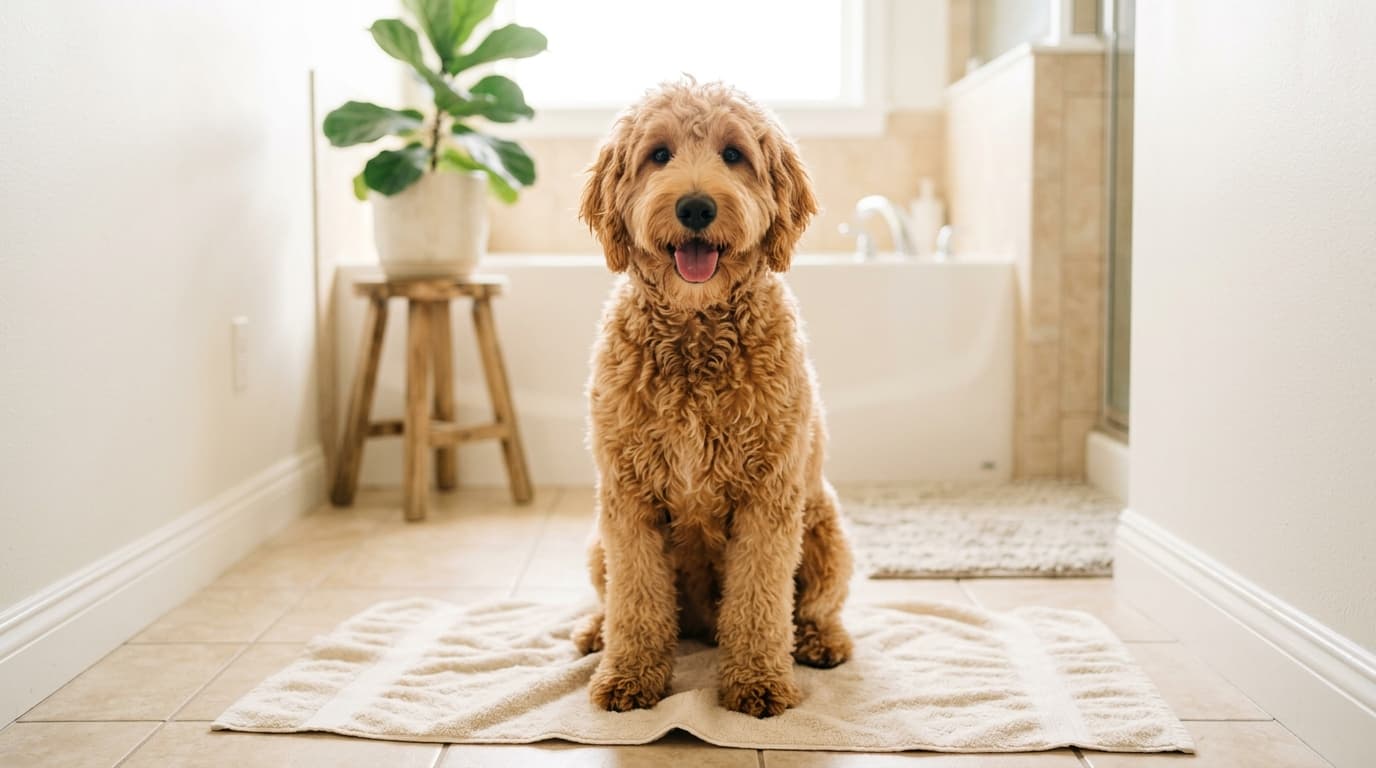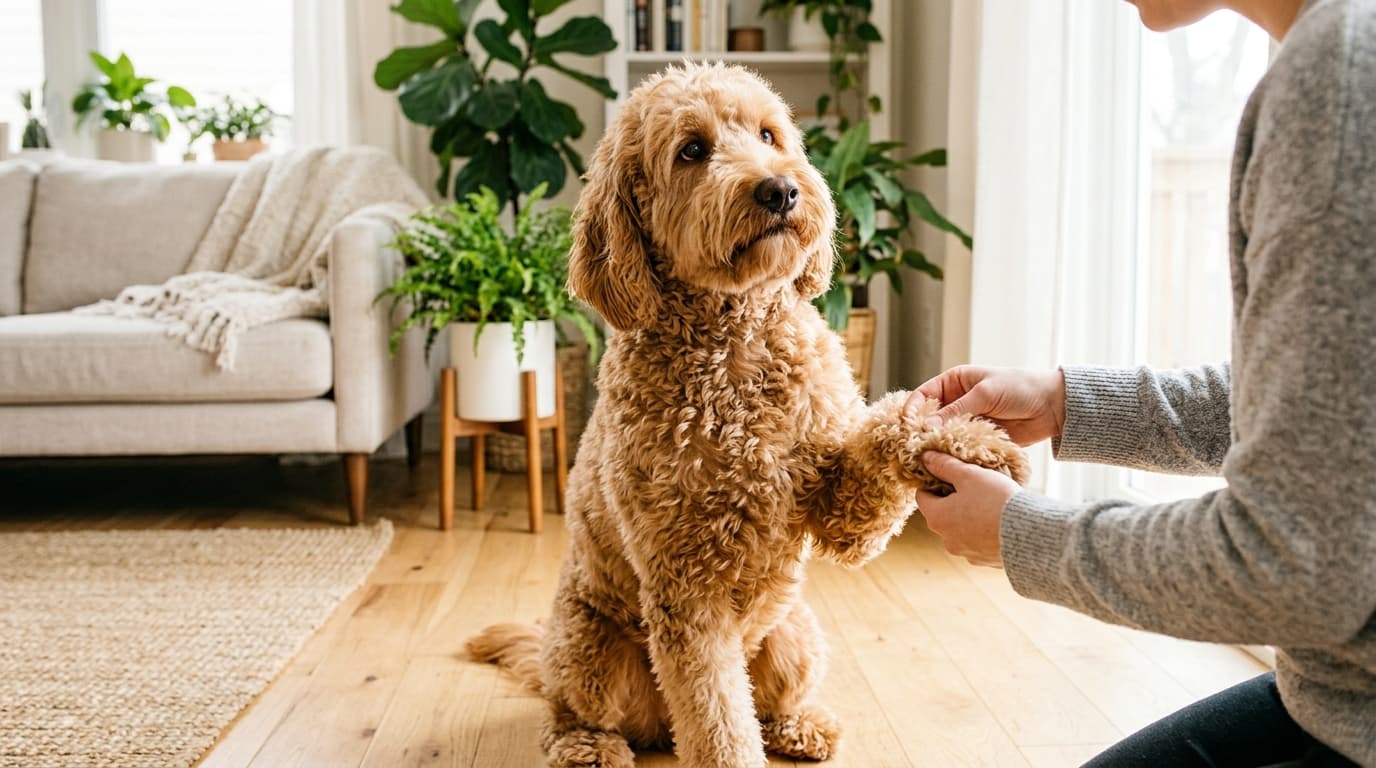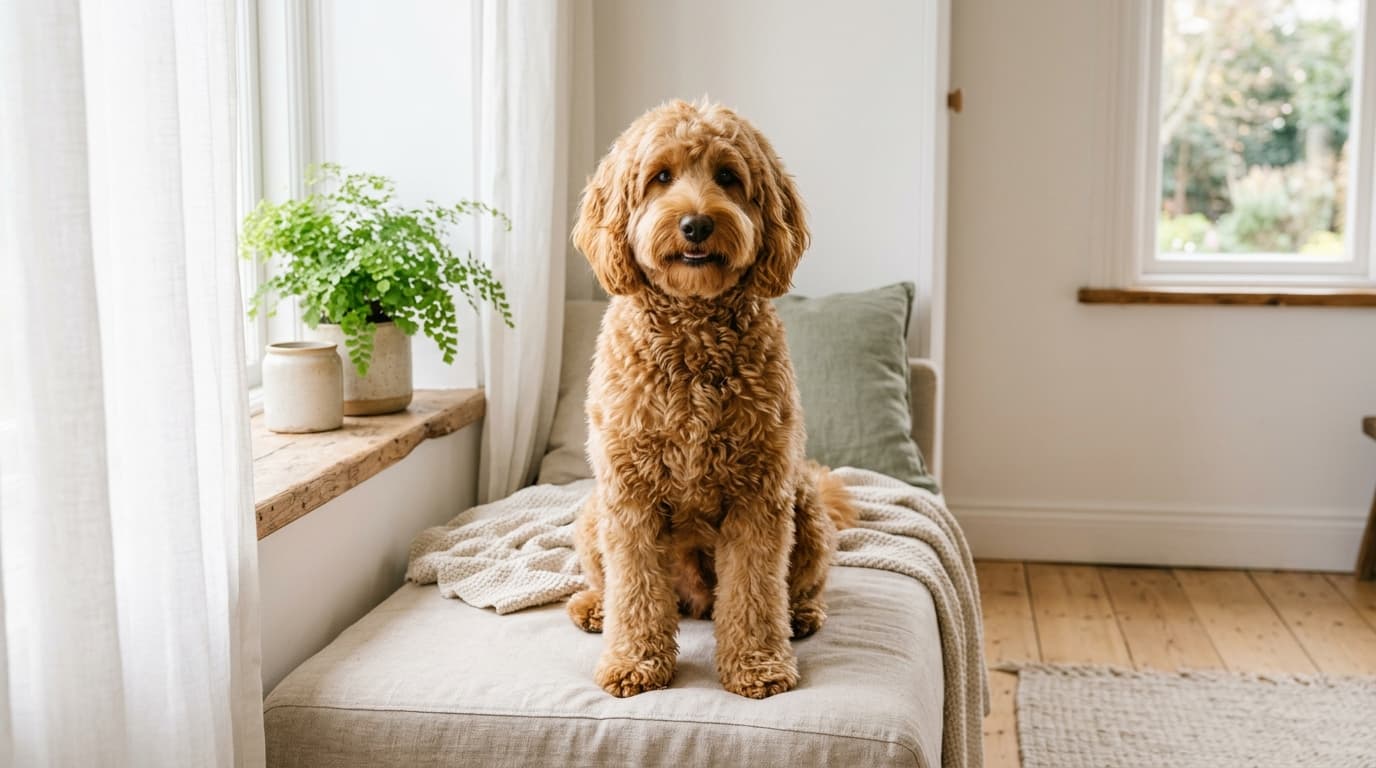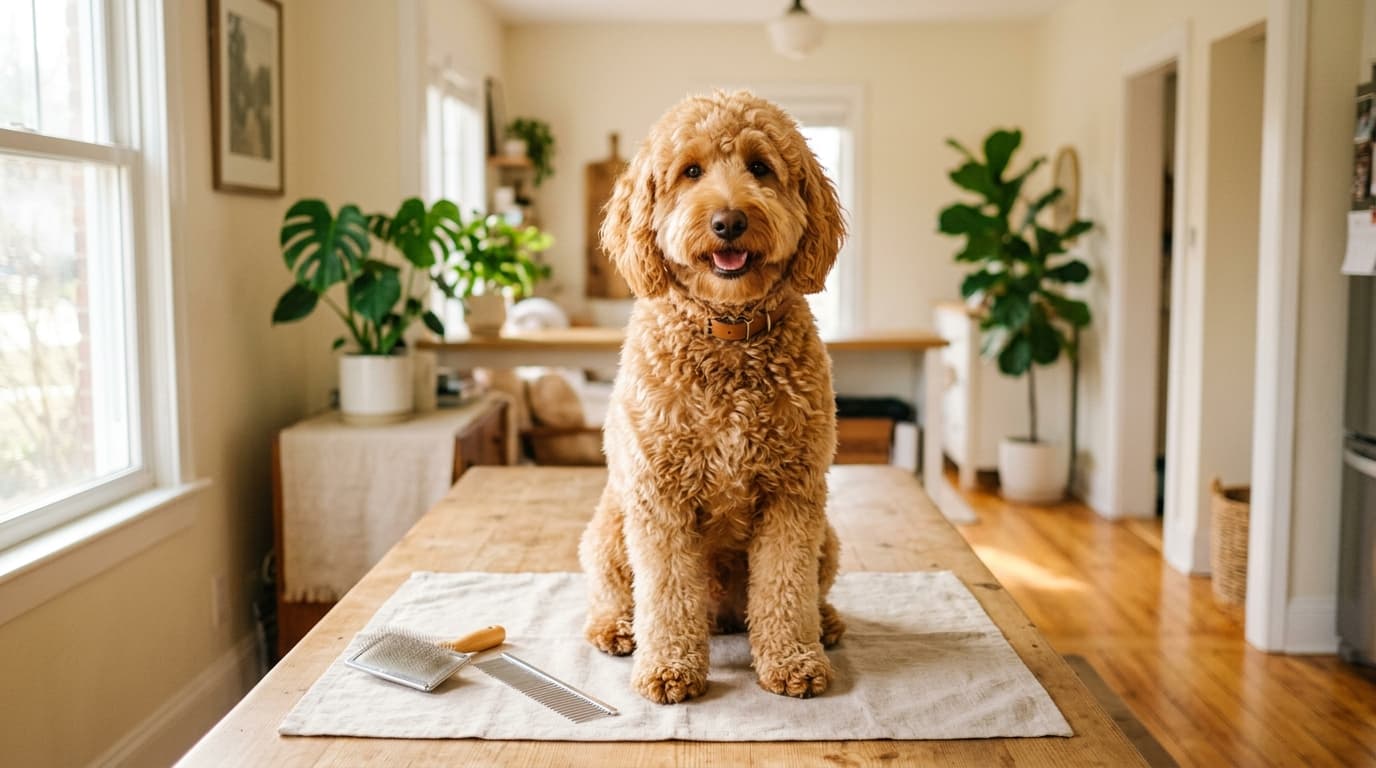
Most doodles have a wavy or fleece coat, and the good news is you can keep the long teddy-bear look at home: line brush right down to the skin several times a week, bathe once a month with a conditioner, dry fully, and trim with guard combs to hold an even length. A short clip is the kinder choice only for a tight curly wool coat or a coat that is already matted.
We live with three Australian Labradoodles (Sven, Gunnar and Gösta) and here's the honest part most guides skip: their coats are not the same, so their grooming is not the same. Gösta has a wavy fleece coat with the true teddy-bear look, and with regular brushing we keep it long and mat-free. Sven and Gunnar have tight curly wool, which is a different job entirely. This is the full doodle grooming playbook we actually use, coat type by coat type: brushing, bathing, drying, ears, paws, when to trim at home and when to book a groomer.
If you already know you need clippers and just want the shortlist before diving into the how-to, our tested best dog trimmers for doodles is the shortcut for the impatient reader. If your dog is itchy under all that coat, our guide to the best gentle shampoos for itchy doodles is the one to bookmark. And if your dog is already fighting tangles and you want the rescue plan, jump straight to doodle matting: how to prevent and remove mats.
Why doodle grooming is its own skill
A short-haired dog sheds its old coat onto your floor. A doodle largely doesn't: the low-shed coat that makes these dogs so appealing also means the dead hair stays in the coat, tangling with the live hair. Left alone, that can become matting. So with an Australian Labradoodle, Goldendoodle or Bernedoodle, coat care is a genuine ongoing job, not an occasional tidy-up.
Two doodle traits make this trickier than it sounds:
- A curly or fleece coat hides the skin. You genuinely cannot see a hot spot, a rash or an early mat under a couple of inches of curl. Grooming is how you find skin problems, not just how you prevent them.
- Floppy ears trap moisture. The coat grows down into the ear canal and holds water after a bath or a swim. That's the setup for yeast and ear trouble, and our Gunnar taught us this the hard way.
If you want our full home-trim walkthrough as well, our how to trim a doodle at home guide takes the clipper work step by step.
For general, vet-backed guidance on coat and skin care, the American Veterinary Medical Association is a reliable place to start.
Australian Labradoodle coat types (and what each needs)
Before any tool touches the coat, work out which coat type you're dealing with. It decides everything else. Australian Labradoodles come in fleece (wavy or curly), wool (curly/spiral), and a less common straight hair coat.
| Coat type | Look & feel | Shedding | Matting risk | What it needs |
|---|---|---|---|---|
| Fleece, wavy | Soft, wavy, flowing | Very low | Moderate | Thorough, frequent brushing; keeps the long teddy look |
| Fleece, curly | Softer curls, less tight than wool | Very low | Moderate to high | Frequent brushing to the skin; can stay long with upkeep |
| Wool (curly/spiral) | Tight spiral curls, dense, plush | Lowest | Highest | Mats readily even with brushing; kinder kept short |
| Straight hair | Straighter, coarser, sheds more | Higher | Lowest | Least demanding; brush a couple of times a week |
A wavy fleece coat, like Gösta's, is the one most readers have (our coat types guide shows how to tell which one you have) and the one that rewards brushing. Brush it thoroughly and often, all the way to the skin, and it stays mat-free and keeps that long teddy-bear look. That's exactly our experience: Gösta must be brushed regularly, and with that he holds a beautiful long coat without any trouble.
A tight curly wool coat, like Sven's and Gunnar's, is a completely different animal, and here we'll be honest against the usual advice: brushing did not stop matting for us, and they can mat anyway. A curly wool coat cannot realistically be kept long, and our groomer agrees. For that coat, a short clip is the kinder answer, and we cover it properly further down.
A few honest notes on breed. Australian Labradoodles are bred toward a consistent low-shed fleece or wool coat. First-generation Labradoodles vary far more: one can carry a flatter, shedding hair coat that mats less than its wool-coated littermate. The name on the pedigree tells you less than what you feel with your hands. If you want to understand how the cross affects the coat, our guide to doodle generations explained breaks down F1, F1b, F2 and multigen.
How to keep the teddy-bear look
If your doodle has a wavy or fleece coat, the long teddy-bear look is absolutely within reach at home, and this is the main thing most owners actually want. It is Gösta to a T: he has the true doodle teddy look, and because his fleece is easy-care with brushing, we keep him long year-round. Here is the routine that holds a long coat mat-free.
Line brush to the skin, several times a week
The whole secret of a long fleece coat is brushing that actually reaches the skin, not just the surface. Line brushing means you part the coat and brush one thin layer at a time, working from the skin outward.
- Start at a paw or the lower back leg. With one hand, push the coat up so you expose a clean horizontal part down to the skin.
- With a slicker brush, brush the exposed thin line downward, from the skin out to the tips.
- Let the next thin layer fall, part again, brush again. Work up the leg, then the body, in horizontal lines.
- Follow every section with a metal comb. The comb is your honesty check: if it glides from skin to tip, that section is done. If it snags, there's a mat the slicker skipped.
That comb test is the step people skip, and it is the one that keeps a long coat genuinely mat-free. Do this several times a week on a fleece coat and you stay ahead of tangles. We use the Chris Christensen Big G slicker (our best brushes for doodles covers it and the alternatives), plus a steel comb and a rotating-tooth comb for the check.
The monthly bath, with a conditioner
Bathe about once a month. A doodle's dense coat repels water, so a rushed bath only wets the outer layer: work shampoo down to the skin in sections (part, wet, lather, part again) and rinse twice as long as you think you'll want to, since leftover shampoo is a common cause of itch. Always follow with a conditioner, which is what keeps a long coat soft and far less prone to tangling.
We use Isle of Dogs shampoo and conditioner, bought as concentrate and mixed in cheap dilution bottles (the ratio-marked mixing bottles groomers use). Two of them, one for shampoo and one for conditioner, cost a few dollars and cut the running cost of bathing sharply: one bottle of concentrate makes many baths. Diluted shampoo also travels through a dense coat and rinses out, where neat shampoo squeezed onto the back just sits on top and takes endless rinsing.
Dry fully, then brush while slightly damp
A doodle coat can feel dry on the surface while the skin underneath stays damp for hours, and damp skin under dense coat is where hot spots and yeast start. We no longer blow-dry as a routine: with an ordinary hair dryer, drying a doodle coat to the skin can take an hour unless you own a proper high-velocity grooming dryer.
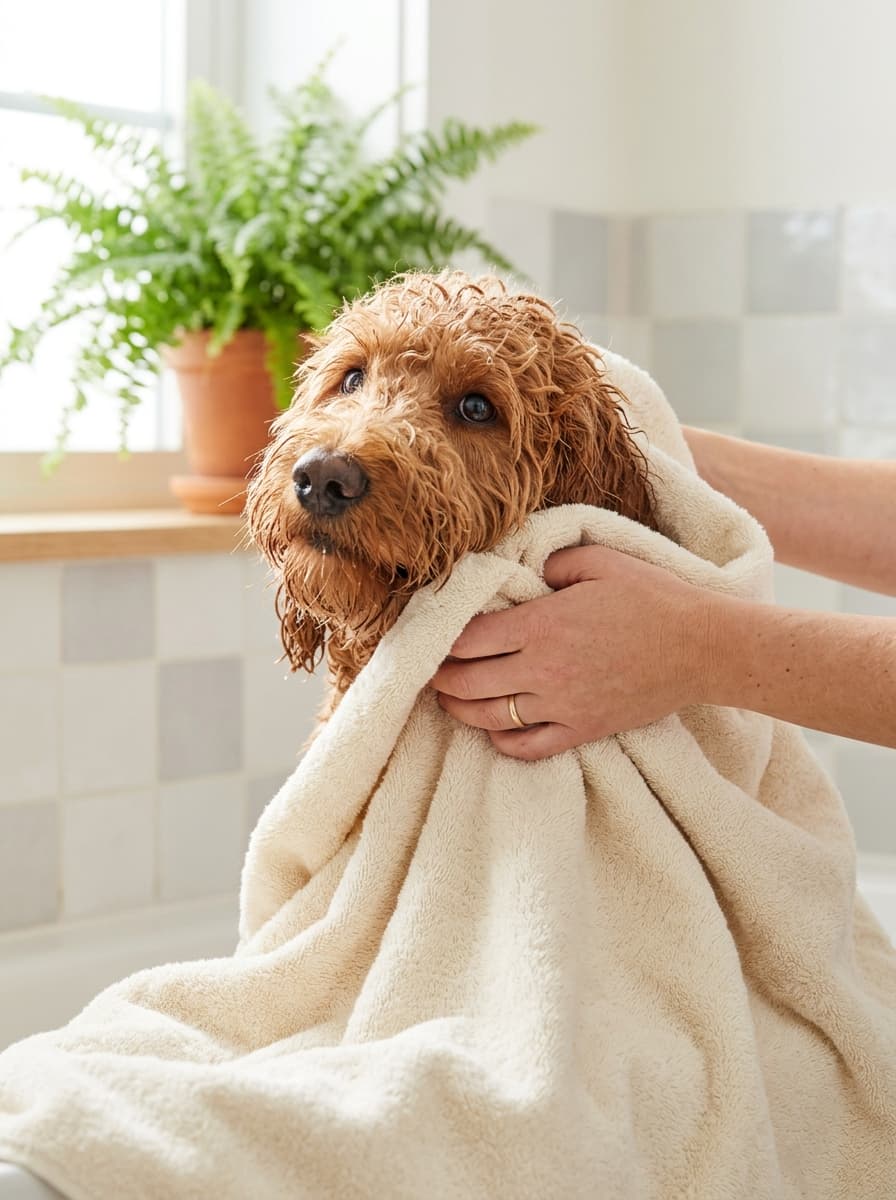
What we use is dog drying robes (bathrobes for dogs), and they work really well. We bathe the evening before and trim the next day: a super-absorbent robe goes on for about an hour, which leaves the dog already fairly dry, then it comes off because the robe itself is soaked and the dog would get cold. The coat finishes drying overnight and is dry to the skin by morning. Gösta's fleece gets brushed once it has dried a little and is still slightly damp, which is when a fleece coat combs out beautifully. A forced-air grooming dryer is a good option if you have the time and budget and want a perfect finish at home, but it is a big investment.
A teddy trim that keeps length, at home
You can keep the long look and still tidy the coat yourself. This is exactly how we trim Gösta's wavy fleece:
- Body at an even length with guard combs. Clip attachment guard combs over a #10 blade on a good clipper to leave the body coat at a set length all over. The combs are much easier than switching to a longer blade (a longer blade needs the coat brushed completely straight and cut flat first), and on a fleece coat the result looks really nice and even. Length attachments are sold separately, so budget for a comb set with the clipper.
- Round the feet. Use grooming scissors or a small trimmer to round the foot and tidy the edges.
- Trim between the paw pads. Clip the hair level with the pads and clear the hair between them (more on why in mats between the paw pads).
- Keep the eyes clear and tidy the face. A rounded teddy face is pure style, so shape it to your taste, but keep the coat out of the eyes; hair in the eyes is a common cause of tear stains.
- Sanitary trim. A short trim under the tail keeps things clean.
With these basics done at home, a full trim about every 12 weeks is plenty to keep a long teddy coat looking good. Gösta is our easy example: he lets us do every grooming chore without fuss, and his fleece holds length the whole way through.
When a short clip is the kinder choice
For a tight curly wool coat, like Sven's and Gunnar's, or for any coat that is already matted, a short clip is the kind answer, not a failure. We'll be honest against the usual advice: routine brushing did not keep our wool boys mat-free, and it made the adult coat frizzy. So we don't run a brushing schedule for them. Instead:
- Bathe once a month with a conditioner. For our boys the monthly bath with conditioner is the single most important thing against matting, more than any brush.
- Clip short whenever the coat gets too long. A curly wool coat can't realistically be kept long, so we accept the shorter look and reclip as it grows, roughly every two to three months.
- Hand-check several times a week. Skipping the brush doesn't mean skipping the checking: we feel through their coats by hand so nothing hides, and clip out any single mat right there, the paw pads especially.
Mats are a welfare issue, not a cosmetic one: they pull on the skin, hurt, and hide skin problems underneath. If your dog already has tight mats near the skin, don't fight them under running water. Tight or pelted mats at the skin are shaved off with clippers, never cut with scissors near the skin, and a confident owner can do this at home as we do (a groomer is an option if the mats are widespread or your dog is stressed, and a vet if there are sores or broken skin under the mat). Our dedicated method is in doodle matting: how to prevent and remove mats.
Winter clothes after a short clip
Once a curly wool coat is clipped short, there's no undercoat left to keep the dog warm. In autumn and winter we put clothes on the boys, and our rule is simple: when we ourselves need a jacket or a hat outside, the dogs get clothes too. Below 0 °C (32 °F) they always wear something, and even on a mild day, if one of them is clearly cold, he gets a hoodie. In our experience, if you don't keep a short-clipped doodle warm, they get stiff, tense muscles (that's our observation, not a veterinary claim). Spring and summer are no problem.
Where mats form first
How often you brush depends on the coat: a wavy or curly fleece gets thorough line brushing several times a week, while a tight curly wool coat like our boys' is hand-checked instead. Our full schedule for brushing, bathing, ears, nails and trims is in how often to groom a doodle. Wherever you are on that schedule, these are the zones that mat first:
- Behind and under the ears
- The armpits and where the harness or collar sits
- The chest and "beard"
- The base of the tail and the back legs
- Between the paw pads, the hardest mats on our boys, and the reason for constant paw licking when we miss them
Ears, paws and the rest of the tidy-up
Whatever length you keep, a few areas need care between full trims. Small trimmers and a pair of blunt-nosed scissors are ideal here, genuinely useful even if you use a professional groomer.
Ears
The coat grows into a doodle's ear canal and holds water. After every bath, dry the ear flaps and the opening, and check for redness or a yeasty smell. Some doodles need the ear hair gently thinned or plucked; ask your groomer or vet to show you, as it's not right for every dog. Keep a good cleaner on hand and use it when the ear looks or smells off; see our best ear cleaners for doodles.
Paws, face and sanitary trim
- Paw pads and between the toes. This is the hardest spot on our boys: the mats between the paw pads are the toughest ones we deal with, and they drive constant paw licking. Where we live there are four real seasons, and autumn and spring are mud season, so we wash paws a lot, and all that washing raises the risk of mats forming between the pads. That's why we keep the paw and between-pad hair trimmed short. Trim the hair level with the pads, and check and trim between them regularly; it's also a setup for yeast on doodle paws.
- Around the eyes. Keep the coat out of the eyes so your dog can see and tears drain.
- Sanitary area. A short trim under the tail keeps things clean.
Nails need doing regularly too (we trim ours once a week with plain plier-style clippers; see our nail clipper guide); long nails change how a dog stands and can make grooming a fight. We trim ours once a week.
If your dog scratches more after grooming, that's a known pattern with its own fixes in doodle itchy after grooming. And never leave a doodle to air-dry curled up in a bed, because that trapped moisture is a classic trigger for doodle hot spots.
Should you trim your doodle yourself?
We trim all three of ours at home, but plenty of owners happily use a groomer, and many do both. Here's how to think about the cost either way (we won't quote exact prices, because they vary too much to state as fact).
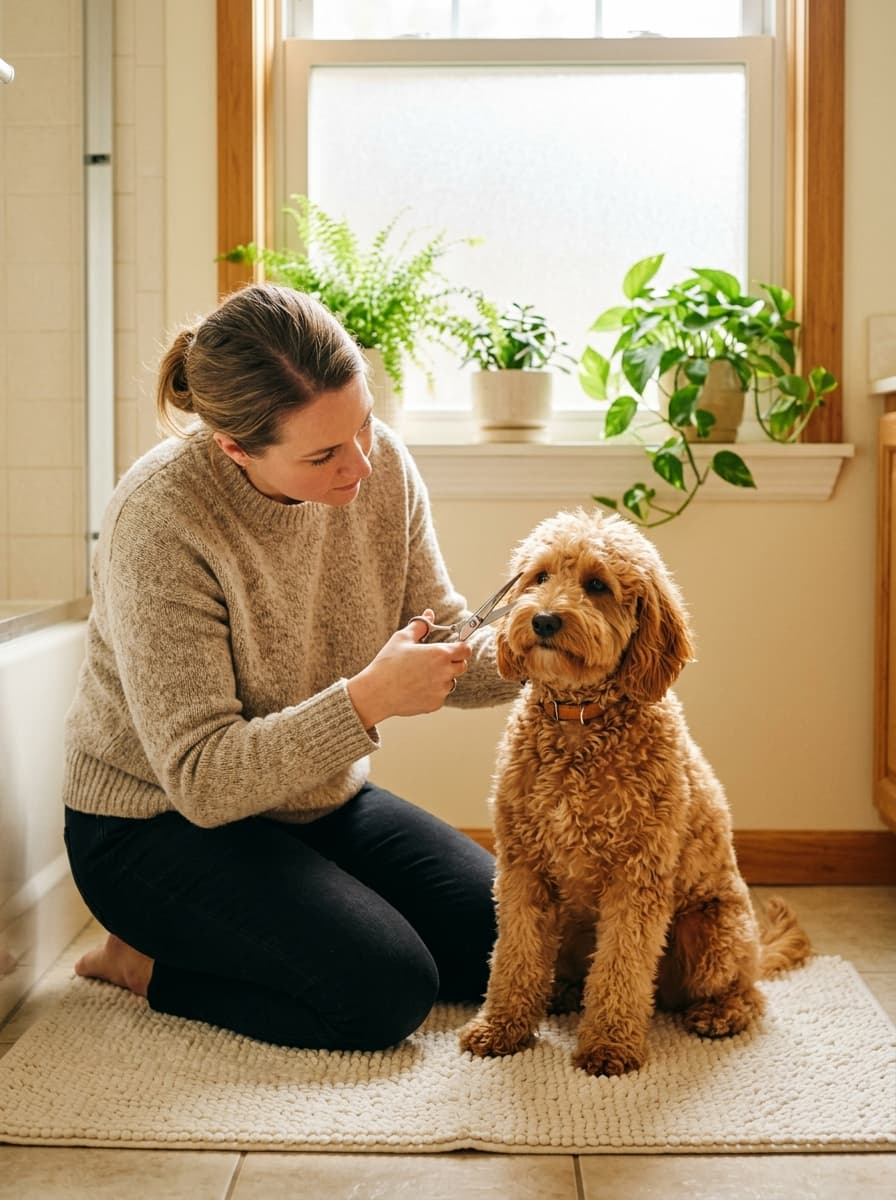
What drives groomer cost:
- Size of the dog. A big Sheepadoodle takes far more time than a mini.
- Coat condition. A maintained coat is quick; a neglected one is slow.
- Matting fees. Most groomers charge extra to work through mats, and a badly matted dog may have to be clipped short humanely.
- Your region. City prices run higher than rural ones.
- How often you go. A professional doodle groom typically runs around $100 to $150 per visit (check local prices), which adds up over a year with several dogs.
What home trimming costs: a one-off outlay for a good clipper (a quality one is around $200 and lasts years), plus scissors, your time and a bit of practice. Brands we rate are Andis (the Andis AGCB brushless is really good) and Aesculap. Note that length attachments are sold separately: a clipper does not come with the extra blades or attachment guard combs, so budget for a comb set and a spare blade or two. Small trimmers are genuinely worth it even if you keep using a groomer. They let you tidy paws, face and the sanitary area and clip out single mats the moment you find one, instead of waiting weeks for the next appointment. If you want our tested kit, see the best dog trimmers for doodles.
Tools you actually need
You can groom a doodle well with a short kit. Don't over-buy.
For the shampoo and conditioner we actually keep in the bathroom, see the best shampoo and conditioner for doodles.
How to groom a Goldendoodle at home vs. a Labradoodle
The mechanics of the wet work (bathe to the skin, dry to the skin, tidy ears and paws) are the same across crosses. What changes is the coat, and that's what sets your routine.
How to groom a Goldendoodle in practice depends heavily on its coat: a wavier fleece Goldendoodle rewards regular brushing and holds the long teddy look nicely, while the curlier, more Poodle-leaning Goldendoodles carry wool coats that mat fast, where a short clip is often kinder the way we manage our wool boys. Labradoodle grooming spans the widest range of all: a flat-coated first-gen sheds and mats less, an Australian Labradoodle's fleece needs thorough brushing several times a week to stay long.
A Bernedoodle with a wool coat is among the highest-maintenance we've seen; a Sheepadoodle's dense coat is similar. The rule holds across every one of them: feel the coat, not the label, and set the routine to what it actually is.
Groomer visits
With the basics done at home, a doodle manages about 12 weeks between full trims, and with nothing done in between it needs a groomer far more often; the details are in how often to groom a doodle. We trim our three at home, but we have taken them to a professional groomer a few times on purpose so they get used to other people handling them, which pays off at the vet too.
Common doodle cuts explained (and which is "right")
None of them is "correct." The best cut is the one that keeps your dog mat-free and comfortable. Here's what the names mean:
- Teddy bear cut. Rounded face, even medium-to-long body. The classic doodle look, and the one most owners want. Holds best on a wavy or fleece coat you brush regularly (Gösta's is exactly this).
- Lamb cut. Body clipped shorter, legs left a touch longer. Practical and still soft-looking.
- Puppy cut. An even short-to-medium length all over. Easy to maintain.
- Kennel / short cut. Clipped short all over. The lowest-maintenance option and the realistic long-term choice for a tight curly wool coat.
Tell your groomer, in inches or centimeters, the length you'll actually keep up with, not the length you wish you had time for. A length you maintain beats a longer cut that mats.
Making grooming easy on the dog
Grooming should be boring, in the best way. A dog that dreads the process makes every step harder.
- Start young. Get a puppy used to handling right away (brushing, nail trimming, tooth brushing, looking at the ears, teeth and paws) so being handled is normal. Two calm minutes a day beats one dreaded hour a week.
- Reward on the table or the floor. A smear of something tasty on a lick mat keeps a fidgety dog still; our best lick mats for doodles get used at grooming time in our house. A grooming table is optional, by the way: a worktop with a non-slip mat or the floor does the same job, and the floor is right for a nervous or big dog. Never leave a dog alone on a table.
- Never force a tight mat out. If it hurts, the dog will fight grooming forever. Clip it out with clippers.
- Get them used to other people too. Even though we groom at home, we have taken ours to a professional groomer a few times on purpose, so they accept being handled by someone else, which matters a lot for vet visits.
Gösta is our easy one here: he lets us do every grooming chore without any fuss. Sven and Gunnar are more sensitive to handling, so for the tricky spots one of us holds while the other trims, and we kept their early sessions very short and paired them with a treat every time. Tolerance for handling can be trained with short, rewarded practice. The habit is what makes it work, not the willpower. For more of our hands-on routine, including setup, keeping them still and handling matting, see our doodle grooming at home tips.
FAQ
Line brush a wavy or fleece coat right down to the skin several times a week, check every section with a metal comb, bathe once a month with a gentle shampoo and always a conditioner, and dry fully to the skin. For the trim, clip the body to an even length with guard combs over a #10 blade, round the feet, trim between the pads, keep the eyes clear and tidy the face. With the basics done at home, a full trim about every 12 weeks keeps the long look.
Work out the coat type first. Brush a wavy fleece thoroughly and often, right down to the skin; bathe with a gentle shampoo and always a conditioner, then dry fully to the skin. Keep ears dry and clean, and trim paw pads, face and sanitary area. A tight curly wool coat mats even with brushing, so for that coat a short clip is often the kinder choice, which you can learn to do at home.
The principles are the same, but the coats differ. Australian Labradoodles have fleece (wavy or curly) or wool (curly/spiral) coats, plus a less common straight hair coat, and each needs a different routine. First-generation Labradoodles vary more widely and can carry a flatter, shedding hair coat that mats less. Match your routine to the coat your individual dog actually has, not to the breed name.
With a wavy fleece coat, it usually means the brush is only touching the top. Mats form at the skin first, so you'll want to part the coat and brush from the skin outward, checking with a comb after every section. With a tight curly wool coat, honest fact: brushing may not stop matting at all. In our house the wool boys mat despite brushing, so we bathe with conditioner and keep them short instead.
Both work. Groomer cost is driven by your dog's size, coat condition, matting fees, your region and how often you go. Home trimming is a one-off cost for clippers and scissors plus your time, and it lets you clip out single mats the moment you find them. Many owners do both: a groomer for the full cut and small trimmers at home for paws, face and tidy-ups.
Your next step
If you take one thing from this guide, make it this: most doodles can keep the long teddy-bear look at home. A wavy or fleece coat rewards thorough, frequent line brushing, a monthly conditioning bath, full drying and a simple guard-comb trim, and that keeps it long and mat-free. A short clip is the kinder choice only when the coat is tight curly wool or already matted. Either way, keep the ears clean and clip out single mats (especially between the paw pads) the moment you find them.
From here, pick the piece that matches your dog right now: if you're already fighting tangles, go to doodle matting; and if your dog is itchy under all that coat, start with why is my doodle so itchy all the time. You can also browse everything skin-related in our itchy skin & paws hub.