How often should a goldendoodle be groomed? It depends on the coat and on how much you do at home. If you keep up the basics between grooms, brushing a fleece coat, pulling out mats, keeping the eyes clear, tidying the face, paws and armpits, and cutting the nails, a goldendoodle manages about 12 weeks, roughly every three months, between full trims or professional grooms. If you do nothing in between, it needs grooming much more often.
The frustrating part is that "doodle" isn't one coat. A Goldendoodle, an Australian Labradoodle, a Labradoodle, a Bernedoodle and a Sheepadoodle can all carry very different coats, and the coat type, not the breed name, decides how hard you have to work. Below is a schedule you can actually follow, broken down by what your dog's coat is really doing.
If you already want to look at products, our guide to the best gentle shampoos for itchy doodles is the shortcut; the rest of this article explains the why first.
With three Australian Labradoodles at home, we've learned that grooming is less about the occasional big session and more about a small, steady routine that simply becomes part of life with your dog (our doodle grooming guide covers the full how-to; this article is about the how often), and that the right routine looks completely different depending on the coat. If mats are already your main battle and you just want the fixes, our doodle matting guide is the shortcut for prevention and safe mat removal, and if you'd rather handle the whole trim yourself, how to trim a doodle at home is the walkthrough. Otherwise, let's build your routine.
The short answer: a doodle grooming schedule at a glance
Here's the baseline every doodle owner can start from, then adjust by coat type.
| Task | How often | Notes |
|---|---|---|
| Fleece coat brushing | Often, down to the skin | Keeps a fleece coat long and mat-free |
| Curly wool coat | Hand-check daily or several times a week | Clip out single mats right away; routine brushing can frizz it |
| Full groom or home clip | About every 12 weeks if you do the basics at home | Much more often with no care between |
| Bathing | About once a month | With conditioner; over-bathing dries the skin |
| Ear check | Weekly | Redness, smell, head shaking |
| Nail trim | Once a week | Or when you hear clicking on the floor |
For general, vet-backed guidance on coat and skin care, the American Veterinary Medical Association is a reliable place to start.
How often should a Goldendoodle be groomed? It depends on the coat
There's no single number, and any honest answer starts with the coat. Australian Labradoodle and Goldendoodle coats fall into a few types, fleece (wavy or curly) and wool (tight, curly/spiral), plus the less common straight-hair coat (Australian Labradoodle coat types explains how to tell yours apart), and each one behaves so differently that they almost need different owners.
Two things drive frequency for every coat:
- How fast it mats (curly and wool coats mat fastest).
- How long you want to keep it (long coats need far more upkeep than short ones).
Here is the honest grooming-interval answer we've landed on: how often a doodle needs a full groom depends mostly on how much coat care you do yourself. If you do the basics at home, brush a fleece coat well, pull out mats, keep the eyes clear, tidy the face, paws and armpits, and cut the nails, a doodle manages about 12 weeks (roughly every three months) between full trims or professional grooms. If you do nothing in between, it is much more often.
Many groomers will tell you to line brush every doodle coat, every type, right down to the skin, and that is genuinely good advice for a coat you want to keep long. We do exactly that with one of our three. But we've also learned the hard way that some coats simply won't stay long no matter how diligent you are, so here's what actually happens in our house, alongside the mainstream view.
What works in our house across three Australian Labradoodles
We trim all three of ours ourselves at home, so when we say "how often to groom," for us that means how often we clip, not how often we book a groomer.
- Sven and Gunnar have curly wool coats. As puppies we brushed them several times a week, even daily, and that was completely fine while they were small. But once the adult curly wool came in, brushing started to make the coat frizzy. It's a bit like the "curly girl method" for curly human hair: one of us has curly hair and never brushes it, and we ended up doing the same for the boys. With curly wool, brushing didn't stop the matting for us, they can mat anyway. So instead they get a bath about once a month WITH a conditioner (the conditioner is what actually helps against matting), we hand-check them by feel daily or several times a week and clip out any single mats right away, and we clip them short every two to three months, roughly four times a year, sooner if the coat looks in poor shape. A curly wool coat can't realistically be kept long; our groomer agrees.
- Gösta has a wavy fleece coat. Completely different animal. He gets brushed thoroughly and often, once it has dried a little after a bath, and with that he stays mat-free and can be kept long, the true teddy-bear doodle look. For his coat, the standard line-brushing advice works beautifully.
How often should a Goldendoodle be groomed by coat type?
If you want a single interval that fits every Goldendoodle, there isn't one, the honest answer is "as often as your specific coat needs it." Here's how the frequency shakes out once you know your coat.
Brushing: the task that actually prevents mats (on a fleece coat)
If you're keeping a fleece coat long, brushing is the single most important thing you do, and it's the one most owners get wrong. Doodle coats mat from the base up, near the skin, where a quick surface brush glides right over the tangle without touching it. Weeks later you find a solid mat you never felt.
This is the hardest lesson we learned with Gunnar, our first doodle. His puppy coat was fairly straight, almost fleece-like, so we brushed him and thought he was in good shape. But we had a poor brush and not yet the technique, so we were only reaching the surface while believing we were getting to the skin. His coat changed into a much curlier adult coat, and the first time we clipped him ourselves we found he was matted all over underneath: we had been brushing over the mats. We had to shave him completely down that first time and felt terrible about it. After that we bought a proper slicker brush and learned how curly coats actually work.
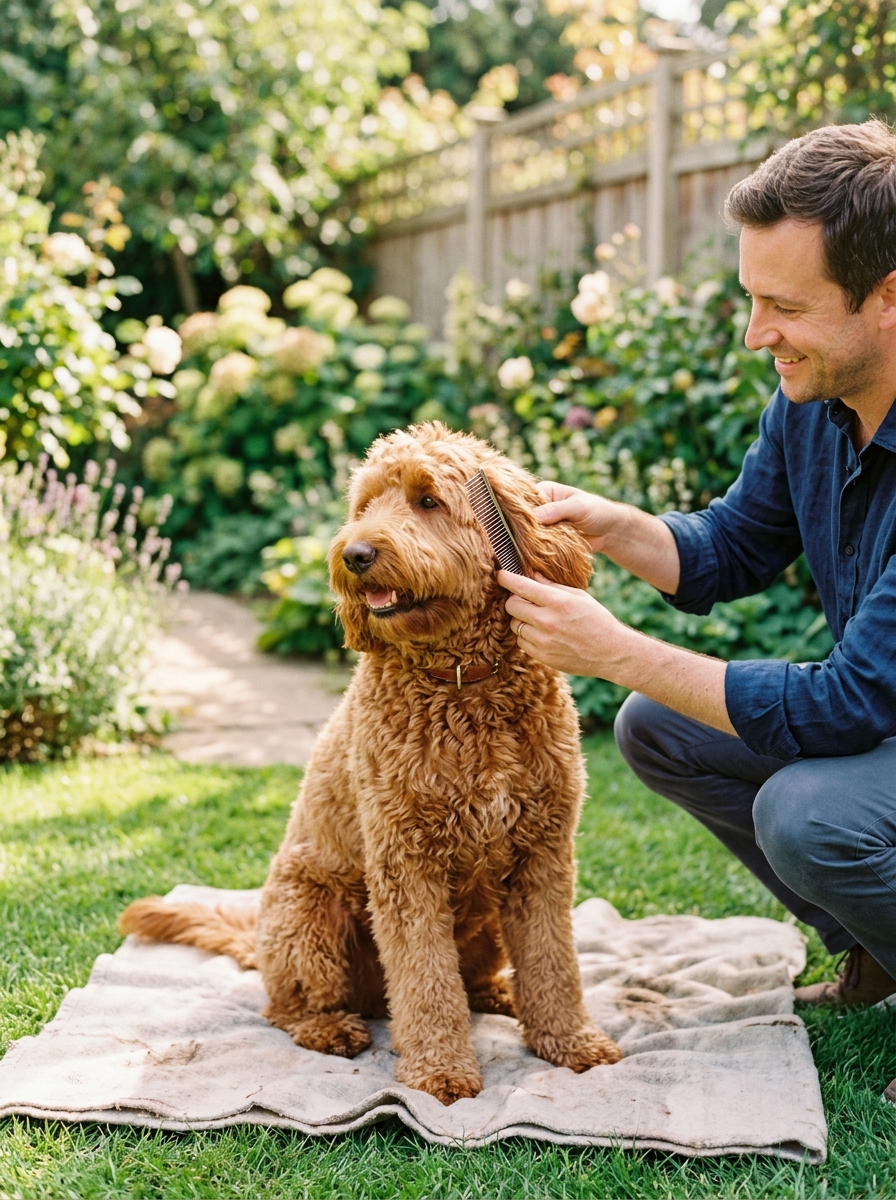
The fix for a fleece coat is to brush in sections, right down to the skin, with a slicker brush followed by a metal comb (the ones we'd pick are in best brushes for doodles). If the comb won't pass through cleanly, you've missed a spot.
How often to work each coat:
- Wool / tight curly (poodle-like): this is Sven and Gunnar. We do not brush it routinely, it just goes frizzy and mats anyway. Instead we keep it short, bathe monthly with conditioner, and hand-check daily or several times a week. Never try to keep a curly wool coat long with daily brushing; it doesn't work.
- Wavy / fleece: brush thoroughly and often, down to the skin. The most common Australian Labradoodle and Goldendoodle coat, and the one that rewards brushing by staying long and mat-free (this is Gösta).
- Straight / flat coat: a couple of times a week. Sheds more, mats less.
Puppies going through their coat change (often around 8-12 months) mat almost overnight, so check and work the coat more closely through that stretch no matter what coat they'll settle into.
Check between the paw pads
The hardest mats on our boys form between the paw pads, and those are the ones that lead to constant paw licking. We check and trim between the pads regularly, it's an easy spot to forget because you can't see it under all that fur. Where we live there are four real seasons, and autumn and spring are mud season, so we wash paws a lot then, and all that washing makes mats between the pads more likely (wet hair felts). That's why we keep the paw and between-pad hair trimmed short, especially going into autumn and spring. On a doodle that licks its paws, this is worth ruling out alongside (never instead of) the usual skin and yeast causes.
Professional grooming vs. clipping at home
A full groom about every 12 weeks keeps a doodle manageable if you keep up the basics in between. The real driver isn't a fixed calendar, it's how much you do at home:
- If you do the between-groom basics (brush a fleece coat well, pull mats, keep eyes clear, tidy face, paws and armpits, cut nails weekly), roughly every three months between full trims is realistic.
- If you do nothing in between, the coat needs a full groom far more often, because mats build up where you aren't checking, and matting genuinely hurts once it pulls at the skin.
- A curly wool coat still does best kept short, because it mats faster than you can keep up with when it's long.
We clip all three of ours at home (how to trim a doodle at home walks through it), on no fixed calendar, we clip when the coat gets too long or looks in poor shape, which for our two curly wool boys comes around roughly every two to three months, and less often of a fuss for Gösta because we keep him long and brushed. A small trimmer is handy for tidy-ups between full trims (paws, face, the sanitary area, and single mats), even if you use a professional groomer for the big cuts. If you're thinking about doing the full trim yourself, our how to trim a doodle at home walkthrough covers the steps.
If you do use a groomer, they do more than a haircut, they clip the paw pads, tidy the sanitary area, and often handle nails and ears. Costs vary a lot by size, coat condition, how matted the dog is (many groomers charge a matting fee), and your region, so ask locally rather than trusting a flat online figure; a professional doodle groom typically runs around $100 to $150 a visit where we've seen prices, which is why with several doodles many owners learn to clip at home. But the groom does not replace home care. A long-coated dog that isn't brushed between appointments arrives matted, and matted coats often have to be shaved short anyway, which is uncomfortable for the dog and disappointing for you.
Bathing: about once a month, and why more isn't better
Bathe a goldendoodle about once a month, always with a conditioner (how to bathe a doodle has the step-by-step). It's tempting to bathe more, doodles roll in things and a fleece coat holds a smell, but frequent bathing strips the coat's natural oils and leaves the skin dry, flaky and itchy. A dry, itchy doodle scratches, and a curly or fleece coat hides the resulting irritation until it's a real problem. Our two curly wool boys, Sven and Gunnar, get a bath about once a month, and for them the bath is the centerpiece of the whole routine, because the conditioner at bath time is what does the most against matting.
A few rules that keep bathing from backfiring:
- Work out mats before the bath, never after.
- Always use a conditioner, for a curly wool coat especially, it's the single most helpful anti-matting step we have. We use Isle of Dogs shampoo and conditioner (more options in best shampoo and conditioner for doodles), bought as concentrate and mixed in cheap ratio-marked dilution bottles, which cuts the running cost sharply and rinses out far more easily than neat shampoo.
- Keep water out of the ears. A floppy doodle ear that fills with water is exactly where ear trouble starts, so wash around the ears with a damp cloth, tilt the head down, and dry the ear flaps afterwards.
- Rinse twice as long as you think you'll want to. Leftover shampoo is a classic cause of post-bath itch.
- Match the shampoo to the dog. A plain gentle shampoo is fine for a healthy coat; an itchy or yeasty dog needs the right formula, our best shampoo for itchy doodles guide matches the shampoo to the cause.
Gunnar is our ears-and-yeast dog, and with him we're much stricter about drying than about bathing frequency. A damp coat left to air-dry in those armpit and ear folds is exactly where yeast likes to set up. We bathe the evening before and let the coat finish drying, using a super-absorbent dog drying robe for about an hour after the bath, which leaves him already fairly dry; the coat finishes drying overnight and is dry to the skin by morning.
Ears: check weekly, especially on yeast-prone dogs
Doodle ears are floppy and often hairy inside, which traps warmth and moisture, a perfect environment for yeast and infection. Check them weekly. You're looking for:
- Redness inside the flap
- A yeasty, sour or "corn chip" smell
- Head shaking or ear scratching
- Excess brown or waxy buildup
Clean with a vet-recommended ear cleaner when you see buildup, not on a rigid schedule, over-cleaning irritates too. Our best ear cleaners for doodles covers what to use and how.
Gunnar's ear history is exactly why weekly checks became non-negotiable in our house. Catching a little redness early is a two-minute clean; missing it for three weeks is a vet visit. If you're not sure whether you're seeing a yeast flare or an allergy flare, allergy vs yeast infection in doodles helps you tell them apart.
Nails: once a week
Trim nails once a week, or whenever you hear clicking on hard floors. We use a plain plier-style clipper, never a guillotine one; best nail grinders and clippers for doodles compares the options. Getting into a weekly rhythm keeps the quick short and makes each trim quick and low-stress. Overgrown nails change how a dog stands and can be genuinely painful over time. If your doodle hates the clippers, a lot of treats and short, calm sessions often go better, and if you use a groomer, many owners simply let them handle nails at each appointment too.
Putting it together: a real rhythm
You don't need a spa day. You need a rhythm that matches your dog's coat (our 12 tips for grooming at home make it easier). Here's how ours actually shakes out across three dogs:
For a long fleece coat, the regular brushing is what makes the whole thing work. Skip it for a fortnight and you'll spend an hour fighting mats you can't feel yet, which is exactly why, for our curly wool coats, we made peace with keeping them short. A short clip doesn't look very "doodle" for the first few weeks, and we've accepted that: a dog without mats and feeling well matters more to us than the look. If you want the full walkthrough for doing it yourself, our how to trim a doodle at home guide pulls it all together.
FAQ
It depends on how much you do at home. If you keep up the basics between grooms (brush a fleece coat, pull out mats, keep the eyes clear, tidy the face, paws and armpits, cut the nails), a goldendoodle manages about 12 weeks, roughly every three months, between full trims or professional grooms. If you do nothing in between, it needs grooming much more often. We trim all three of ours at home, so for us this just means how often we clip, but whether you book a groomer or DIY, home care between grooms is what sets the interval.
About once a month is a good default for most goldendoodles and labradoodles, always with a conditioner. Bathing much more often than that can strip the coat's natural oils and leave the skin dry and itchy. Our curly wool boys, Sven and Gunnar, get a bath about once a month with a conditioner, which is what actually helps against matting for their coat. If your doodle has a skin condition, follow your vet's or groomer's schedule instead, which may be more frequent with a medicated shampoo.
It depends on the coat. A wavy fleece coat (like Gösta's) should be brushed thoroughly and often, right down to the skin with a slicker brush and a comb, and once it has dried a little after a bath. A tight curly wool coat (like Sven's and Gunnar's) is different: in our house routine brushing just made the adult wool coat frizzy and did not stop the matting, so we skip brushing, give a monthly bath with conditioner, and hand-check the coat daily or several times a week, clipping out any single mat right away.
Check floppy, hairy doodle ears weekly. Look for redness, a yeasty or sour smell, head shaking, or excess wax, and clean with a vet-recommended ear cleaner when needed. Weekly checks catch trouble early, especially in breeds prone to yeast.
The real variable is coat type, not breed. A tight curly wool Australian Labradoodle and a tight curly Goldendoodle both mat fast and usually do best kept short, while a wavy fleece coat of either breed can be brushed often and kept long. Match the routine to the coat in front of you, not to the breed name.
Next step
Grooming frequency is only half the picture, knowing how to spot and prevent the mats is the other half. If mats are already your enemy, go straight to our how to prevent and remove doodle mats guide, and if you're not sure whether your doodle's paw licking is a mat between the pads or a yeast flare, allergy vs yeast infection in doodles will help you tell them apart.