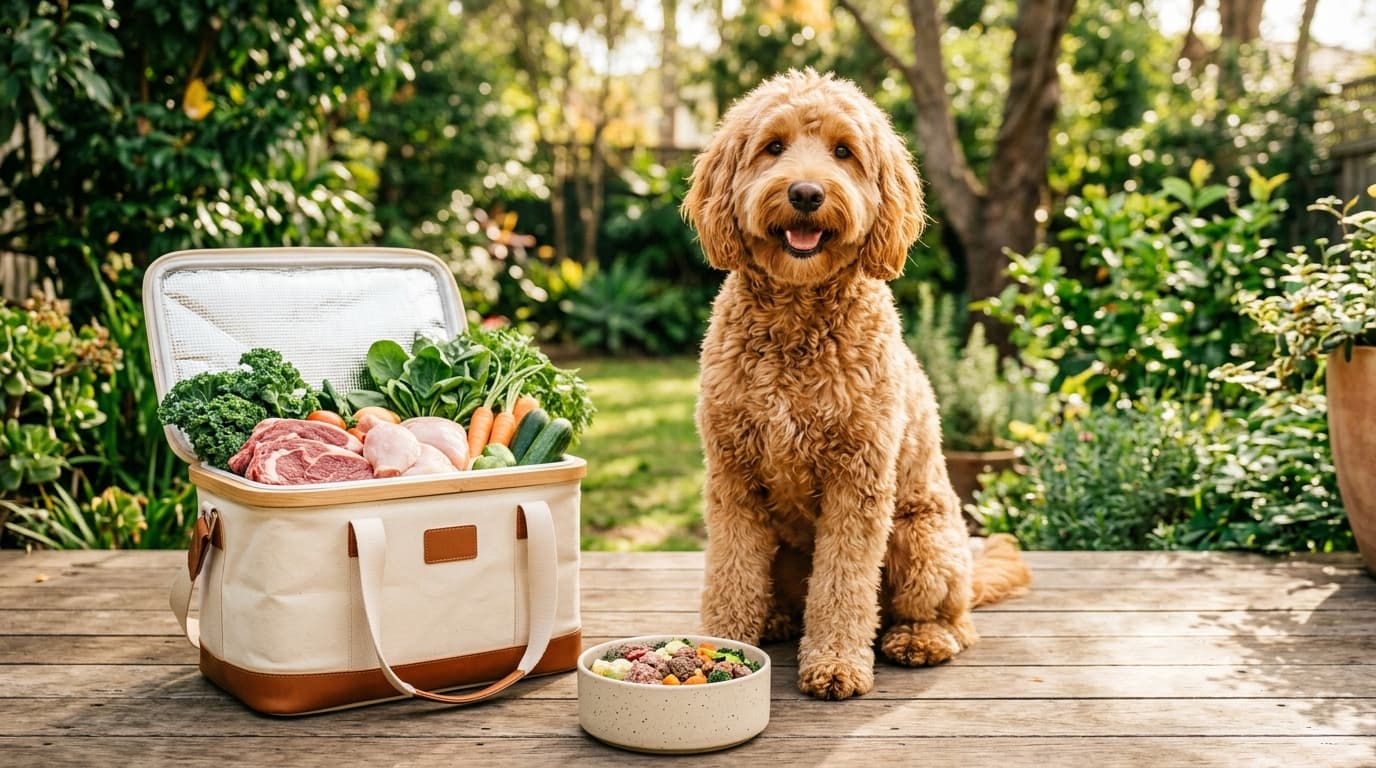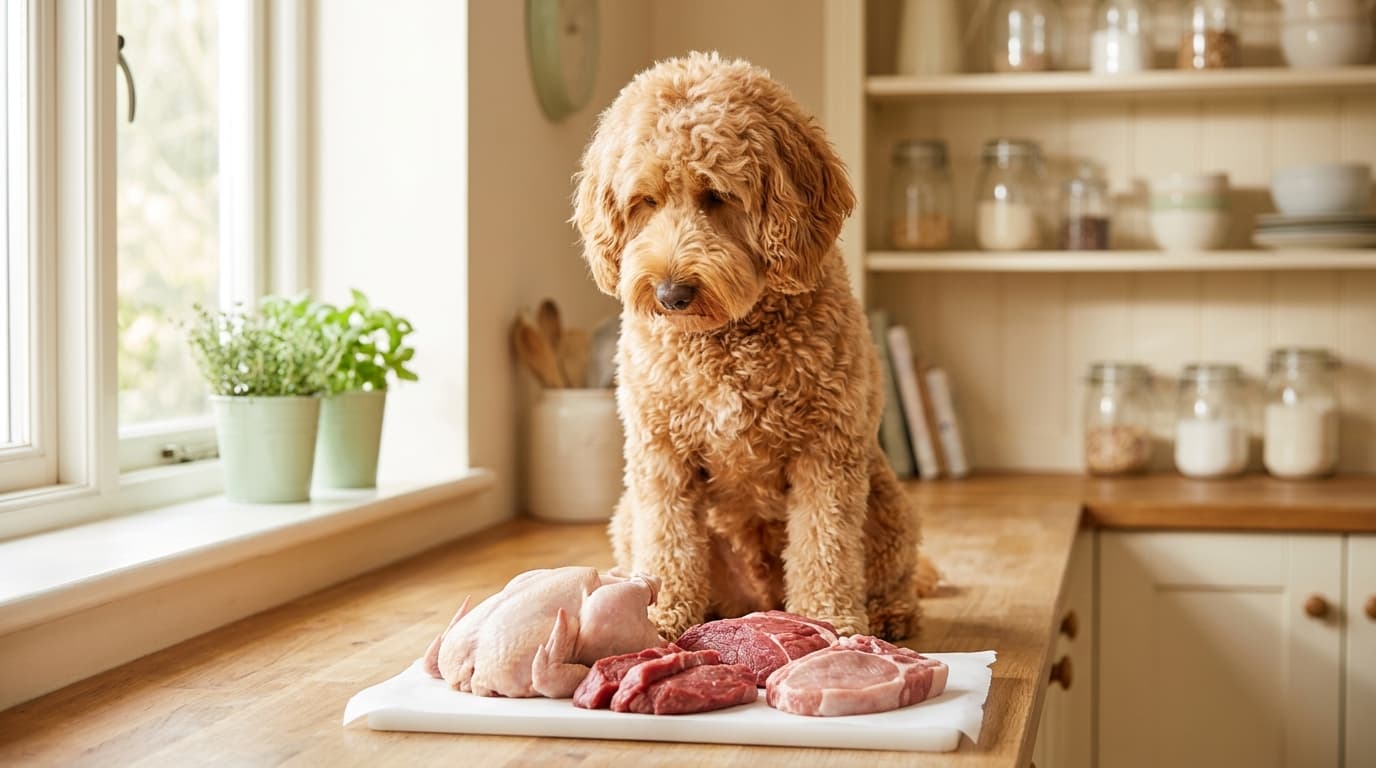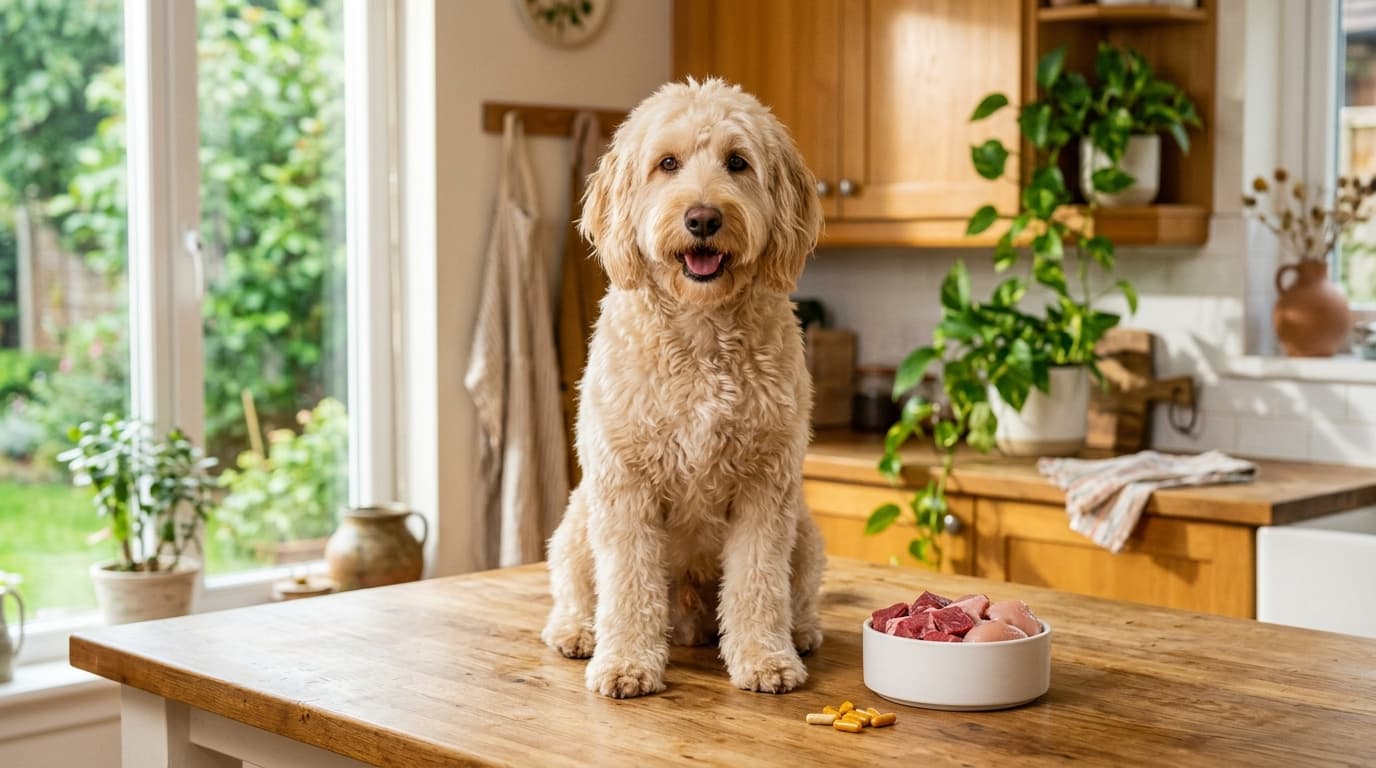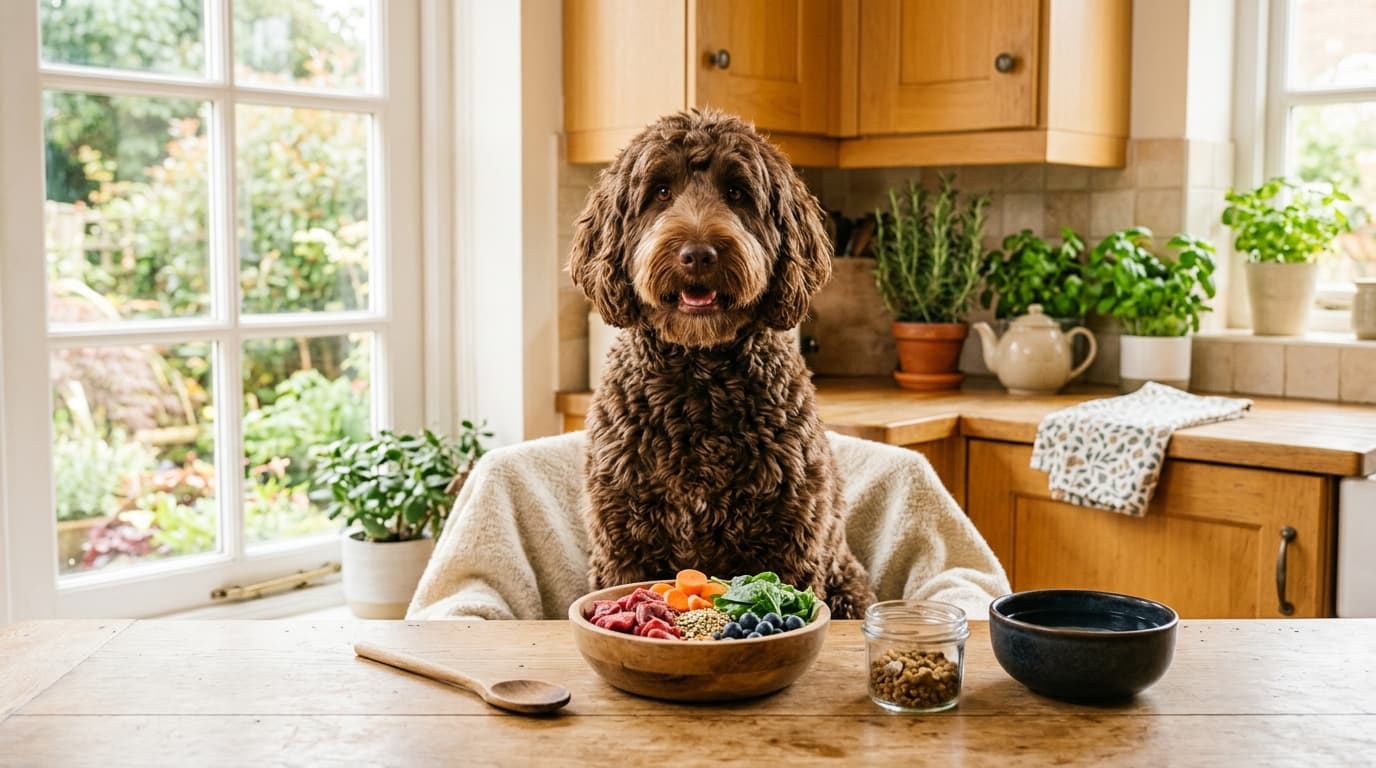
Raw feeding safety is five layers stacked on top of each other: where the meat comes from, how it's frozen, how it's thawed, what happens on the kitchen counter, and what happens at the bowl. Each layer catches what the one before it lets through. Problems start when a household skips one.
We feed three Australian Labradoodles raw at home, with premium kibble and premium freeze-dried raw when we travel. Gösta has eaten raw since he was a puppy; Gunnar and Sven moved over from kibble (the honest case for and against is in raw diet pros and cons). Nobody in the house, human or dog, has gotten sick from it, and the rules below are why.
This page is the overview: one section per layer, with the rule we follow and why. Each layer has its own deep-dive in the series, linked from its section, so this page stays a map rather than repeating them.
The Real Risks (and the Perceived Ones)
Three bacteria dominate the raw-feeding safety conversation: Salmonella, E. coli and Listeria. All three can be present in raw meat, the same as in the raw meat you buy for your own dinner. The FDA flags them specifically for raw pet food handling. How big that risk actually is for dogs and for people, and what the published research does and doesn't show, is the subject of our Salmonella and E. coli guide. The short version that shapes the protocol:
- The main risk is to the humans, through cross-contact. Bacteria travel from raw meat to a counter, a hand, a phone or a dog's beard, and from there to someone's mouth. The layers below exist to break that chain.
- A healthy-looking raw-fed dog can still shed bacteria in its stool. That's why poop pickup with a bag, hand-washing afterwards, and keeping the dog off food-prep surfaces are part of the protocol, not optional extras.
- Bones are a mechanical risk, not a bacterial one. Cooked bones splinter and are never fed. Ground raw bone in a complete raw food is the usual way bone enters the diet. Whole raw bones can still break teeth or cause a blockage, so they're sized to the dog, supervised, and taken away once they're small enough to swallow whole (gentler chew options are in best natural chews).
Where extra care is needed:
- Vulnerable household members. Infants, elderly or immunocompromised people and pregnant women face higher consequences from any bacterial exposure. See the household section below.
- Thawing on the counter. This is where most home mistakes start.
- Food left in the bowl. We pick up within 30 minutes, every meal.
Sourcing: the First Safety Filter
A perfect kitchen routine can't fix meat that arrived contaminated or warm, so the supplier is the first filter. What we ask of any supplier: it sells specifically for raw pet feeding, can tell you where the meat comes from, freezes before sale, has some form of pathogen testing or batch tracking, and keeps the cold chain intact through delivery. The full checklist, the red flags and how to compare channels (premade brands, co-ops, butchers) are in our sourcing guide.
For our household: we buy from a wholesaler that specialises in raw pet feeding. Our three rotate across horse, lamb, pork, venison and turkey, and no chicken, because chicken is Gunnar's trigger. Meat arrives pre-portioned and goes from the delivery box straight into the freezer, so there's no extra cutting step in our kitchen. If you're new to raw, a complete premade raw food from a brand that publishes its testing is the simpler start; our kibble-to-raw transition plan covers the pacing.
Freezing: What It Kills, What It Doesn't
Freezing does one job well and one job not at all:
- It kills parasites. Held at -18 °C (0 °F) or colder for at least three days, freezing kills the parasites relevant to pet feeding in farmed meat. We run our freezer at -20 °C (-4 °F) for margin and check it with a separate thermometer, because the dial on the door is not a measurement. Wild game such as bear or wild boar is the exception: some Trichinella strains in wild animals survive freezing, so we don't feed those raw.
- It does not kill bacteria. Salmonella, E. coli and Listeria go dormant in the freezer and wake up again when the meat thaws. The Merck Veterinary Manual makes the same point. That's why freezing is one layer, not the whole protocol.
Our own rules are short: everything goes into the freezer the day it arrives, in meal-sized portions so nothing is ever thawed and refrozen, every bag is dated, and raw meat never sits above human food. Storage times, freezer sizing and what to do in a power cut are in the freezing and thawing guide. Our portion calculator helps size the bags.
Thawing: Where Most Home Mistakes Happen
Bacteria multiply fastest between about 4 °C and 60 °C (40-140 °F). Meat thawing on the counter spends hours in that range at the surface while the centre is still frozen.
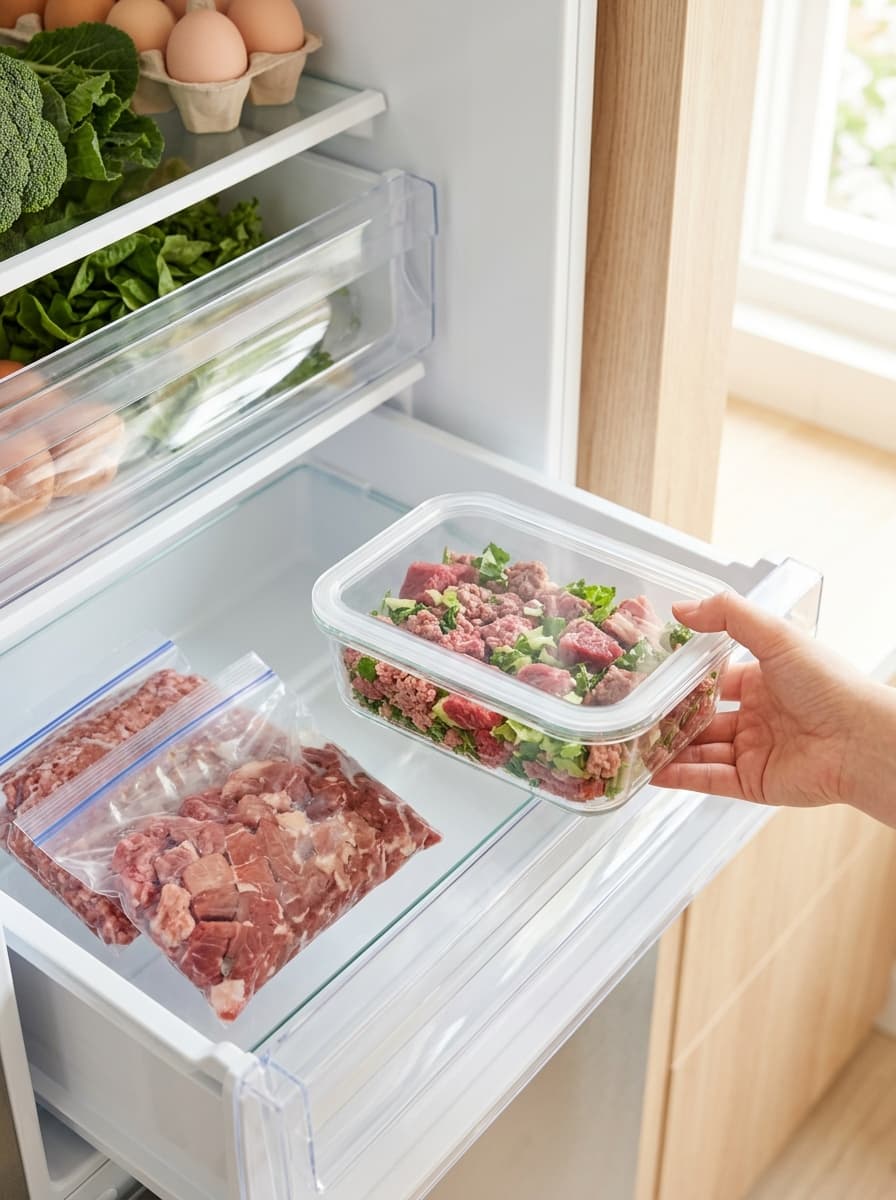
Two methods are acceptable: in the fridge overnight (in a sealed container on the bottom shelf, fed within 24-48 hours), or in a sealed bag in cold water with the water changed every 30 minutes, for the days you forgot. Counter, microwave and hot water are out. Anything that has sat at room temperature for more than two hours goes in the bin. The step-by-step, including how to recover from a forgotten portion, is in the freezing and thawing guide.
The five safety layers
| Layer | What it does | The rule |
|---|---|---|
| Sourcing | Removes the upstream risk | Supplier with testing, batch tracking and a real cold chain |
| Freezing | Kills parasites | -18 °C (0 °F) or colder for at least three days (we run -20 °C); this does not kill bacteria |
| Thawing | Keeps bacteria from multiplying | Fridge or sealed cold water only, never the counter |
| Kitchen hygiene | Stops cross-contact with human food | Separate boards and surfaces, clean as you go |
| Feeding hygiene | Closes the loop | Wash the bowl in hot soapy water after every meal |
Kitchen Hygiene Rules
These are the rules that keep raw pet food from crossing over to household food. How they fit into an actual day, minute by minute, is in the 5-minute daily kitchen routine.
Surfaces:
- A dedicated cutting board for raw pet food, color-coded if possible. Never used for human food preparation, washed in hot soapy water after every use.
- The counter is wiped with hot soapy water after any raw-meat contact. For deeper sanitation, a dilute bleach solution (1 tablespoon per gallon of water, about 4 ml per litre) once a week or after any visible spill, then rinsed.
- The dog's bowl is washed after every meal with hot soapy water and a separate sponge, not the same sponge that washes human dishes.
Hands:
- Wash with hot soapy water after every contact with raw meat, before touching anything else.
- Don't touch your face, phone, or other surfaces between handling raw meat and washing hands.
- Avoid handling raw meat with cuts on hands. If unavoidable, use disposable gloves.
Tools:
- Knives, scissors, and tongs used for raw meat go directly to hot soapy water (or to the dishwasher on a hot cycle).
- Plastic containers used for portioning go to the dishwasher.
- Never use the same tool for raw meat and ready-to-eat food without thorough washing in between.
Storage:
- Thawed raw meat is stored in sealed containers on the bottom shelf of the fridge, never above produce or ready-to-eat food.
- Frozen raw meat is in sealed bags, separated from human food by a divider or tray.
- Bowls of fed raw food are not left out. Pick up and wash after meal time.
Feeding Hygiene
Where the dog eats:
- A defined feeding area, ideally tile or another easy-to-clean surface. Not on a rug or upholstered surface.
- The same spot every time, easier to clean, easier to monitor, easier for the dog.
- Out of high-traffic family areas where small children might crawl through immediately afterwards.
The feeding routine:
- Put down the bowl, let the dog eat, pick up immediately when done.
- Don't leave raw food in the bowl for more than 30 minutes.
- If the dog doesn't finish, the rest goes back to the fridge in a sealed container, once. Don't refrigerate, re-offer, refrigerate again.
- After every meal: wash the bowl in hot soapy water. Wipe the floor under and around the bowl only if there's visible spillage, most tidy raw eaters don't leave anything behind.
Mouth and face:
- Wipe muzzles and beards after the meal if needed. A doodle beard holds residue in a way a short-coated muzzle doesn't, so with three Australian Labradoodles the beard wipe is simply part of the after-dinner routine here.
- Avoid face-to-face contact for the first 60 minutes after eating, because the beard and fur can carry residue.
Households With Kids, Elderly, or Immunocompromised Members
The protocol scales up for these households. The age-by-age detail for families with children is in raw feeding with kids in the house; the summary is below.
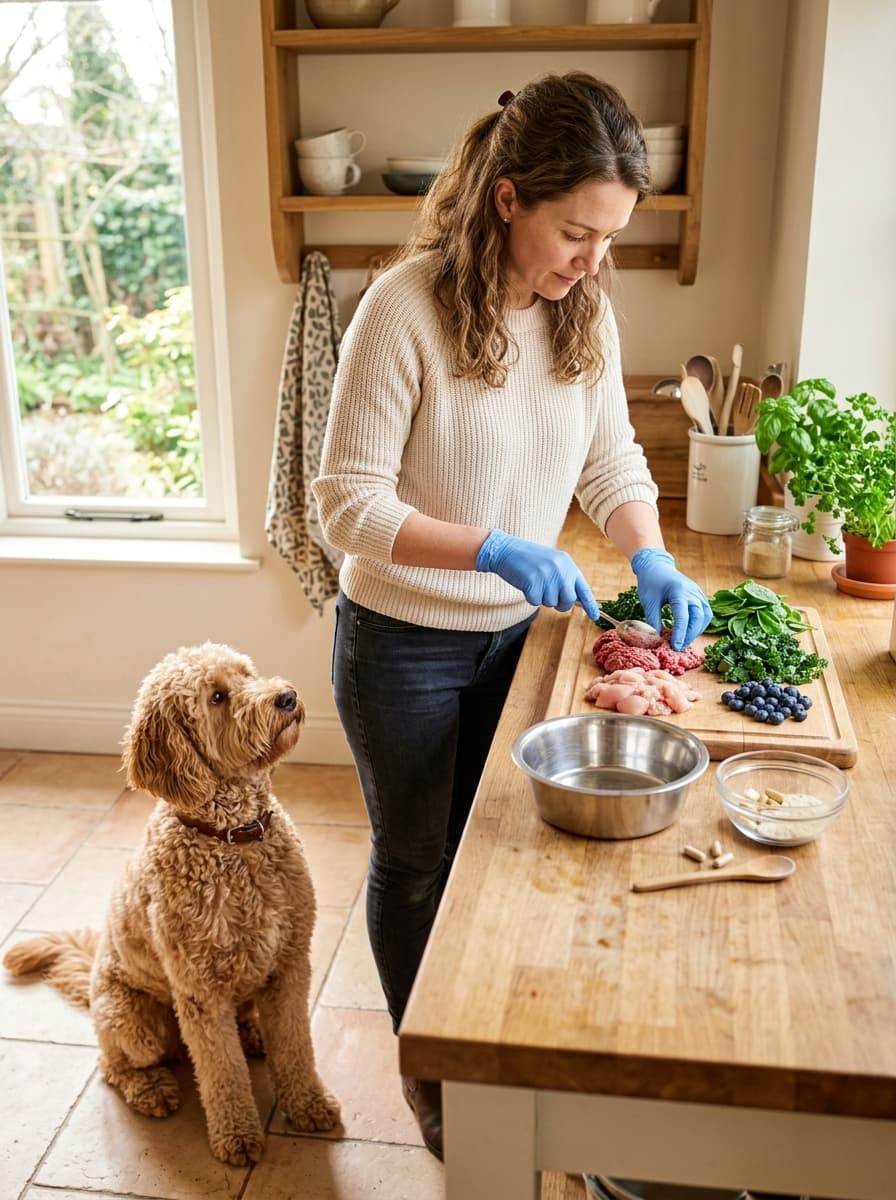
- Small children: feed when they aren't on the floor nearby, keep them away from raw meat and raw bowls entirely, wipe the dog's face after meals, and no face kisses for an hour after a raw meal.
- Elderly or immunocompromised family members: the same rules, and ideally someone else does the handling. Hand-washing after touching the dog in the post-meal hour matters more here.
- Pregnancy: someone else handles the raw meat for the duration. Toxoplasmosis is the main concern; freezing lowers that risk but the handling rule stays.
Freeze-dried raw is easier to handle cleanly, but it is still raw and still not sterile, so the same hand-washing and bowl rules apply to it.
What to Do If Your Dog Gets Sick
Symptoms that mean a call to the vet, not a wait-and-see:
- Vomiting more than once in 24 hours
- Diarrhea lasting more than 24-48 hours
- Lethargy that doesn't lift
- Loss of appetite (different from a single skipped meal)
- Fever (rectal temperature above 39.5 °C / 103 °F)
- Any blood in the stool
What to do:
- Stop the current raw protein and save a sample of the batch (even if frozen) in case the vet wants it tested.
- Call the vet and tell them the dog is raw-fed and which protein. A vet who doesn't know may read the bloodwork or stool culture differently.
- Ask the vet whether to rest the stomach before feeding again. Puppies, toy-sized dogs and dogs with other conditions shouldn't be fasted without that advice.
- When food goes back in, a bland cooked meal (turkey or white fish plus rice) for two to three days comes before raw.
- If a specific protein or batch is implicated, leave it out for at least 30 days and reintroduce in small amounts.
What to Do If a Human Gets Sick
Foodborne illness symptoms in humans (vomiting, diarrhea, fever, abdominal pain) within 6-72 hours of raw-meat contact may indicate cross-contact contamination.
What to do:
- Standard care, hydration, rest, contact a doctor if symptoms are severe or last more than 24 hours.
- Tell the doctor that you handle raw pet food. This affects the differential diagnosis.
- Audit the kitchen for the failure mode: was a surface cross-contaminated? Did the affected person handle the dog directly after a meal? Did food sit in the bowl too long?
- After recovery, tighten the protocol that failed. The point isn't to abandon raw feeding, it's to fix the specific gap.
Travel and Raw Feeding
Fresh raw doesn't travel: no freezer, no controlled counter, no proper sink. Away from home our three eat premium kibble and premium freeze-dried raw, and the bowl comes with us and is washed after every meal wherever we are. Trip-by-trip protocols, kennel stays and getting back onto fresh raw afterwards are in the travel feeding guide.
Raw Food Safety Quick Checklist
Before any raw meal, mentally check:
After the meal:
FAQ
Yes, when the protocol is followed. Raw feeding involves the same bacterial-handling considerations as cooking raw meat for your own dinner: source from a supplier with testing and batch tracking, freeze at -20 °C (-4 °F), thaw in the fridge, keep meat off shared surfaces, and wash bowls after every meal. Problems come from skipping layers, not from raw feeding itself.
No. Freezing kills parasites but only makes bacteria dormant. Salmonella, E. coli, Listeria and Campylobacter all survive standard freezer temperatures indefinitely and reactivate within minutes of thawing. Freezing is a parasite control, not a sterilisation step, which is why the thawing and hygiene rules still matter.
In the fridge, overnight, in a sealed container on the lowest shelf. Cold-water thawing in a sealed bag is the acceptable fast alternative. Never thaw on the counter or in the microwave: counter thawing lets the surface reach room temperature while the centre is still frozen, and that is exactly the window bacteria multiply in.
Yes, with adjustments. Wash hands between handling meat and touching a child, keep a dedicated feeding area away from where children play on the floor, and apply a 60-minute wait before face-to-face contact after a meal. Families with an infant under one year often switch to freeze-dried raw for that period.
Not strictly, but it makes the protocol much easier. What matters is that raw pet food is stored below human food or in sealed containers so nothing can drip onto ready-to-eat items, and that the freezer holds -20 °C (-4 °F) reliably. A dedicated chest freezer removes the cross-contamination question entirely.
Where to Go from Here
Raw is the strongest tier in our feeding hierarchy, but the right answer for your household depends on what fits your life. If raw isn't realistic, freeze-dried is the next-best step and shares much of this safety protocol.
Cross-links to companion guides:
- Sourcing raw meat for sensitive doodles, what to look for in a supplier, the red flags, the sourcing channels
- Freezing and thawing raw dog food, the cold-chain protocol from delivery to bowl
- The 5-minute daily kitchen routine for raw feeders, what the day-to-day actually looks like
- Raw feeding with kids in the house, how the protocol scales for households with children
- Salmonella and E. coli in raw dog food: real risks vs. fearmongering, the bacterial-risk question, honestly
- Travel feeding for raw-fed doodles, what to feed when you're not in your kitchen