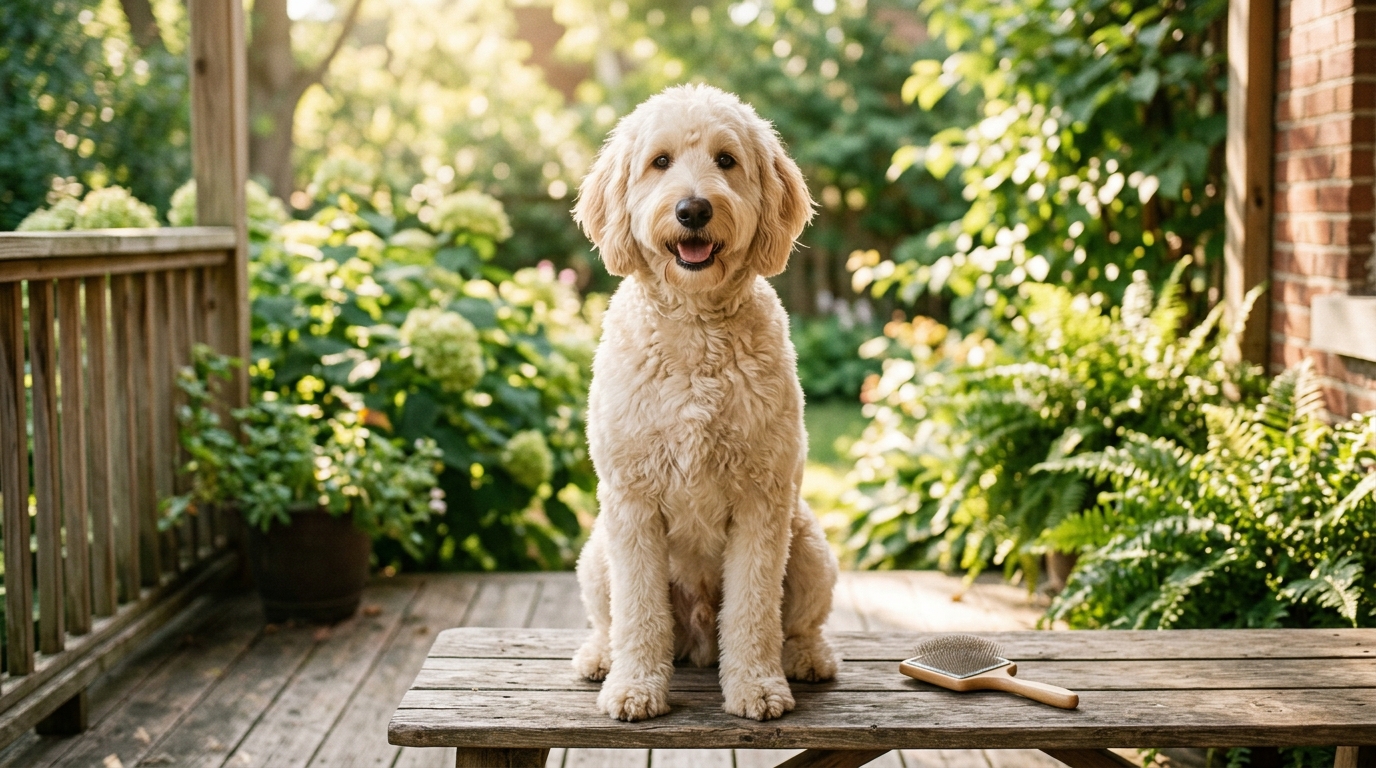
The best brush for a Goldendoodle is a long-pin slicker brush used with the line-brushing method, paired with a metal greyhound comb to confirm you actually reached the skin. The slicker does the detangling and fluffing; the comb is the test that proves the coat is brushed all the way to the roots and not just smoothed on the surface. A slicker on its own is how a fluffy-looking doodle ends up matted underneath.
If you take one thing from this page, it's that a doodle grooming kit for a brushing coat is two tools, not one. Get the slicker right, add the comb, and you have caught most of the matting battle. The detangling spray and a small trimmer for tidy-ups are the occasional-emergency drawer, not the daily driver.
We live with three doodles, Sven, Gunnar and Gösta, and between three different coats we've learned this the way most owners do: by finding a mat behind an ear that a nice-looking brush-through completely missed. Below is the exact tool logic, our picks with honest cons, and the two-minute test that tells you you're done.
If you already know you want the shortlist and just want to buy the right slicker, jump to our Top Picks below, otherwise keep reading for how each one differs.
Which coats actually need a brush
Here's the honest part most brush guides skip: not every doodle coat rewards routine brushing equally, and in our house that difference is stark. All three of ours are Australian Labradoodles, but they carry two very different coat types.
- Gösta has a wavy fleece coat, and this is where a good slicker and comb genuinely earn their place. His coat must be brushed thoroughly and often, and with that routine he stays mat-free and can be kept long. If you have a wavy or fleece doodle, the tools below are exactly what your coat needs.
- Sven and Gunnar have curly wool coats, and we do not brush them routinely. We tried, and brushing did not stop the matting for us, they'd mat anyway. Instead we hand-check them daily or several times a week, clip any single mat straight out, bathe them once a month with conditioner, and clip the whole coat off short roughly every 2-3 months (about four times a year), sooner if the coat looks in poor shape. For a curly wool coat, a good clipper and a short cut can matter more than the brush, and our groomer agrees a curly wool coat can't realistically be kept long.
Here's the twist we didn't expect: as puppies we brushed Sven and Gunnar often, several times a week, sometimes daily, and while they were small that worked fine. But once their adult curly wool came in, brushing started making the coat frizzy rather than smooth. It's a lot like the "curly girl method" for curly human hair, one of us has curly hair and never brushes it, and we ended up doing the same for the boys. For their curly wool, that monthly bath with conditioner plus a short clip does more against matting than any brush did. Gösta's wavy fleece is the coat where these brushes genuinely earn their place, and we brush his fleece once it has dried a little after the bath and is still slightly damp.
Gunnar was our first doodle, and he taught us this the hard way. His puppy coat was fairly straight, almost fleece-like, and we brushed him and thought he was in good shape, but we had a poor brush and not yet the technique, so we were only skimming the surface while believing we reached the skin. When his coat changed into a much curlier adult coat and we first trimmed him ourselves, we found him matted all over underneath: we'd been brushing over the mats. We had to shave him completely down that first time, and felt terrible after trying our best. Then we bought a proper slicker and learned how curly coats actually work, and with Sven, our second, that never happened.
So before you buy, look at your own dog's coat. A wavy or fleece coat is a brushing coat. A tight, spiral, curly wool coat may respond better to hand-checks, a short clip and a regular bath than to hours of brushing that still leaves mats at the roots.
For general, vet-backed guidance on coat and skin care, the American Veterinary Medical Association is a reliable place to start.
Why a doodle coat needs a slicker and a comb
Doodle coats, whether your dog is an Australian Labradoodle, a Labradoodle, a Goldendoodle, a Bernedoodle or a Sheepadoodle, are a curl or fleece coat that holds shed hair instead of dropping it. That's part of why so many people call doodles low-shedding (worth reading our honest take on whether doodles are hypoallergenic). But the trade-off is that the shed hair tangles into the growing coat, and mats form from the skin outward, invisible under a coat that still looks soft and full on top.
That's the whole problem in one sentence: a doodle coat can look perfectly groomed and be matting at the roots. This is why the two tools have two jobs:
- The slicker brush, fine, angled pins that detangle and lift the coat. This is what you spend most of your grooming time using on a fleece coat.
- The metal comb, a greyhound-style comb with wider and finer teeth. This is your quality control. If it slides from skin to tip cleanly, that section is done.
Alongside a slicker, the two other tools we actually reach for are a rotating-tooth comb, the teeth spin, and it's genuinely good for working through a coat because the spinning slips it through tangles instead of dragging, and a human hair detangler brush, which works surprisingly well on a dog coat. Neither replaces the metal comb as your test, but both make a fleece coat easier to work through.
The build matters too. A large, deep-chested Bernedoodle carries a lot more coat to get through than a mini Goldendoodle, if you're still deciding on size, our mini vs medium vs standard doodle guide is useful, because more dog means more brushing minutes per session.
Top Picks
We chose these on three things: pin length (does it actually reach a doodle's skin?), how gentle it is on sensitive skin, and real-world review depth. The Chris Christensen Big G is the slicker we personally own and use on Gösta's fleece; the other three are researched picks we haven't had in our own hands, chosen on specs and review depth rather than testing. Every one here is a long-pin slicker suited to a curl or fleece coat, they differ mostly on price, build and how "doodle-specific" the branding is. Remember: whichever slicker you pick, add a metal comb. None of these replaces the comb test, and if your dog has a tight curly wool coat you can't keep brushed out, a good clipper for a short cut may serve you better than any of these.
| Product | Best For | Ours or Researched | Rating |
|---|---|---|---|
| Chris Christensen Big G Slicker | Best Overall | Our own brush | 4.7 |
| Freshly Bailey Doodle Brush | Best Doodle-Specific Design | Researched pick | 4.7 |
| 2PCS Slicker Brush + Comb Set | Best Value (Brush + Comb) | Researched pick | 4.7 |
| Paw Brothers Extra Long Slicker | Best Budget | Researched pick | 4.7 |
One buying note that actually matters here: slicker size. The "Large" version of these brushes is right for a standard or medium doodle, but on a mini the large head can feel unwieldy around the face and legs, a smaller head gives you more control on delicate spots. And if you buy a slicker that doesn't come with a comb, budget for one separately; you can browse combs and grooming gear in Amazon's pet grooming section to complete the kit.
What makes a good doodle slicker brush
Not all slickers suit a doodle. The pet-store standard slicker with short, stiff pins works fine on a Labrador and barely reaches the skin on a doodle. Here's what we actually look for.
Long pins. This is the single most important feature for doodle coats. Extra-long pins reach through a dense curl to the skin without you pressing hard, and pressing hard is exactly what causes skin irritation. Short pins force you to dig; long pins let the length do the work.
A comfortable handle. You will be brushing for real minutes, not seconds. An ergonomic grip is the difference between a thorough session and a rushed one, and rushed sessions are where mats survive.
Gentle, flexible pins. Doodles from the Poodle line can carry a genuine predisposition to sensitive, allergy-prone skin (some inherit it, some don't). Gunnar is our itchy-skin-and-paws dog, and a brush that's too aggressive leaves him scratchier afterward, a real thing we cover in doodle itchy after grooming. Flat, light strokes on a gentle slicker keep grooming from becoming a skin trigger.
How to actually use it: line brushing
Owning the right slicker doesn't help if you brush the way most people do, smoothing the top of the coat while the roots stay tangled. The technique that works is line brushing, and it's simple. This is the routine we use on Gösta's wavy fleece coat.
- Part the coat down to the skin with your free hand, exposing a horizontal "line" of skin.
- Brush upward and outward from the skin at that line with the slicker, small sections at a time.
- Drop your hand slightly to expose the next line and repeat, working your way up the body in layers.
- Run the metal comb through each finished area from the skin. Snag = not done. Clean glide = move on.
Focus on the friction zones where mats form first: behind the ears, the armpits, the collar and harness lines, the base of the tail and the back of the legs. In our house, a quick daily comb-through of just those spots on Gösta takes a couple of minutes and heads off nearly every mat. The full line-brushing happens every day or two, and Gösta lets us do every grooming chore without any fuss. The rotating-tooth comb and the human hair detangler brush both come in handy for working through the longer sections before we go back over them with the metal comb to check.
We groom on a table or on the floor, with a lick mat smeared with something tasty to keep them still. Gösta stands happily for all of it; on Sven and Gunnar, who are more sensitive to handling, one of us holds while the other works the tricky spots, and that tolerance is trainable with short, rewarded sessions.
When a clipper matters more than a brush
For a tight curly wool coat, the tool that earns its keep isn't the brush, it's the clipper. This is what we use on Sven and Gunnar, and it's why we're honest that not every doodle needs the brushes above.
We tried a cordless clipper first, but it only coped with Gösta's soft fleece; Sven's and Gunnar's curly wool was too tough for it, so we switched to a corded Andis and never looked back. We run a #10 blade on the boys, and because blades get hot we keep four of them and rotate as they heat up, that lets us trim all three dogs in one session without long breaks. For Gösta we use a #10 (or a longer equivalent) or a #10 with attachment guard combs to leave the coat at different lengths. A small trimmer handles the fiddly bits: between the toes, the face and the sanitary area, and clipping the mats between the paw pads matters, because those are the hardest ones on our boys and they lead to constant paw licking (an extra grooming cause alongside Gunnar's yeast and allergy paw story).
A quality clipper is worth buying rather than a cheap kit. A good one lasts many years and costs around $200 (about €185) once, and a professional doodle groom typically runs around $100-150 (about €90-140) per visit (check your local prices), so with several doodles the savings add up fast. Brands we rate are Andis (the Andis AGCB brushless is really good) and Aesculap. Even owners who use a groomer find a small trimmer handy for tidy-ups between visits.
For drying, we no longer blow-dry as a routine, with an ordinary hair dryer, drying a doodle coat to the skin can take an hour. We use dog drying robes (bathrobes for dogs) instead and they work really well; a high-velocity grooming dryer is a good option if you have the time and budget for a perfect finish at home, but it's a big investment. Gösta's fleece gets brushed once it has dried a little and is still slightly damp.
What a brush won't fix
A great slicker and a disciplined comb routine keep a wavy or fleece coat mat-free, they don't fix a coat that's suffering from the inside, and they won't turn a tight curly wool coat into a low-maintenance one.
If your doodle is chewing, scratching or licking more than usual, that's a skin-health question, not a grooming one. In our house that's Gunnar's department, he's our ears, yeast and itchy-paws dog, and no brush touches the cause. Skin trouble usually traces back to diet, allergies or a yeast flare, and it's worth learning to tell those apart in allergy vs yeast infection in doodles. Diet plays a real role for many itchy doodles too, we cover it honestly in can diet fix doodle skin problems.
A brush also won't fix a coat that's matting because the dog won't hold still. If grooming is a fight, shorter and more frequent sessions with a lick mat smeared with something tasty change the whole experience, see our best lick mats for doodles for the calm-down trick we use.
FAQ
A long-pin slicker brush is the best all-round brush for a Goldendoodle because the longer pins reach through a thick, curly coat to the skin without you having to press hard. Our overall pick is the Chris Christensen Big G, it's the slicker we actually use in our house, but the real kit is a slicker plus a metal comb, and the comb is what tells you the coat is actually brushed to the roots and not just smoothed on top. Note that this brushing routine suits a wavy or fleece coat; a tight curly wool coat may respond better to a short clip and a monthly bath.
Yes. The slicker does the detangling and fluffing, but a metal greyhound comb is your test: if it glides from skin to tip anywhere on the body, that section is truly mat-free. A slicker can smooth the surface while mats sit undisturbed at the roots, which is exactly how doodle owners get surprised by pelting under a fluffy-looking coat. A rotating-tooth comb is also genuinely good for working through a coat, since the spinning teeth slip through tangles instead of dragging. On a curly wool coat we skip brushing entirely and hand-check instead, but the comb is still the test wherever you do brush.
Most adult doodles in a longer wavy or fleece coat need a full line-brushing every 1-2 days, and a quick comb-through daily around friction zones, behind the ears, armpits, the collar line and the back legs. Curly wool coats mat differently: in our house we don't brush the wool boys at all, we hand-check them daily or several times a week and clip any single mat straight out, then clip the whole coat off short every 2-3 months. Coats changing from puppy to adult (often around 8-12 months) mat almost overnight and need close attention for a few weeks.
Used gently and flat against the coat, a good slicker shouldn't hurt. Problems come from digging the pins into the skin or scrubbing the same spot, that causes 'slicker burn' and post-grooming itch. Keep strokes light, let the pin length do the work, and never brush a dry, tightly matted area; loosen it first, clip it out, or shave it off with clippers.
Once mats are set, no everyday slicker will fix them comfortably. Work small mats loose with your fingers and a detangling spray, or clip a single mat straight out. If the coat is pelted close to the skin, that's a clipper shave-down and a fresh start, not a brushing job, a confident owner can do this at home with a corded clipper and a suitable blade; use a groomer if you're unsure or the dog is stressed, and a vet if there are sores under the mat.
Your next step
Look at your dog's coat first: if it's wavy or fleece, pick one slicker from the list above, add a metal comb if it doesn't include one, and start the line-brushing-plus-comb-test habit this week. If it's a tight curly wool coat you can't keep ahead of, hand-checks, a short clip and a monthly bath with conditioner may serve you better than any brush, that's the honest call we made for two of our three.
If matting is already the problem you're fighting, go straight to doodle matting: how to prevent and remove mats for the removal plan. And if scratching after grooming is part of the picture, our guide to doodle scratching after grooming walks through the likely causes. You can also browse the rest of our gear in the best products hub.