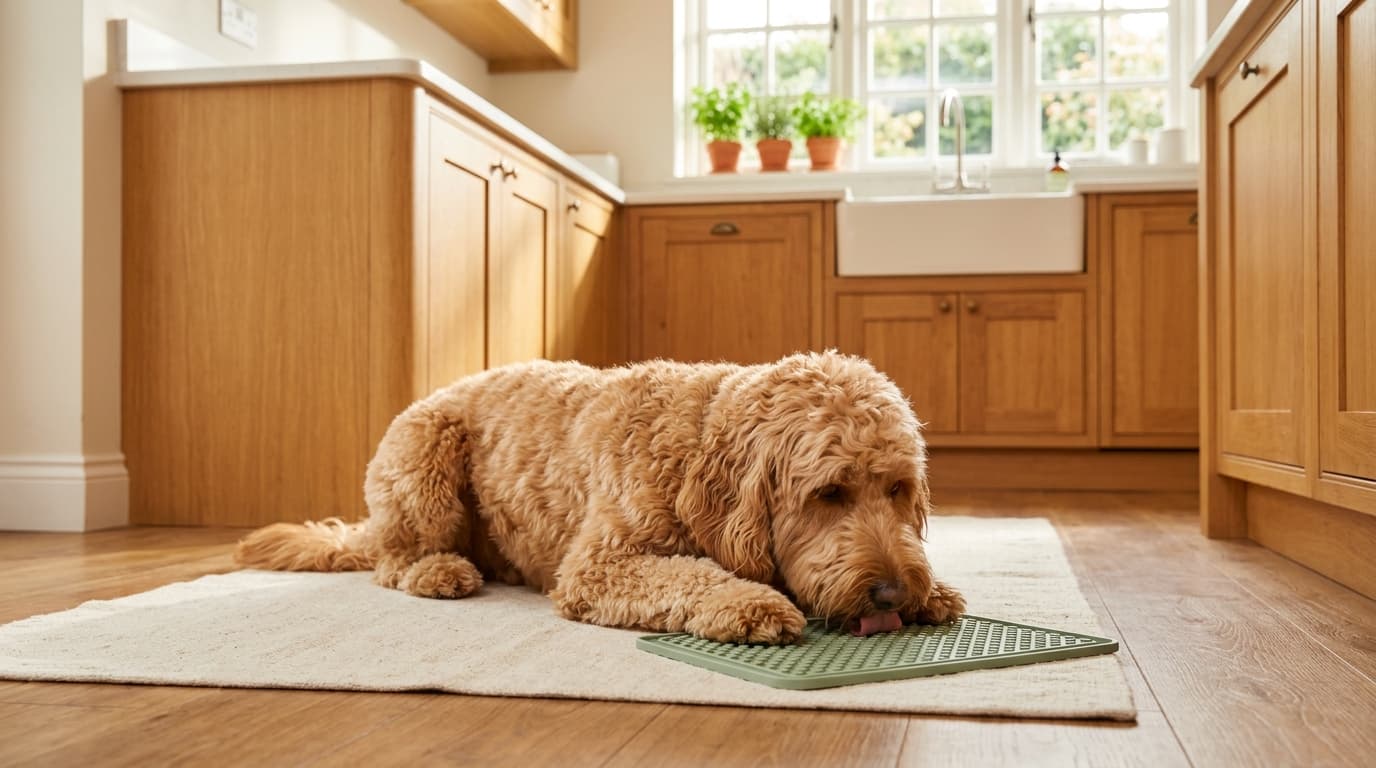
A lick mat is the right tool for raw, wet or freeze-dried food that will not sit in a ridged bowl. Spread food thin across the texture and a doodle has to lick rather than bite, which stretches the meal out and has a calming effect, because repetitive licking is self-soothing for most dogs. Choose a dot texture for runny food and a raised cross texture for chunky spreads.
If you feed raw (or are switching to it), you already know a maze bowl is built around dry kibble. Wet food fills the channels and comes out in two mouthfuls. A mat solves that, and it does a second job the bowl cannot: it settles a dog down.
If you already know you want one and just want the shortlist, the LickiMat Classic Soother is the sensible default for most doodles. Below is how the textures differ, what to spread on them, and where each pick fits.
What a lick mat is actually for
Two jobs, and it helps to keep them separate.
Slowing food down. A thin layer pressed into a textured surface takes real time to work out. For a Mini or Medium doodle, a whole raw meal spread across a large mat can take fifteen or twenty minutes, considerably longer than a maze bowl manages.
Settling a dog. Repetitive licking is self-soothing. Our calm doodle guide explains why calm comes first, and leaving a doodle home alone shows where a mat fits into departures. That makes a mat useful at moments that have nothing to do with hunger: before the groomer, during fireworks, while the other dogs eat, or on a post-groom afternoon when a freshly clipped Australian Labradoodle wants to gnaw at their own skin. In our house that last one is the mat's main job, a busy mouth is not chewing at a pink belly.
Texture: dots versus raised patterns
| Pattern | Suits | Session length | Notes |
|---|---|---|---|
| Fine dots | Runny food: yoghurt, thinned wet food, bone broth | 10-20 min | The longest sessions; hardest to clean |
| Raised cross or ridge | Chunky spreads, raw, pumpkin, pâté | 5-15 min | Easiest to load and rinse |
| Heavy-duty thick | Any, for dogs who bite the mat | Varies | Thicker material resists chewing |
| Suction-backed | Any, dogs who drag the mat off | Varies | Sticks to tile, glass or a smooth wall |
The short version: dots for runny, ridges for chunky, heavy-duty for chewers, suction for draggers.
Our picks
Best overall: LickiMat Classic Soother
The default for most doodles. The fine dot pattern is the one that produces genuinely long sessions with runny food, yoghurt, thinned wet food, rehydrated freeze-dried, because the food sits down in the texture rather than on top of it. The large size takes a meaningful amount, and it is thin and flexible enough to freeze flat, which stretches a session further on a hot day.
The con: the fine dots are the hardest pattern to clean, so it wants rinsing straight away rather than sitting on the side, and the classic material is not built for a dog who bites rather than licks.
Two is the useful number. One mat in the freezer and one in use beats a single mat you are forever washing, and they are cheap enough that this costs little. Prices swing a lot between brands for near-identical mats, so it is worth comparing them.
Best for chewers: LickiMat Tuff Heavy-Duty Soother
If your doodle treats a soft mat as something to bite, this is the version to buy. A dog who mostly wants to chew is better served by a natural chew or a stuffable toy. Same soothing dot surface, considerably thicker and tougher material, so an enthusiastic dog is far less likely to take a chunk out of it. That matters, swallowed pieces of a chewed mat are a genuine risk, not a theoretical one. The Merck Veterinary Manual describes how swallowed foreign objects can lead to gastrointestinal obstruction.
The con: it is heavier and less flexible, so it does not freeze flat as neatly, and it costs more than the classic version.
Best for Standard doodles: LickiMat XL Breed Soother
A Standard Goldendoodle, Bernedoodle or Sheepadoodle has a big tongue and a big meal, and a regular mat is a two-minute exercise for them. The extra-large version gives enough surface area that a full portion of raw or wet food actually spreads thin, which is what makes the session last.
The con: it takes up real space, so it is awkward in a small kitchen and does not fit tidily in a dishwasher alongside everything else.
Best suction base: Hyper Pet IQ Treat Lick Mat
The pick for a doodle who picks the mat up and carries it off, or who pushes it around until the food is on the floor. Suction cups on the back hold it to tile, porcelain or glass, which also makes it usable on a wall or the side of a bath, genuinely handy for keeping a dog occupied during a wash.
The con: the suction only grips smooth, non-porous surfaces, so it does nothing on wood or textured tile, and the cups need wetting and a minute to seat properly.
What to spread on it
Keep it simple and keep it safe:
- Raw or wet food, thinned slightly if it is stiff
- Plain unsweetened yoghurt
- Plain canned pumpkin, which doubles as a fibre boost, see best pumpkin supplement for dogs
- Rehydrated freeze-dried food, worked into a paste
Check any peanut butter for xylitol before it goes near the mat. That sweetener is toxic to dogs and it turns up in ordinary supermarket brands. The ASPCA lists xylitol among the substances toxic to dogs. For a wider look at food, probiotics and tools that suit dogs with digestive, allergy or skin issues, see Best Products for Sensitive Doodles: Food, Supplements & Tools.
FAQ
Anything soft enough to spread and safe for dogs: raw or wet food, plain unsweetened yoghurt, plain canned pumpkin, a little wet food thinned with water, or a scoop of their normal freeze-dried food rehydrated into a paste. Check any peanut butter for xylitol before it goes anywhere near the mat, because that sweetener is toxic to dogs. Spread the layer thin, because a thick pile defeats the purpose and turns a twenty-minute job into a two-minute one.
For many dogs, yes. Repetitive licking is self-soothing behaviour, and a mat gives a dog something structured to do at moments when they would otherwise be pacing or fussing. It is genuinely useful before a groomer visit, during fireworks, or while other dogs in the house are eating. It is a management tool rather than a treatment for real separation anxiety, which needs a behaviour plan.
For raw and wet food it often can, especially for a Mini or Medium doodle whose whole meal fits spread across a large mat. For dry kibble a ridged bowl works better, because kibble sits on top of a mat rather than pressing into the texture. Plenty of households use both: the bowl for the bulk of a dry meal and the mat for toppers, raw food, or keeping one dog occupied while the others eat.
Not the standard soft ones. A determined chewer will bite chunks out of a thin flexible mat, and swallowed pieces are a genuine risk. If your doodle chews rather than licks, buy a heavy-duty version made from thicker material and supervise every session. Take any mat away as soon as it is clean, and replace it once the surface shows real bite damage.
Rinse it immediately after use, because food dries into the texture and then needs soaking. Most mats are top-rack dishwasher safe, which is the easiest route for raw feeders who want a proper hot wash. A soft brush lifts residue out of the deeper patterns better than a sponge. Freeze a loaded mat if you want to extend the session, but wash it as soon as it thaws.
Where to start
Buy the classic dot mat in a size that matches your doodle, spread the first load thinner than feels right, and see how long it lasts. Move to the heavy-duty version if your dog bites it, the extra-large if they clear it too fast, and the suction model if they carry it off.
If dry kibble is what you are trying to slow down, a ridged bowl does that job better, see best slow feeder bowls for doodles. And if post-groom itching is why you are here, doodle scratching after grooming covers the rest of that afternoon.