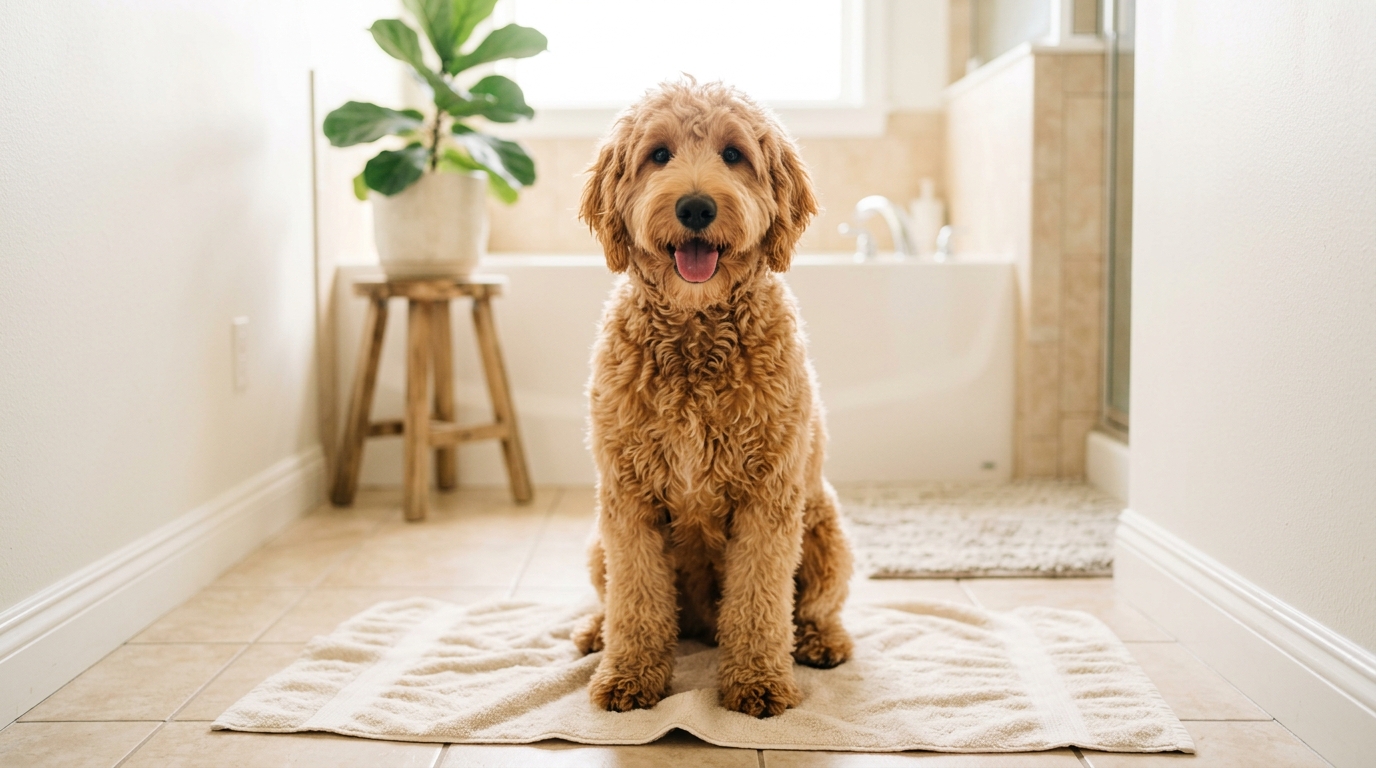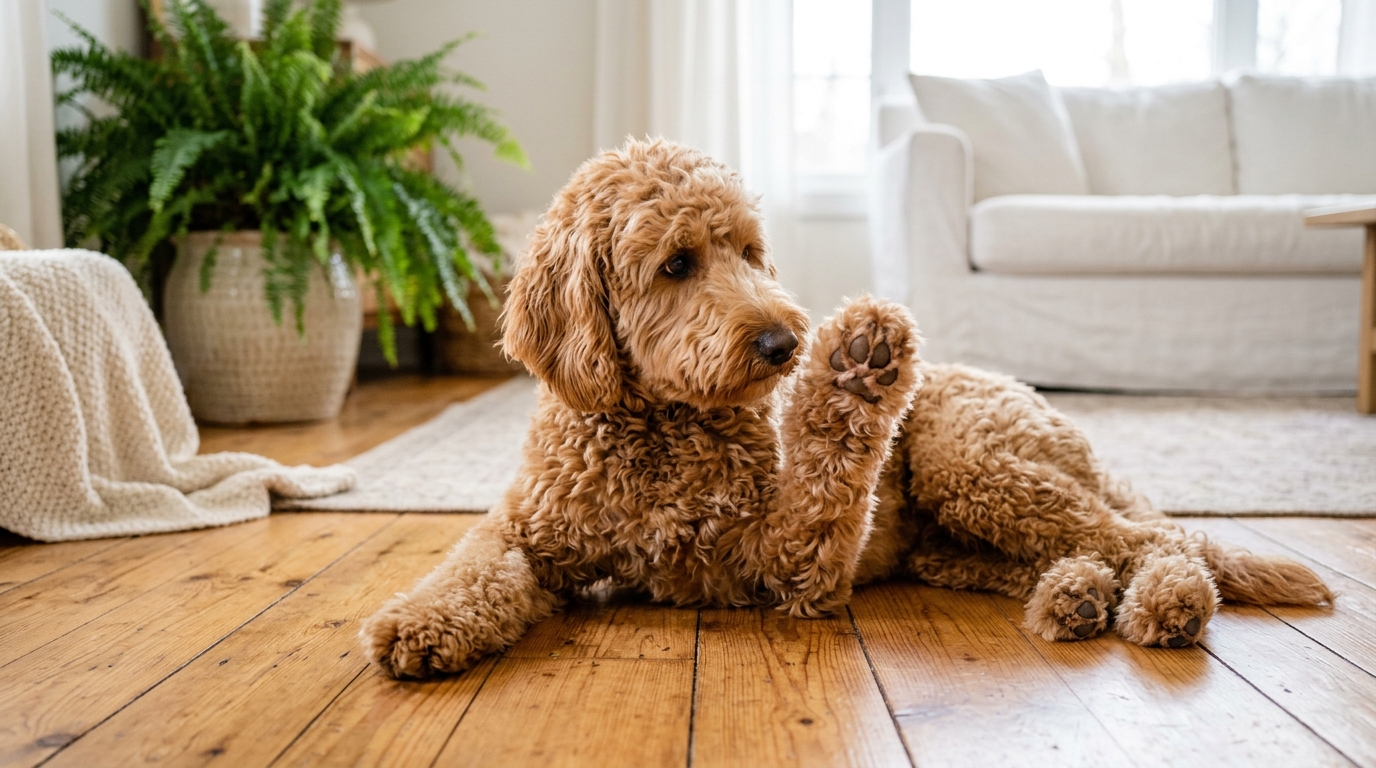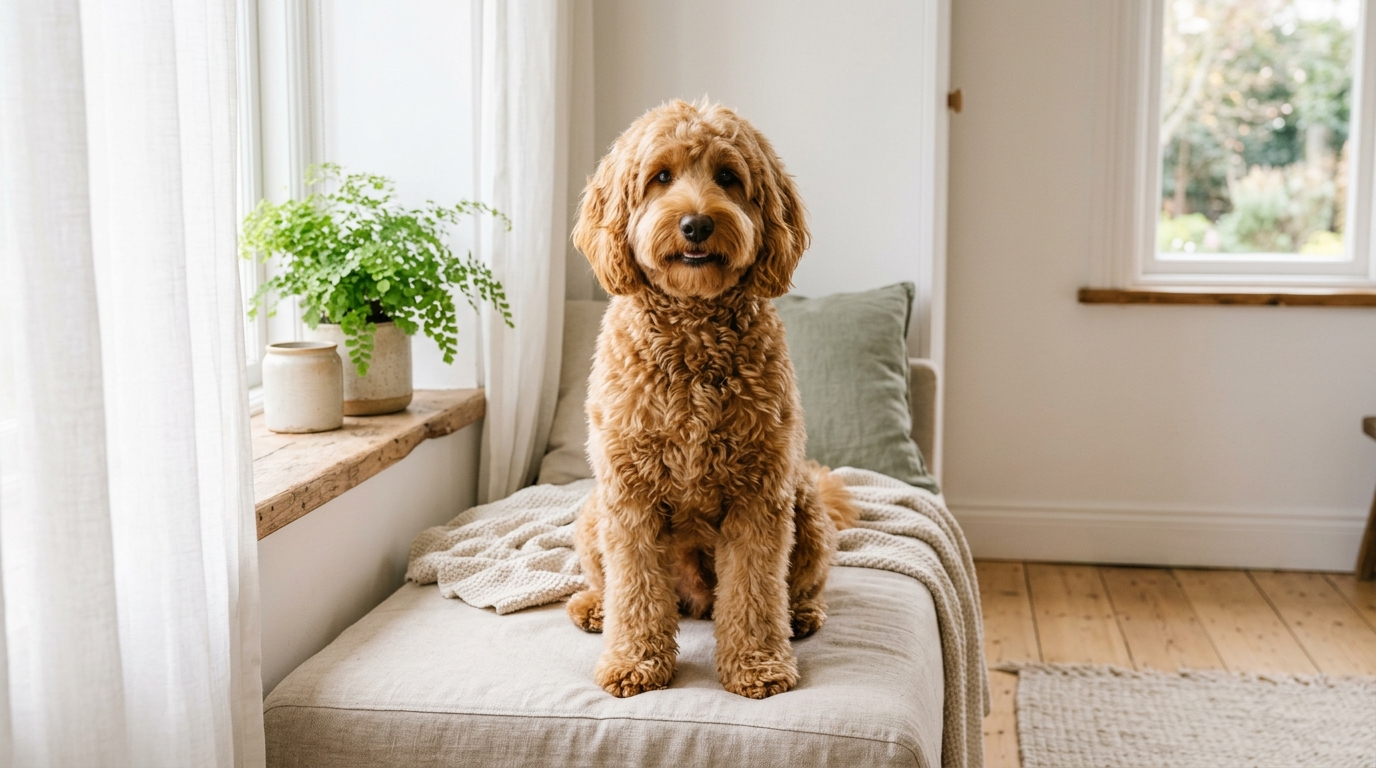
If you want to trim a doodle at home, the short version is this: bathe the coat with a conditioner and dry it completely first, never clip a dirty or matted coat, then use clippers with a #10 blade and guard combs for the body and blunt-tip or curved scissors with a steel comb held between the blade and the skin for legs, face, paws and sanitary areas. How short you go depends on the coat, a curly wool coat usually has to go short, while a wavy fleece coat can stay longer if it's brushed often.
We trim all three of our Australian Labradoodles ourselves at home, and have for years. It took practice, a few uneven legs, and learning the hard way that you cannot rush the face. But it saves us real money and a lot of car trips, and once you have a routine it's genuinely satisfying.
This is the exact setup and routine we use, the real tools, the real order we do things in, and the honest bits about when we'd send a dog to a professional instead.
If your real problem is mats rather than the haircut itself, a coat that keeps felting up no matter what you do, match your plan to your dog first with our guide to Australian Labradoodle coat types, which walks through fleece, wool and hair coats so you know how short to go and how much upkeep the trim will need. And because we clip on a clean, dry coat every time, it's worth sorting the bath out too: if your dog's skin flares up, our best shampoo for itchy doodles will help you pick something gentle before you bathe and dry ahead of the clip. A curly wool coat that's a tight mess of mats at the skin is a shave-down job, not a scissor job, we'll come back to that below.
First, know your doodle's coat type
You cannot copy one trim across every doodle, because a Goldendoodle, a Labradoodle and an Australian Labradoodle can all carry very different coats, and so can two dogs from the same litter. Coat type decides how short you'll go and how much upkeep the trim needs.
In our house the difference is dramatic:
- Sven and Gunnar have curly wool coats. We do not brush them routinely, with curly wool, brushing never stopped the matting for us, and they mat anyway. So we bathe them once a month with a conditioner (the conditioner is the part that actually helps against matting) and, roughly every two to three months, clip the whole coat off short, sooner if the coat looks in poor shape. A curly wool coat cannot realistically be kept long, and our groomer agrees.
- Gösta has a wavy fleece coat. Completely different animal to groom. He gets brushed thoroughly and often, and with that he stays mat-free and can be kept longer, so his trims are lighter, more of a tidy-up than a full clip-down.
Even though we skip brushing on the curly boys, we never skip the checking: we feel through their coats by hand daily or several times a week, and clip out any single mat with a small trimmer the moment we find it. Many groomers recommend line brushing for every doodle coat, and that's a fair position, it does work for a lot of dogs. Our experience is that it depends heavily on the coat, and a curly wool coat is a losing battle to keep long.
What Gunnar taught us about brushing over mats
Gunnar was our first doodle, and he taught us the hardest lesson we've ever had about coats. His puppy coat was fairly straight, almost fleece-like, and we brushed him and thought we were on top of it. But we had a poor brush and hadn't yet learned the technique, so we were only brushing the surface while believing we were reaching the skin. Then his coat changed into a much, much curlier adult coat, and the first time we sat down to trim him ourselves, we found he was matted all over underneath. We'd been brushing straight over the mats for months.
We had to shave him completely down that first time, and we felt terrible about it after genuinely trying our best. It's the reason we now feel through the whole coat by hand, and the reason we tell every new doodle owner the same thing: a brush that glides nicely over the top of a curly coat can be missing the felted layer against the skin entirely. When Sven came along as our second, we had a proper slicker and knew how curly coats work, and the same thing never happened.
For general, vet-backed guidance on coat and skin care, the American Veterinary Medical Association is a reliable place to start.
What we actually use to trim a doodle at home
You don't need a full salon, but you do need the right few things, and here's exactly what's in our kit. These are the tools we own and use, not a wish list (the links go to Amazon, and we may earn a small commission if you buy):
- A corded two-speed Andis clipper (the AGCB brushless or its two-speed sibling, around $200). We tried a cordless clipper first, it only managed Gösta's fleece, and Sven's and Gunnar's curly wool was too tough for it, so we switched to corded. Andis is clearly the best in our experience.
- A #10 blade for the body, plus a 3/4 blade and guard combs for leaving the coat longer.
- Four #10 blades that we rotate as they heat up. We trim all three dogs in one session, and swapping to a cool blade lets us keep working without long breaks.
- Small trimmers for between the toes, the face and the sanitary area, an Andis CLT MultiTrim and a small cordless Aesculap Exacta.
- Plain plier-style nail clippers (Millers Forge) for nails, nothing fancy, trimmed once a week.
- Scissors for the details, curved shears, short blunt-tip scissors, thinning shears and angled trimming shears.
- A stainless steel comb, the single most important safety tool, kept between the blade and the skin.
- A lick mat to keep the dog nicely still while we work, the ones that survive doodle tongues are in our best lick mats for doodles guide.
We groom on a table or on the floor, whichever suits the dog that day. For the tricky spots, Sven and Gunnar are a bit more sensitive to handling, so one of us holds the dog while the other trims. Gösta, bless him, lets us do every grooming chore without any fuss.
How do you trim a doodle at home? Step by step
1. Bathe with conditioner and dry completely first
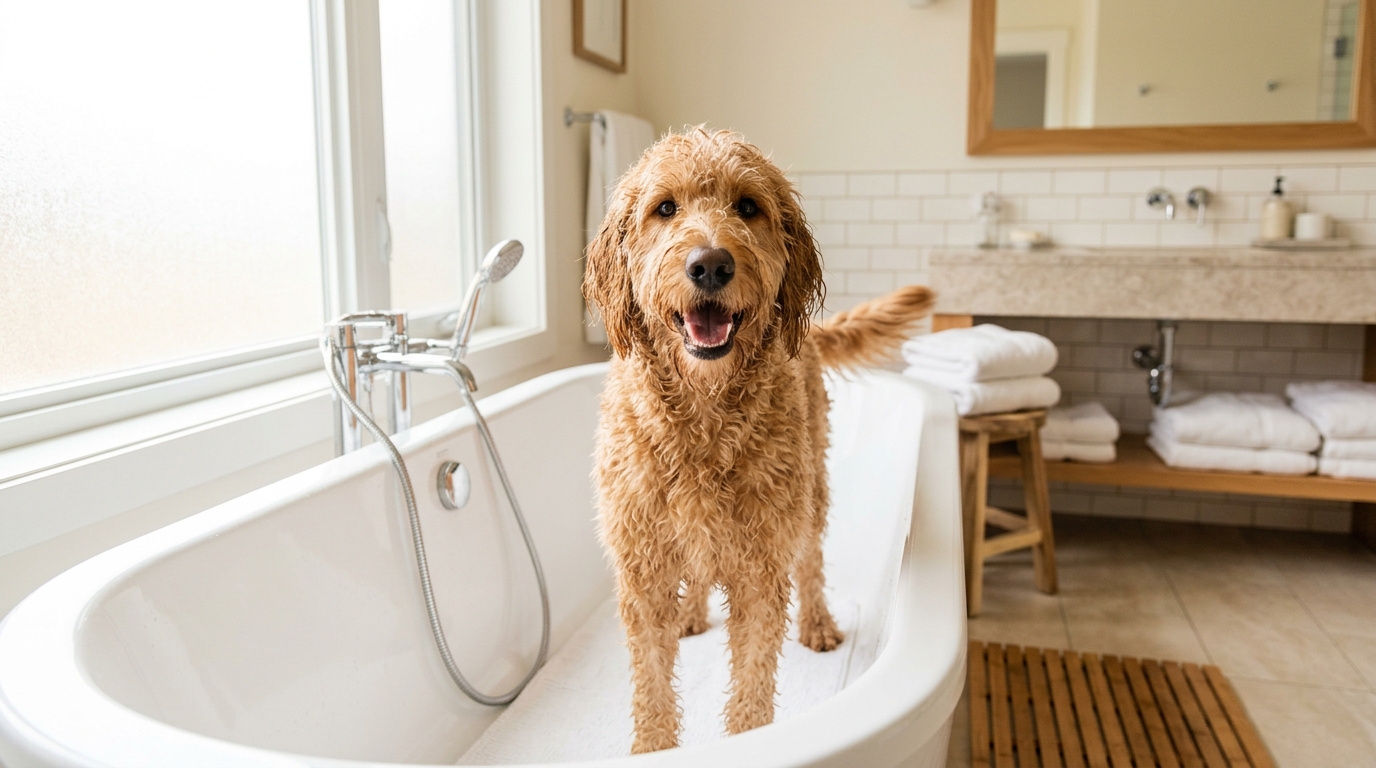
Never clip a dirty or matted coat. Dirt dulls blades fast, and clipping over a mat drags the skin painfully. Bathe your doodle with a conditioner, on our curly boys the conditioner is genuinely the thing that helps keep matting down, then dry the coat fully before a single blade touches it. A damp coat clogs the clipper and gives you a lumpy, uneven finish.
We no longer blow-dry as a routine. With an ordinary hair dryer, drying a doodle coat to the skin can take an hour unless you own a proper high-velocity grooming dryer. What we do instead is simple: we bathe the evening before and trim the next day. After the bath the dog goes into a dog drying robe, a bathrobe for dogs, for about an hour. A super-absorbent robe leaves the dog fairly dry by then, but the robe itself is soaked, so we take it off before the dog gets cold, and by morning the coat is dry right down to the skin. Gösta's fleece gets brushed once it has dried a little, while it's still slightly damp. A high-velocity dryer is a lovely option if you have the time and budget, but it's a big investment.
2. Body with a guard comb
Start on the body, where mistakes are least visible and your dog settles into the rhythm. Attach a guard comb over the #10 blade, and clip in the direction the coat grows, in long smooth passes. Keep the clipper flat against the body and let the guard do the work, don't dig in.
A longer guard comb is far more forgiving if your hand is still learning. You can always take more off; you can't put it back.
3. Legs
Legs are trickier because they're round. Clip down them with the same guard comb, following the shape of the leg, then tidy up with scissors. Comb the leg hair out, then trim to a clean cylinder, comb between scissors and skin every time.
4. Paws and pads
Trim the hair around the paw to a neat round outline with curved shears. Then deal with the part most owners miss: the hair between the paw pads. On our boys these are the hardest mats of all to prevent, and a tight mat between the pads leads straight to constant paw licking. Clip the hair between the pads flush with a small trimmer so it can't collect debris and felt up. Go slowly, paws are sensitive and most dogs fidget here.
5. Face and eyes
This is where we take our time. Comb the face hair forward, then use short blunt-tip scissors only near the eyes, cutting away from the eye, never toward it. Doodle hair grows into the eyes fast, so keeping this area clear also keeps them comfortable. Small snips, frequent combing to check your work. Sometimes we leave the face a little longer even when the body goes short. The small cordless Aesculap Exacta is handy for tidying the face when scissors feel fiddly.
6. Ears
Doodle ears are floppy and trap moisture, which sets up the ear and yeast trouble our Gunnar has always been prone to. Trim the ear feathering to a length you can keep clean with thinning or angled shears, and keep the hair around the ear opening tidy so air can circulate. Never poke scissors or a trimmer into the ear canal. If your dog is an ear-infection dog, staying on top of cleaning matters as much as the trim.
7. Sanitary area
A quick, gentle clip with a small trimmer (or careful scissors with the steel comb) around the sanitary area keeps things clean, especially on a longer-coated fleece dog. Go conservative and calm here.
How short should you cut a doodle?
There's no single "right" length, it depends on the coat and the season.
For curly wool coats like Sven's and Gunnar's, we clip short, often something in the half-inch to one-inch range (about 13-25 mm), simply because that coat mats regardless of effort and a short clip is realistic to maintain. For a wavy fleece coat like Gösta's, we keep things longer because regular brushing actually holds it mat-free, and on his coat the guard combs over a #10 give a really nice finish.
Be ready for one thing: a short clip does not look very "doodle" for the first few weeks, the fluffy teddy-bear shape is gone until it grows back. We've made our peace with that. A dog that's mat-free and comfortable matters far more to us than the look, and mats aren't cosmetic, they pull on the skin, hurt, and hide skin problems underneath.
A few honest rules of thumb:
- Newer at this? Go shorter. A longer guard comb hides unevenness and a slightly-too-short clip grows back fine.
- Summer or a swimming dog? Shorter is kinder and dries faster.
- A coat that mats fast? Short is not a failure, it's the sensible choice.
Is it cheaper to groom a doodle yourself?
Over time, usually yes, but the honest answer is "it depends," and the variables matter more than any single price.
What drives professional grooming cost:
| Factor | Why it moves the price |
|---|---|
| Dog size | A standard doodle takes more time and product than a mini |
| Coat condition | A clean, brushed coat is quick; a neglected one is slow |
| Matting | Many groomers add a matting fee for de-matting or shave-downs |
| Region | Urban and high-cost areas run higher |
| Frequency | About every 12 weeks if you keep up the basics at home; far more often if nothing is done in between |
What home grooming costs: a good clipper is a one-off purchase of around $200 that lasts many years, and the ongoing cost is mostly your time. A professional doodle groom typically runs around $100-150 per visit, call two or three local groomers and check the price for your dog's size and coat, plus matting fees. Honestly, having someone else bathe and groom your dog is a genuine luxury, and if you can do it, it's lovely. But with several doodles it gets expensive fast: for us, a clipper that lasts years pays for itself very quickly, which is exactly why we do all three ourselves.
The trade-off is time and skill. A full trim on a big, dense doodle can take a couple of hours when you're learning. If your evenings are precious and your dog is easy, a groomer may still be worth every dollar.
Tight mats at the skin: shave, don't scissor
When a mat is tight or pelted right against the skin, do not try to cut it out with scissors, scissors that close to the skin nick a dog, easily. Shave it off with clippers and a suitable blade instead. A confident owner can absolutely do this at home; it's what we do when we find one on Sven or Gunnar during a hand-check, and it's how Gunnar's very first trim ended up being a full shave-down when we discovered the mats underneath.
Consider handing it to a groomer only if you're unsure, your dog is stressed, or the matting is widespread across the coat. And if you find sores, redness or broken skin under a mat, see your vet before you clip, that's a skin issue, not just a grooming one.
When to use a groomer instead
Doing it yourself is great, and most of it is well within reach for a confident owner. But a groomer is a reasonable option in these cases:
- Widespread matting or an uncertain hand. If mats are all over the coat and you're not confident with a clipper, a pro can shave it flat and hand it back to you to maintain.
- A dog that panics. A frightened dog plus sharp tools is not worth it. Some dogs need a groomer's calm handling, or even a vet's help for a very anxious dog.
- The first full haircut. For a puppy's first proper groom, a good groomer can set a calm tone that pays off for life.
A quick pre-trim checklist
FAQ
Start with a clean, fully dried, mat-free coat, for us that means a bath with a conditioner, which is what actually helps against matting on our curly boys, then about an hour in a super-absorbent dog drying robe, which leaves the coat fairly dry, before the robe comes off, we bathe the evening before and trim the next day. Set up on a table or the floor with a lick mat to keep the dog still, clip the body with a #10 blade under a long guard comb so you cannot go too short by accident, and keep a comb between your scissors and the skin. Work in short calm sessions, save the face and paws for when you and your dog are both settled, and if your dog panics or the coat is tightly matted at the skin, stop and either shave those mats out with clippers or book a groomer.
It depends on the coat type. A curly wool coat like our Sven and Gunnar's cannot realistically be kept long, so we clip it short, often a half-inch to one inch (about 13-25 mm), because it mats no matter what. A wavy fleece coat like Gösta's can be kept longer if it is brushed thoroughly and often. Go shorter in summer or if you are new to home trimming, since a longer guard comb is far more forgiving of mistakes. A short clip looks a bit un-doodle-like for the first few weeks, but a mat-free, comfortable dog matters more than the look.
Usually yes over time, but the savings depend on your dog's size, coat condition and how often it needs doing. A professional doodle groom typically runs around $100-150 per visit (check local prices), and a doodle needs one about every three months if you keep up the basics yourself, brushing, pulling out mats, keeping the eyes clear, tidying paws and nails, or much more often if you don't, so with several dogs it adds up fast. A good clipper is a one-off cost of around $200 and lasts years, so it pays for itself, the real price is your time and the learning curve.
We do not recommend it. Human clippers overheat quickly and lack the power to cut through dense doodle coat cleanly, which leads to snagging, pulling and hot blades against the skin. A corded dog clipper with a #10 blade and detachable guard combs is designed for coat volume. We tried a cordless clipper and it only managed Gösta's fleece, Sven's and Gunnar's curly wool was too tough for it, so we use a corded two-speed Andis. Whatever you use, wrist-check the blade temperature often.
A confident owner can shave tight mats out at home with a clipper and a suitable blade, that is what we do, so a groomer is an option, not a requirement. Consider one if the mats are widespread, your dog panics or won't stand safely, or for a first full puppy haircut where a calm, experienced hand sets the tone for life. See a vet first if there are sores, redness or broken skin under a mat.
Where to go next
Home trimming gets easier every time, and the single biggest factor is coat maintenance between trims, for us that's the monthly bath with conditioner and regular hand-checks rather than brushing. Match your plan to your dog with Australian Labradoodle coat types explained, and because every good trim starts on a clean, dry coat, pick something gentle for the bath with our best shampoo for itchy doodles before you clip.