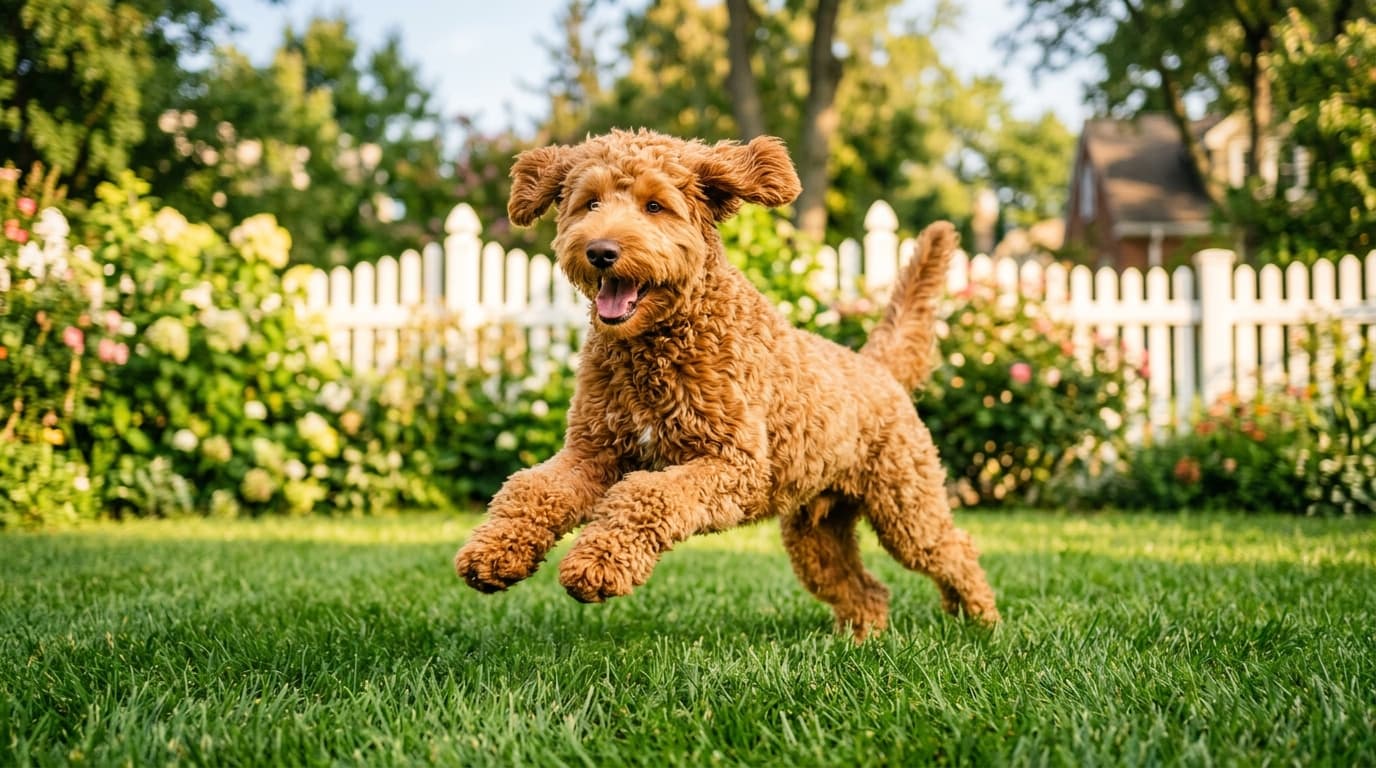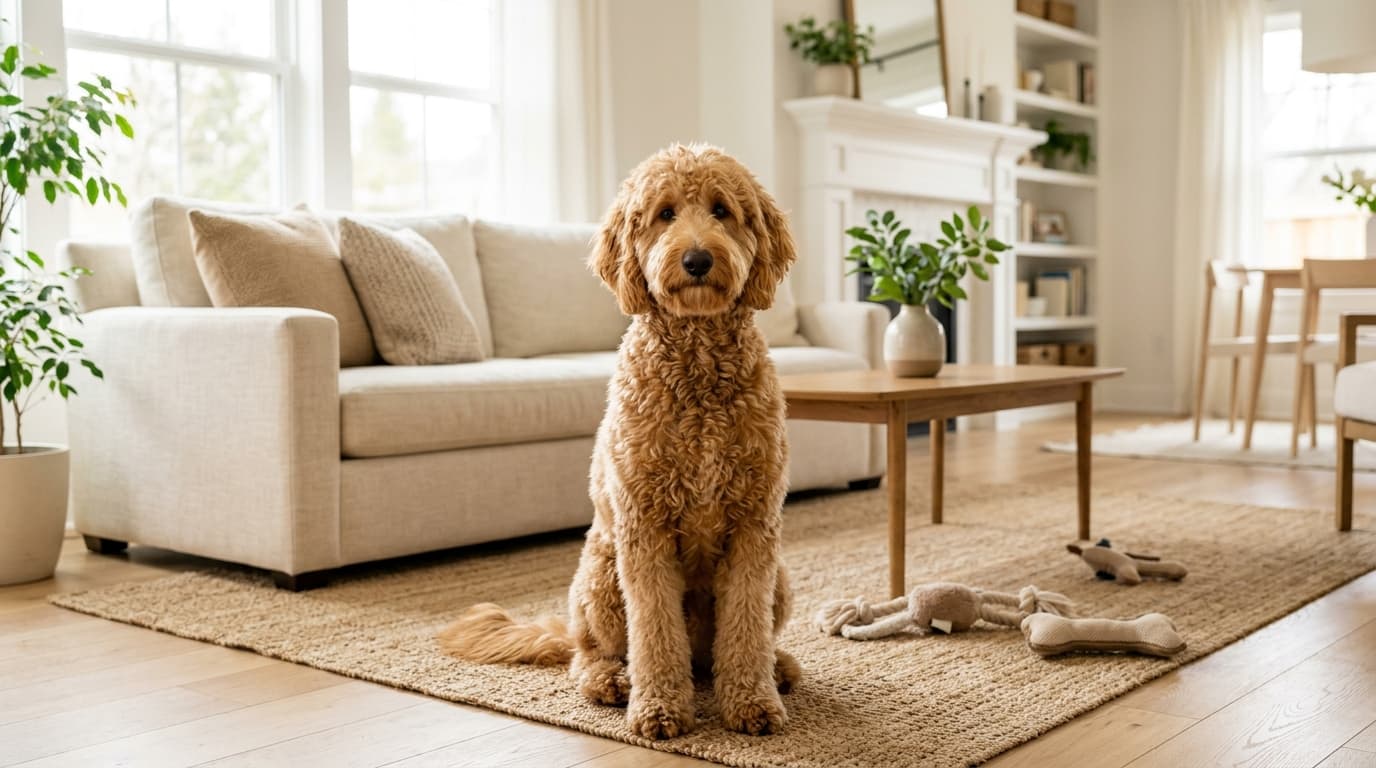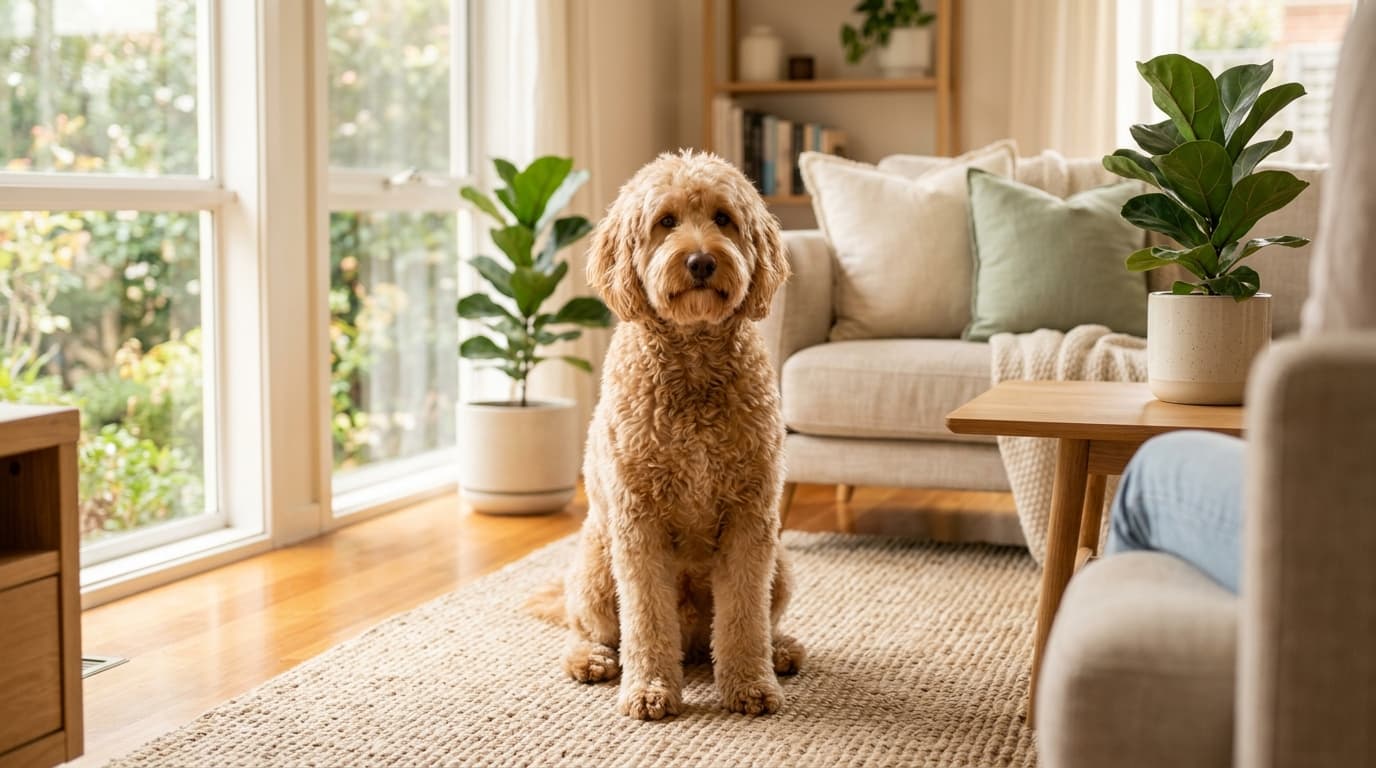
Doodle anxiety is common because Australian Labradoodles, Goldendoodles and other doodles are bright, people-oriented crosses, but the single most important thing you can train is relaxation, and it has to be actively practiced, because it does not come on its own. First rule out discomfort (pain, itching, ears, a grumbling gut can all look like anxiety), then build calm before you add mental work, protect 12-15 hours of sleep a day, and bring in a vet or behavior professional for severe anxiety or any aggression.
If that sounds like your dog, you are in the right place. This is the pillar guide for our Calm & Behavior cluster, and it covers the whole picture: how to tell real anxiety from ordinary hyper energy, the surprisingly strong gut-brain link, why calm has to come before stimulation, and the routine that helps a sensitive doodle feel safe.
If you already know mental work is your missing piece and just want the shortlist, our ranked puzzle feeder guide is the shortcut. Read the rest of this first, though, because puzzles are the second layer in our house, mental work comes after calm, never instead of it. More on that below.
We live with three doodles, Sven, Gunnar and Gösta, so we know how much of "calm" comes down to boring, repeatable structure that we actually practiced with them. Let's get into it.
Why are doodles prone to anxiety?
Doodles are deliberately bred to be smart, biddable and deeply bonded to people. The Poodle side is one of the most intelligent breeds there is, and the retriever side of an Australian Labradoodle, Labradoodle or Goldendoodle was built to work closely with a handler all day. Cross those together and you get a dog who wants to be with you, watches you constantly, and notices when things change.
That's wonderful company. It's also exactly the temperament that can tip into anxiety when life gets unpredictable, or when a dog was simply never taught to switch off.
A few things stack the deck:
- They're velcro dogs. Many Australian Labradoodles and Goldendoodles follow their people room to room, which makes being left alone genuinely hard to learn.
- They're sensitive to routine. A schedule change, a house move, a new baby or even a different walk time can unsettle a doodle who thrives on knowing what comes next.
- Hyper tips easily into stress. A bright brain with no off-switch, given more and more to do, doesn't calm down, it winds up. Restlessness that looks like anxiety is often a dog who has never practiced relaxing.
- Discomfort masquerades as anxiety. Pain, itchy skin, sore ears or a reactive gut leave a dog on edge, and that low-grade misery reads as anxiety or hyperactivity. This is why ruling out discomfort comes first, always.
- Coat hides the early tells. A curly or fleece coat can mask body-tension cues (raised hackles, tucked tail) that a smooth-coated dog would show plainly, so owners often notice the behavior before the body language.
Our own Gunnar taught us this the hard way. He is the sensitive, highly intelligent one, and the only one of our three who has had real behavior problems, separation anxiety and some reactivity, both long resolved now. His stress was tied to discomfort (his itching and his ears) and, honestly, to us not yet knowing how to communicate with him. We started doing things differently when he was about three, and it took longer with him because at first we didn't understand what he was telling us.
For vet-reviewed background on dog behavior and anxiety, the ASPCA is a reliable place to start.
What does anxiety look like in a doodle?
Anxiety shows up in the body and in behavior, and the earliest signs are quiet ones. The mildest tell is a dog who can't fully switch off, always half-watching, quick to stand up, slow to lie down and stay down.
Signs to look for, roughly from mild to more serious:
- Restlessness: pacing, circling, an inability to settle even when tired
- Panting or drooling when it isn't hot and there's been no exercise
- Whining, whimpering or repetitive barking
- Clinginess that intensifies, shadowing you, blocking doorways, pawing for contact
- Lip licking, yawning, a tucked tail, "whale eye" (whites of the eyes showing)
- Destruction focused on exits, door frames, window sills, crates, especially when alone
- House-training slips in a previously reliable dog
- Loss of appetite, or gut upset that flares with stress (more on that below)
Context is everything. A single yawn means nothing. The same dog yawning, lip-licking and pacing every time you pick up your keys is telling you something.
Is my doodle anxious or just a hyper adolescent?
This is the question we get most, and it's a fair one, because in an eight-month-old Goldendoodle the two look almost identical from across the room.
The key difference: hyper energy is need-driven and anxiety is emotion-driven. A hyper adolescent doodle is bursting with fuel and has never practiced settling; anxiety stays wound up even after a good day, because the discomfort isn't about spare energy, it's about feeling unsafe, or unwell.
But here's the honest catch we've learned living with three: for both, the answer starts the same way, teach relaxation. A doodle who was never shown how to switch off will look hyper or anxious no matter how far you walk them.
| Cue | Hyper energy | Anxiety |
|---|---|---|
| Timing | Bursts, "zoomies," then settles | Persistent, or tied to triggers (you leaving, storms) |
| After a full day + settling practice | Sleeps it off | Still restless, can't settle |
| Trigger | Boredom, no off-switch trained | Being alone, change, noise, crowds, discomfort |
| Body language | Loose, bouncy, playful | Tense, panting, lip licking, tucked tail |
| Appetite | Normal | Often reduced when stressed |
| Recovery | Quick once tired and settled | Slow or absent until the trigger ends |
Of our three, Gösta is the only hyper one. He wants to be first in everything, even if there's a queue, he somehow squeezes to the front, and he's a funny, very social, slightly me-me character who loves everybody. Gunnar and Sven are clearly the calmer two: Gunnar has never been hyper (his issues were stress and anxiety, not energy), and Sven is laid back and happy-go-lucky.
The most important thing to train: relaxation
If you take one idea from this whole guide, make it this: relaxation is the single most important thing you can train, and it must be practiced. Settling down and sleeping do not come by themselves for a bright doodle. When you skip that work, hyper tips into stress, and stress makes a dog even more hyper and restless, the exact opposite of what you wanted.
Here's the part that runs against the usual advice, and it's honestly our view from years of doing this: more stimulation does not calm a hyper doodle. If you only pile on puzzle games, or walk the dog for hours a day, you often make things worse, you build a fitter, more wound-up dog who has learned that life is a constant stream of excitement. Calm comes first. Mental stimulation comes second, once the dog can actually switch off.
How we practice settling
The concrete tool we use is simple. Indoors, we use a slip lead when we need it. We hold the lead while we work, and the dogs learn that in that moment they stay close to us and settle in place. It's practice, not punishment, short, low-key, repeated until settling becomes the default.
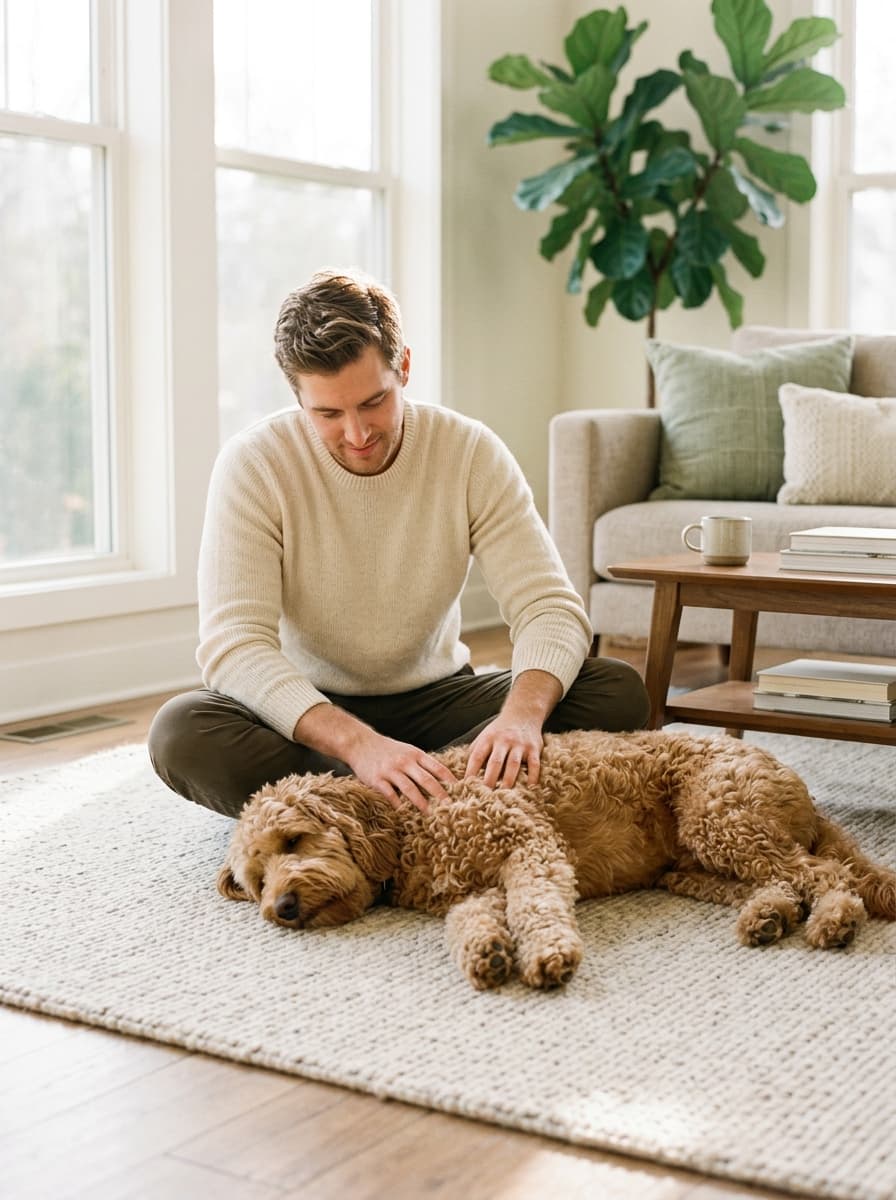
We've put a lot of work into this over the years, and the payoff is real: now when one of us works at home, the dogs lie down next to us, and when we move around they come along because they want to follow what we do. That connection is the whole point.
Our approach: communication, not obedience drilling
The way we work with our dogs isn't about drilling commands. It's about gentle communication and a genuine connection, figuring out how to talk to the dog in a way the dog actually understands. The behavior problems we've had came from failing to communicate, not from a "bad" dog. When we finally learned to read Gunnar and respond to him, the anxiety that had been there for years faded.
That means short, rewarded sessions, patience, and reading your dog rather than overpowering them. Tolerance for handling and settling can both be trained this way, a little at a time.
How are a doodle's gut and mood connected?
Here's the part owners often miss. Stress and digestion run on the same wiring. The gut-brain axis is a two-way street: an anxious dog can develop a nervous stomach, and a dog with ongoing gut discomfort can become anxious and irritable because they simply don't feel well. This is exactly the "rule out discomfort first" point wearing a different hat.
We see this pattern all the time in the doodle world. A dog gets loose stool before a car trip. A boarding stay ends in a bout of stress colitis. A sensitive dog who's out of sorts becomes clingy and won't settle, and it turns out the mood and the belly were the same problem.
In our own house, Sven is our most sensitive stomach of the three, and his digestion is a genuine barometer: when his routine gets choppy, his gut is the first thing to grumble. We keep his feeding rhythm as boring and predictable as we can precisely because a calm gut and a calm dog go together.
If your anxious doodle also has a reactive belly, don't treat them as separate projects. Our guide to stress and digestive problems in doodles covers the connection, and if soft stool is a recurring theme, the gut health routine for sensitive doodles is the place to start.
Does exercise fix an anxious doodle? (Calm first, stimulation second)
Not on its own, and reaching for more exercise is the most common well-meaning mistake. Owners of a wound-up Goldendoodle or Labradoodle run the dog hard twice a day and end up with a fitter dog who is still restless and now has the stamina to be restless longer. Hours of walking doesn't teach a dog to be calm; it teaches endurance.
That said, exercise is absolutely real, and calm-first does not mean a couch-bound dog. Here's what a genuinely active day looks like for our three:
- Free running: we have a big yard and they run free in it several times a day (they usually follow us outside anyway)
- Walks: 1-2 a day, usually a 30-60 minute walk (we need the exercise too), plus a short 5-15 minute walk before bed so everyone pees, poops and sleeps peacefully
- Settling practice: the daily habit that ties it all together, see the section above
- Mental work, second: only once a dog can switch off do we add puzzles and games
Mental work comes after calm
Doodles are very intelligent, so puzzle games work beautifully, as the second layer, not the first. We've tried all the Nina Ottosson puzzles, and our three are honest proof that dogs differ:
- Gunnar is really clever and truly loves them, he can do the level 4 puzzles and lights up the moment we bring one out.
- Sven does a little and then asks to be excused; the treats are rarely good enough to keep our laid-back boy going.
- Gösta is in between, he loves treats so much that he'll do them purely for the food.
If you want to build this layer, our ranked puzzle feeder guide sorts options by difficulty so you can match the challenge to your dog, start easy, and only after your doodle can already settle on cue.
Why does routine matter so much for a sensitive doodle?
Because predictability is safety for a dog who reads the world closely. When your doodle knows roughly when they'll eat, walk, get attention and rest, there's far less to worry about, the day stops being a series of surprises.
You don't need a military schedule. You need reliable anchors:
- Meals at consistent times (this helps the gut too)
- A predictable morning and evening rhythm
- Calm, boring arrivals and departures, no big emotional hellos and goodbyes
- Consistent house rules everyone follows
Running three doodles taught us that structure scales beautifully. We keep a simple, repeatable daily flow, the same feeding order, the same rest windows, the same wind-down at night, and the boring sameness of it is exactly what keeps the household relaxed. Sven, Gunnar and Gösta all do better when the day is predictable, and honestly, so do we.
Keep departures unremarkable
For everyday alone-time, the trick is to make coming and going a non-event. Skip the drawn-out goodbye. Come home, ignore the party for a minute, then greet calmly once the dog has four feet on the floor. You're teaching your doodle that your leaving and returning are ordinary, not dramatic.
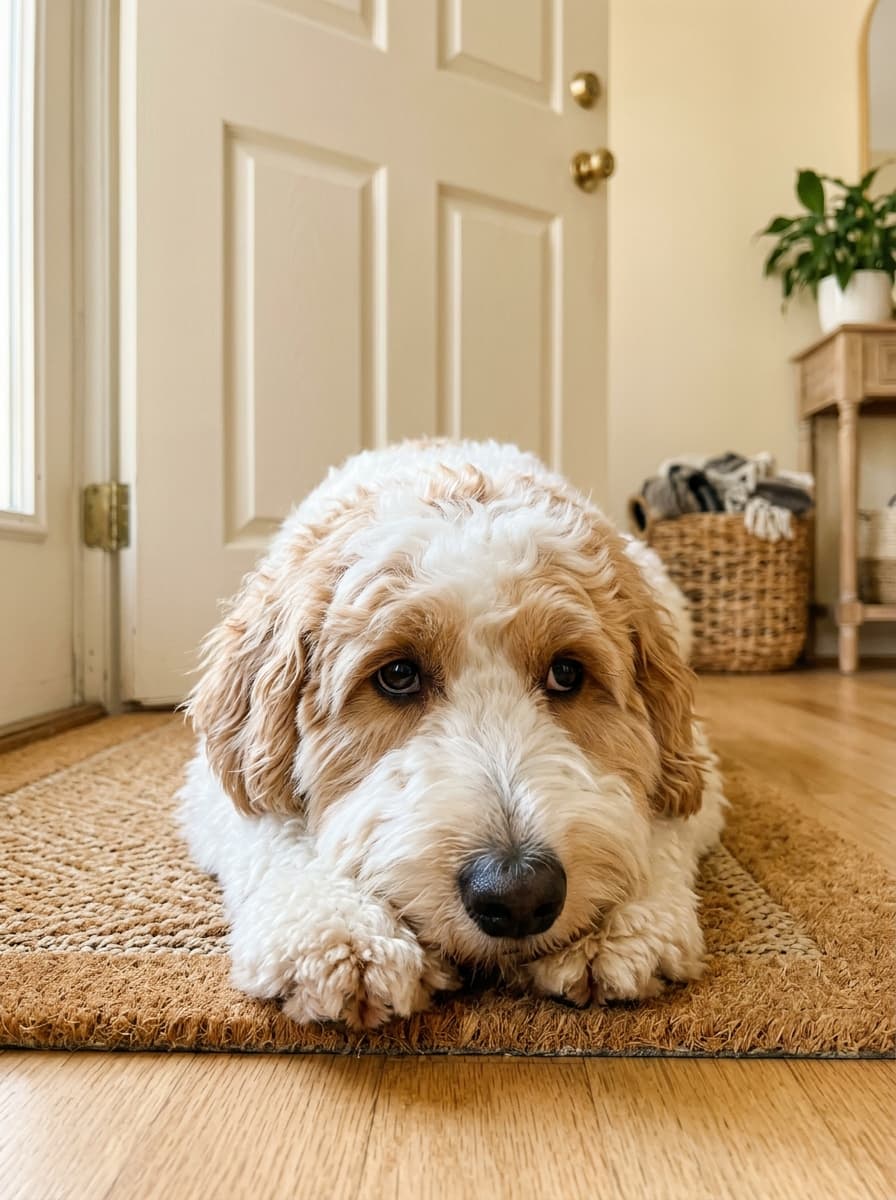
True separation anxiety is a different, bigger project, a genuine panic response to being alone, not just boredom or protest. Gunnar had it, and it resolved, but it took a structured, patient approach and a lot of communication work, not a quick fix.
How much sleep does a doodle actually need?
More than you think. Adult doodles need roughly 12 to 15 hours of sleep a day, often more, and puppies need even more. An overtired doodle is not a calm doodle, sleep-deprived dogs are famously more reactive, more hyper and less able to cope, exactly like an overtired toddler.
A lot of "anxiety" is really an exhausted brain that never gets to power down. Ours sleep through the night, and whenever we sit still working, they sleep right alongside us, because they've practiced it.
To protect rest:
- Give a quiet, den-like spot away from foot traffic, a covered crate or a bed in a low-key corner
- Build in enforced naps, especially for puppies and adolescents who won't stop on their own
- Keep the last hour before bed calm, no roughhousing, no adrenaline games
- Watch for the "tired but wired" dog who gets more frantic as the day goes on; that's usually a signal to slow down, not speed up
A simple wind-down routine
A short evening ritual tells your doodle the day is closing: our short 5-15 minute walk before bed, a lick mat or stuffed toy in the rest spot, lights down, and quiet. Do it the same way each night and it becomes a cue all on its own.
What are the everyday tools that actually help?
There's no single fix for doodle anxiety, it's the stack of small, consistent things that works. Here's the practical checklist we'd hand a friend with an anxious Australian Labradoodle or Goldendoodle:
What about calming chews and supplements?
Calming chews, usually built around L-theanine, tryptophan, chamomile or milk-derived proteins, can take the edge off mild, situational stress for some dogs. They tend to help most with predictable events: fireworks, storms, a car trip. What they don't do is replace routine, settling practice or veterinary care, and results vary a lot dog to dog.
Think of them as one tool on the shelf, not the answer. For daily or severe anxiety, talk to your vet before leaning on any supplement, some interact with medications, and persistent anxiety deserves a real plan. A lick mat or stuffed toy is often the more useful everyday tool for self-soothing, and it doubles as the mental-work layer once your doodle can settle.
When should you bring in a vet or behaviorist?
Home management is enough for a great many mildly anxious or over-energetic doodles. But some situations are genuinely beyond DIY, and recognizing that early is a kindness to your dog.
Loop in your vet when:
- Anxiety is worsening despite a good routine and settling practice
- Your doodle can't be left alone at all, or panics when alone
- There's self-injury or destructive escape behavior
- Anxiety comes packaged with appetite loss, vomiting or diarrhea
- You suspect pain, itching or discomfort (this always comes first, discomfort masquerades as anxiety)
Ask for a behavior professional (a veterinary behaviorist or a credentialed, force-free trainer) when:
- There's any aggression, this is not a wait-and-see situation
- Fear is intense enough to disrupt normal daily life
- You're dealing with true separation anxiety and need a structured, patient plan
None of this is a failure on your part. Anxiety has a genetic component, it has an early-experience component, and sometimes a dog needs a professional plan the same way a person might. Our own biggest breakthrough with Gunnar came when we stopped guessing and learned to communicate with him, the families whose doodles come out the other side are the ones who asked for help sooner rather than later.
FAQ
Doodles are bright, social crosses of the Poodle and breeds like the Labrador Retriever or Golden Retriever, and that sensitivity means many struggle with being alone, sudden routine changes and overstimulation. The first thing to rule out is discomfort: pain, itching, ears or a grumbling gut can leave a dog on edge and looking anxious. Common triggers also include never being taught to settle, poor sleep and an unpredictable schedule. Genetics and early socialization matter too, so two doodles from the same litter can differ.
Hyper energy comes in bursts and settles once your doodle has run, walked and eaten; anxiety persists even when needs are met and often shows up when you leave or when the environment changes. Watch for pacing, panting, drooling, whining, an inability to lie down and stay down, or destruction focused on exits and windows. But remember the most important thing works for both: relaxation has to be actively practiced, because a doodle who was never taught to switch off will look hyper or anxious no matter how much you exercise them.
Teach relaxation first, before you add any mental work: practice settling in place, indoors we hold a slip lead while we work so the dog learns to stay close and switch off. Protect 12 to 15 hours of sleep a day for adults and more for puppies, give a quiet den-like rest spot, and keep arrivals and departures low-key. Only once a dog can settle do we add mental work such as puzzle feeders. Rule out pain and gut discomfort first, since a dog who feels off cannot relax.
In our experience, no, and this runs against the usual advice. More stimulation or hours of walking does not calm a hyper doodle; it can feed a stress cycle where hyper tips into stress, stress makes them more restless, and behavior problems follow. Exercise is still real and important, but calm comes first and mental stimulation second. We give a big yard for free running plus 1 to 2 walks a day, then actively practice settling and protect sleep.
See your vet if anxiety is worsening, if your doodle can't be left alone at all, if there is self-injury, or if anxiety comes with appetite loss, vomiting or diarrhea. Always rule out pain, itching or discomfort first, because these drive restless and anxious behavior. Any aggression, or fear intense enough to disrupt daily life, is a reason to involve your vet and a behavior professional rather than managing it alone. Severe separation anxiety in particular responds best to a structured plan.
Your next step
If you take one thing from this guide, make it this: calm is built and practiced, not bought. Ruling out discomfort, actively training relaxation, protecting 12-15 hours of sleep and keeping a predictable routine will do more for an anxious doodle than any single product, and they cost nothing but consistency and connection.
From here, pick the path that fits your dog. If you're ready to add the second layer once your doodle can settle, our ranked puzzle feeder guide is where we'd start. And if stress keeps landing in the belly, begin the gut health routine for sensitive doodles. You've got this, one boring, predictable day at a time.