
Goldendoodle hip dysplasia is a real inherited risk that comes from both parent lines, Golden Retrievers and Labrador Retrievers appear on breed lists for hip dysplasia, and the Standard Poodle is a large, deep-chested dog that can pass it on too. Being a mixed breed does not reliably breed the problem out. You cannot change your dog's genes, but the single biggest thing within your control is keeping your doodle lean for life, backed by choosing a breeder who health-tests both parents' hips and by managing puppy growth gently.
That is the honest headline, and it applies just as much to Labradoodles, Bernedoodles and Sheepadoodles as it does to Goldendoodles. The good news is that "risk" is not "destiny." Plenty of doodles from tested parents live long, active lives with sound hips.
If you already want to look at products, our guide to the best omega-3 supplements for doodles is the shortcut; the rest of this article explains the why first.
This is the pillar guide for our Joints, Weight & Senior cluster. Below we walk through what hip and elbow dysplasia actually are, what parent health testing means in plain English, how growth and calcium matter in puppyhood, why weight is the factor that matters most, how to exercise a doodle by age, and the specific signs that mean it is time to call your vet. If you already know your dog is stiff or sore and just want the shortlist of what we use, skip ahead to our guide to the best joint supplements for doodles, then come back for the how and why.
What is hip dysplasia in doodles?
Hip dysplasia is a developmental malformation of the hip joint. The hip is a ball-and-socket joint; in a dysplastic hip the ball and socket do not fit together snugly, so the joint is loose. That looseness lets the surfaces grind and rub over time, which drives inflammation, cartilage damage and, eventually, osteoarthritis. The Merck Veterinary Manual describes it as an inherited developmental condition where joint laxity leads to degenerative joint disease, and both genetics and growth-period factors play a part.
Elbow dysplasia is the front-leg equivalent: a group of developmental problems in the elbow joint that also lead to pain and arthritis. Both are relevant to doodles, and both come partly from genetics and partly from how a puppy grows.
A few things make hip dysplasia in doodles easy to miss:
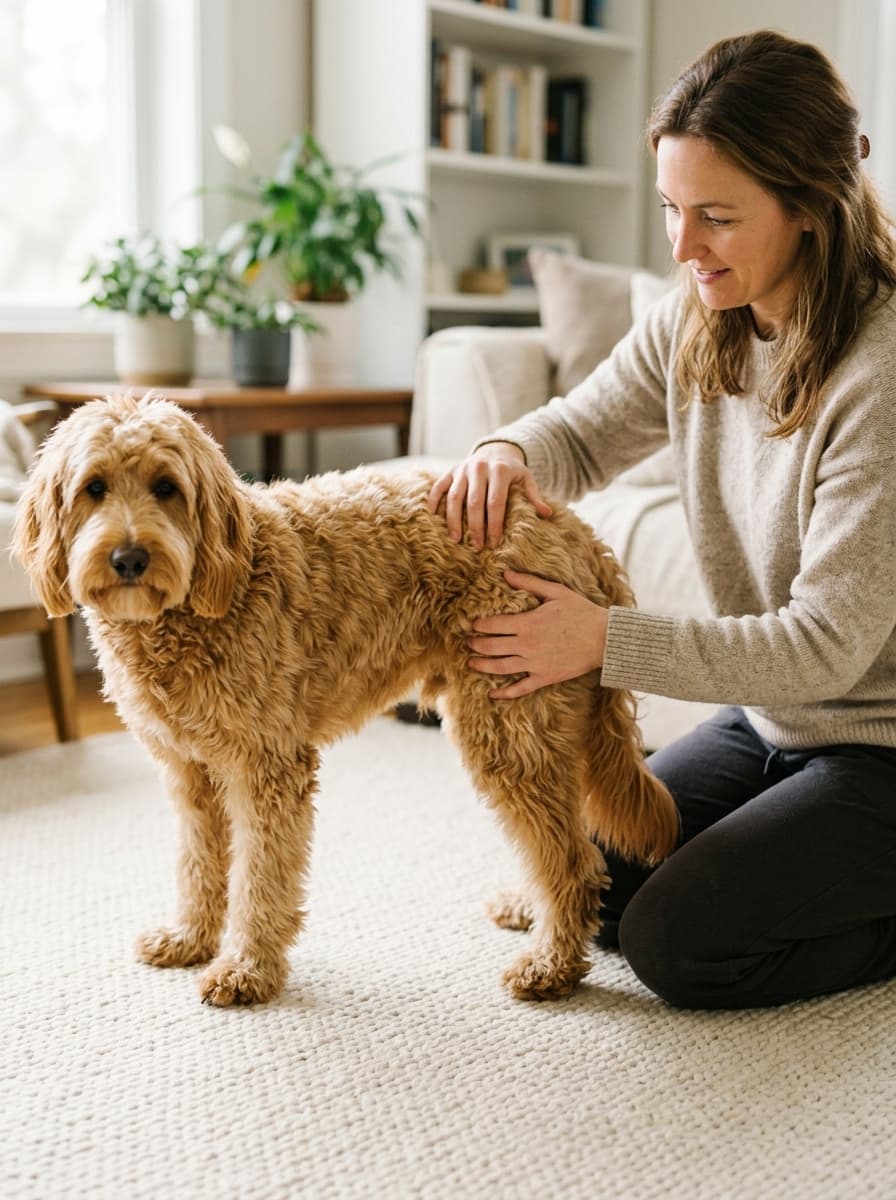
- The coat hides everything. A curly or fleece coat covers the topline and hindquarters, so you may not see muscle wasting over the hips until it is advanced. Run your hands over your dog regularly, not just your eyes.
- Doodles are stoic and bouncy. A young, happy doodle will keep playing through mild discomfort. The absence of yelping does not mean the joints are fine.
- Signs come and go. Early joint pain often looks like "a bit stiff first thing, fine after a walk," which is easy to dismiss.
Are Goldendoodles and Labradoodles prone to hip dysplasia?
Yes, and it is worth understanding why rather than just accepting it. Hip dysplasia is not a doodle invention; it is inherited from the founding breeds.

- Golden Retrievers and Labrador Retrievers both appear on veterinary and breed-association lists for hip and elbow dysplasia.
- Standard Poodles are a tall, large-framed, deep-chested breed, and large breeds carry more joint-loading risk in general.
When you cross two lines that both carry a predisposition, the cross does not cancel it out. This is the key limit of "hybrid vigor": crossing helps most when the two breeds carry different problems. With hip dysplasia, they overlap, so a Goldendoodle or Labradoodle can absolutely inherit it. The same logic applies to the Bernedoodle (Bernese Mountain Dog and Standard Poodle are both large, deep-chested breeds with genuine joint and bloat/GDV considerations) and the Sheepadoodle.
So the honest answer to "are doodles prone to joint problems?" is: the risk exists in the line, it is not guaranteed in the individual, and your breeder's testing plus your dog's lifetime weight decide far more than the word "doodle" on the papers. If you already know your doodle is stiff or slowing down and just want the vetted shortlist, our guide to the best joint supplements for doodles is the fastest route, though as you will see below, nothing beats a lean body weight.
What does parent health testing mean (OFA and PennHIP)?
This is the part that matters most before you ever bring a puppy home, because it is the only genetic safeguard you get. A responsible breeder screens the hips (and ideally elbows) of both the sire and the dam. Two main systems exist in the US:
- OFA (Orthopedic Foundation for Animals) grades hip X-rays taken in a standard position. Hips are graded from Excellent down through Fair and into the dysplastic categories. OFA also certifies elbows.
- PennHIP measures joint laxity (literally how loose the hip is) and compares it to a breed database. It can be done on younger dogs and focuses on the looseness that predicts future arthritis.
You do not need to become an expert in the scoring. What you need is simpler:
Ask the breeder to show you the hip results for both parents, by name, from OFA or PennHIP. "The parents are healthy" is not testing. Registration papers are not health testing. A vet check is not a hip X-ray. If a breeder cannot produce documented hip results on both parents, that is a meaningful red flag for a large-breed doodle. The American Animal Hospital Association is a good general reference on why pre-breeding health screening and lifelong preventive care matter for orthopedic conditions.
Generation and size both interact with this. If you're still deciding on the type of doodle, our guides to doodle generations (F1, F1b, F2 and multigen) and mini vs medium vs standard doodle explain how the cross and the adult size affect what to look for.
Does size change the risk?
Size matters because bigger, heavier dogs load their joints harder, and large-breed puppies grow fast enough that growth itself becomes a factor. A Standard Goldendoodle or a Bernedoodle carries more frame and weight than a Mini, so their hips and elbows do more work for a lifetime.
That does not mean Minis are immune (small doodles get luxating patellas and their own joint issues) but the classic large-breed hip and elbow picture is most relevant to Standard and larger Medium doodles. If you want a realistic sense of adult size before you commit, see how big do doodles get.
How do growth and calcium affect a doodle puppy's joints?
Here is something many owners don't realize: you can influence joint outcomes during puppyhood through how fast the puppy grows and what it's fed.
Large-breed puppies that grow too fast (pushed by overfeeding or by a diet with the wrong calcium and mineral balance) are at higher risk for developmental joint problems (how growth shows up in the gut, too, is covered in our doodle puppy growth guide). The goal for a large-breed doodle puppy is steady, moderate growth, not the biggest, fastest-growing puppy in the litter.
Two practical rules:
- Feed a diet formulated for the right growth stage and size. For a doodle that will be large as an adult, a large-breed puppy formula (or an all-life-stages food with appropriate calcium levels) is designed to control the growth rate and calcium intake. Do not over-supplement calcium: more is not better and can actively harm developing joints.
- Keep the puppy lean, not chubby. A roly-poly puppy is not "healthy" for a large breed; that extra weight is loading joints that are still forming.
We cover food choices in detail in best puppy food for Goldendoodles and, for the sensitive crowd, best puppy food for sensitive Labradoodles. When it's time to move off puppy food, when to switch a doodle puppy to adult food by size explains the timing: larger doodles stay on puppy formula longer.
Why is healthy weight the biggest factor you control?
If you take one thing from this whole guide, take this: keeping your doodle lean is the single most powerful thing you can do for its joints, at every age.
You can't rewrite genes and you can't undo a loose hip. But you can decide how much weight those hips carry every day. Excess body weight loads vulnerable joints harder, accelerates cartilage wear, and speeds the arthritis that turns "has dysplasia on an X-ray" into "is painful and slowing down." Lean dogs stay comfortable and mobile longer, full stop.
The tricky part with doodles is that the coat hides body condition (our healthy weight for a doodle guide shows how to check it by hand). A fluffy dog can carry real extra weight under all that fleece and still look "just fluffy." So don't judge by eye alone:
- You should be able to feel the ribs with light pressure, like the back of your hand.
- Looking down from above, there should be a visible waist behind the ribs.
- From the side, the belly should tuck up, not hang level.
If you can't feel ribs, your doodle is likely carrying weight its joints would rather not. This is genuinely where most joint outcomes are won or lost. Our free portion calculator and other tools help you size meals for the weight you're aiming for, not the weight your dog is now.
In our own house, mealtime uses slow feeders and measured portions for all three dogs, partly because Sven is our most sensitive stomach and eats better slowly, but also because it keeps everyone's intake honest. Gösta, our easy eater who would happily inhale anything put in front of him, would absolutely be a chunky dog if we free-fed him; measured meals keep his frame lean and his hips loaded lightly. If your doodle wolfs food, slow feeder bowls and portion tools do double duty for pace and portion control.
How should I exercise a doodle by age?
Exercise builds the muscle that supports and stabilizes joints, so the goal is the right exercise for the life stage, not zero exercise.
| Life stage | Age (approx.) | Joint-smart exercise approach |
|---|---|---|
| Puppy | Under ~12-18 months (larger doodles longer) | Frequent short sessions of free play and gentle leashed walks. Avoid forced repetitive impact (long jogs, jumping off couches, repeated ball-chuck sessions) while growth plates are open. |
| Young adult | ~1.5-5 years | Build stamina gradually. Mix walks, swimming and play. Warm up before hard runs; avoid the "weekend warrior" pattern of nothing all week then a marathon hike. |
| Mature adult | ~5-8 years | Keep consistent daily activity to hold muscle. Watch for the first stiffness after rest. |
| Senior | ~8+ years (large doodles sooner) | Shorter, more frequent, low-impact walks; swimming is excellent. Keep moving to preserve muscle, but let comfort set the pace. |
A useful rule for puppies of larger doodles: self-directed play on soft ground is safer than owner-driven repetitive impact. Let a puppy trot, stop, sniff and rest at its own pace rather than making it run beside a bike or leap for a frisbee. Swimming is one of the best joint-friendly activities at any age because it builds muscle without loading the joints.
For older dogs, the whole picture (mobility, comfort, diet and vet monitoring) is covered in senior doodle care.
What are the signs of hip dysplasia, and when should I see a vet?
Because doodles are stoic and their coats hide muscle changes, learn the signs and act on the persistent ones. Watch for:
When to call the vet: any limp, stiffness or reluctance to move that lasts more than a couple of days, or that keeps coming back, deserves a veterinary exam. Don't wait and hope. Early diagnosis widens your options: weight management, physical therapy, medication, supplements, and in some cases surgical procedures that work best when done early.
Do joint supplements help doodles?
For a young, healthy doodle from tested parents, supplements are optional: they are not a substitute for a lean body weight, and no chew undoes an extra five pounds (see best natural chews for doodles for chews that don't add empty calories). For a dog with diagnosed dysplasia, early arthritis, or a large senior frame, many owners (us included) use omega-3 fish oil and a joint supplement as part of a broader plan set with the vet.
We favor fish-based omegas anyway: salmon and other fish oils are what we reach for, and they double as skin-and-coat support. Gunnar, our ears-and-yeast dog, was already on a fish-oil routine for his skin long before joints were on our radar, so it slots in naturally. For the skin angle, see best omega-3 fish oil for dogs with itchy skin; for the joint-specific picks, best joint supplements for doodles is the shortlist. Talk to your vet about what fits your individual dog rather than starting things blindly.
FAQ
Goldendoodles can inherit hip dysplasia because both parent lines carry a predisposition, Golden Retrievers and Labrador Retrievers appear on breed lists for hip dysplasia, and Standard Poodles are a large, deep-chested breed that can pass it on too. A mixed-breed cross does not erase the risk. It is a real possibility rather than a certainty, and the best protection is choosing a breeder who health-tests both parents' hips and keeping your dog lean throughout life.
Not on its own. Hybrid vigor can help when the two parent breeds carry different genetic problems, but hip dysplasia is common to both retrievers and Poodles, so the cross does not reliably breed it out. The only genetic safeguard is parents with documented good hip scores, which is why OFA or PennHIP results on both the sire and dam matter far more than the fact that the puppy is a doodle.
It varies widely. Some doodles show signs as puppies between 4 and 12 months, with a bunny-hop gait or trouble rising, while others have no obvious symptoms until arthritis develops in middle age or their senior years. Because early signs are subtle and a fluffy coat hides muscle loss, any persistent limp, stiffness after rest, or reluctance to jump deserves a vet visit rather than a wait-and-see approach.
Keep your doodle lean. Excess weight is the single biggest controllable factor in joint disease, every extra pound loads already-vulnerable hips and elbows and speeds up arthritis. Beyond weight, feed a growth-appropriate puppy diet with correct calcium levels, avoid forced high-impact exercise while a large-breed doodle is still growing, and keep muscle strong with regular, moderate activity for life.
For a young, healthy doodle with health-tested parents, a supplement is optional and not a substitute for lean body weight. For a dog with diagnosed dysplasia, early arthritis, or a large senior doodle, many owners and vets use omega-3 fish oil and joint supplements as part of a plan. Talk to your vet about what fits your individual dog rather than starting one blindly.
Where to go next
Hip and elbow dysplasia can feel scary, but the levers you actually control are calm, everyday ones: buy from a breeder who tests both parents, grow a large-breed puppy slowly, and keep your doodle lean for life. Do those three things and you've handled the biggest part of doodle joint health.
The two most useful next reads in this cluster are senior doodle care for keeping an older dog comfortable and mobile, and the best joint supplements for doodles if your dog already needs extra support. If you're still choosing a puppy, start with best puppy food for Goldendoodles to get growth and calcium right from day one.