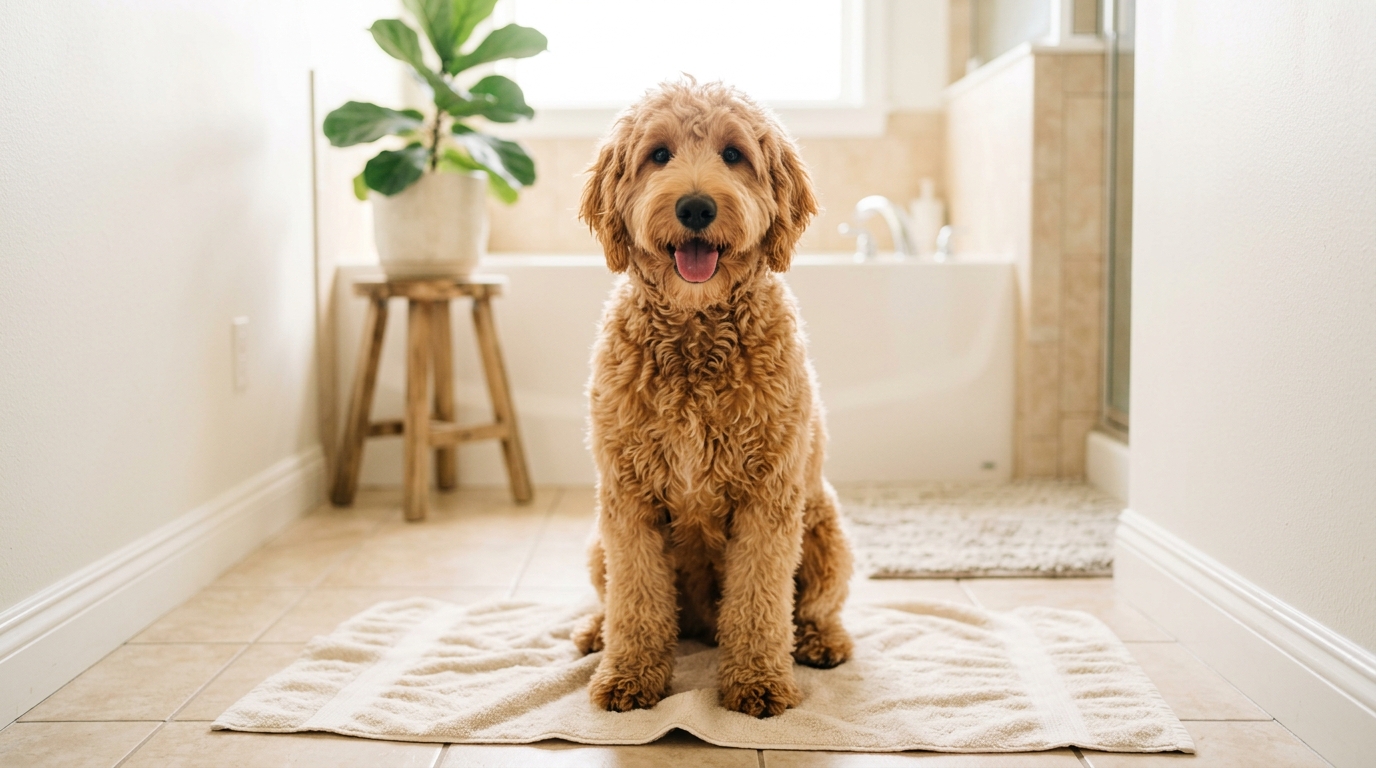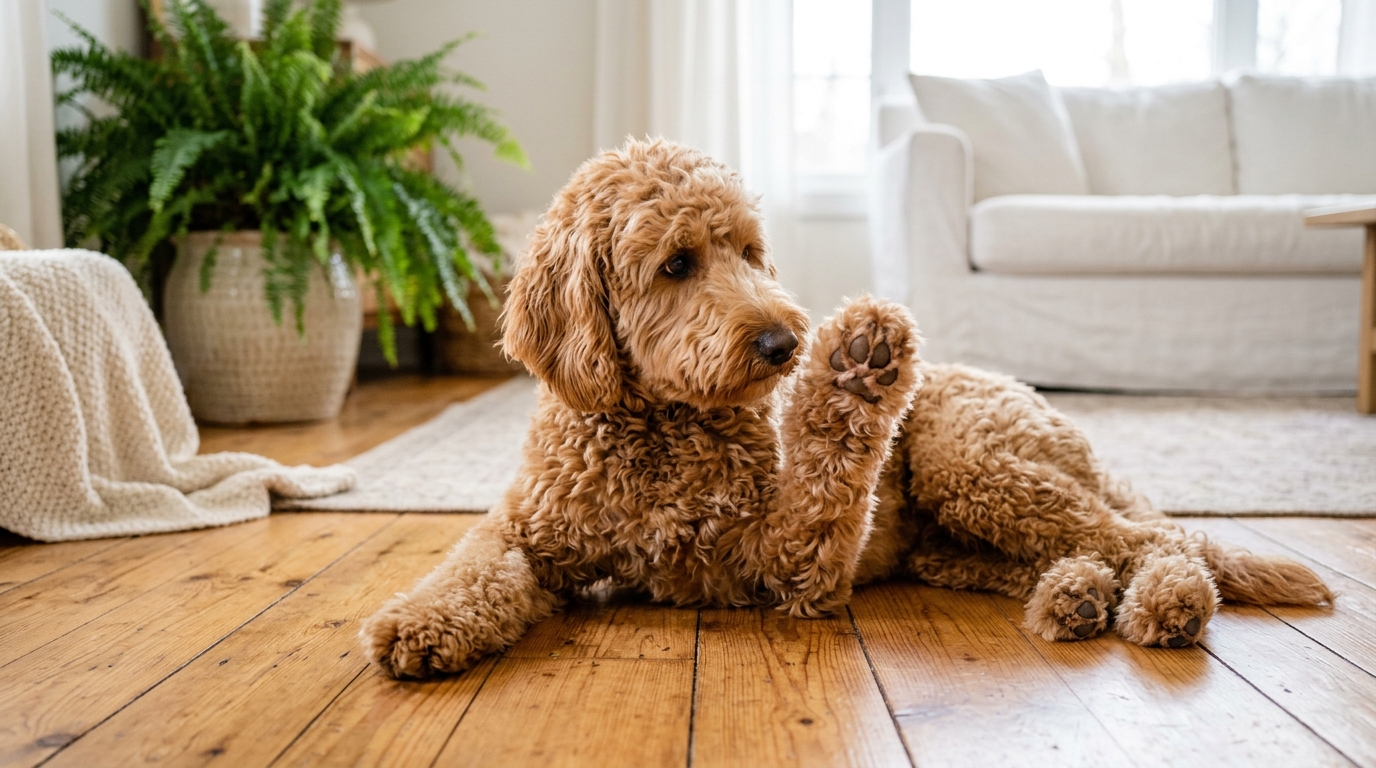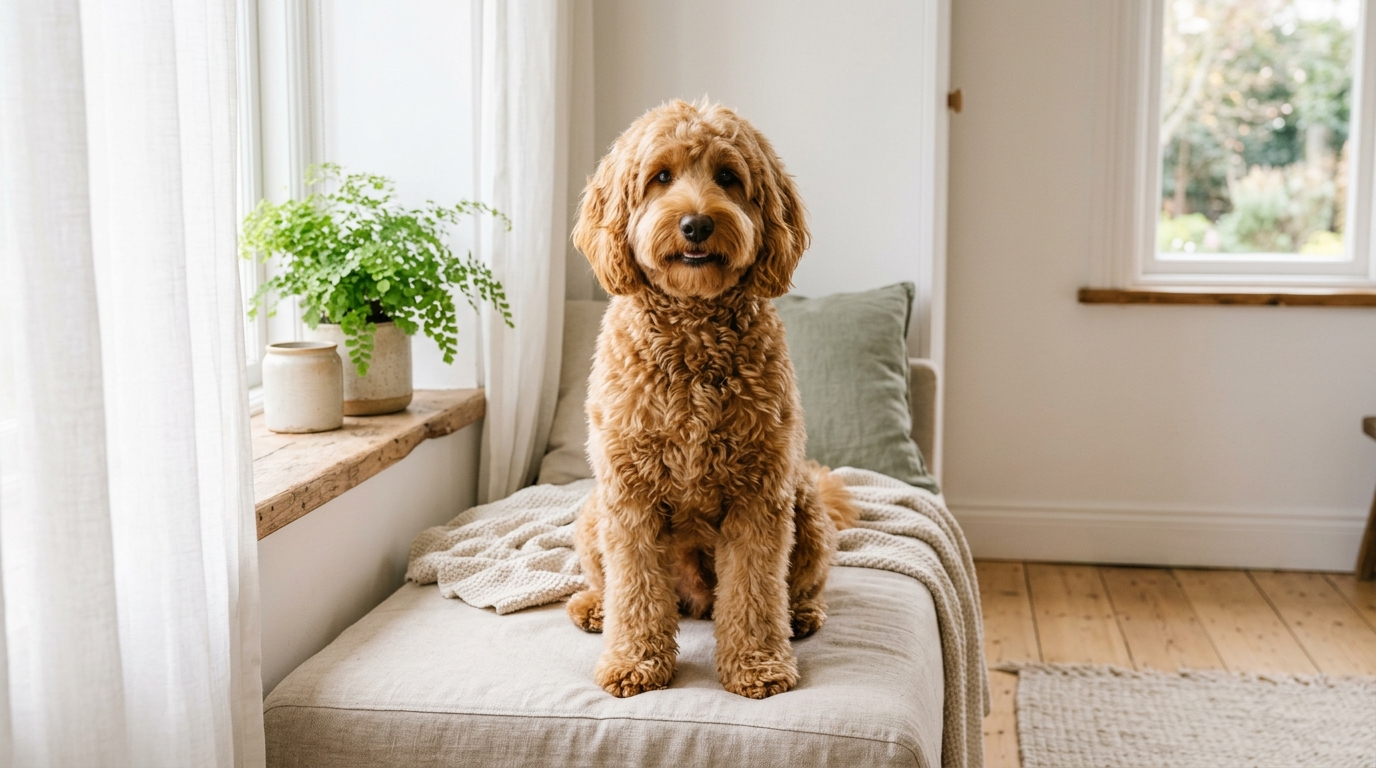
Australian Labradoodles come in three coat types: fleece (which shows up as wavy fleece or curly fleece), wool (a tighter curly or spiral coat), and the less common straight hair coat. Fleece and wool are both low-shedding and low-dander; wool mats the fastest and is the hardest to keep long. The single most useful thing to know is this: the coat type, not the breed name, decides your grooming routine.
We live with three Australian Labradoodles and they look almost identical from across the room. Up close, they are two completely different grooming jobs. Sven and Gunnar have curly wool coats. Gösta has a wavy fleece coat. What keeps one mat-free would leave the others matted, and vice versa.
If you're trying to figure out which coat your dog has and what to actually do with it, this guide walks through how to tell them apart by feel and look, how each one sheds and mats, how the coat develops through the puppy coat change, and the routine each type needs. And if you already know your dog's coat and just want the at-home clipping method, skip ahead to how to trim a doodle at home.
What coat types do Australian Labradoodles have?
The breed's coat is usually sorted into three categories:
- Fleece, soft, silky, and low-shedding. Fleece comes in two textures: wavy fleece, which falls in loose, relaxed waves, and curly fleece, which forms more defined but still open curls. This is the coat many people picture when they think "Australian Labradoodle."
- Wool, a denser, tighter coat that sits in spiral or corkscrew curls, often described as feeling like lamb's wool or cotton. It's the lowest-shedding of the three and typically the lowest-dander.
- Hair (straight), the least common. It's coarser, sheds more than fleece or wool, and looks and behaves more like a retriever coat. Reputable Australian Labradoodle breeders generally select away from the hair coat, so you'll see it far less often.
For general, vet-backed guidance on coat and skin care, the American Veterinary Medical Association is a reliable place to start.
How do I tell if my dog has a fleece or wool coat?
The fastest test is your hands, not your eyes. Coats can look similar under grooming, so go by feel.
The feel test
- Fleece feels soft, silky, and fluid. Run your fingers through it and it slips. The waves or curls are open and they move when your dog shakes off. Gösta's fleece drapes, it hangs and swings rather than sitting rigid.
- Wool feels denser and springier, more like a sheep's fleece than human hair. Press it and it bounces back. The curls are tight and sit close to the body. Sven and Gunnar's wool holds its shape; it doesn't drape, it packs.
The look test
Hold up a small section near the skin. Fleece parts and you can see down to the skin fairly easily. Wool is so dense it closes over itself, which is exactly why it traps moisture, hides skin issues, and mats near the roots before you notice on the surface.
That density matters for more than grooming. A dense wool coat over floppy doodle ears and between the paws can hold damp and hide the early signs of a problem, which is why coat-hidden issues like yeast on the paws or a red belly rash can be well established before an owner spots them. If your dog is already scratching and you want the shortlist of gentle, coat-friendly options, our best shampoo for itchy doodles roundup is the quick shortcut.
How each coat sheds and mats
All three coats shed something, no dog is truly non-shedding, but the amount differs, and matting risk differs even more.
| Coat type | Texture | Shedding | Matting risk | Grooming needed | Can it be kept long? |
|---|---|---|---|---|---|
| Wavy fleece | Soft, silky, loose waves | Low | Moderate | Thorough, frequent brushing | Yes, with diligent brushing |
| Curly fleece | Soft, defined open curls | Low | Moderate, high | Frequent brushing | Sometimes, harder |
| Wool (curly/spiral) | Dense, springy, tight curls | Lowest | High | Monthly conditioning bath + hand-checks, clip short every 2-3 months | Not realistically for most owners |
| Hair (straight) | Coarse, retriever-like | Highest of the three | Low | Occasional brushing | Yes |
The pattern: the tighter and denser the curl, the less it sheds loosely into your home, and the more it mats, because shed hair has nowhere to fall out to. It stays trapped in the coat and felts. That's the trade-off nobody explains before you bring a wool-coated puppy home.
The puppy coat change: when matting gets serious
Most Australian Labradoodles go through a coat change roughly between 8 and 14 months of age. The soft puppy coat is gradually replaced by the coarser, denser adult coat, and for a few months both are present at once. This is when matting accelerates the most, the shedding puppy coat tangles into the incoming adult coat and felts fast, often overnight and often right at the skin where you can't see it. We walk through the whole window in the doodle puppy coat change.
Gunnar was our first doodle, and he taught us this the hard way. His puppy coat was fairly straight, almost fleece-like, and we brushed him and honestly thought we were on top of it. But we had a poor brush and hadn't yet learned the technique, so we were only brushing the surface while believing we'd reached the skin. Then his coat changed into a much, much curlier adult wool coat, and the first time we started trimming him ourselves, we found he was matted all over underneath. We'd been brushing right over the mats. We had to shave him completely down that first time, and felt terrible about it after trying our best. Afterward we bought a proper slicker brush and learned how curly coats actually work, and with Sven (our second) the same thing never happened.
Here's the other thing we learned with Sven and Gunnar: as puppies we brushed them often, several times a week, sometimes daily, and while they were small that was completely fine and kept them tidy. But as their adult curly wool coats came in, the brushing started to make the coat frizzy rather than smooth. It's a lot like the "curly girl method" for human hair: one of us has curly hair and never brushes it, and we ended up doing exactly the same thing for the boys. Once the adult coat has fully come in, you'll know what you're really dealing with, and the routine that suits it. A wavy fleece puppy sometimes tightens into a curlier adult coat; a wool coat generally stays wool.
What each coat needs: our honest routine
Here's where I'll be straight with you, because the standard advice and our lived experience don't fully agree, and both are worth knowing.
The common groomer recommendation is line brushing for every doodle coat: parting the coat in sections and brushing from the skin outward with a slicker and comb, several times a week, no matter the texture. Many excellent groomers stand by this, and if it works for you and your dog, keep going.
What actually works in our house is different, and it depends entirely on the coat type.
Sven and Gunnar, curly wool
We do not brush Sven and Gunnar routinely anymore. We tried. With their dense adult wool, brushing didn't stop the matting, they'd mat anyway, close to the skin, between brushes, and it made the coat frizzy on top. So we made peace with the reality of a wool coat, and the thing that actually helps most is the bath:
- Bath once a month, always with a conditioner. The conditioner is the part that does the heavy lifting against matting on a wool coat, far more than brushing ever did for us.
- Hand-check the coat daily or several times a week. We skip brushing completely, but never the checking: we feel through the whole coat by hand so there are no mats anywhere, and clip out any single mat ourselves right away.
- Clip the whole coat off short every 2-3 months, about four times a year, sooner if the coat looks in poor shape or there's a problem, sometimes leaving the face a little longer. We do this at home ourselves.
- We accept that a curly wool coat cannot realistically be kept long. Our groomer agrees. A short clip doesn't look very "doodle" for the first few weeks, and we're fine with that, a dog without mats and feeling well matters more than the look.
One more thing that catches a lot of wool-coat owners: the mats between the paw pads are the hardest on our boys, and they drive constant paw licking. We check and trim between the pads regularly with a small trimmer (see mats between the paw pads). That's an extra, purely mechanical cause of paw licking to rule out, alongside, never instead of, a yeast or allergy story if your dog has one.
Gösta, wavy fleece
Gösta is a completely different job. His wavy fleece must be brushed thoroughly and often, and when we do that, he stays mat-free and can be kept long. We brush him once his coat has dried a little after the bath and is still slightly damp, and his coat rewards the effort that Sven and Gunnar's simply doesn't. Same household, same breed, opposite routines. Gösta also lets us do every grooming chore without any fuss; Sven and Gunnar are more sensitive to handling, so for the tricky spots one of us holds the dog while the other trims. A lick mat keeps all three nicely still, and that tolerance can be trained with short, rewarded sessions.
Drying, tools and cost
We no longer blow-dry as a routine. With an ordinary hair dryer, drying a doodle coat all the way to the skin can take an hour unless you own a proper high-velocity grooming dryer, so what we use instead is dog drying robes (bathrobes for dogs), and they work really well. A high-velocity dryer is a good option if you have the time and budget and want a perfect finish at home, but it's a big investment. Gösta's fleece gets brushed once it has dried a little and is still slightly damp.
We groom on a table or on the floor and trim all three ourselves. On tools: a cordless clipper we tried only managed Gösta's fleece, Sven and Gunnar's curly wool was too tough for it, so we use a corded Andis clipper with a #10 blade on the boys. Blades get hot, so we own four #10 blades and swap them as they heat up, which lets us work through all three dogs in one session without long breaks. For Gösta we use a #10 or a longer equivalent blade, sometimes a #10 with attachment guard combs to leave the coat at different lengths. A small trimmer handles the toes, face and sanitary area, and single mats, handy for tidy-ups between full trims even if you use a professional groomer.
On cost: a good clipper lasts many years, while a professional doodle groom typically runs around $100, $150 per visit (check your local prices), so with several doodles the savings add up fast, invest in a quality clipper rather than a cheap kit. Brands we rate are Andis (the Andis AGCB brushless is really good) and Aesculap. And never trust a flat quote as gospel: grooming prices depend on your dog's size, the coat condition, whether there are matting fees, and your region, so a matted coat that needs a full shave-down costs more. If you want to try it yourself, we walk through the tools and technique in how to trim a doodle at home.
Is fleece or wool better for allergies?
Neither is clearly better for most people, and no dog is truly hypoallergenic. Both fleece and wool are low-shedding and low-dander, which is why the breed appeals to allergy-sensitive homes in the first place. Wool sheds even less loose hair than fleece, which helps some people, but the reactions people have are usually to dander and saliva proteins, not hair, and those vary dog to dog.
The honest advice: spend real time with the specific dog before you commit, and know that a low-dander coat still needs regular bathing and grooming to stay that way. A neglected, matted coat holds more dander, not less.
Other doodles vary even more
If you have a Goldendoodle, a Bernedoodle, a Sheepadoodle, or a non-Australian Labradoodle, expect more variation than this. Earlier-generation crosses can produce flat, wavy, and curly coats in a single litter, and a Bernedoodle's coat behaves differently again. The three-type fleece/wool/hair framework still gives you the vocabulary and the feel-test, just don't assume your dog's coat from the breed name alone. Figure out the texture, then match the routine.
FAQ
Australian Labradoodles have three recognized coat types: fleece (which appears as either wavy fleece or curly fleece), wool (a tighter curly or spiral coat), and the less common straight hair coat. Fleece and wool are the two you'll see most often, and both are low-shedding and low-dander.
Feel it. A fleece coat feels soft and silky and falls in loose waves or open curls that move when your dog shakes. A wool coat feels denser and more cotton-like, sits in tight spiral curls close to the body, and springs back when you press it. Wool also mats faster and is harder to keep long.
Both fleece and wool are low-shedding and low-dander, so neither is clearly better for most allergy sufferers, and no dog is truly hypoallergenic. Wool sheds even less loose hair than fleece for some people, but the deciding factor is usually the individual dog and how often you groom and bathe. Always spend time with the specific dog before committing.
Yes. Most go through a coat change roughly between 8 and 14 months as the soft puppy coat is replaced by the denser adult coat. During this window matting speeds up dramatically because the shedding puppy coat tangles into the new coat, so this is the time to be most diligent with checking or clipping.
It depends on the coat type. A wavy fleece coat can be kept long with thorough, frequent brushing. A curly wool coat realistically cannot be kept long for most owners because it mats faster than brushing can manage, so keeping it clipped short every 2-3 months is usually kinder and easier.
Where to go next
Once you know your dog's coat type, the next step is a routine you'll actually keep up. If matting is your main worry, read our doodle matting guide for prevention and safe removal, then try clipping at home with how to trim a doodle at home. And if your dog is scratching after a groom or the coat seems to hide skin trouble, doodle itchy after grooming walks through what to check first.