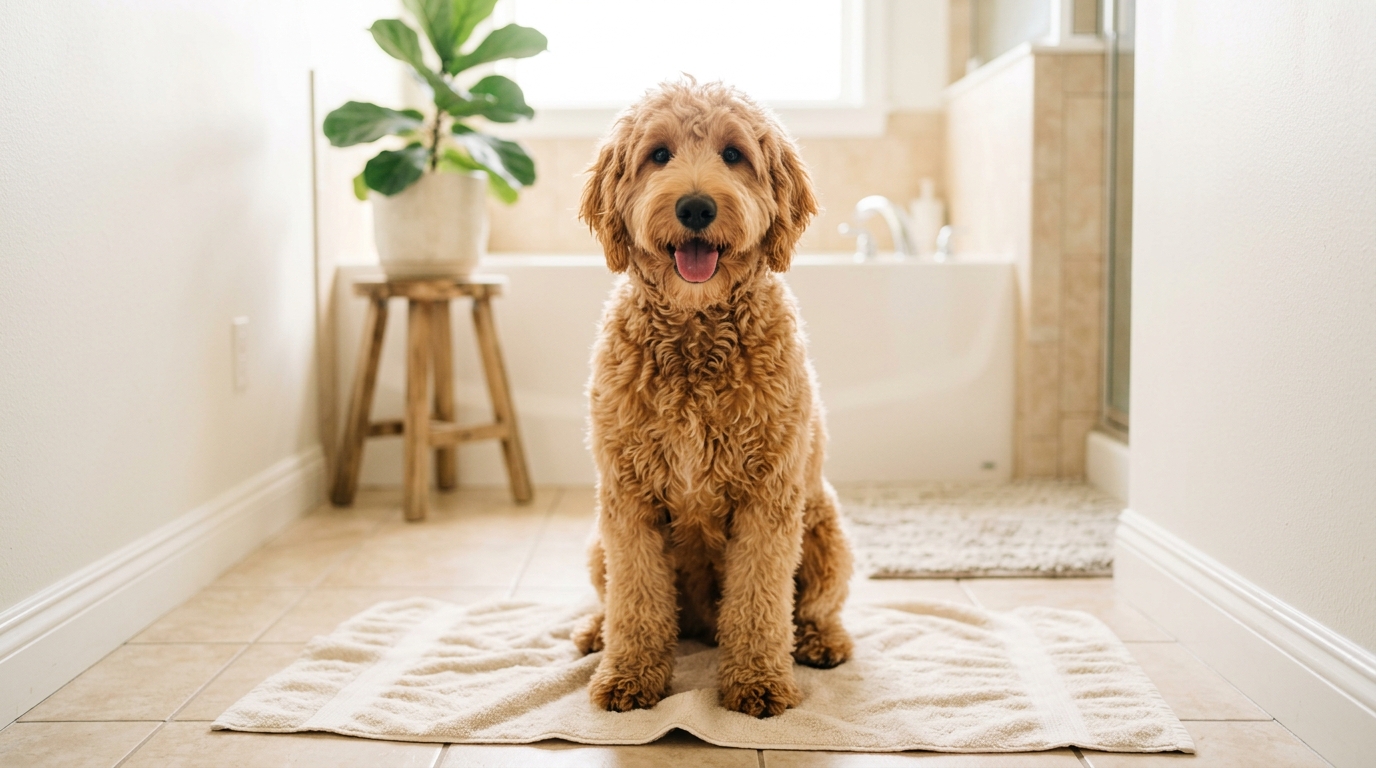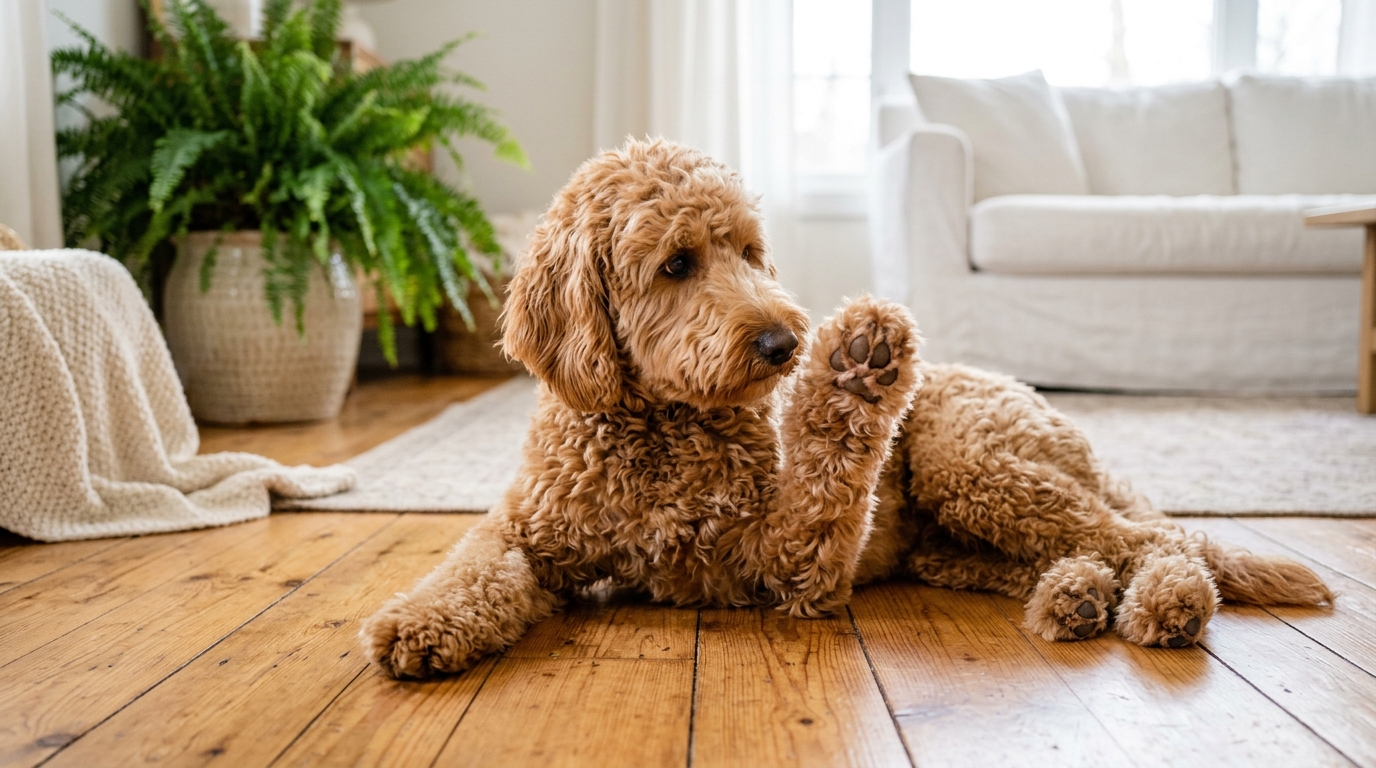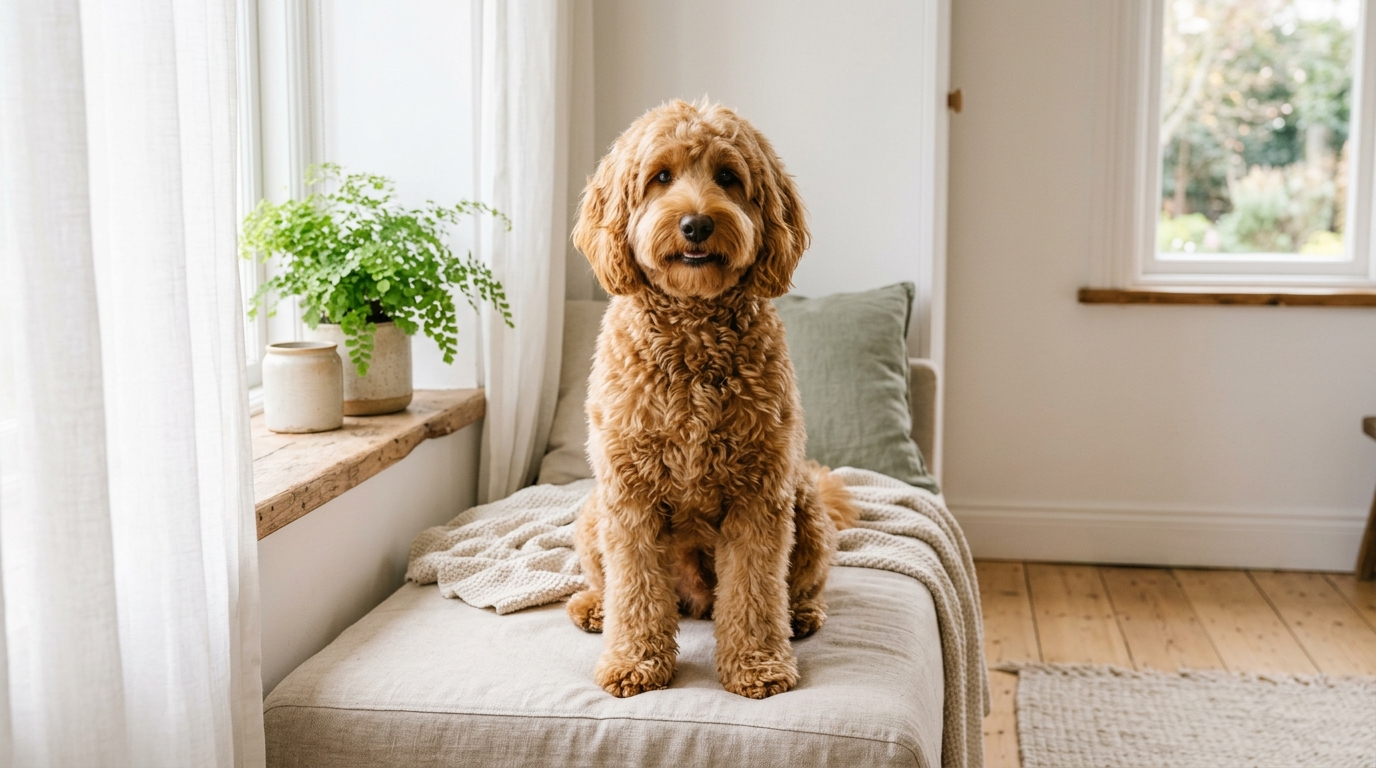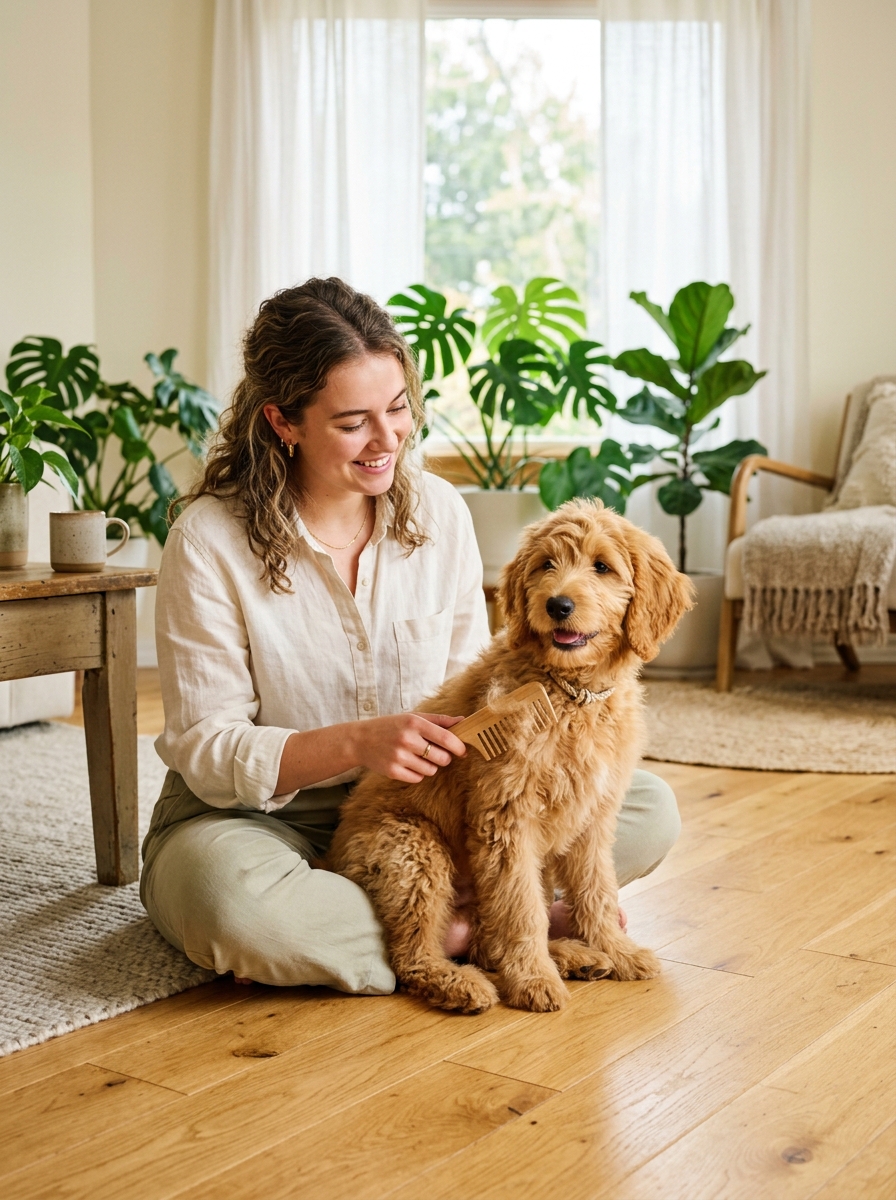
Yes, Goldendoodles shed, but usually far less than a Golden Retriever. Low-shedding is not no-shedding, and how much your dog drops depends far more on its coat type and generation than on the word "Goldendoodle." A tight curly coat sheds least; a straighter, flatter coat sheds most. A sudden jump in shedding can mean a coat change, stress, a diet issue, or a skin problem worth a vet check.
If you came here worried about hair on the couch, take a breath, this is one of the most common questions new doodle owners ask, and the honest answer is reassuring. In our house we live with three multigenerational Australian Labradoodles, and nothing actually drops on our floors: the hair comes out, but in the brush, the bath or the clip, not on the sofa. Below we'll break down exactly what drives shedding in Goldendoodles and Labradoodles, how generation changes the odds, and how to tell normal turnover from a problem that needs attention.
If you already want to look at products, our guide to the best gentle shampoos for itchy doodles is the shortcut; the rest of this article explains the why first.
If a sudden change in shedding has you worried it's a skin issue rather than a grooming one, and you just want the shortlist of things that actually help an itchy, flaky coat, jump straight to our skin & paws guides, otherwise read on for the full picture.
Do Goldendoodles shed? The honest answer
Every dog with hair sheds something, because hair grows, dies, and gets replaced on a cycle. Goldendoodles are no exception. What makes them "low-shedding" is that a lot of that loose hair gets caught in the coat instead of falling on your floor, which is great for your rugs and terrible for mats if you skip brushing.
So the real answer to "do Goldendoodles shed" is: a little, and usually much less than the Golden Retriever parent. The Poodle side of the cross is what pulls shedding down. But you'll still find hair on a black sweater, in the brush, and around the house during coat changes.
The same logic applies to the broader question of do doodles shed at all: yes, all of them do to some degree, and the amount varies enormously between individuals, even within a single litter.
Why coat type matters more than the breed name
If you only remember one thing, make it this: coat type predicts shedding better than the breed label. Goldendoodles and Labradoodles come in roughly three coat types, and they behave differently (our Australian Labradoodle coat types guide shows how to tell them apart).
- Curly (wool) coat, tight curls, Poodle-like. Sheds the least and traps the most hair, so it also mats fastest; in our house the wool coats are kept short and checked by hand rather than brushed long.
- Wavy (fleece) coat, the classic soft "teddy bear" look. Low shedding, but easier to maintain than a full wool coat.
- Straight (flat/hair) coat, flatter, more Retriever-like. Sheds the most of the three and often looks less "doodley."
A wavy or curly-coated Australian Labradoodle bred over generations for a consistent fleece coat is often extremely low-shedding. An early-generation Goldendoodle that inherited a flatter coat can shed noticeably more. Both are "doodles", the coat is what's actually on your couch.
A hair-trapping coat cuts both ways: less on the floor, but more chance of tangles if you skip brushing. If you already know the real issue is tangles rather than shedding and just want the practical fixes, our guide to doodle matting is the shortcut; it covers the flip side of that low-shedding coat.
Do Labradoodles shed differently from Goldendoodles?
Not in any predictable, breed-wide way. Do Labradoodles shed? Yes, on the same rules: coat type and generation drive it. Australian Labradoodles in particular are often bred toward a stable low-shedding fleece or wool coat, so a well-bred one may shed very little. A first-generation Labradoodle with a flatter coat may shed more, exactly like a Goldendoodle would. Don't assume the breed name tells you the answer; ask about the coat.
How generation changes shedding: F1, F1B and multigen
Generation is the second big lever, because it changes how much Poodle is in the mix, and the Poodle line is what pushes shedding down.
| Generation | Poodle influence | Shedding tendency |
|---|---|---|
| F1 (Poodle × Golden/Labrador) | ~50% | Most variable, some shed noticeably |
| F1B (F1 × Poodle) | ~75% | Usually lower-shedding, curlier |
| F2 (F1 × F1) | ~50%, less predictable | Highly variable litter to litter |
| Multigen (F3+) | Bred for consistency | Often the most reliably low-shedding |
The pattern: more Poodle generally means curlier and lower-shedding, but it's a tendency, not a promise. Individual puppies vary, and a reputable breeder will be honest about the range within a litter. We walk through all of this in doodle generations explained, worth reading before you choose a puppy if a truly low-shed coat is your priority.
Why is my Goldendoodle shedding more than usual?
Here's where owners understandably start to worry. If you're asking why is my Goldendoodle shedding all of a sudden, run through these common causes first, most are completely normal.
The puppy coat change
Somewhere between 6 and 12 months, doodles swap their soft puppy coat for their adult coat (we cover the whole phase in doodle puppy coat change). This is the single most notorious phase: you'll see more loose hair and far more matting, because the shedding puppy hair tangles into the incoming adult coat. Brushing has to step up during these months, or you'll be facing mats you can't work out by hand. This is the toughest grooming stretch of the whole first year, it passes.
Gunnar, our first doodle, taught us this the hard way. His puppy coat was fairly straight and almost fleece-like, so we brushed him and thought he was in good shape. But we had a poor brush (the ones we'd choose now are in best brushes for doodles) and not yet the technique, so we were only skimming the surface. When his coat turned much curlier as an adult, the first time we clipped him ourselves we found he was matted all over underneath, we had been brushing over the mats. We had to shave him completely down and felt terrible after trying our best. The lesson: during the coat change, you have to reach the skin, not just the surface.
Seasonal turnover
Even low-shedding coats cycle a little with the seasons, a bit more in spring and fall. It's mild in most doodles compared to a double-coated breed, but it's real.
Stress
Dogs can "blow" hair when they're stressed, a move, a kennel stay, a new baby. If your dog is also having loose stool alongside the stress, our guide to stress and digestive problems in doodles may be relevant, since the same trigger often shows up in more than one system.
Diet
An under-nourished or unbalanced diet shows up in the coat before almost anywhere else. A dull, brittle, shedding coat can improve dramatically with better nutrition and adequate omega-3s. If your dog also has itchy skin, omega-3 fish oil for doodle skin is a sensible place to look, and can diet fix doodle skin problems sets honest expectations.
A skin problem
This is the one to take seriously. The Poodle line carries a genuine predisposition to allergic skin disease (atopy) and food sensitivities, some doodles inherit it, some don't. The Merck Veterinary Manual describes atopic dermatitis as a common, often inherited allergic skin condition in dogs, and it can cause the kind of hair loss and shedding that a curly, hair-hiding coat masks until it's advanced. Our own Gunnar is our ears-and-yeast dog, and his itchy skin flares taught us how easily a dense doodle coat hides trouble at the skin level, by the time you see thinning, it's usually been building underneath. If you already suspect a flaky, itchy coat is behind the shedding and just want the shortlist that helps, the omega-3 fish oil for doodle skin picks are a good shortcut; otherwise why is my doodle itchy all the time and allergy vs yeast infection in doodles will help you tell causes apart.
Managing normal shedding in a doodle household
For everyday, healthy shedding, the plan is simple and it doubles as mat prevention (the full how-to is in our doodle grooming guide):
With three doodles, we've learned that coat care looks different depending on the coat. Gösta has a wavy fleece coat, so he gets brushed thoroughly and often and stays mat-free. Sven and Gunnar have curly wool coats, which in our experience don't respond to routine brushing the way a fleece does, so instead we feel through their coats by hand daily or several times a week to catch any starting mat, bathe them monthly with a conditioner, and clip the whole coat short every couple of months. None of the three leaves hair on our floors; the coat holds onto it until it comes out in brushing, the bath or the clip. That's low-shedding working exactly as advertised: the hair comes off in the coat care, not on the sofa.
FAQ
Yes. Every Goldendoodle sheds a small amount, because all dogs lose and regrow hair. The difference is that most Goldendoodles shed far less than a Golden Retriever, and much of the loose hair stays trapped in the coat instead of landing on your floor, which is exactly why regular brushing matters so much.
A tight curly coat typically sheds the least and holds the most hair in the coat, followed by wavy fleece coats. Straighter, flatter coats, more common in some F1 and F2 dogs, shed the most of the three. Coat type is a better predictor than the word "Goldendoodle" alone.
On average, yes. An F1B has more Poodle in its genetics, which tends to push toward a curlier, lower-shedding coat. But it's a tendency, not a guarantee, individual puppies within a litter vary. Our generations guide explains how F1, F1B and multigen crosses stack up.
The common causes are the puppy-to-adult coat change (usually 6-12 months), seasonal turnover, stress, a diet or food change, or a skin problem such as allergies or yeast. If the shedding comes with bald patches, redness, odor, or constant scratching, that's a call-your-vet situation rather than normal turnover.
Not necessarily, both breeds follow the same rule that coat type and generation matter more than the breed name. Australian Labradoodles bred for a consistent fleece or wool coat are often very low-shedding, while an early-generation Labradoodle with a flatter coat may shed more, just like a Goldendoodle would.
The bottom line
Goldendoodles and Labradoodles shed, a little, and how much comes down to coat type and generation far more than the breed name. Manage normal turnover with regular coat care, feed for a healthy coat, and treat sudden or patchy shedding as a signal worth investigating rather than ignoring.
If a low-shed coat is your real goal, read doodle generations explained next to understand how F1, F1B and multigen crosses change your odds, and if sudden shedding is pointing you toward a skin issue, our itchy skin & paws guides are the place to keep that coat working the way it's supposed to.