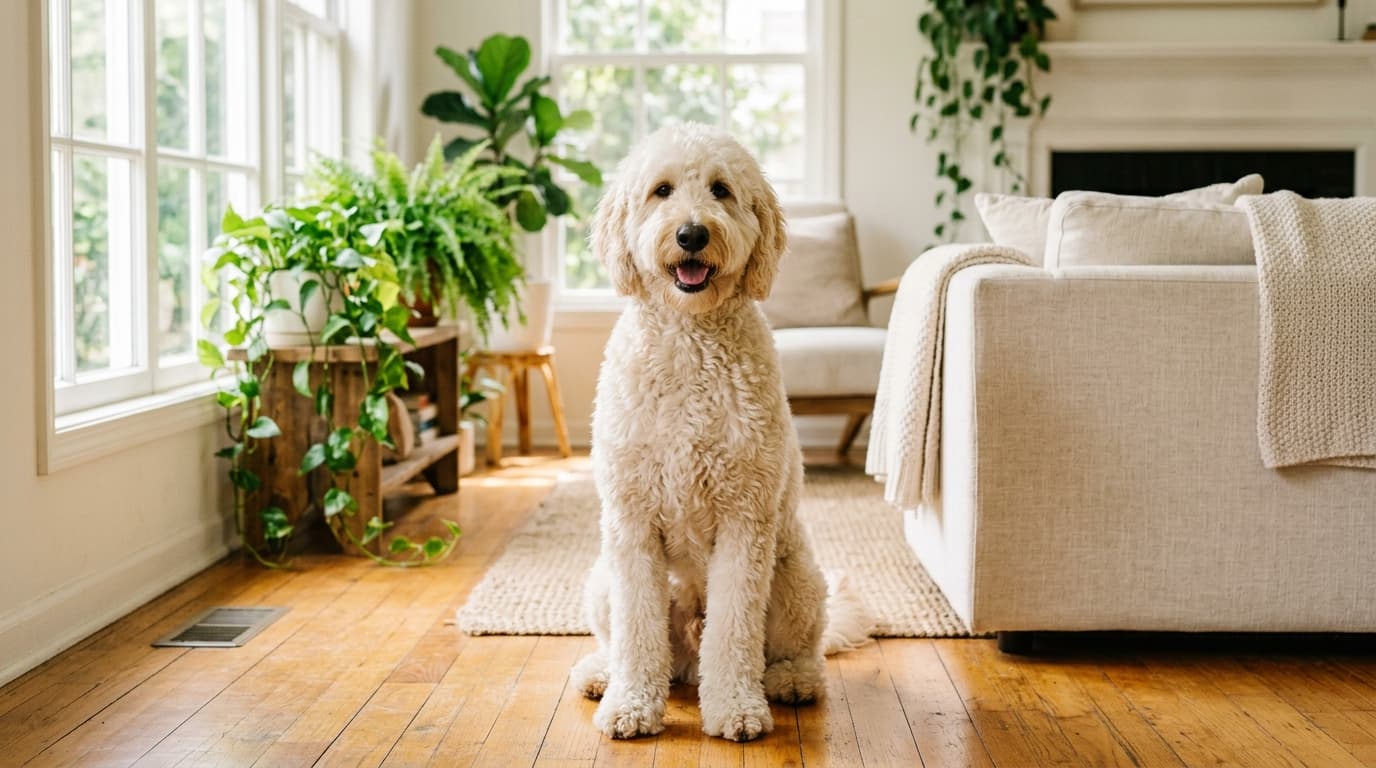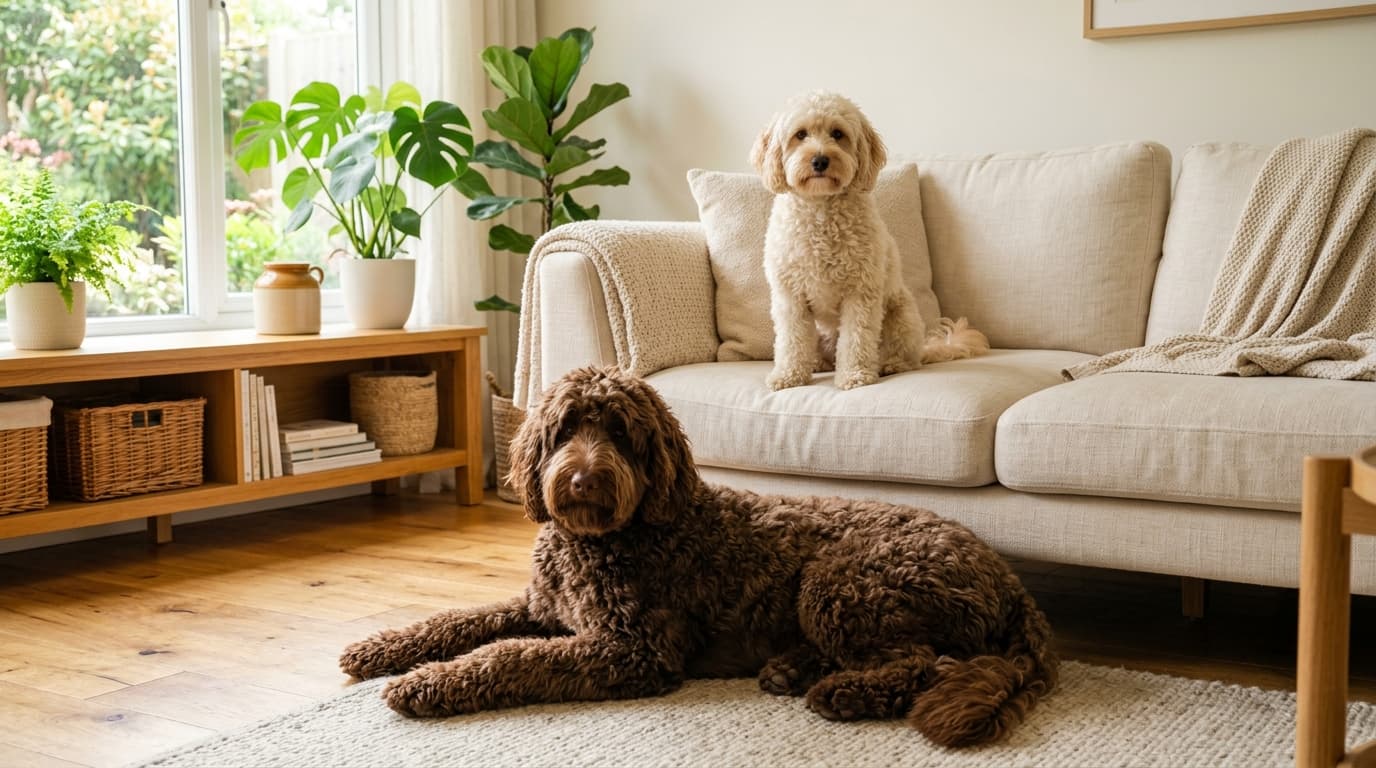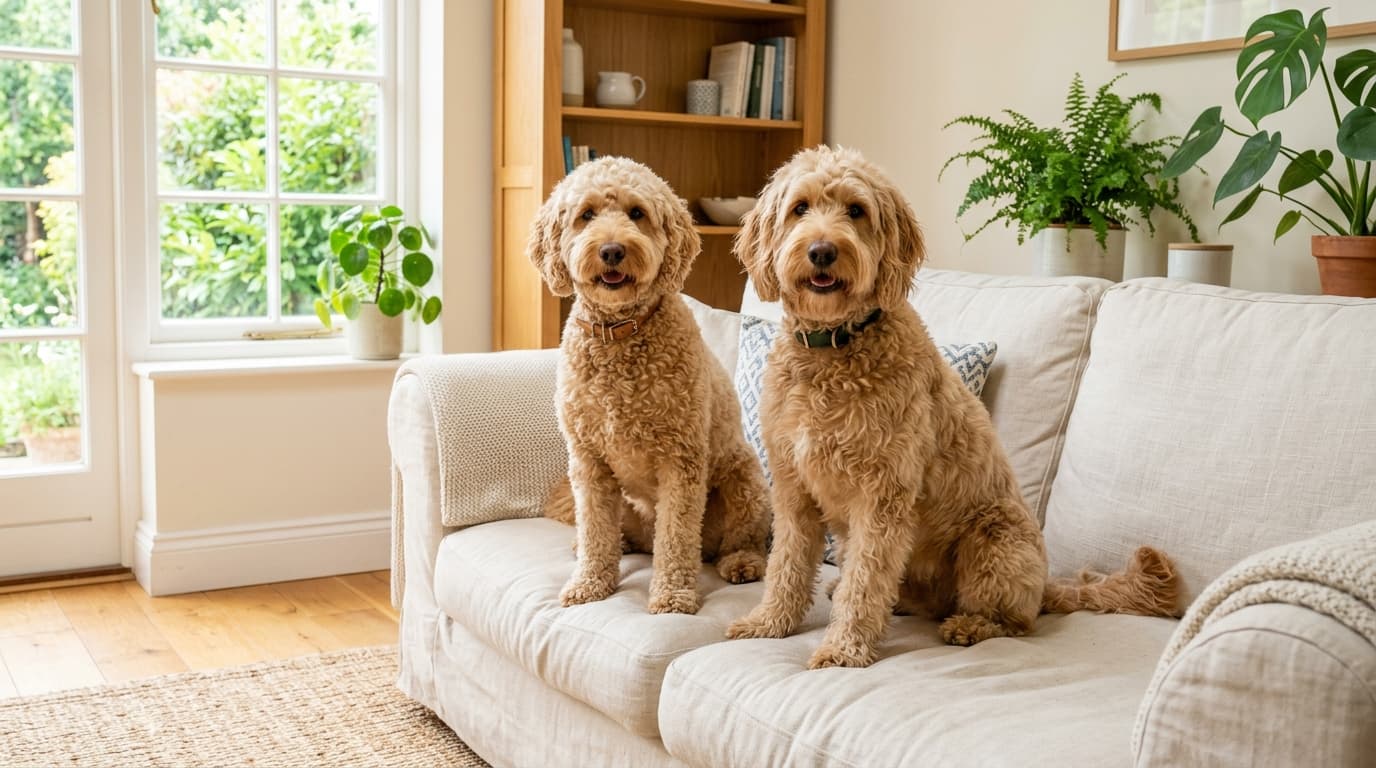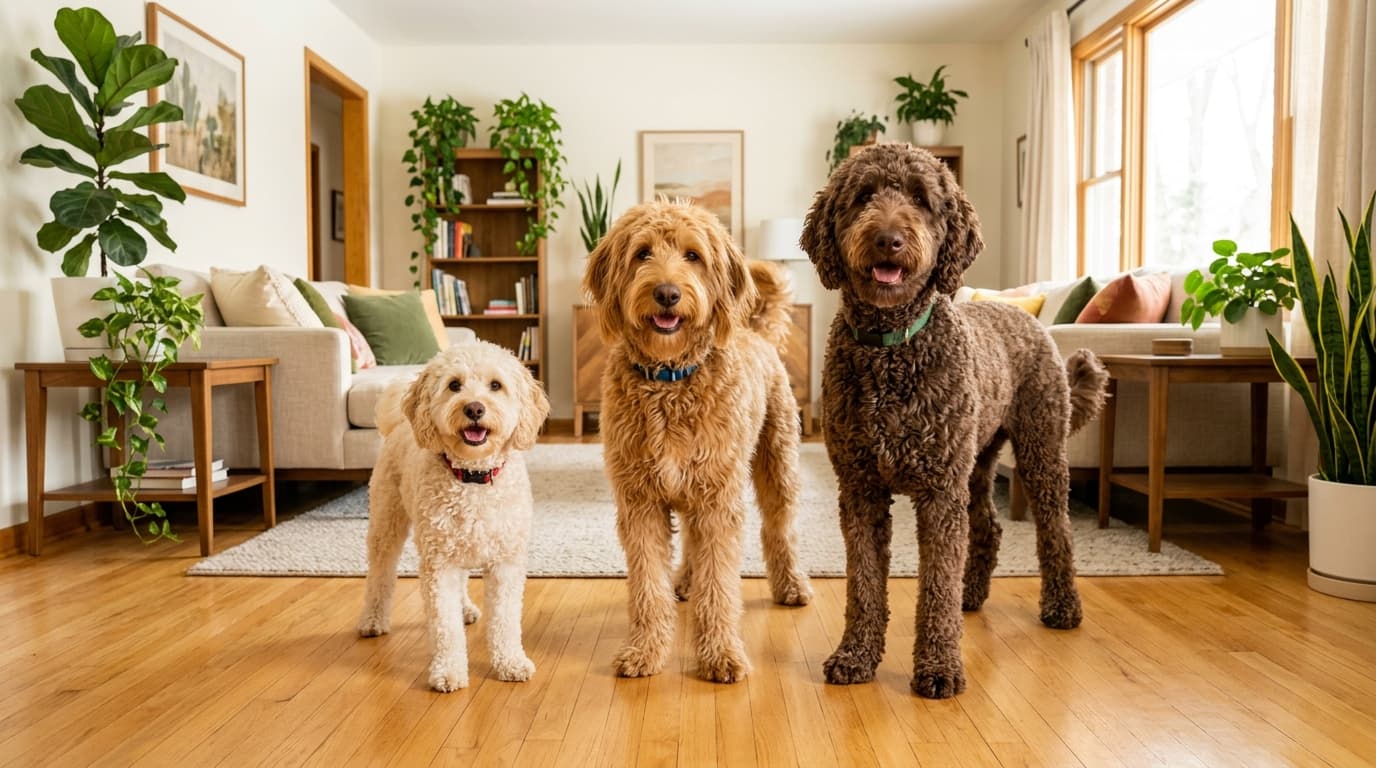
Mini doodles usually finish under 25 pounds (11 kg), Mediums land around 25 to 45 pounds (11 to 20 kg), and Standards run from 45 to about 90 pounds (41 kg) depending on the breed. Bernedoodles and Sheepadoodles reach the top of that range. Within any bracket, the size of the Poodle used in the cross matters more than any other single factor.
That last point is the one that catches people out. "Goldendoodle" does not describe a size, a Goldendoodle bred from a Toy Poodle and one bred from a Standard Poodle are different dogs living in different-sized houses.
If you want a number for your own puppy rather than a range for the breed, our adult size predictor estimates it from their current age and weight, or from the parents.
Size chart by breed
| Breed | Mini | Medium | Standard |
|---|---|---|---|
| Goldendoodle | 15-30 lb (6.8-14 kg), 14-17 in | 30-45 lb (14-20 kg), 17-20 in | 50-75 lb (23-34 kg), 20-24 in |
| Labradoodle | 15-30 lb (6.8-14 kg), 14-16 in | 30-45 lb (14-20 kg), 17-20 in | 50-75 lb (23-34 kg), 21-24 in |
| Australian Labradoodle | 15-25 lb (6.8-11 kg), 14-16 in | 25-40 lb (11-18 kg), 17-20 in | 45-65 lb (20-29 kg), 21-24 in |
| Bernedoodle | 20-35 lb (9.1-16 kg), 14-17 in | 35-55 lb (16-25 kg), 18-22 in | 60-90 lb (27-41 kg), 23-29 in |
| Sheepadoodle | 25-40 lb (11-18 kg), 16-20 in | 40-55 lb (18-25 kg), 18-22 in | 60-90 lb (27-41 kg), 22-27 in |
Height is measured at the shoulder, not the head. These are the ranges breeders and owners report in practice; individual dogs fall outside them in both directions, and a dog at the top of a Mini range and one at the bottom of a Medium are effectively the same dog with different labels.
The same chart in kg and cm
| Breed | Mini | Medium | Standard |
|---|---|---|---|
| Goldendoodle | 7-14 kg, 36-43 cm | 14-20 kg, 43-51 cm | 23-34 kg, 51-61 cm |
| Labradoodle | 7-14 kg, 36-41 cm | 14-20 kg, 43-51 cm | 23-34 kg, 53-61 cm |
| Australian Labradoodle | 7-11 kg, 36-41 cm | 11-18 kg, 43-51 cm | 20-29 kg, 53-61 cm |
| Bernedoodle | 9-16 kg, 36-43 cm | 16-25 kg, 46-56 cm | 27-41 kg, 58-74 cm |
| Sheepadoodle | 11-18 kg, 41-51 cm | 18-25 kg, 46-56 cm | 27-41 kg, 56-69 cm |
Same figures, converted, most breeders quote pounds and inches, so the imperial chart is the one you will be handed. Our adult size predictor takes either unit and shows the result in both.
What actually determines the size
The Poodle parent, first. Poodles come in Standard, Miniature and Toy, and that choice drives the size bracket more than anything else. This is why the same breed name spans 15 to 90 pounds. (6.8 to 41 kg)
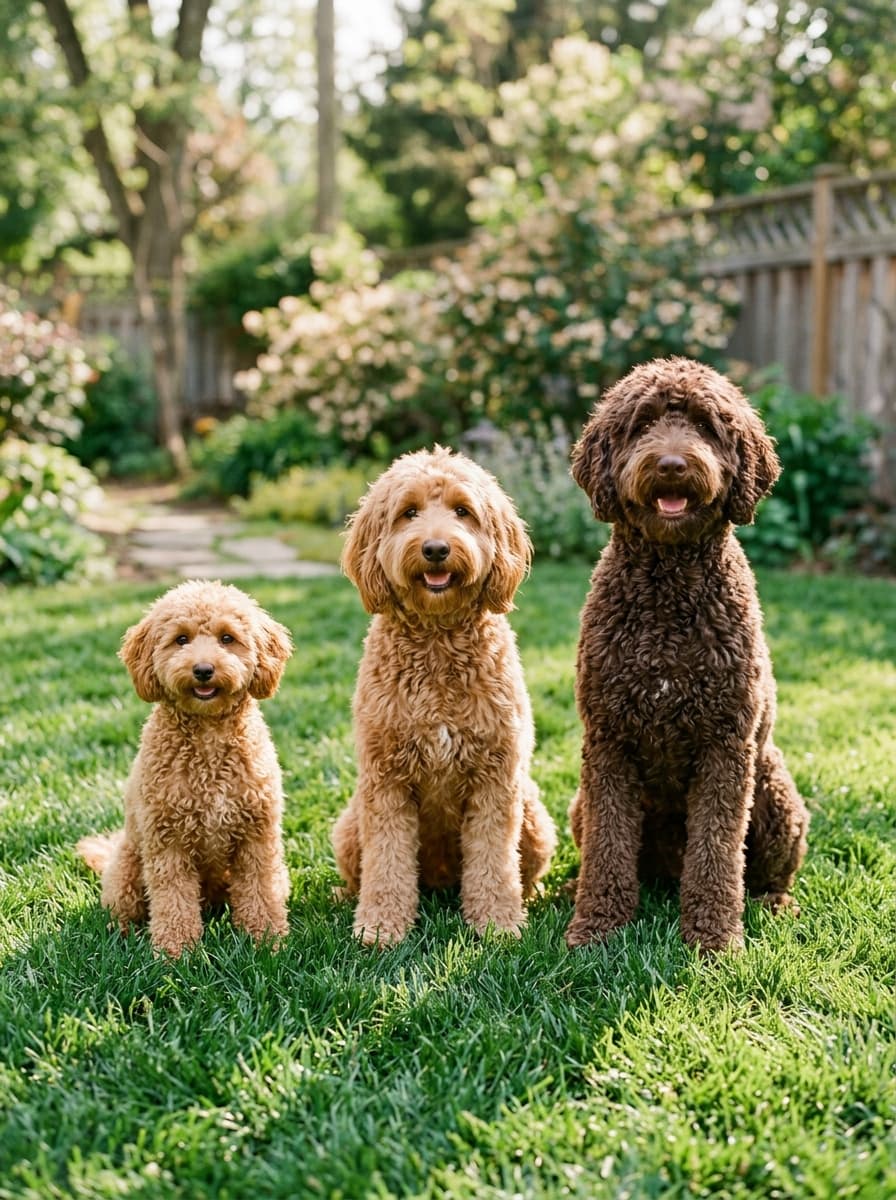
The other parent, second. A Bernese Mountain Dog and an Old English Sheepdog are large breeds, which is why Bernedoodles and Sheepadoodles top the chart. A Golden Retriever and a Labrador are medium-large, which puts Goldendoodles and Labradoodles a step below.
Generation, third. An F1b is backcrossed to a Poodle, so it often lands a little smaller than the average of the original pair, and which Poodle was used matters again. Multigenerational lines, including Australian Labradoodles, tend to be the most predictable because breeders have selected for consistency across generations. Doodle generations explained covers this properly.
The individual dog, always. Littermates finish at different weights. A range is the honest answer; a single number never is.
When do doodles stop growing?
Smaller dogs finish earlier, and height finishes before weight.
- Mini: close to full height by 10-12 months, filling out to about 12 months.
- Medium: full height by 12-14 months.
- Standard: full height by 15-18 months, still filling out in chest and shoulders for a few months after that.
A Standard Goldendoodle who has stopped getting taller at 14 months may still be adding meaningful weight at 18. That is normal, and it is exactly why large doodles stay on puppy food longer, the full reasoning is in when to switch a doodle puppy to adult food.
How to predict your own puppy's size
Two methods, and one thing that beats both.
From your puppy's current weight. Project forward using a growth curve. It works, and it gets noticeably more reliable after about 16 weeks, before that, a puppy has not shown enough of their growth pattern to project from. Our adult size predictor does this arithmetic and gives a range rather than a single figure.
From the parents' weights. If you are still choosing a puppy, the average of the two parents is a reasonable starting point, adjusted down slightly for an F1b. The same tool takes this input.
What beats both: a breeder who can tell you the adult weights of previous litters from that exact pairing. That is real data from the line rather than a formula applied to it. Ask for it, a breeder who has repeated a pairing will know, and it is the single most useful question you can ask about size.
Why the number matters beyond curiosity
Size is not trivia. It changes three practical decisions.
Which puppy food is correct. Doodles expected to finish over about 50 pounds (23 kg) should be on a large-breed puppy formula with controlled calcium, because excess calcium during rapid growth can stress developing joints. A 12-pound (5.4 kg) puppy who will become a 65-pound (29 kg) adult needs large-breed growth nutrition now, see best puppy food for Goldendoodles. The Merck Veterinary Manual makes the same point about controlled calcium during large-breed puppy growth.
How much to feed. Portions scale with weight, and eyeballing them drifts upward over a week without anyone noticing. Work it out properly with the portion calculator, and read why it matters in overfeeding and stomach issues in doodles.
How carefully to manage mealtimes. Large, deep-chested dogs carry a genuine, documented risk of bloat and gastric torsion, and eating fast is one contributing factor. For a Standard, a slow feeder bowl is a sensible precaution rather than a gadget.
FAQ
It depends on the size variety and the breed. Mini doodles usually finish under 25 pounds (11 kg), Mediums land around 25 to 45 pounds (11 to 20 kg), and Standards run from 45 to about 90 pounds (20 to 41 kg). Bernedoodles and Sheepadoodles sit at the top of that range because their non-Poodle parent is a large breed. Within any of those brackets, the size of the Poodle used in the cross is the single biggest factor.
Smaller doodles finish earlier. A Mini is usually close to full height by around 10 to 12 months, a Medium by 12 to 14 months, and a Standard somewhere between 15 and 18 months. Height finishes before weight does, so a Standard that has stopped getting taller may still fill out in the chest and shoulders for several more months. That timeline is also why large doodles stay on puppy food longer.
Two methods work reasonably well. If you have your puppy, project from their current age and weight using a growth curve, which becomes noticeably more reliable after about 16 weeks. If you are still choosing, the parents' weights are a good guide, adjusted for generation. Neither beats a breeder who can tell you the adult weights of previous litters from the same pairing, because that is real data from that specific line.
Standard Bernedoodles and Standard Sheepadoodles are typically the largest, because Bernese Mountain Dogs and Old English Sheepdogs are big breeds to begin with. A Standard Bernedoodle can reach 90 pounds (41 kg) or more. Standard Goldendoodles and Labradoodles usually finish somewhat lower, in the 50 to 75 pound (23 to 34 kg) range, though individuals vary widely.
Yes, and more than most owners expect. Doodles expected to finish over about 50 pounds (23 kg) should be on a large-breed puppy formula with controlled calcium, because too much calcium during rapid growth can stress developing joints. Large, deep-chested dogs also carry a genuine bloat risk, which makes meal pace worth managing. Portions should be worked out by weight rather than by eye at any size.
Where to start
Get a number rather than an adjective. Run your puppy's age and weight through the adult size predictor, or ask your breeder what previous litters from the same pairing finished at.
Then use it: pick the right puppy formula, work out the portion with the portion calculator, and if you are still choosing a size, Mini vs Medium vs Standard walks through what each one is actually like to live with. Size is only one part of the decision, so it is also worth reading our honest answer to are doodles hypoallergenic before settling on a breed and size combination.