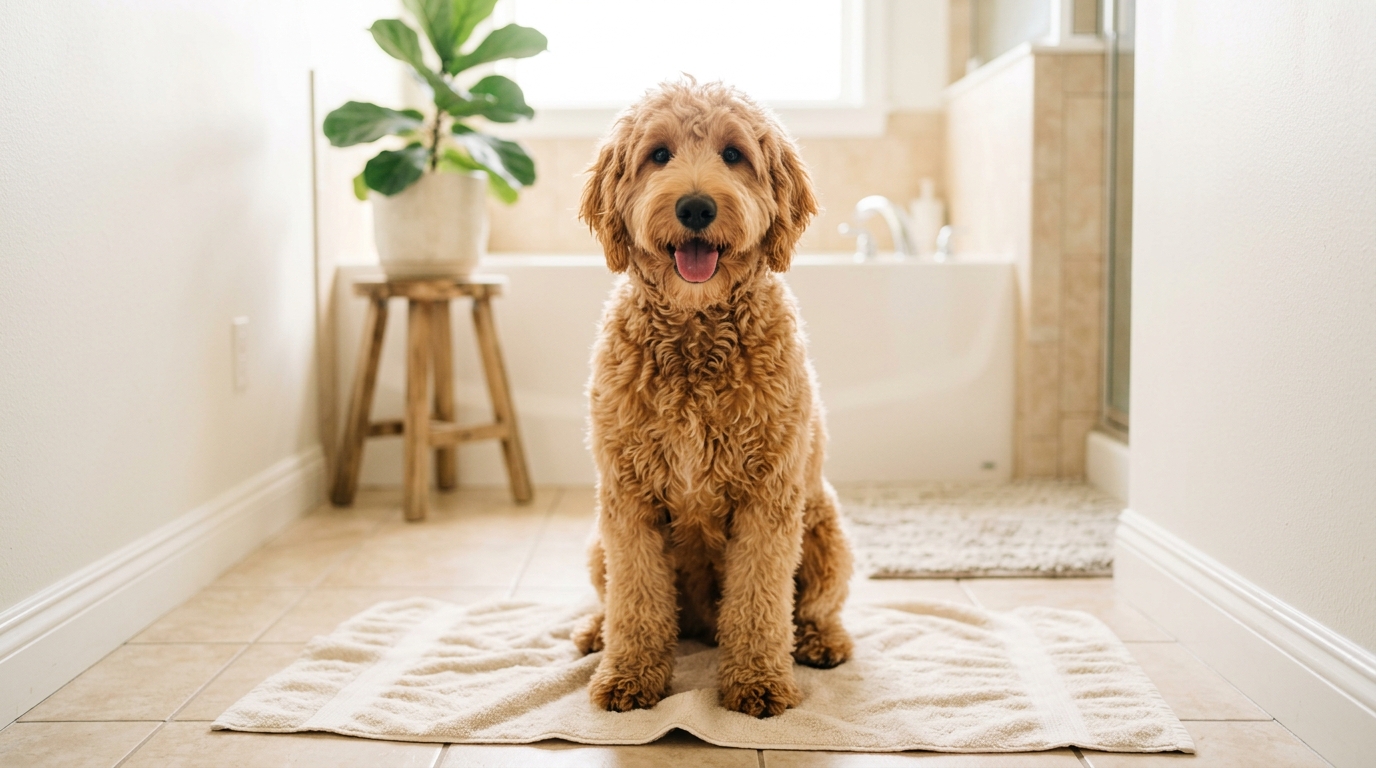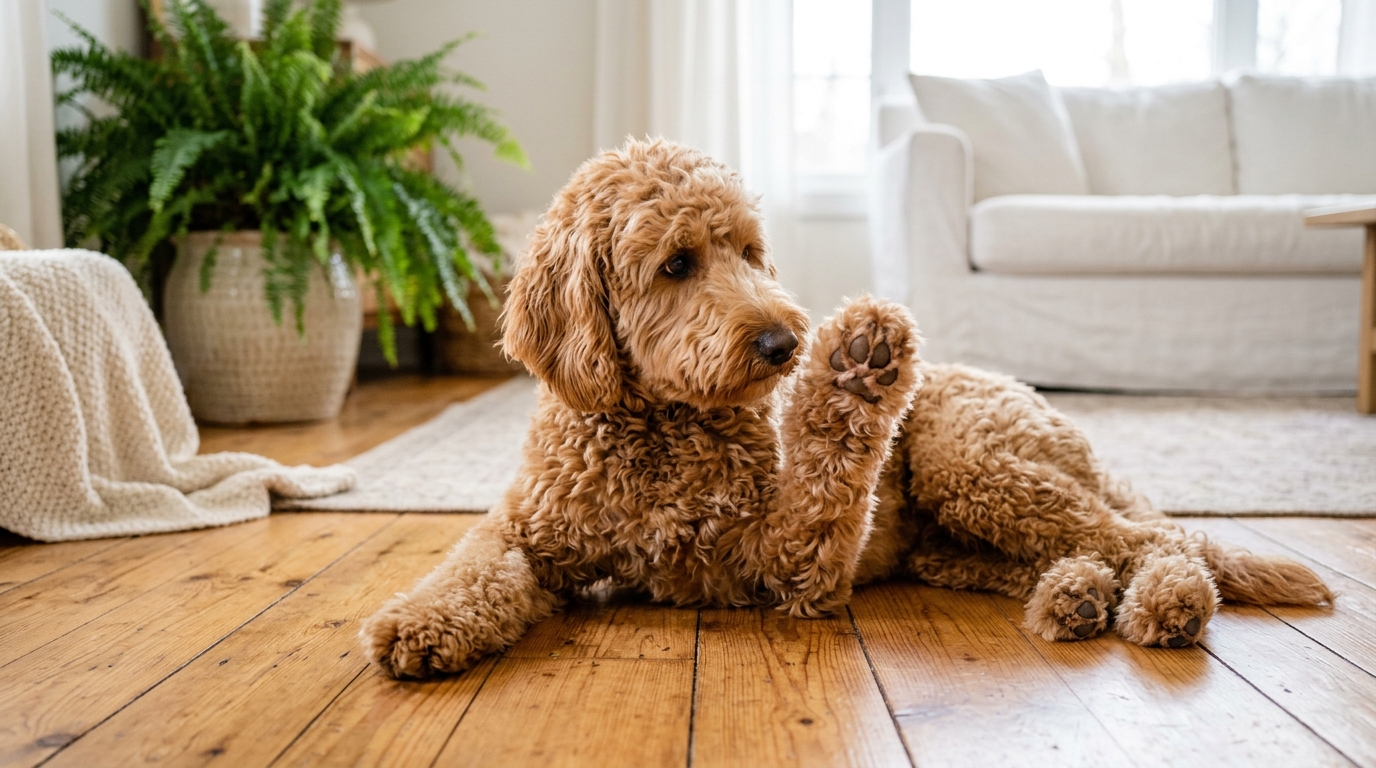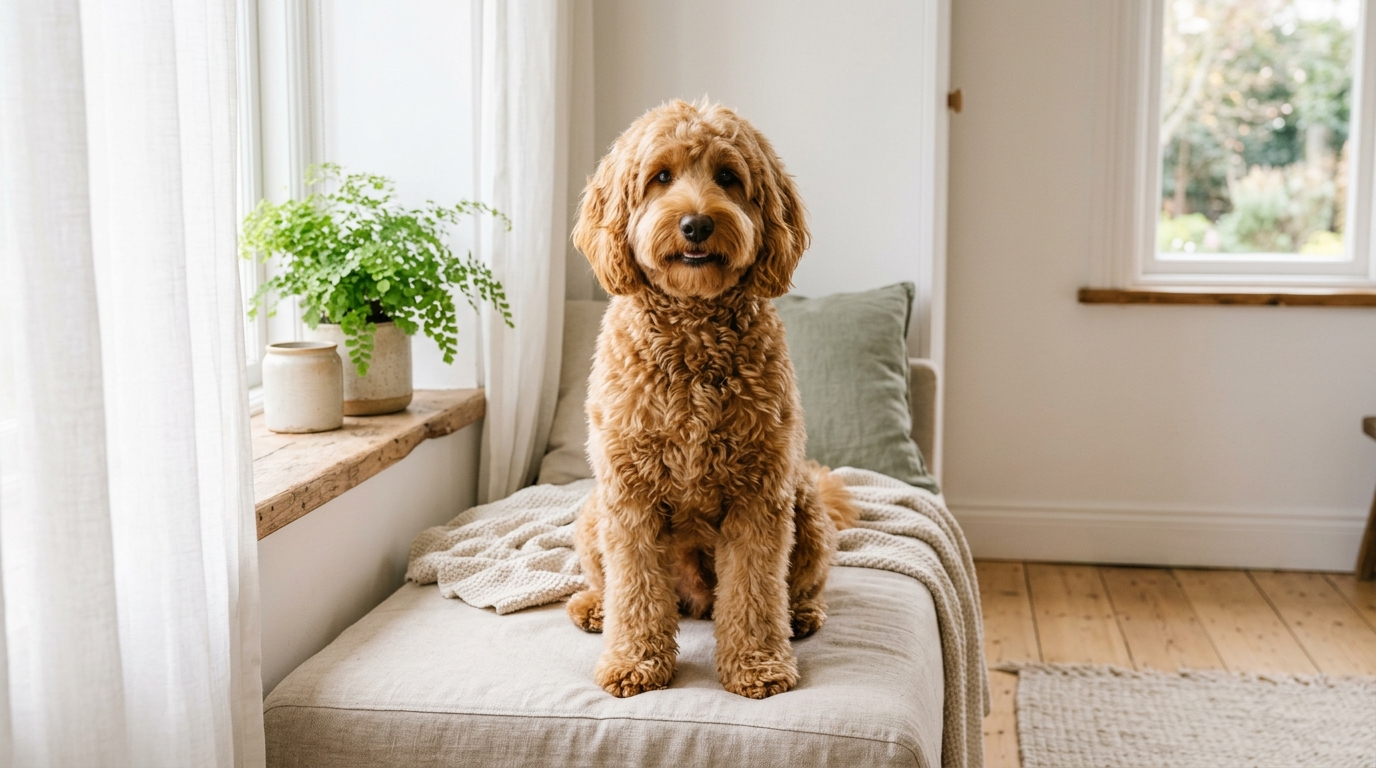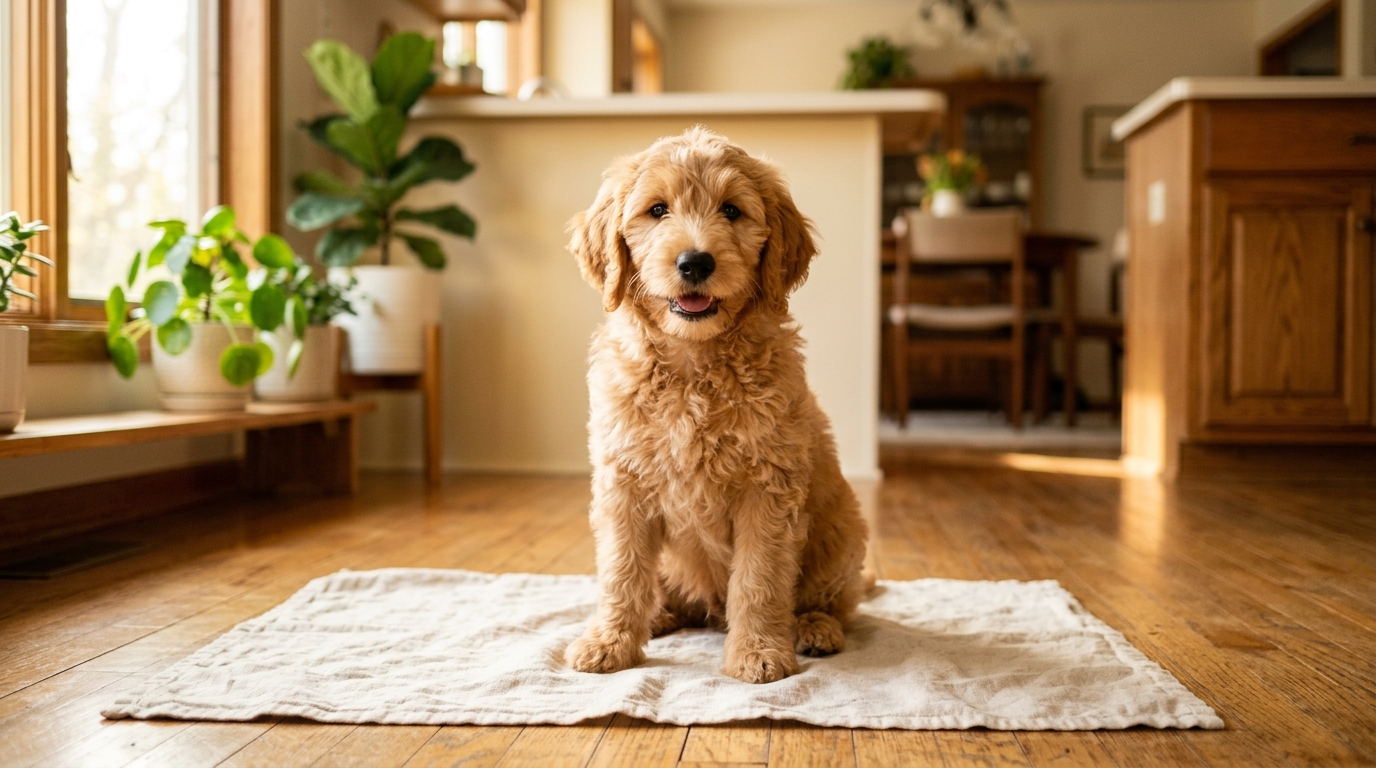
The Goldendoodle puppy coat change usually happens between about 6 and 12 months, though some doodles start earlier and some later. As the soft puppy fluff is gradually replaced by the coarser, denser adult coat, mats form fast and you'll notice more loose hair coming out on the brush. What matters most on the other side of it is the adult coat type, a wavy fleece and a curly wool coat need completely different routines.
If you've suddenly gone from a puppy that barely tangled to one that mats overnight, you are not doing anything wrong, you've just hit the coat change. It catches almost every doodle owner off guard, and the good news is it's temporary. Get your routine right for a few months and you come out the other side with an adult coat you can plan around.
This guide walks through when the doodle coat transition happens, what it actually looks like, why matting spikes right now, and how the adult coat type decides everything that comes next.
When do Goldendoodles get their adult coat?
There is no fixed age, and any site that gives you one exact number is guessing. In our house and in most doodles we know, the change lands somewhere in this range:
| Milestone | Typical range | What you'll notice |
|---|---|---|
| Coat change begins | ~6-9 months | Mats appear faster, coat feels different at the skin |
| Peak of transition | ~8-12 months | Grooming has to step up, most shedding of puppy fluff |
| Adult coat settled | ~12-18 months | Texture stabilizes, matting eases to a new normal |
The same window applies to a Labradoodle puppy coat change and to Australian Labradoodles, Bernedoodles and Sheepadoodles, the timing is broadly similar across the doodle types, even though the finished coat can look quite different from one dog to the next.
Watch the coat, not the calendar. A dog with a very curly poodle-leaning coat may change earlier and more dramatically than one with a looser, wavier coat. Size plays a small role too, if you're still deciding between builds, our mini vs medium vs standard doodle guide covers how size affects grooming load.
Gunnar's coat change caught us out
Gunnar was our first doodle, and he taught us the hardest lesson of the coat change. His puppy coat was fairly straight, almost fleece-like, and we brushed him and honestly thought we were doing a great job. But we had a poor brush and not yet the technique, so we were only brushing the surface while believing we were reaching the skin. Then his coat changed into a much, much curlier adult coat, and the first time we started trimming him ourselves, we found he was matted all over underneath. We'd been brushing right over the mats.
We had to shave him completely down that first time and felt terrible after trying our best. We then bought a proper slicker brush and learned how curly coats actually work, and with Sven, our second, the same thing never happened. If there's one thing we can hand you before your dog's coat change, it's this: don't trust the surface.
For general, vet-backed guidance on coat and skin care, the American Veterinary Medical Association is a reliable place to start.
What does the doodle coat transition actually look like?
Three things tend to show up together, often within a couple of weeks of each other.
Sudden, stubborn matting
This is the big one. The soft puppy coat and the incoming coarse adult coat tangle against each other right at the skin, where a curly or fleece coat hides them completely from view. You can run your hand over your dog and feel nothing, then part the coat and find a tight mat sitting flat against the skin behind the ears or in the armpits.
A change in texture
The coat starts to feel different, often coarser, denser, sometimes wavier or curlier than the puppy fluff. Many owners describe the adult coat as "more work but more doodle," because it's the coat the breed is known for.
Shedding of the puppy fluff
Doodles are low-shedding, not no-shedding, and during the coat change you'll see more loose hair than usual as the puppy coat lets go. Most of it ends up trapped in the coat rather than on your floor, which is exactly why it turns into mats if you don't stay on top of it.
Australian Labradoodle coat types (and why they change the routine)
For the full breakdown of each coat and what it means for grooming, see Australian Labradoodle coat types: fleece vs wool vs hair.
Here is the part that matters most once the puppy fluff clears: the adult coat type decides the routine, not the age of the dog. With Australian Labradoodles specifically, you'll usually land in one of a few coat types:
- Fleece, wavy or curly. A soft, flowing coat. The wavy version can be kept long with thorough, frequent brushing.
- Wool, curly or spiral. A dense, tighter curl that behaves more like a poodle coat. It mats readily and does not stay long easily.
- Straight hair coat. The less common one, more like a flat-coated retriever, lower maintenance but higher shedding.
We have all three dogs, and two very different stories under one roof.
Curly wool coats (Sven and Gunnar)
Sven and Gunnar grew curly wool adult coats, and this is where the standard advice stopped working for us. As puppies we brushed them several times a week, sometimes daily, and while they were small that was fine. But as the adult wool coat came in, brushing started to make it frizzy, and it did not actually stop the matting. It's a lot like the "curly girl method" for curly human hair: one of us has curly hair and never brushes it, and we ended up doing the same for the boys.
So we skip brushing on Sven and Gunnar completely, but never the checking. What actually works for their coat is:
- A bath once a month, always with a conditioner, the conditioner is the part that helps against matting.
- Feeling through their coats by hand daily or several times a week, so there are no mats anywhere, and clipping any single mat out ourselves right away.
- Roughly every 2-3 months (about four times a year) we clip the whole coat off short, sooner if the coat looks in poor shape or there's a problem. Sometimes we leave the face longer.
A curly wool coat cannot realistically be kept long, our groomer agrees. A short clip doesn't look very "doodle" for the first few weeks, and we've made our peace with that: a mat-free dog who feels comfortable matters more than the look. Mats are a welfare issue, not a cosmetic one, they pull on the skin, hurt, and hide skin problems.
Wavy fleece coats (Gösta)
Gösta grew a wavy fleece coat, and it's a completely different animal. His coat must be brushed thoroughly and often, but with that, he stays mat-free and can be kept long. He's the easy one for everything, and he'll happily lie there and let us do every grooming chore without any fuss. For a wavy fleece, daily-ish, to-the-skin brushing genuinely pays off, and the length is yours to keep.
Brushing to the skin (for the coats that need it)
For a wavy fleece like Gösta's, and during the peak of the coat change for most doodles, the mistake we see most is surface brushing: running a slicker over the top so it looks tidy while mats quietly build underneath. That's exactly the trap Gunnar's coat change caught us in. On a doodle you have to brush to the skin.
Drying without the hour-long blow-dry
We no longer blow-dry as a routine. With an ordinary hair dryer, we've used our own, drying a doodle coat right to the skin can take an hour, which nobody has time for after every bath. What we use instead are dog drying robes (bathrobes for dogs), and they work really well. A high-velocity grooming dryer is a good option if you have the time and budget and want a perfect finish at home, but it's a big investment. Gösta's fleece gets brushed once it has dried a little and is still slightly damp.
Trimming at home
We trim all three dogs ourselves at home, on a table or on the floor, with a lick mat to keep them still. Sven and Gunnar are more sensitive to handling, so for the tricky spots one of us holds while the other trims; Gösta lets us do everything without fuss, and that tolerance is something you can train over short, rewarded sessions; we get puppies used to brushing, nail trims and having their ears, teeth and paws checked from day one.
A quick word on tools, because this is where the coat change tips people into buying gear. We tried a cordless clipper first, and it only managed Gösta's fleece, Sven's and Gunnar's curly wool was simply too tough for it, so we use a corded Andis clipper with a #10 blade for the boys. Blades get hot with a lot of coat to work through, so we own four #10 blades and swap them as they heat up; that lets us trim all three in one session without long breaks. For Gösta we use a #10 (or a longer equivalent blade), or a #10 with attachment guard combs that leave the coat at different lengths. A small trimmer handles the fiddly bits, between the toes, the face and the sanitary area, and it's worth having even if you use a professional groomer, for tidy-ups and single mats between full trims.
A shorter trim is a legitimate option
Plenty of owners book a shorter "puppy cut" style trim to ride out the coat change, and there's nothing wrong with that. Less length means mats form more slowly and are easier to reach. For more ways to make home grooming easier through the coat change, see doodle grooming at home: 12 tips. For a wavy fleece it's a stopgap; for a curly wool coat, short is often the honest long-term answer rather than a temporary one.
How coat type relates to generation
Here's where honesty matters more than a tidy promise: generation gives you odds, not a guarantee.
A more poodle-leaning cross (like an F1b) tends toward a curlier, lower-shedding coat, while a first cross (F1) is more of a coin toss on curl and texture. But littermates from the exact same pairing can turn out with noticeably different coats, and the coat change is often when that variation finally reveals itself. The fluffy puppy that looked like it would be wavy sometimes grows in far curlier, or the reverse. Gunnar is our own proof of that: he started almost fleece-like and finished decidedly wool.
So use generation as a rough expectation, not a contract. If you want to understand the labels properly before you read too much into them, our doodle generations explained guide breaks down F1, F1b, F2 and multigen without overselling what any of them promise.
And to head off the most common follow-up: the coat change is a texture and shedding shift, it is not a verdict on allergens. If that's your question, are doodles hypoallergenic? answers it directly.
What if the itching is more than coat change?
The coat change can make a dog fidgety, but it shouldn't make them genuinely itchy. If your doodle is scratching, chewing paws or looking uncomfortable through this period, that's worth separating out from the grooming, because the poodle line does carry a real predisposition to allergic skin issues.
Gunnar is our ears-and-yeast dog, and one thing we learned early is that a matted, moisture-trapping coat can mask a skin problem rather than cause it, you clip the mat out and find irritated skin that was there all along. If the coat looks fine but the dog is still itchy, that's a skin question, not a brush question. Start with why is my doodle so itchy all the time? to sort grooming irritation from something that needs a closer look.
FAQ
Most Goldendoodles begin the coat change somewhere between 6 and 12 months, and the transition can stretch over several months rather than happening overnight. Some individuals start closer to 5 months and others not until well past a year, so treat these numbers as a range and watch your own dog's coat rather than the calendar.
Sudden, stubborn matting is the hallmark sign of the coat change. As the coarser adult coat grows in under the soft puppy fluff, the two textures tangle together at the skin, and mats form faster than they did before. This is temporary, but it means your grooming routine has to step up while it lasts.
The coat change is a texture and shedding shift, not a verdict on allergen levels. Doodles are not reliably hypoallergenic to begin with, and coat type varies by individual and generation. If dander sensitivity is your concern, focus on the specific dog in front of you rather than a breed promise.
It depends on the adult coat coming in. A wavy fleece coat needs thorough, frequent brushing right to the skin to stay mat-free, and daily is reasonable during the peak. A curly wool coat is a different story, in our house, routine brushing made it frizzy without stopping mats, so we skip brushing on those two entirely, rely on a monthly bath with conditioner, keep them clipped short, and check their coats by hand several times a week instead.
A shorter trim genuinely reduces how fast mats form and buys you time between grooms, which many owners choose during this window. It will not stop the coat change itself, and the adult coat will still come in. For a curly wool coat, short is often the honest long-term answer rather than a stopgap.
Your next step
The coat change is a season, not a life sentence, a few months of staying on top of it and you land on the adult coat you'll actually be grooming for years. Once you know whether you have a wavy fleece or a curly wool coat, the routine gets a lot clearer. If your doodle is scratching through it and you suspect skin rather than tangles, the best allergy supplements for doodles is a sensible next read, and keep the doodle matting guide bookmarked for the weeks when tangles feel relentless.