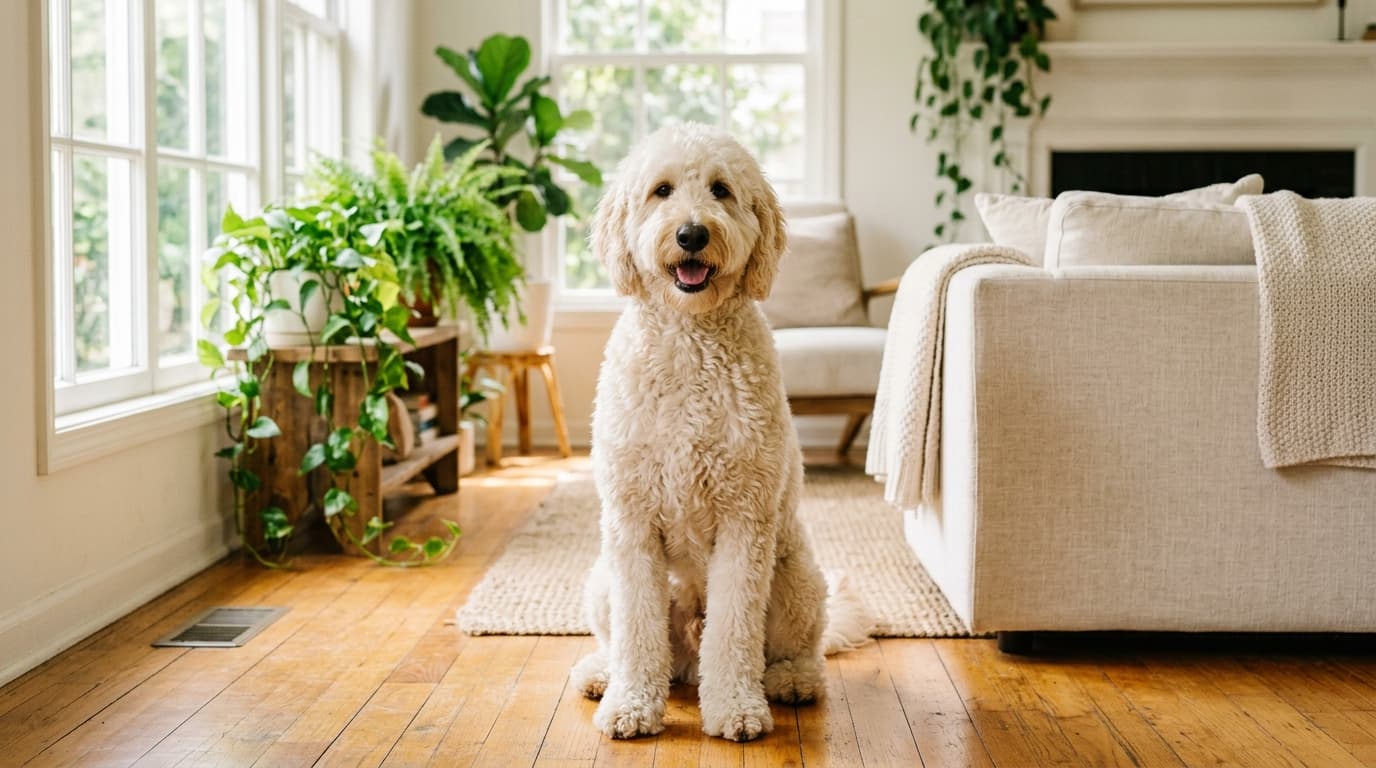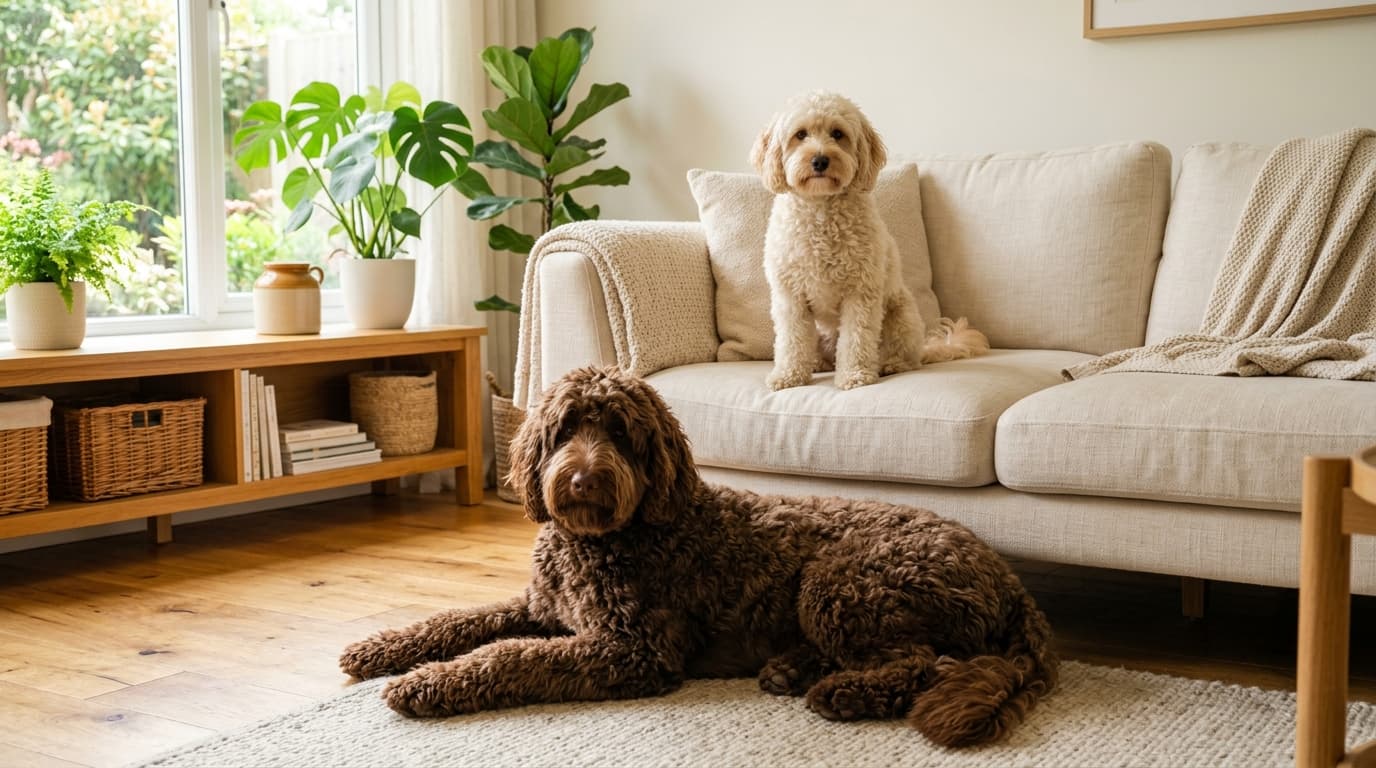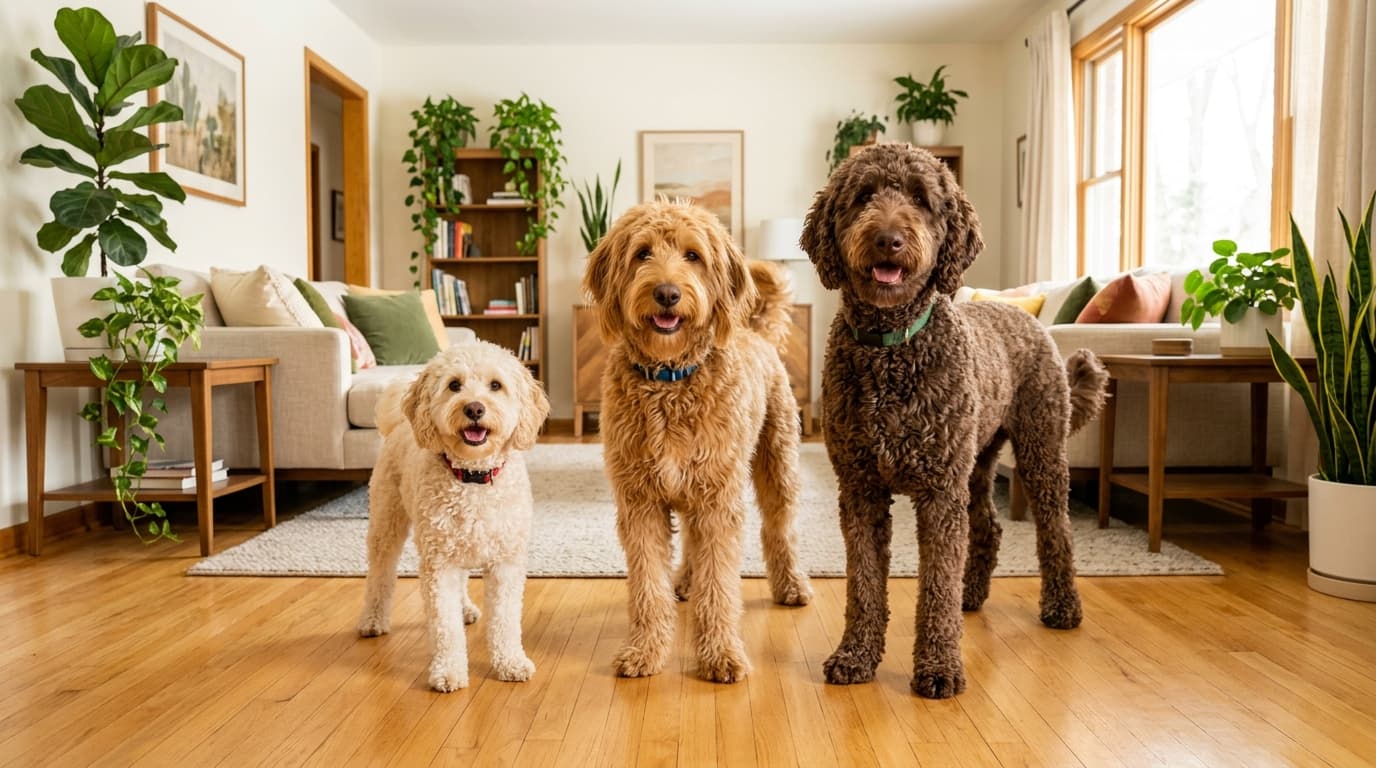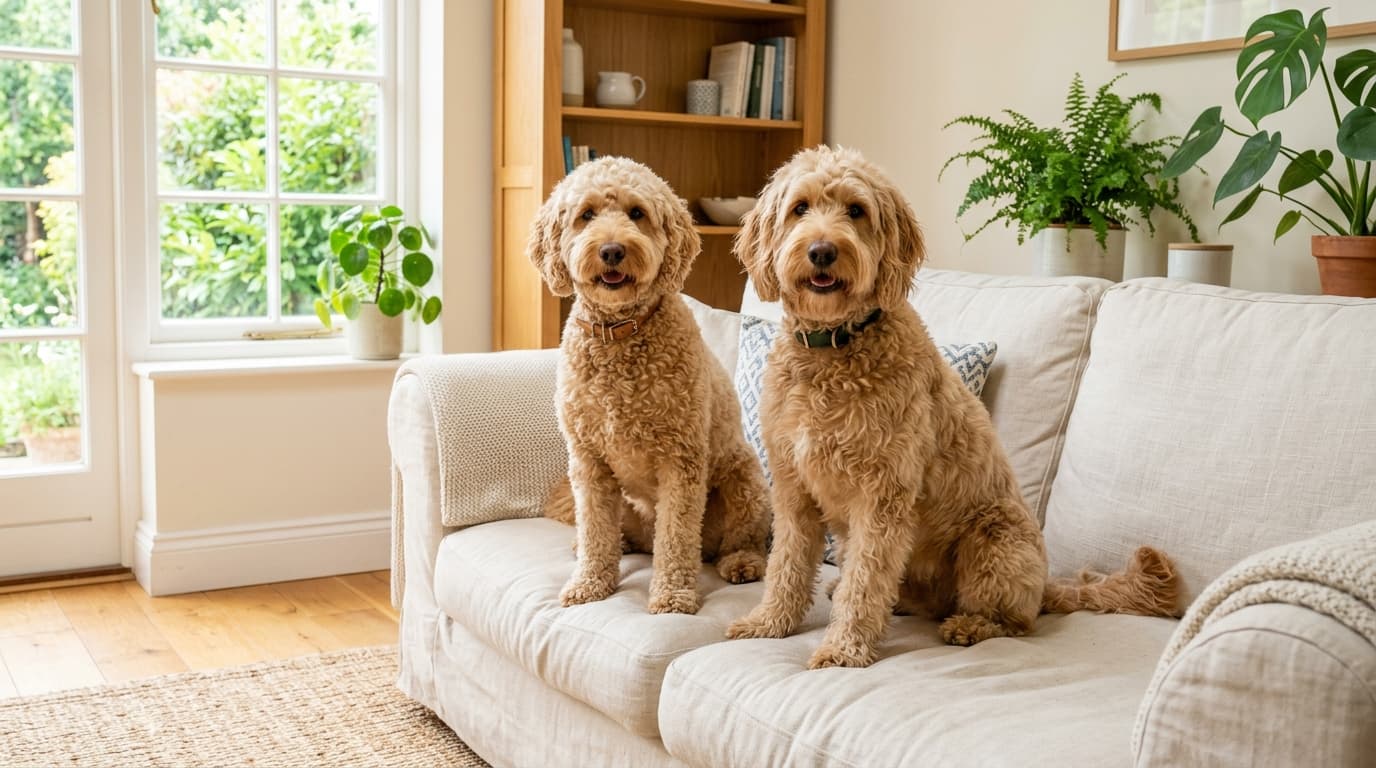
F1 is a first cross between two breeds. F1b is an F1 bred back to a Poodle. F2 is two F1s bred together. Multigen means several generations of doodle-to-doodle breeding. The practical difference is predictability: coat and shedding vary most in F1 and least in multigen, and no generation is a guarantee of a non-shedding dog.
If you are reading a breeder's listing and it says "F1b mini goldendoodle" and you are not sure whether that is good news, this is the page for that. The labels are not marketing fluff; they tell you something real about how likely a puppy is to turn out the way the photos suggest. They just do not tell you as much as people assume.
If you want the size side of this, our adult size predictor asks for the generation and factors it in.
What the labels actually mean
| Label | What it is | Roughly | Coat predictability |
|---|---|---|---|
| F1 | First cross: purebred × Poodle | 50% Poodle | Lowest, a single litter can vary a lot |
| F1b | F1 bred back to a Poodle | ~75% Poodle | Higher; curlier on average |
| F2 | F1 × F1 | ~50% Poodle | Low, and often less predictable than F1 |
| F2b | F2 bred back to a Poodle | ~62% Poodle | Moderate |
| Multigen | Several generations of doodle × doodle | Varies | Highest, when the line is well established |
The b stands for backcross. It almost always means back to the Poodle, because that is the side people are selecting for.
The counterintuitive one is F2. People assume more generations means more consistency, but crossing two F1s reshuffles the deck: an F2 litter can produce puppies ranging from nearly straight-coated to tightly curled. Consistency comes from generations of selection, not from generation number alone.
Why the coat varies at all
The Poodle side brings a curly, continuously growing coat that sheds very little. The other side, Labrador, Golden Retriever, Bernese Mountain Dog, brings a double coat that sheds seasonally. A first cross gets one copy of each parent's genes, and which combination a given puppy inherits is not something the breeder controls.
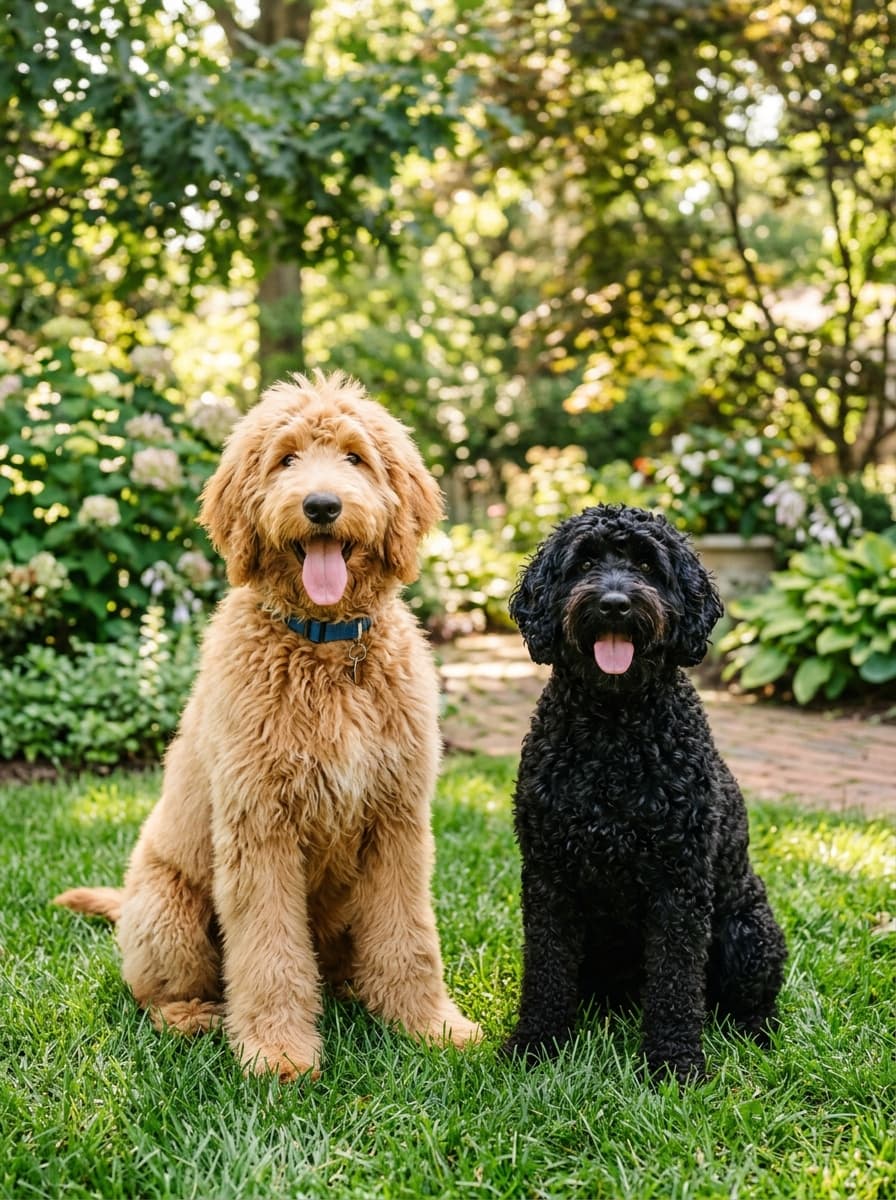
That is why an F1 litter can contain a puppy who barely sheds and a littermate who leaves hair on the sofa. Both are F1 (more in do Goldendoodles shed?). Neither breeder nor buyer did anything wrong.
Backcrossing to a Poodle raises the odds of the curlier, lower-shedding outcome, which is why F1b is popular with allergy-conscious families. The trade-off people forget: a curlier coat mats more and needs more grooming, not less. A low-shedding coat is not a low-maintenance coat, it is the opposite, because the hair that would have fallen out stays in the coat and tangles.
Labradoodle and Australian Labradoodle are not the same thing
This is the distinction most sites get wrong, and it is worth getting right.
A Labradoodle is a cross between a Labrador Retriever and a Poodle. Coat, shedding and size vary by generation and within litters, exactly as described above.
An Australian Labradoodle is a separate multigenerational breed. Its documented background includes other breeds beyond Labrador and Poodle, and it has been bred over many generations specifically for a consistent fleece or wool coat and minimal shedding. That consistency is the whole point of the breed, and it is the reason the two names are not interchangeable.
Calling an Australian Labradoodle "a labradoodle" is not a shorthand, it flattens the thing that distinguishes it. Our three are Australian Labradoodles (their coat types explained), and the difference in coat consistency compared with a first-cross Labradoodle is not subtle.
Which generation should you look for?
It depends on which thing you are optimising for, and there is a real trade-off.
If shedding is the priority, an allergy in the household, or you simply do not want hair everywhere, look at multigenerational lines first, and F1b second. Then ask the breeder what previous litters from that pairing actually produced. That answer is worth more than the label.
If you want a lower-maintenance coat (what each coat needs), an F1 with a wavier coat is often easier to live with than a tightly curled F1b, and you accept some shedding in exchange. This is a genuine trade and plenty of families make it deliberately.
If predictability matters most, you have a clear picture of the dog you want, a well-established multigen line is the most likely to deliver it, because breeders have selected for consistency across generations rather than hoping for it in one.
What generation does not decide
Worth stating plainly, because the labels get asked to carry too much:
- Temperament. Generation is not a personality setting. Socialisation, the parents' temperaments and how the litter was raised matter far more.
- Health. What matters is whether the parents were health tested for the conditions relevant to their breeds, not the letter on the listing.
- Whether your doodle will have a sensitive stomach. This one comes up constantly. The Poodle line does carry a documented predisposition to allergic skin disease and food sensitivities, and that runs through doodle crosses, but it is a predisposition, not a forecast, and it varies between individual dogs far more than between generations. The Merck Veterinary Manual covers atopic dermatitis and food sensitivities in more depth. If you are dealing with it now, start with signs your doodle has a sensitive stomach rather than the pedigree.
FAQ
F1b means an F1 doodle bred back to one of the original breeds, almost always the Poodle. The b stands for backcross. Because that puts roughly three quarters Poodle into the mix, F1b puppies tend to have curlier coats and shed less on average than F1 puppies. It is a tendency across a litter rather than a promise about any individual puppy, and it usually means more grooming rather than less.
On average, generations with more Poodle behind them shed less, so F1b and multigen litters are usually less shedding than F1. But shedding is inherited puppy by puppy, and F1 litters in particular can contain both low-shedding and clearly shedding puppies. No generation is a guarantee. A breeder who has seen previous litters from the same pairing can tell you far more than the generation label can.
No, and the distinction matters. A Labradoodle is a cross between a Labrador Retriever and a Poodle, and its coat and shedding vary by generation and even within a single litter. An Australian Labradoodle is a separate multigenerational breed with other breeds in its documented background, bred over many generations specifically for a consistent fleece or wool coat and low shedding. Using the two names interchangeably is the mistake that owners and breeders notice immediately.
No dog is truly hypoallergenic. Allergic reactions are usually to proteins in dander and saliva rather than to hair itself, so a low-shedding coat reduces how much allergen moves around a house without removing it. Multigenerational lines bred for coat consistency are the most reliable option for an allergy household, but individual reactions still vary and the honest advice is to spend time with the actual dogs from that line before committing.
It can. An F1b is backcrossed to a Poodle, so the size depends heavily on whether that Poodle was a Standard, Miniature or Toy, and F1b litters often land a little smaller than the average of the original pair. Multigenerational lines are generally the most predictable because breeders have been selecting for consistency across generations. Our adult size predictor takes generation into account for exactly this reason.
Where to go next
If you are choosing a puppy, the generation label is a starting filter and the breeder's account of previous litters is the real answer. Ask that question and weigh it above everything on the listing.
If you already have your doodle and you are working out how big they will get, our adult size predictor uses generation as one of its inputs, and how big do doodles get has the size ranges by breed. If you are still deciding between a Mini and a Standard, that comparison is here.