Yes, matting hurts dogs, and often more than owners realize. A mat is hair knotted tight against the skin, and it pulls with every step, stretch and head turn. Severe matting restricts movement and circulation, traps moisture and heat against the skin, and hides hot spots, sores and parasites underneath. Matting is a genuine welfare issue, not a cosmetic one, and when mats are tight to the skin, a clipper shave-down is the kind fix.
That distinction matters because so much doodle grooming talk is about looks, the round teddy-bear face, the fluffy legs. But a mat isn't a styling problem (for the full care routine that keeps the teddy look and the skin healthy, see our doodle grooming guide). It's a physical thing pressing on your dog's skin, all day, every day. In this guide we'll walk through exactly why mats hurt, how to check your own Australian Labradoodle, Goldendoodle or Labradoodle by hand, and when a matted coat is still a confident home job versus a groomer or vet call.
If you already know your dog is matted and just want the practical prevent-and-remove steps, our dedicated guide on doodle matting is the shortcut, this article is the why.
Does matting hurt dogs? Here's what a mat actually does
Picture a knot of your own hair pulled tight at the root and never let go. That's a mat, except your dog can't ask you to loosen it. As the knot tightens and grows, it starts doing real damage:
- It pulls on the skin constantly. Every movement tugs at the mat's anchor points. A dog with mats behind the ears flinches when their head is touched; a dog matted in the armpits or groin can move stiffly because the coat literally tethers the skin.
- It restricts circulation and movement. Large, tight mats, especially a "pelt," where the whole coat felts into one solid layer, press on the skin and limit how freely a dog can move. Air can't reach the skin either.
- It traps moisture, heat and dirt. Under a mat, the skin stays damp and warm. That's exactly the environment yeast and bacteria love, which is a real issue for the poodle-line skin many doodles inherit.
- It hides problems until they're bad. A curly wool or fleece coat already hides the skin. Add mats and you can't see a developing hot spot, a rash, a scab, a tick or a flea infestation until it's advanced.
Because a mat traps damp, warm skin and irritates it, the skin underneath is often red and sore by the time you find it, and once the coat is clear again, that irritated skin needs the right wash to settle. Our roundup of the best shampoo for itchy doodles is the shortcut if you already know you need one for a reactive, easily-irritated coat.
For general, vet-backed guidance on coat and skin care, the American Veterinary Medical Association is a reliable place to start.
The pain owners don't see
Dogs are stoic. They don't limp on a mat or whine about a knot behind the ear the way they would about a paw injury. Instead the discomfort shows up as small, easy-to-miss signs:
- Flinching or pulling away when you touch a matted area
- Skin twitching, or sudden scratching and licking at one spot
- Reluctance to be handled around a matted patch (they've learned it hurts)
- Constant licking of the feet, which, on our boys, is almost always a pad mat
That last one is worth spelling out, because it's the one we deal with most.
Mats between the paw pads: the worst offender
On our two curly-wool boys, Sven and Gunnar, mats between the paw pads are the hardest ones we deal with, and they're the ones that cause the most obvious misery. Hair grows between the pads, felts into a hard little wad, and then presses into the sensitive skin there every time the dog walks. The result is constant paw licking. If your doodle is suddenly obsessed with one foot, part the pads and look before you assume it's an allergy. (If the licking continues once the mat is gone, our guides on itchy paws at night and licking paws after eating go deeper, with Gunnar there's a real yeast and allergy story alongside the grooming one.)
We check and trim between the pads with a small trimmer as part of our routine, and it makes a real difference to how comfortable they are.
How to check your doodle for mats by hand
Brushing alone won't tell you the whole story on a doodle, the brush can glide over the surface while a mat sits down at the skin. We learned this the hard way. Gunnar was our first doodle, and as a puppy his coat was fairly straight, almost fleece-like. We brushed him and thought he was in good shape, but we had a poor brush and not yet the technique, so we were only skimming the surface while believing we reached the skin. His adult coat came in much, much curlier, and the first time we trimmed him ourselves we found he was matted all over underneath, we'd been brushing right over the mats. We had to shave him completely down that first time, and felt terrible about it after trying our best.
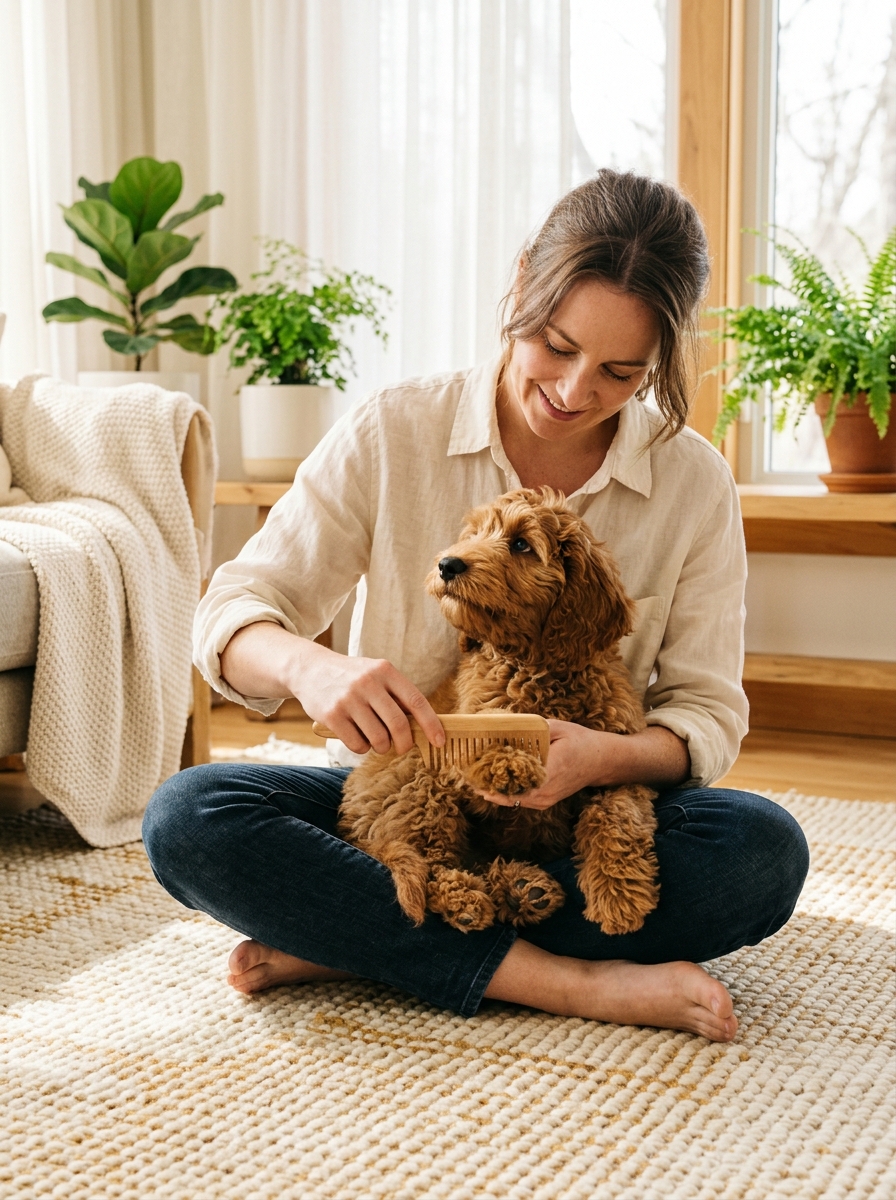
So now we check by hand, daily or several times a week, running our fingers all the way down to the skin in the spots that mat first. On our curly-wool boys we don't brush routinely at all, it never stopped their mats and just made the adult coat frizzy, so the hand-check is the safety net.
The high-friction, high-moisture zones, check every one:
- Behind and under the ears, floppy ears rub here and trap moisture (check the ear itself while you're there, see best ear cleaners for doodles)
- The collar and harness line, anywhere gear rubs
- The armpits (behind the front legs), constant motion, constant friction
- The groin and belly, soft coat, lots of movement
- The base of the tail and the "sanitary" area
- Between the paw pads and around the feet (a yeasty smell here is a different problem, see yeast infection on doodle paws)
You're feeling for a tight knot, or a firm, felted patch that doesn't move freely when you push the coat. A single fresh mat feels like a small tangle you can tease apart, ideally with a little detangling spray; an older one feels like a hard board against the skin.
When we find a single mat, we clip it out ourselves right away, a job that takes seconds when caught early and is genuinely miserable if you leave it for weeks. If you want the shortlist of clippers that handle a curly wool coat, our roundup of the best dog trimmers for doodles is the shortcut, and trimming a doodle at home walks through the technique.
When it's a home job vs. a groomer or vet job
Not every mat is a scissors-out job, but almost all of it can still be done at home with the right tool. Here's how we think about it.
| Situation | Who handles it |
|---|---|
| A single soft tangle, coat still moves at the skin | Home, clip it out or work it loose |
| A few small mats in easy spots | Home, clip them out |
| Tight mats close to the skin | Home, with clippers, never scissors |
| Joined mats or a pelted coat (large areas felted into one layer) | Home, a full clip-down with clippers if you're confident; a groomer if it's widespread or your dog is stressed |
| Red, raw, oozing, smelly or sore skin under a mat | Vet first, then clip |
The line to remember: if the mat is tight against the skin, you cannot safely cut it out with scissors. Scissors near matted skin are how dogs get cut, because the skin tents up into the mat and you can't see where hair ends and dog begins. Tight and pelted mats come off with clippers, working flat against the skin, and a confident owner can absolutely do this at home, as we do. Reach for a groomer if the matting is widespread, your dog is very stressed by handling, or you're simply not sure; reach for a vet if there are sores, redness or broken skin under the mat.
Is it cruel to shave a matted doodle? No, it's the kind choice
This is the part owners agonize over, so let's be clear: when a doodle is badly matted, a clipper shave-down is the humane option, not a punishment.
Here's the logic. Once mats are tight at the skin, "brushing them out" means dragging a tool through knots that are anchored to sore skin, hours of pulling that genuinely hurts your dog. A clean shave releases all of that tension at once and lets you actually see the skin to check for sores, redness and hot spots that the coat was hiding.
The catch is honest: a shaved doodle does not look very "doodle" for the first few weeks. In our house, we've decided that's fine. A dog without mats, whose skin can breathe and be seen, matters more to us than the fluffy look, and the coat always grows back. We'd rather our Australian Labradoodles look a little un-doodle-like for a while than live tethered to their own coat.
Doing the shave-down at home
We do our shave-downs ourselves. For a matted curly-wool coat you need a decent corded clipper, we tried a cordless one and it only coped with our fleece-coated dog's coat, while Sven's and Gunnar's wool was too tough for it, so we use a corded Andis with a #10 blade. Blades get hot with a dense coat, so we keep four #10 blades and swap them as they heat up, especially when we're doing all three dogs in one session. We groom on a table or on the floor, a lick mat keeps them still, and because the boys are more sensitive to handling one of us holds while the other trims the tricky spots; our fleece-coated dog just lets us get on with it. A quality clipper is a real investment, but a professional doodle groom typically runs around $100-150 per visit (check your local prices), with several doodles, a good corded clipper that lasts years pays for itself quickly.
Preventing the shave-down next time
A once-matted-to-the-skin coat is a lesson, not a life sentence. Puppies are most at risk during the coat change, when the shedding puppy coat tangles into the adult one. What works depends on the coat type, and Australian Labradoodle coats vary, curly wool, wavy fleece, and the less common straight hair each behave differently. Our coat-types guide breaks that down, and our matting guide covers prevention in full.
In our own house it splits by coat:
- Our curly-wool boys get a monthly bath with conditioner (how to bathe a doodle), the conditioner is what actually helps against matting, plus hand-checks daily or several times a week, single mats clipped out on the spot, and a full clip-down every 2-3 months (roughly four times a year), sooner if the coat looks rough. We dry them with dog drying robes rather than fighting an hour with an ordinary hair dryer. Routine brushing never stopped their mats and made the adult coat frizzy, so we skip it entirely.
- Our fleece-coated dog is the opposite: thorough, frequent brushing (once the coat has dried a little after the bath and is still slightly damp) keeps him mat-free and lets us keep him long.
For a realistic schedule by coat type, see how often to groom a doodle, and our 12 tips for grooming at home make the routine easier. Many groomers recommend line-brushing every doodle coat, and for a lot of coats that's exactly right, so match the routine to your dog's coat, not to a blanket rule. If your doodle keeps itching right after a groom, that's a separate puzzle we cover in scratching after grooming.
FAQ
Yes. A mat is a tangle of hair knotted tight against the skin, and it pulls with every step, head turn or stretch your dog makes. Bad mats restrict movement and circulation, trap moisture and heat against the skin, and hide problems like hot spots, sores and parasites. A dog living in a heavily matted coat is often in real, ongoing discomfort even if they don't complain about it.
No, the opposite is true. When mats are tight against the skin, brushing them out is what hurts, because every tug pulls on already-sore skin. A clipper shave-down releases that tension instantly and lets you see and treat the skin underneath. A confident owner can do this at home with a good clipper and a suitable blade, as we do. It may not look very "doodle" for a few weeks while the coat grows back, but a comfortable dog matters more than the look.
Friction and moisture spots: behind the ears, the collar and harness line, the armpits, the groin, the base of the tail, and between the paw pads. On our Australian Labradoodles the pad mats are the worst, they lead to constant paw licking. Check all of these by hand daily or several times a week, especially on Goldendoodles and Labradoodles with dense curly coats.
By hand, daily or several times a week, not just when you brush, and for our curly-wool boys we skip routine brushing entirely and rely on the hand-checks. Run your fingers down to the skin in the high-friction zones and feel for tight knots or a felted, board-like patch. Catching a single mat early means you can clip it out in seconds; missing it for weeks means it grows and pulls.
Yes. Mats trap moisture, heat and dead skin against the coat, which is exactly what yeast and bacteria need, and they hide developing hot spots and sores so you don't see them until they're advanced. If you find raw, red, smelly or oozing skin under a mat, that's a call-your-vet situation, not a DIY one.
The bottom line, and where to go next
Mats aren't a grooming style issue, they're a comfort and welfare issue. A matted coat pulls, traps heat and moisture, and hides skin problems your doodle can't tell you about. The two habits that protect against all of it are simple: hand-check the friction zones daily or several times a week, and deal with mats early with clippers instead of letting them tighten to the skin.
Ready to put it into practice? Start with our full doodle matting prevention and removal guide, and if you found sore or red skin under a mat, read up on doodle hot spots before your next groom.