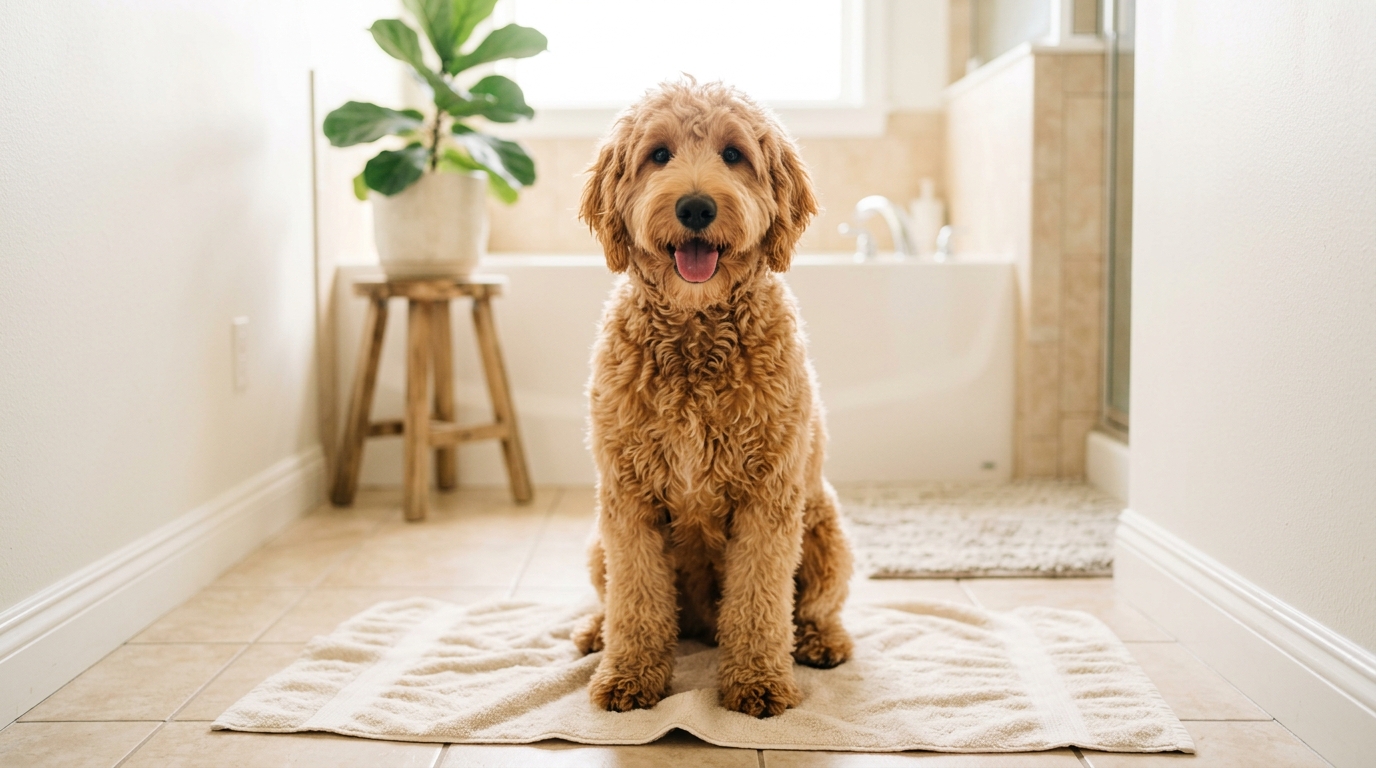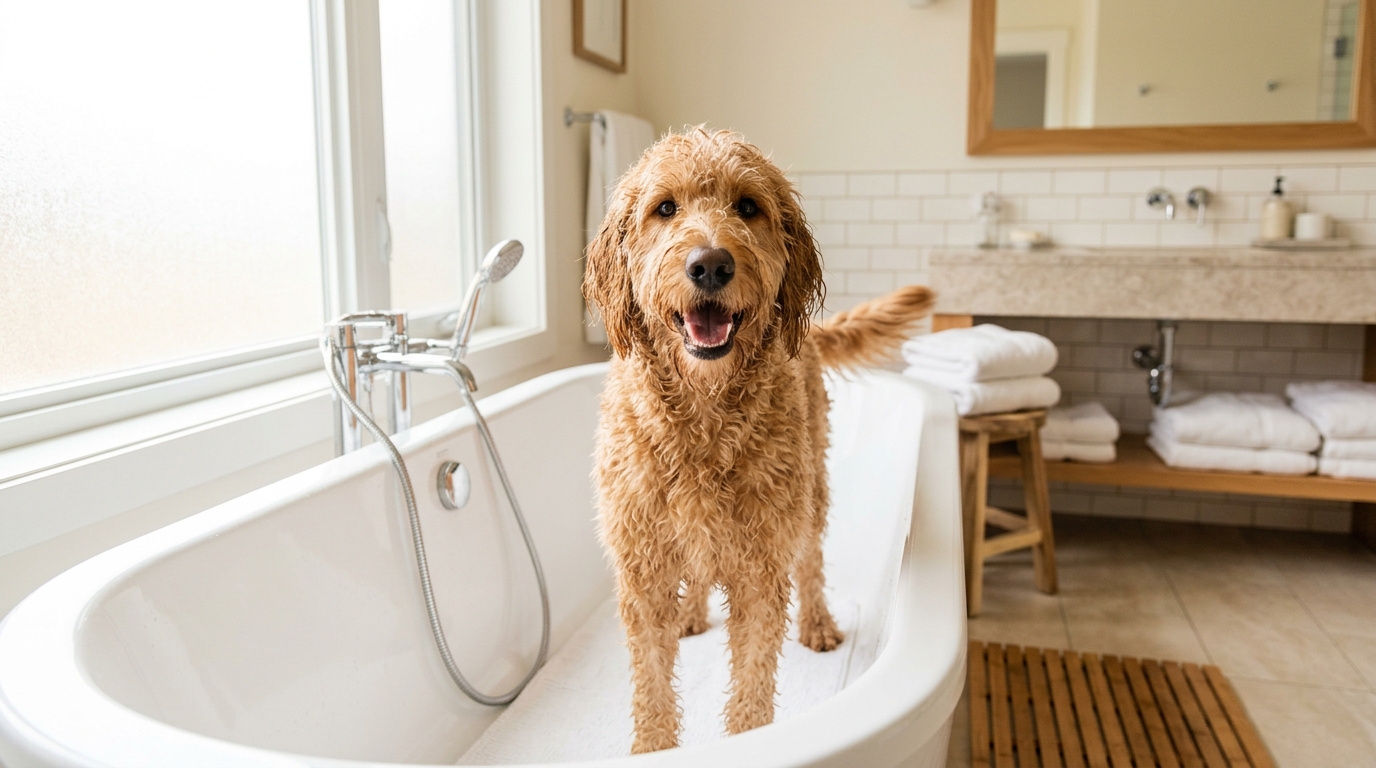
To bathe a Goldendoodle or Australian Labradoodle without making matting worse, work in this order: check for and clip out any mats BEFORE the bath (water tightens mats into felt), wet and shampoo the coat down to the skin in sections, apply conditioner and leave it on for 3-5 minutes, rinse until the water runs completely clear, then dry all the way to the skin. Most doodle coats do well with a bath about once a month.
That order matters more than the product you buy. A doodle's dense curl hides the skin, so it is easy to lather the surface, rinse the surface and dry the surface, and leave the coat closest to the skin dirty, damp and knotting. This is the exact bath routine we use on our three Australian Labradoodles, plus how often to bathe by coat type and when a bath is really a skin-problem question.
If you already know your dog is itchy and you just want the right product, jump to our guide on the best shampoo for itchy doodles, matching the shampoo to the cause matters more than how often you wash.
Before anything: check for mats (water makes them worse)
Water tightens a mat. What was a loose tangle before the bath comes out of the tub as a hard little pad of felt against the skin. So the bath actually starts dry, with a mat check.
On a brushable coat, a wavy fleece Australian Labradoodle, or many Goldendoodles and Labradoodles, brush right down to the skin first and work any tangles out before water touches them. On a curly wool coat, our approach is different: we do not brush our two wool boys at all, we feel through the whole coat by hand and clip out any single mat we find with clippers before the bath.
If you hit tight or pelted mats at the skin, they are shaved off with clippers, never scissors, scissors near the skin cut the dog. A confident owner can do a full clip-down at home; see our doodle matting guide and how to trim a doodle at home for the technique. Only reach for a groomer if the mats are widespread or the dog is stressed, and a vet if there are sores or broken skin under the mat.
The Gunnar lesson: brushing the surface isn't brushing
Gunnar was our first doodle, and he taught us this the hard way. His puppy coat was fairly straight and almost fleece-like, we brushed him, and we thought he was in great shape. But we had a poor brush and not yet the technique, so we were only brushing the surface while believing we reached the skin. As his adult coat came in much curlier, the first time we trimmed him ourselves we found he was matted all over underneath, we had been brushing over the mats and had to shave him completely. If you brush your doodle before a bath, part the coat and check that the brush is actually reaching skin.
For general, vet-backed guidance on coat and skin care, the American Veterinary Medical Association is a reliable place to start.
How to bathe a doodle, step by step
Once the coat is mat-free, here is the actual wash.
- Set up so your dog stays still. In the tub, a lick mat stuck to the wall keeps them happily occupied. For our two more handling-sensitive boys, one of us steadies while the other works.
- Wet the coat to the skin, but keep water out of the ears. This takes longer than you think on a dense curl. Keep working the water in with your fingers until you feel wet skin, not just wet surface. Never let water run into the ears: water trapped in a floppy doodle ear can cause problems. Keep the head tilted down while you rinse the neck, and wash the face and head with a damp cloth instead of pouring water over them.
- Shampoo in sections, down to the skin, with diluted shampoo. We buy shampoo and conditioner as concentrate and mix each in its own dilution bottle. That makes the biggest difference to how easily the shampoo rinses out: diluted shampoo spreads through a dense coat and washes back out, while neat shampoo squeezed onto the back sits on top of the curls and takes endless rinsing. Work a section, massage to the skin, move on. Don't just smooth product over the top of the coat.
- Rinse that shampoo thoroughly before conditioner.
- Apply conditioner and leave it on 3-5 minutes. On a curly or wool coat this is the most important step for matting, more on that below.
- Rinse until the water runs completely clear. Leftover product itches and attracts dirt. Rinse longer than feels necessary, especially the belly, armpits and behind the ears where product hides.
- Squeeze, don't rub. Rubbing a doodle coat with a towel creates tangles. Squeeze water out down the length of the coat instead.
- Dry to the skin (see below).
Should you brush a doodle before or after a bath?
Both answers are correct, it depends on the coat, so here's how it splits across the common coats.
| Coat type | Common in | Brush before or after? | Bath frequency (typical) |
|---|---|---|---|
| Wavy fleece | Australian Labradoodle, many Goldendoodles | Brush thoroughly after, once slightly damp | ~4-5 weeks |
| Curly wool / spiral | Australian Labradoodle, curlier Labradoodles | We don't brush, hand-check + clip mats before | ~4 weeks (once a month) |
| Straight/hair | Less common in all doodles | Brush before, light | As needed |
In our house Gösta has the wavy fleece coat, he must be brushed thoroughly and often, and we do that once his coat has dried a little after the bath and is still slightly damp, which keeps him mat-free and lets us keep him long. Sven and Gunnar have curly wool, and for them brushing the adult coat just made it frizzy (it's like the "curly girl method", one of us has curly hair and never brushes it either). We hand-check them daily instead. Many groomers recommend line-brushing every doodle coat, so if brushing works for your dog, keep doing it. See Australian Labradoodle coat types to work out which coat you actually have.
How often should you bathe a Goldendoodle?
About once a month suits most doodle coats, and that's what our curly-wool boys get. A wavy fleece can stretch a little longer if it's brushed regularly. Bathe more often only if your dog is genuinely dirty or your vet is managing a skin condition, over-bathing with the wrong product strips oils and can make itch worse, not better.
Drying a doodle: get down to the skin
Surface-dry is not dry. A damp undercoat traps moisture against the skin, which is exactly what encourages both matting and yeast, and with floppy doodle ears trapping water, damp is the enemy.
We no longer blow-dry as a routine. With an ordinary hair dryer, drying a doodle coat all the way to the skin can take an hour. What works for us is dog drying robes, bathrobes for dogs, which wick the coat dry while your dog wanders around. A high-velocity grooming dryer is faster and gives a lovely finish at home, but it's a big investment; we compare options in best dog dryers for doodles. We keep the robe on for about an hour, then take it off once it is soaked so the dog doesn't get cold. Gösta's fleece gets brushed once it has dried a little and is still slightly damp.
Don't forget the ears
Keep water out of the ears during the bath, then after every bath dry the ear flaps and use an ear cleaner if your routine includes one, trapped moisture in a floppy doodle ear is a classic setup for trouble. Our best ear cleaners for doodles covers what we use and how often.
When a bath is really a skin-problem question
If your doodle is red, scratching constantly, or the skin looks inflamed, a bath alone won't fix it. The Poodle line carries a real predisposition to allergic skin disease, so itch in a doodle is often more than dirt. Match the shampoo to the cause with best shampoo for itchy doodles, and if the skin is broken or the itch is relentless, that's a call-your-vet situation, not a wash-more-often one. If itch flares specifically after grooming, see doodle itchy after grooming.
FAQ
Most doodles do well with a bath roughly once a month, and that is exactly what our two curly-wool Australian Labradoodles get. A wavy fleece coat can go a little longer between baths as long as it is brushed regularly. Bathe more often only if your dog gets genuinely dirty, smelly or has a skin issue your vet is managing, over-bathing with the wrong product can dry the skin and make itch worse.
It depends on the coat. A brushable coat should be brushed and de-matted BEFORE the bath, because water tightens any mat that is already there. Our fleece-coated dog gets brushed thoroughly once the coat has dried a little and is still slightly damp. Our two curly-wool dogs we do not brush at all, we feel through the coat by hand and clip out any single mat before water ever touches it.
For a curly or wool doodle coat, conditioner is the single most useful part of the bath. In our house the monthly bath WITH conditioner is what helps most against matting, it smooths the coat so hair slides past itself instead of knotting. Leave it on for a few minutes, then rinse thoroughly, because leftover product left in the coat itches.
Dry all the way to the skin, not just the surface, a damp undercoat traps moisture and encourages matting and yeast. We use dog drying robes rather than blow-drying, because an ordinary hair dryer can take an hour to reach the skin. A high-velocity grooming dryer is faster and gives a great finish but is a big investment.
Sometimes a bath with the right shampoo genuinely helps, and sometimes itch is a skin-problem question that a bath alone will not fix. If your doodle is red, scratching constantly, or the skin looks inflamed, match the shampoo to the cause and talk to your vet rather than just bathing more often.
Your next step
Get the mat check right before you ever run the water, that one habit prevents more grooming problems than anything else. If you want the full de-matting method, including how we shave out a tight mat at home safely, read doodle matting: how to prevent and remove mats next.