Diet can completely fix a doodle's skin problem when the cause is a true food allergy or gut-linked yeast, remove the trigger and the itch resolves. Omega-3 fatty acids reliably improve any dog's skin barrier. But diet only partly helps environmental (atopic) allergies, and it won't touch problems caused by grooming reactions, fleas, or moisture trapped in floppy ears. The trick is figuring out which camp your doodle is in before spending money.
So if you're standing in the pet aisle wondering whether a $90 bag of allergy food will finally stop the scratching, this is the honest triage guide I wish someone had handed us years ago. We live with three doodles, Sven, Gunnar, and Gösta, and skin and coat questions come up constantly in a curly-coated household. Below is a clear decision framework: when diet will fix it, when it only helps, and when it won't help at all.
The short version: three buckets
Every doodle skin problem falls into one of three buckets, and your realistic expectations depend entirely on which one you're dealing with.
| Cause of skin issue | Will diet fix it? | What diet actually does |
|---|---|---|
| True food allergy | Yes, can fully resolve | Removing the trigger protein stops the reaction |
| Gut-linked yeast overgrowth | Often, largely | Reduces sugar/carb fuel, supports gut, calms flares |
| Essential fatty acid deficiency | Yes | Adding omega-3s rebuilds the skin barrier |
| Environmental / atopic allergy | Partly | Lowers total itch load; won't remove pollen |
| Fleas, mites, grooming reaction | No | Diet is irrelevant to the actual cause |
| Moisture-trapped ear infection | No (support only) | Ear anatomy and hygiene are the real drivers |
Keep this table in mind as we go. Most of the frustration owners feel comes from throwing food at a problem that lives in bucket four, five, or six.
When diet WILL fix it
True food allergies
This is the clearest win. In a genuine food allergy, your doodle's immune system reacts to a specific protein, most often chicken, beef, or dairy. The classic doodle picture is itchy paws, a red belly, recurring ear gunk, and sometimes soft stool. Remove the offending protein and, given enough time, the skin calms down for good. The Merck Veterinary Manual makes the same point that food allergies are diagnosed and managed by identifying and eliminating the offending ingredient.
Doodles are worth taking seriously here because both parent lines carry food-sensitivity tendencies. If you want the breed-specific background, we cover it in Are Doodles Prone to Allergies?. And it genuinely matters whether you're dealing with an allergy or a milder intolerance, they look similar but respond differently, which we break down in Food Allergy vs Food Intolerance in Doodles.
The two proteins we see blamed most in doodles are chicken and beef. Both have dedicated guides: Chicken Allergy in Doodles and Beef Allergy in Goldendoodles.
Gut-linked yeast
If your doodle has that musty, corn-chip smell, greasy paws, or brown ear buildup, yeast may be part of the story. Yeast feeds on sugars, and a gut that's out of balance can let it flourish. Diet helps here by cutting the fuel and supporting a healthier gut microbiome, often alongside topical care and, when needed, medication. Yeast and allergy overlap so often that it's worth learning to tell them apart: see Allergy vs Yeast Infection in Doodles and, for paws specifically, Yeast Infection on Doodle Paws.
Essential fatty acid support
Even a dog with no allergy can have a dull, flaky, itch-prone coat if the diet is short on omega-3s. This is the one diet lever that helps essentially every dog. EPA and DHA calm skin inflammation and rebuild the barrier that keeps irritants out. We treat fish oil as foundational, not optional, details in Best Omega-3 for Doodle Skin Health.
When diet only HELPS (but won't cure)
Environmental / atopic allergies
Here's the reality check most owners need: pollen, grass, dust mites, and mold are the most common causes of chronic itch in dogs, and diet cannot remove them. If your doodle flares seasonally, itches worse after walks, or licks paws year-round in a dusty house, you're likely dealing with atopy.
Does that mean food is pointless? No. A dog fighting environmental allergens is already at a high "itch threshold." A clean diet plus omega-3s lowers the total inflammatory load, so it takes more to push your dog over the edge into scratching. Think of it as raising the floodwall, not stopping the rain. For the bigger picture on chronic cases, read Why Is My Doodle Itchy All the Time? and Chronic Itching in Doodles.
Ear infections in floppy-eared doodles
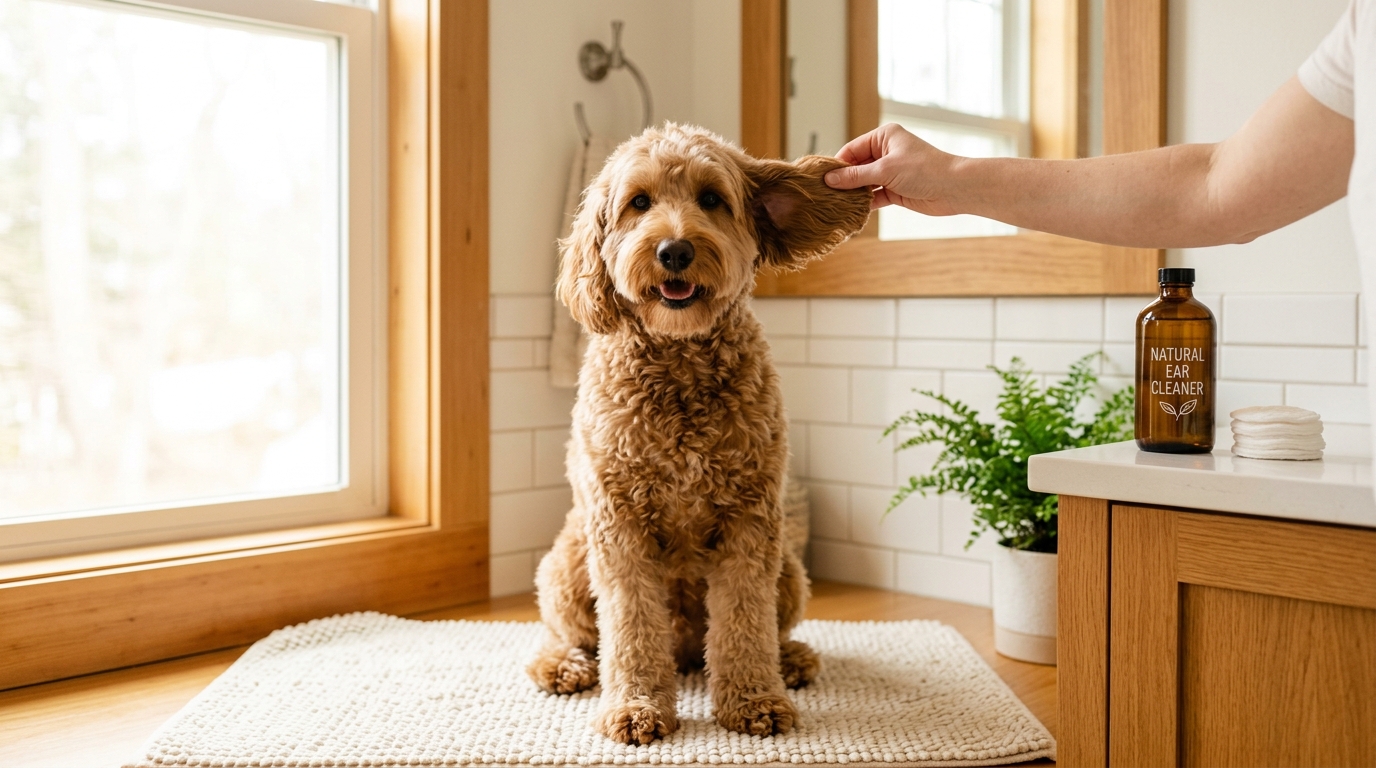
Doodle ears are a design problem. Those adorable floppy, hairy ears trap warmth and moisture, the perfect environment for yeast and bacteria. If a food allergy is feeding recurring ear infections, diet helps. But the anatomy and hygiene are the real drivers, so diet is support, not a cure. Regular drying after baths and swims matters more than most food swaps here.
When diet WON'T help at all
Be honest with yourself before spending money on prescription food. Diet does nothing for:
- Fleas and mites, even one flea bite can set off an allergic dog. Rule out parasites first, always.
- Grooming reactions, clipper irritation, shampoo residue, or a too-close shave. We cover this in Doodle Scratching After Grooming.
- Hot spots that have already erupted, an active hot spot needs treatment now; diet won't heal an open sore fast enough.
- Contact irritation, new lawn treatment, a wool blanket, harsh cleaning products.
How to actually test the food connection
If you suspect food, guessing at ingredient labels is a waste of time, many "limited ingredient" foods still contain trace proteins. The only reliable test is a proper elimination trial.
The elimination diet
You feed one novel protein (something your dog has never eaten, think rabbit, venison, kangaroo) or a hydrolyzed diet, and nothing else for 8-12 weeks. No treats, no flavored chews, no table scraps, no flavored supplements. One cheat resets the clock. If the skin clears, you've found your answer; you then reintroduce old proteins one at a time to confirm the trigger.
This is genuinely hard in a multi-dog house. With three doodles, we've learned to feed separately and sweep the floor between meals, because Gunnar is a champion at hoovering up whatever Sven leaves behind. Our full step-by-step is in Elimination Diet for Doodles, and the broader roadmap lives in Food Allergies in Doodles: The Complete Owner's Guide.
Novel protein vs hydrolyzed
- Novel protein foods use a single new protein the immune system hasn't reacted to yet. Great when you know your dog hasn't eaten it before.
- Hydrolyzed foods break protein into pieces too small for the immune system to recognize. Useful when you're not sure what your dog has been exposed to. We weigh the pros, cons, and cost in Hydrolyzed Dog Food for Doodles: Is It Worth It?.
For everyday shopping, our vetted picks are in Best Limited Ingredient Dog Food for Doodles and, for goldendoodles specifically, Best Food for Goldendoodle With Allergies.
Watch the paws and the poop
Two of the earliest signals of a food problem show up away from the skin. Post-meal paw licking is a classic tell, see Doodle Licking Paws After Eating. And chronic soft stool alongside itch points toward a gut-and-skin connection worth investigating; Doodle Soft Stool But Acting Normal helps you gauge whether it's worth worrying about.
The gut, skin connection (why food matters even when it's not the "cause")
Even when food isn't the trigger, gut health influences skin because so much of the immune system lives in the gut. A balanced microbiome supports a calmer immune response and a stronger skin barrier. This is why we lean on quality food plus, when it helps, a good probiotic, our current thinking is in Best Probiotics for Doodles with Digestive Issues and the Gut Health Supplements hub.
This is also the strongest argument for feeding a clean, appropriate diet regardless of the itch's origin: you're building a more resilient dog. It's a big part of why we feed the way we do, you can read about that in our feeding philosophy.
Your decision framework, in plain steps
- Rule out fleas and mites first. No exceptions. This is the cheapest, fastest thing to eliminate.
- Check for infection or hot spots. Open sores, strong smell, or ear gunk → vet before diet.
- Add omega-3s regardless. They help every category, so start here while you investigate.
- Assess the pattern. Seasonal or walk-related itch = likely environmental (diet is support). Year-round itch with ear/belly/paw involvement and gut signs = worth an elimination trial.
- Run a strict elimination diet for 8-12 weeks if food is plausible. No cheating.
- Judge honestly. Cleared up? Food was the cause. No change? Move on to environmental management with your vet.
FAQ
Sometimes yes, sometimes no. If the itch is driven by a true food allergy, removing the trigger protein can resolve the skin problem completely. Gut-linked yeast often improves dramatically with diet and gut support too. But environmental allergies, flea bites, grooming reactions, and moisture-trapped ear infections are not caused by food, so diet only supports the skin barrier rather than curing the issue. The honest answer is that diet fixes food-driven problems and reduces symptoms in everything else.
Skin turns over slowly, so give any food change 8 to 12 weeks before judging it. A proper elimination diet needs a strict single novel or hydrolyzed protein with zero cheating for that full window. Omega-3 supplements also take about 6 to 12 weeks to noticeably improve coat and reduce inflammation. If you see no change at all after 12 weeks of strict feeding, the cause is probably not food.
It can, but it is not the most common cause. True food allergies affect a minority of itchy dogs; environmental allergens like pollen and dust mites are far more common. That said, doodles carry sensitive-stomach and food-sensitivity tendencies from their poodle and retriever lines, so food is always worth ruling out. The fastest way to know is a strict elimination diet rather than guessing based on ingredient labels.
Omega-3s help almost every itchy dog to some degree because EPA and DHA reduce skin inflammation and strengthen the skin barrier. They rarely cure an allergy on their own, but they lower the overall itch load and improve coat quality, which is why we consider them foundational rather than optional. Give them 6 to 12 weeks and dose by your dog's weight with your vet's guidance.
See a vet if your doodle has open sores or hot spots, a strong yeasty or musty smell, recurring ear infections, hair loss, bleeding from scratching, or any itch that is disrupting sleep. These often need medication to break the cycle, and diet alone will be too slow. A vet can also help you run a proper elimination diet and rule out mites, fleas, and infection.
Your next step
If your doodle's itch fits the food-driven pattern, year-round scratching, itchy paws, a red belly, recurring ears, maybe some soft stool, the highest-value move is a properly run elimination trial. Start with our Elimination Diet for Doodles: Step-by-Step Plan, and while you investigate, get the omega-3 foundation in place so you're helping the skin barrier no matter what the trigger turns out to be. And if things look infected or the itch is disrupting sleep, that's a vet visit, not a food swap.
You can also browse everything we've written on itch and coat in the Itchy Skin & Paws hub.