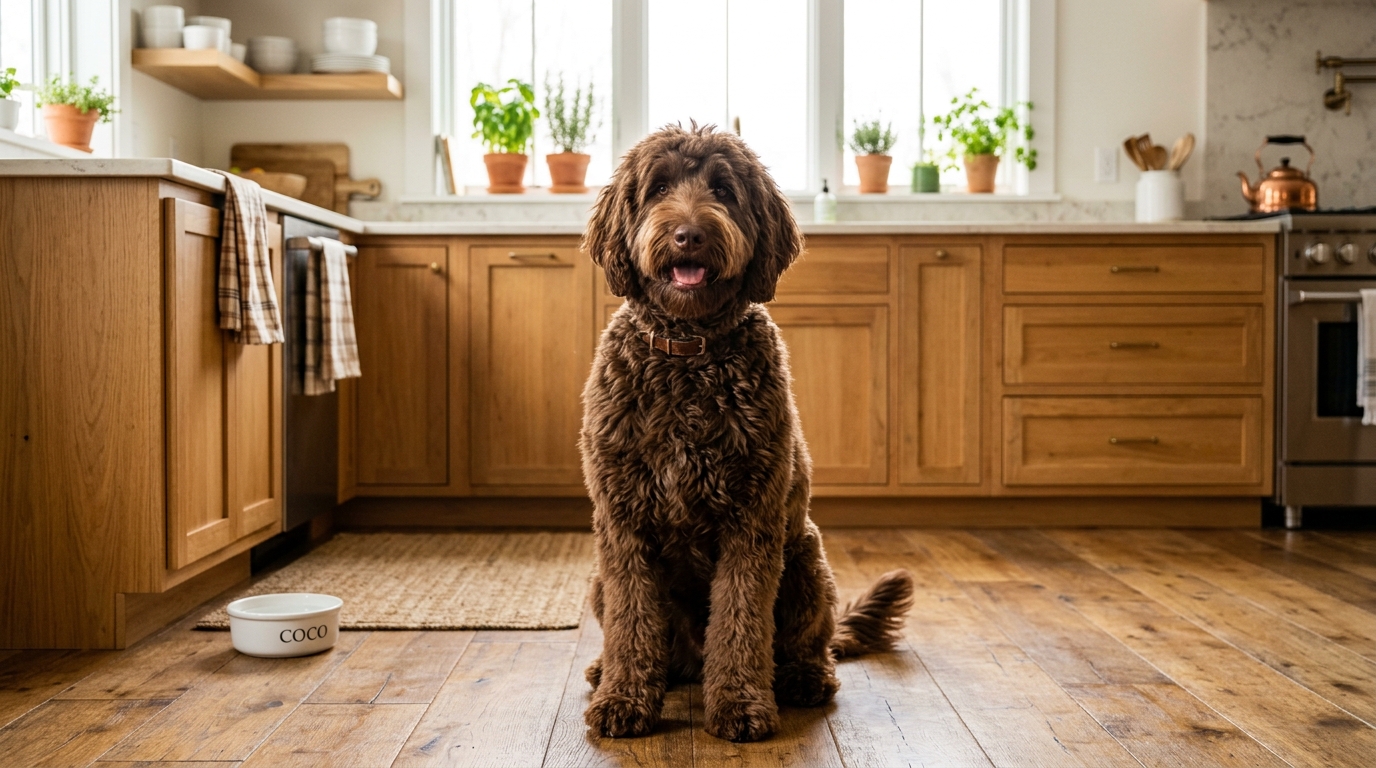
Are doodles hypoallergenic? No, and this is the honest answer that matters most: no dog is fully hypoallergenic, and that includes every doodle. Dog allergens like Can f 1 live in dander, saliva and urine, not just in shed hair, so even a low-shedding Goldendoodle or Australian Labradoodle still produces them. A low-shedding coat may spread less dander around your home, but it does not remove allergens, and individual dogs vary far more than breeds do.
That is the careful, cite-worthy version. But if you or someone in your family is allergic to dogs, "no" is not the end of the conversation, it is the start of a better one. Plenty of allergic people live happily with a doodle. The trick is understanding what you are reacting to, testing your response to the specific dog, and setting up a home routine that actually keeps allergen levels down. (And if your real worry turned out to be your dog's allergies rather than your own, our roundup of the best allergy supplements for doodles is the shortlist for the impatient reader.)
For general, vet-backed guidance on living with pets and allergies, the American Veterinary Medical Association is a reliable place to start.
We live with three multigenerational Australian Labradoodles, Sven, Gunnar and Gösta, in a family where our son has asthma and allergies and one of us adults is allergic to dogs, so this question is personal for us. This guide walks you through the science calmly, shares what has and hasn't worked in our house, and then gives you a clear decision checklist.
What "hypoallergenic" actually means (and doesn't)
The word hypoallergenic means "less likely to cause an allergic reaction," not "allergen-free." No living animal that produces dander, saliva and urine can be allergen-free, because those are the sources of the allergens themselves.
The main dog allergens are proteins, most famously Can f 1, along with several others. They are secreted in saliva and skin oils, shed with dander (microscopic skin flakes), and present in urine. When a dog licks its coat, saliva-borne allergen dries onto the hair and skin and then disperses into the air and onto surfaces. Hair itself is not really the allergen, it is a carrier for it. The American Academy of Allergy, Asthma & Immunology (aaaai.org) makes the same point: pet allergy is driven by proteins in dander, saliva and urine rather than by the fur itself.
This is the core reason a low-shedding coat cannot make a dog hypoallergenic in the true sense:
- A dog that sheds less may distribute less allergen-laden hair and dander around your home (how much doodles really shed is covered in do Goldendoodles shed?).
- But the dog is still producing allergen constantly through skin and saliva.
- How much any individual dog produces and spreads varies enormously, more than the breed label suggests.
Are Goldendoodles and Labradoodles hypoallergenic?
Because both crosses have Poodle in them, Goldendoodles, Labradoodles and Australian Labradoodles are frequently sold as hypoallergenic. Here is the honest breakdown, breed by breed, without conflating them.
Are Goldendoodles hypoallergenic?
Goldendoodles (Poodle × Golden Retriever) are often lower-shedding than a purebred Golden, and a tightly curled Goldendoodle can shed very little. But coat type varies a lot: a wavier, more Retriever-like coat sheds and spreads more dander than a curly one. A Goldendoodle is not reliably hypoallergenic; the individual dog and its coat decide far more than the breed name. (Coat and shedding are their own topic, for shedding-adjacent care see Doodle Matting.)
Are Labradoodles hypoallergenic?
Labradoodles (Poodle × Labrador) and especially Australian Labradoodles, a distinct multigenerational cross bred specifically for consistent low-shedding fleece and wool coats, tend to be among the lower-shedding doodles. Australian Labradoodle breeders have selected for coat consistency over generations, which is why their coats are often more predictable (see Australian Labradoodle coat types). Even so, "lower-shedding" is not "allergen-free." Some allergic people do well with a curly Labradoodle; others react regardless.
The bottom line for all three: a hypoallergenic doodle is a marketing phrase, not a guarantee. If you already know you're allergic and want the practical route, the most useful thing you can do next is understand how coat type varies by generation.
Coat type and generation change the picture
This is where doodles genuinely differ, and it is worth understanding before you meet a litter.
Doodle coats generally fall into three loose categories:
- Curly/wool: tight curls, closest to a Poodle, usually the lowest-shedding.
- Fleece/wavy: soft waves, moderate shedding, the classic "teddy bear" look.
- Straight/hair: flatter coat, more like the Retriever or Lab parent, tends to shed more.
Which coat a puppy gets is influenced by generation (F1, F1b, F2, multigen) and the odds shift with each. An F1b (one Poodle backcross) or a multigen Australian Labradoodle is statistically more likely to carry a curlier, lower-shedding coat than a first-cross F1, though nothing is certain in any single puppy. We cover the whole F1/F1b/F2/multigen picture in Doodle Generations Explained, and it is genuinely worth reading before you choose a breeder.
What the research actually shows
Here we have to be careful, because this is a health decision and the honest answer is more nuanced than the marketing.
In general terms, studies that have measured dog allergen levels in real homes have not found that so-called hypoallergenic breeds reliably produce lower household allergen levels than other breeds. Shedding and allergen production vary so much between individual dogs that the breed label turns out to be a poor predictor of how much allergen ends up in your carpet, sofa and air. The American College of Allergy, Asthma & Immunology (acaai.org) likewise notes that no dog breed is truly hypoallergenic and that allergen levels do not track neatly with breed.
That does not mean coat type is meaningless for you. It means two things:
- Averages hide huge individual variation. One curly Labradoodle might leave far less allergen in your home than another; the label alone won't tell you which.
- Your own reaction is the only test that matters. A dog that a study calls average might be one you tolerate beautifully, or not.
This is exactly why allergists steer people toward testing their personal response to the actual dog, rather than trusting a hypoallergenic claim. No invented numbers here, just the honest state of things.
Doodle allergies in humans: the decision checklist
If someone in your household reacts to dogs, don't guess. Work through this before you bring a doodle home.
How to test your reaction before you commit
The most reliable thing an allergic family can do is simple: spend real time with doodles before you bring one home, and watch how your body responds. A quick cuddle in a parking lot tells you very little. What you want is hours, indoors, more than once.
- Visit the breeder, if they allow it. Many responsible breeders welcome a visit, and it lets you meet the parents and the adult dogs in a home setting, which is much closer to daily life than a short puppy pickup.
- Go to doodle meetups and dog playdates. Local doodle groups and owner meetups are a great way to spend an afternoon among several Labradoodles, Australian Labradoodles or Goldendoodles at once, and to see whether you react to some dogs and not others.
- Spend time with friends' doodles at their home. Sit on the sofa, let the dog greet you properly, and stay a few hours rather than a few minutes.
- Let the dog be a dog. Licks and kisses are part of living with a doodle, and saliva carries allergen, so a test where the dog never touches you can be misleading.
- Notice how you feel later that day and the next morning, not only in the moment. Symptoms such as a runny nose, itchy eyes or a tight chest don't always show up straight away.
If someone in the family has asthma, do this alongside an allergist, not instead of one. And remember that one good afternoon with one dog is encouraging, not a guarantee: reactions are individual, which is exactly why testing with the actual dogs matters more than any label.
A home routine that keeps allergens down
The single most useful mindset shift: you are not managing "hair," you are managing dander and saliva-borne allergen. That reframes what actually helps.
| Strategy | Why it helps | How often |
|---|---|---|
| Regular bathing | Rinses saliva/skin allergen off the coat | About once a month, with a conditioner (how to bathe a doodle) |
| Brushing/grooming | Removes loose dander before it disperses; prevents matting | Depends on the coat: brush a fleece coat often; hand-check a curly wool coat for mats |
| HEPA air purifier | Captures airborne allergen particles | Run continuously in main rooms |
| Vacuum with HEPA filter | Lifts settled dander from floors and furniture | 2-3× per week |
| Wash dog bedding | Dog beds are allergen reservoirs | Weekly, hot wash |
| Dog-free bedroom | Gives the allergic person clean sleep air | Always |
| Hand-washing after petting | Reduces transfer to face and eyes | Every time |
Grooming a doodle is not optional anyway: the coats that owners hope will be "hypoallergenic" are exactly the coats that mat if you neglect them. Our Doodle Matting guide covers keeping a curly or fleece coat healthy, which doubles as allergen control, and the doodle grooming guide has the full routine.
Our experience: an allergic family with three Australian Labradoodles
All three of ours are multigenerational Australian Labradoodles, and allergies were part of the decision from the start: our son has asthma and allergies, and one of us adults is allergic to dogs. In everyday life, neither of them reacts to our three. We know that is our experience, not a promise, and we would never tell another allergic family it will go the same way for them.
The clearest proof of how individual this is comes from a close family member who is also allergic to dogs. Sven loves to give kisses, and when he licks her she can get symptoms, a runny nose and the rest. That is the saliva allergen in action, exactly the Can f 1 point above: no coat type changes what is in a dog's saliva. For her, close contact with saliva matters far more than the coat.
What we can say plainly about shedding: nothing drops on our floors. The hair does come out, every coat renews itself, but it stays in the coat until it comes out in brushing, the bath or the clip, so we don't find dog hair on the sofa or in the corners. Gösta's wavy fleece is brushed thoroughly and often (with the tools in best brushes for doodles); Sven's and Gunnar's curly wool coats are kept short, hand-checked for mats and bathed monthly with a conditioner. That same routine keeps dander from building up around the house.
So our honest summary: it works for us, it does not work the same way for everyone, and an allergic person's reaction to the specific dog is the only test that counts. Routine matters more than breed label, and if someone in your family has asthma, involve the allergist as described above.
Human allergies vs. your dog's allergies, don't confuse the two
One quick clarification, because these searches overlap. This article is about human allergies to dogs, you reacting to your doodle. That is completely different from your doodle having food or skin allergies, which is a separate and common issue in the Poodle line (Poodles carry a documented predisposition to allergic skin disease and food sensitivities, and that trait can pass to doodles).
If you landed here worried about your dog itching, licking paws or reacting to food, start with our Food Allergies hub instead. If a supplement might help calm your dog's skin, our roundup of the best allergy supplements for doodles is the shortlist for the impatient reader. For the human-allergy question, keep reading.
So should an allergic family get a doodle?
Maybe, and that "maybe" is the honest answer, not a cop-out. Here's how we'd frame the decision:
- A doodle can be a reasonable choice for a family with mild dog allergies who are willing to meet the individual dog first, choose coat and generation thoughtfully, and commit to a real cleaning-and-grooming routine.
- A doodle is not a safe bet if you're relying on the word "hypoallergenic" to protect someone with significant dog allergies or asthma. No coat can do that.
The best predictor of how you'll do isn't the breed (Goldendoodle, Labradoodle or Australian Labradoodle), it's your own reaction to the specific animal, plus how consistently you keep your home clean.
FAQ
No dog is fully hypoallergenic, and doodles are no exception. Dog allergens such as Can f 1 are found in dander, saliva and urine rather than only in shed hair, so even a low-shedding Goldendoodle or Australian Labradoodle still produces them. A low-shedding coat may spread less dander around the home, which can help some allergic people, but it does not remove the allergens and results vary a great deal from dog to dog.
Goldendoodles are often marketed as hypoallergenic because of their Poodle parentage and low-shedding fleece or curly coats, but no Goldendoodle is truly allergen-free. Coat type varies by generation, and a wavier, more Golden-Retriever-like coat can shed and spread more dander than a tight curly one. The only reliable test is spending real time with the specific dog before you commit.
Labradoodles and Australian Labradoodles are lower-shedding than many breeds thanks to their Poodle lineage, but they still produce dander, saliva and urine allergens. Some allergic people tolerate a tightly curled Labradoodle well; others react regardless of coat. Meet the individual dog, ideally more than once, and involve your allergist before making a decision.
In general, studies measuring dog allergen levels in homes have not found that so-called hypoallergenic breeds reliably produce lower household allergen levels than other breeds. Shedding and dander spread vary widely between individual dogs, so breed label alone is a poor predictor. This is why allergists recommend testing your own response to the actual dog rather than relying on a hypoallergenic claim.
Spend time with the specific dog first, choose a coat type and generation that suits you, and commit to a consistent grooming and cleaning routine: regular bathing and brushing, HEPA air filtration, frequent vacuuming, washing dog bedding, and keeping the dog out of the allergic person's bedroom. Talk to an allergist about testing and management, and never rely on the word hypoallergenic alone.
Your next step
If you're leaning toward a doodle, the most useful thing you can read next is Doodle Generations Explained, it shows how F1, F1b, F2 and multigen shift the odds on coat type and shedding, which is the closest thing to a lever you have on allergen spread.
And if your real question turned out to be about your dog's allergies rather than your own, head to our Food Allergies hub or read Are Doodles Prone to Allergies? for the breed-specific picture. Either way, the same principle holds: know the individual dog in front of you, and build a routine you can actually keep.