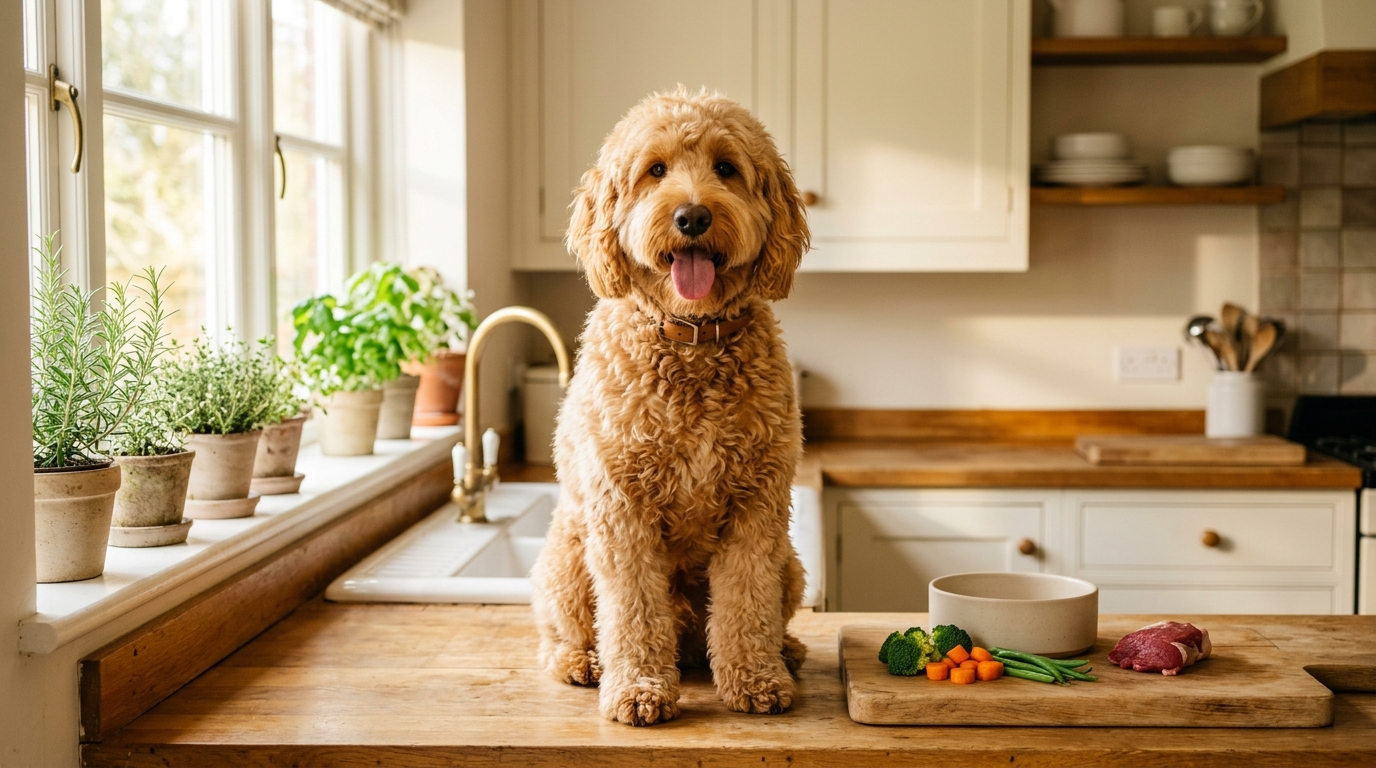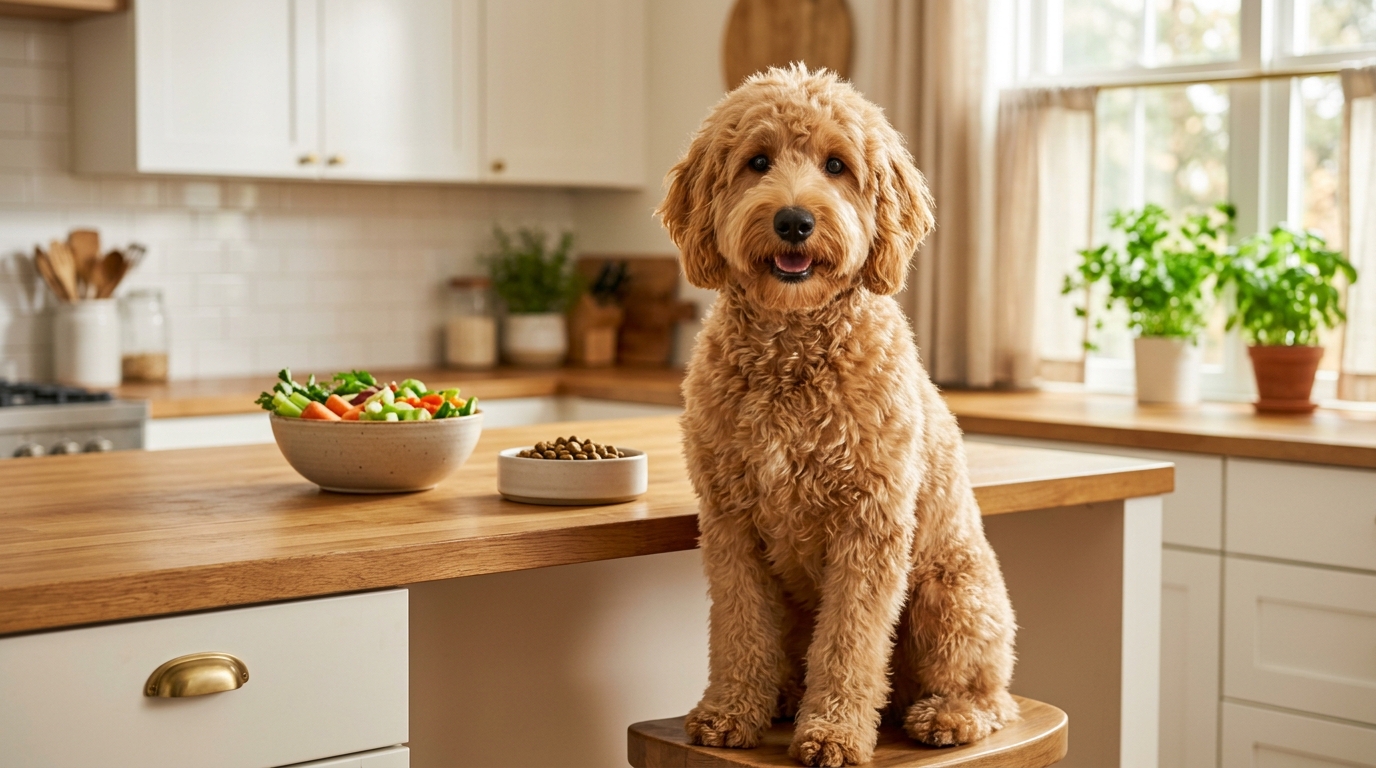
If your doodle has a sensitive stomach, itchy skin, or food intolerances, neither kibble nor fresh food wins across the board. Fresh or gently cooked food is usually easier to digest, much higher in moisture, and lighter on the carb and fiber load that drives gas and loose stool, so it often helps sensitive stomachs, allergies and picky eaters. A premium, limited-ingredient kibble is perfectly fine for many doodles and far more convenient. What actually settles the gut is the right ingredients and a slow transition, not the format alone.
We feed raw at home for our three Australian Labradoodles, with premium kibble and freeze-dried raw when we travel, so we have lived on both sides of this question. What follows is an honest comparison on the things that actually matter for a sensitive doodle: digestibility, moisture, ingredient quality, carb and fiber load, cost, convenience, and how each format behaves with loose stool, gas and yeast-prone skin. Then a simple decision framework and a hybrid option, because the real answer is rarely all-or-nothing.
If you already know you want fresh or limited-ingredient food and just want the shortlist, our best dog food for doodles and limited ingredient picks are the shortcuts.
Kibble vs fresh food for sensitive dogs: the honest short answer
There is no single "best food type for a sensitive doodle" that applies to every dog. The format is a starting point, not a cure.
- Fresh or gently cooked food tends to win on digestibility, moisture and simplicity. For a doodle with ongoing loose stool, gas, or a suspected food intolerance, that often translates to a calmer gut.
- Premium kibble wins on convenience, cost, shelf life and consistency. A well-made, limited-ingredient kibble suits a large number of sensitive doodles with no trouble at all.
The dog in front of you decides. Our Sven, the most sensitive stomach of our three, threw up bile every single morning through his whole first year and went loose after every food change. Going raw ended the morning bile for him, and that experience shapes how we think. But we would never tell you that every doodle needs fresh food, because plenty do beautifully on a good bag of kibble.
Digestibility: fresh vs dry food, what the gut actually sees
Digestibility is how much of the food the dog's body can actually absorb rather than pass out the other end. It is where fresh food has its clearest edge for sensitive doodles.
Kibble is cooked at high heat and extruded, which makes it shelf-stable but also means it has to be built around starch to hold the shape. Fresh and gently cooked diets are made with less processing and usually less starch. For many sensitive guts, that means a more complete breakdown, smaller and firmer stools, and less fermentation (which is what produces that memorable doodle gas).
That does not make kibble "bad." The Merck Veterinary Manual's section on nutrition in dogs is clear that a complete and balanced diet can be delivered in several formats, and that individual tolerance varies enormously. A high-quality kibble with a named meat first and a modest carb load can be very digestible. A cheap one, bulked out with fillers, will not be.
If digestion is your doodle's core problem, it is worth reading our wider doodle sensitive stomach guide alongside this, because food format is only one lever.
Moisture: the quiet advantage of fresh food
Kibble sits around 10 percent moisture. Fresh, raw and gently cooked foods sit around 65 to 75 percent. That difference matters more than most owners realize.
A doodle eating kibble has to drink enough to make up the gap, and not all of them do. Higher dietary moisture supports hydration, can help with firmer-but-not-hard stool, and simply feels more natural to a lot of dogs. For a doodle that bolts dry food and then has loose stool, adding moisture (even just soaking kibble, or using a slow feeder) is often an easy early win.
Ingredient quality and allergies: controlling what goes in
This is where doodle owners with an itchy or reactive dog really need to pay attention. The Poodle line carries a genuine predisposition to allergic skin disease and food sensitivities, and that trait passes into Australian Labradoodles, Labradoodles, Goldendoodles and Bernedoodles to varying degrees. Some dogs inherit it, some do not.
Fresh food for doodles with allergies
Fresh and gently cooked diets, especially the ones you portion yourself, let you control the exact proteins and ingredients. If you are working through a suspected food allergy, that control is gold. It is far easier to run a clean elimination diet when you know precisely what is in the bowl.
Our Gunnar is our ears and yeast dog, and his trigger is chicken. One thing we learned the hard way: chicken hides everywhere. Many "salmon" recipes use chicken fat, so you have to read the full list, not the headline protein. We keep chicken out of our dogs' food entirely, and that is far simpler to guarantee with fresh food or a genuinely limited-ingredient formula.
When kibble is fine for an itchy doodle
If your doodle's itch is not food-driven, changing format will not fix it. Most chronic doodle itch is environmental allergy or a yeast cycle, not diet. Before you spend heavily on fresh food hoping to calm the skin, it is worth telling allergy from yeast apart, because they need different responses. A good kibble plus the right skin care often does more than a fancier bowl.
Carb and fiber load: gas, loose stool and the yeast question
Kibble needs starch to exist. That starch is a carb load, and in some sensitive doodles a high-carb, high-fiber diet means more gas, bulkier stool and more fermentation in the gut. Fresh and raw diets are usually lower in carbohydrate, which is one reason sensitive dogs often firm up on them.
On yeast specifically, owners often hear that carbs "feed yeast." The picture is more complicated than internet shorthand suggests, and food is only part of a yeast-prone doodle's story. If yeast is your main battle, our best dog food for yeast issues guide is more useful than any single carb rule, and it pairs with keeping those floppy, moisture-trapping doodle ears clean.
Cost and convenience: the real-world trade-off
This is where kibble earns its keep. Here is how the two formats actually compare day to day.
| Factor | Premium kibble | Fresh / gently cooked |
|---|---|---|
| Typical digestibility | Good (varies by quality) | Usually higher |
| Moisture | ~10% | ~65-75% |
| Ingredient control | Moderate | High |
| Carb / fiber load | Higher (starch needed) | Usually lower |
| Monthly cost, standard doodle ~55 lb (25 kg) | Lower | Higher, often much higher |
| Convenience / shelf life | Excellent | Needs fridge or freezer, prep or subscription |
| Travel | Easy | Harder (we use freeze-dried raw instead) |
For a single medium doodle around 35 lb (16 kg), fresh food is manageable for many budgets. For a household of standard doodles at 55 lb (25 kg) each, the cost climbs fast. That is a genuine reason plenty of good owners stay on premium kibble, and there is no shame in it.
A simple decision framework for your doodle
Instead of a universal verdict, match the format to the dog.
Lean toward fresh or gently cooked food if your doodle:
- has ongoing loose stool or gas on kibble despite a decent brand
- is working through a suspected food allergy or intolerance
- is a genuinely picky eater who leaves dry food
- drinks very little water
Premium kibble is likely fine if your doodle:
- has normal, firm stool and good energy
- has no confirmed food triggers
- does well on a limited-ingredient, named-meat-first recipe
- lives in a busy household where prep or subscriptions are not realistic
Consider a hybrid if you want some of both, which is what a lot of real doodle households land on.
The hybrid option: the best of both for many doodles
You do not have to choose one side forever. A hybrid bowl is often the sensible answer for a sensitive doodle on a real-world budget.
- Feed a premium, limited-ingredient kibble as the base.
- Add a spoon or two of fresh or gently cooked food as a topper for moisture, palatability and some lower-carb content.
- Keep the topper on the same protein your doodle tolerates, and keep chicken out of both halves.
Introduce the fresh portion slowly, exactly as you would any new food, and watch the total calories. Toppers add up quickly, and overfeeding causes its own loose stool. With our three, meal prep for a household of doodles is a routine, not a drama, and keeping the format simple is part of why it works.
How to transition a sensitive doodle safely
Whichever direction you go, the transition matters more than the destination for a sensitive gut. A sudden swap is the fastest way to diarrhea after switching food.
Sven taught us this. He went loose after every single food change as a young dog, so we learned to crawl through transitions and let his gut keep up. Our step-by-step 7-day food transition plan lays out the daily ratios, and probiotics for doodles can smooth the ride for a reactive dog.
FAQ
Often, yes, but not always. Fresh and gently cooked foods tend to be more digestible and far higher in moisture, and they usually carry a lighter carb and fiber load than kibble, which can mean firmer stool and less gas in sensitive doodles. That said, a good limited-ingredient kibble suits plenty of sensitive dogs perfectly well. What matters most is the ingredient list and a slow transition, not the format on its own.
Only if the itch is driven by something in the diet. Fresh food can help because it is usually simpler and lets you control the exact proteins and ingredients, which makes it easier to avoid a trigger. But most chronic doodle itch is environmental allergy or a yeast cycle, and in those cases changing the food format alone will not stop it. If your doodle is itchy year-round, work through diet and skin causes properly with your vet rather than assuming fresh food is the cure.
It depends on your dog and your budget. For a doodle whose stomach or skin genuinely improves on fresh food, many owners feel it is worth it. For a doodle who does well on a premium kibble, the extra money mostly buys moisture and convenience you may not need. A hybrid approach, where fresh food is part of the bowl rather than the whole bowl, is a sensible middle ground that spreads the cost.
Yes, and many doodle owners do. You can top kibble with a spoon of fresh or gently cooked food, or alternate meals. Introduce the fresh portion slowly, the same way you would any new food, so you do not upset a sensitive gut. Keep an eye on total calories, because toppers add up fast and overfeeding causes its own loose stool.
Go slow. Over at least 7 to 10 days, replace a growing portion of the old food with the new one, watching the stool at each step and holding or backing up if it goes soft. Sensitive doodles like our Sven do far better with a gradual change than a sudden swap. Our dedicated transition plan walks through the daily ratios.
Where to go next
The honest verdict is that format is a lever, not a cure. Pick the one that suits your doodle and your life, keep the ingredients clean, and transition slowly. If you are still narrowing down the actual recipe, start with our best dog food for a doodle with a sensitive stomach, and if diet and skin are tangled together, read can diet fix doodle skin problems before you spend. You can also read more about how we feed our three.