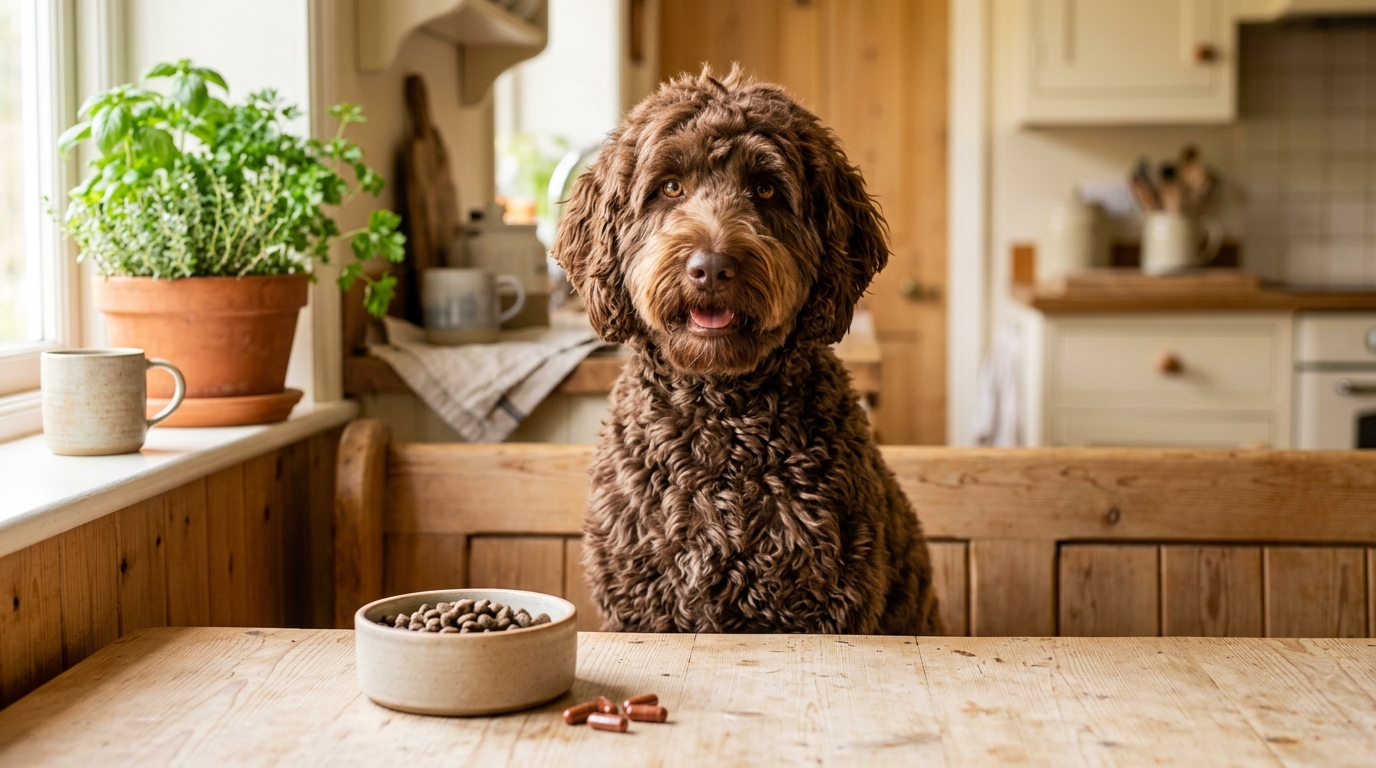
A truly chicken-free dog food has zero poultry anywhere on the ingredient list, not just in the headline flavor, and that includes chicken fat, chicken meal and chicken broth that quietly sit near the bottom of the panel. For a doodle reacting to chicken with itchy skin, paw licking, soft stool or ear flare-ups, the reliable approach is to pick a single novel protein (whitefish, salmon, lamb or beef) and read the whole label, not the bag front. Our overall pick below is the Wellness CORE Grain Free Whitefish, Herring and Salmon Recipe.
If you have ever flipped a "salmon" bag over and found chicken fat two lines down, you already know the catch. That one ingredient is why so many owners switch foods, see no improvement, and assume food is not the problem when chicken was in the bowl the whole time.
We feed raw at home with our three Australian Labradoodles, but we have spent a long time reading labels because our Gunnar is the chicken-reactive one. His first two years on a food that did not suit him drove a recurring ear and yeast cycle, and a protein change is what finally helped. This guide is the label-reading we wish we had done sooner.
Why Chicken Trips Up Doodles Specifically
Chicken is one of the most common food triggers in dogs simply because it is in almost everything, so dogs get exposed to it constantly. The Poodle line behind every doodle carries a real, documented predisposition to allergic skin disease and to cutaneous adverse food reactions. That does not mean every doodle will react, but it does mean an Australian Labradoodle, Goldendoodle, Labradoodle or Bernedoodle is more likely than some breeds to inherit an itchy, reactive tendency.
Here is the doodle-specific twist that generic roundups miss: in a doodle, a food reaction and a yeast problem look almost identical and often feed each other. Itchy skin, paw licking, rusty paw staining, and recurring ear infections under those floppy, moisture-trapping ears can all come from a food trigger, from environmental allergy, or from yeast taking hold on irritated skin. Gunnar had the full loop. If you are not sure which you are looking at, our guide on allergy vs yeast infection in doodles walks through how to tell them apart.
Per general veterinary guidance, including the Merck Veterinary Manual, food allergy is diagnosed with a strict elimination diet rather than a blood test, because the only reliable proof is removing the suspect protein and watching the symptoms clear. That is why reading labels matters so much: one hidden chicken ingredient can ruin an otherwise perfect trial.
If you already know chicken is the problem and just want the shortlist, see our picks for the best food for a Goldendoodle with allergies and keep reading here for the chicken-free comparison.
The Sneaky Chicken Ingredients Most Owners Miss
This is the part competitors skip, and it is the single most useful thing in this article. "Salmon recipe" on the front does not mean chicken-free. Flip the bag and scan the entire list for every one of these:
- Chicken fat (by far the most common hidden source, used as the fat even in fish and lamb recipes)
- Chicken meal and chicken by-product meal
- Chicken broth or chicken stock (common in wet foods and toppers)
- Chicken liver or chicken flavor
- Vague terms like "poultry fat," "poultry meal," "animal fat" or "natural flavor" where the source is not named
The same rule applies to treats, dental chews and toppers, which is where most people cheat without realizing it. For the full breakdown of symptoms and swaps, see chicken allergy in doodles: symptoms and alternatives.
Top Picks: Chicken-Free Foods Compared
A good chicken-free pick for a doodle does three things: it names a single clear protein you can track, it keeps the fat source non-chicken (fish oil, salmon oil, canola or sunflower oil rather than chicken fat), and it is honest about being poultry-free on the whole panel, not just the front. We looked for established formulas that state chicken-free clearly and use fish, fish oil or plant fats instead of poultry fat. These are research-based picks: we feed raw, so we have not fed these to our own dogs, and we say so plainly. Double-check the live ingredient panel on the listing before you buy, because manufacturers do reformulate.
| Product | Best For | Rating |
|---|---|---|
| Wellness CORE Grain Free Whitefish, Herring and Salmon | Best Overall (novel fish blend) | 4.6 |
| Wellness Complete Health Sensitive Salmon and Rice | Best for Sensitive Skin and Stomach | 4.4 |
| Weruva Classic Chicken Free Variety Pack | Best Wet Food / Topper | 4.5 |
One practical note before you buy: start with the smallest bag you can find, not a big economy sack. A food trial can fail on week one if the food itself does not agree with your dog, and a 4 to 5 lb (1.8 to 2.3 kg) bag is enough to see early stool and appetite signs without committing to 30 lb (14 kg) of something your doodle snubs. Once a formula proves itself, size up. You can browse current bag sizes and prices in Amazon's pet section.
Best Overall: Wellness CORE Grain Free Whitefish, Herring and Salmon Recipe
Wellness CORE Grain Free Whitefish, Herring and Salmon Recipe (research-based pick)
This is our overall pick for a doodle who reacts to chicken and tolerates grain-free. It is built around a whitefish, herring and salmon blend with no poultry, so it is a genuine novel-protein option for the Poodle-line allergy tendency, and the high protein level suits active standard doodles. The long review history and 4.6 rating signal it has worked for a lot of sensitive dogs. The honest con: it is grain-free, and grain-free is not automatically better. If your doodle does fine with grains, a grain-inclusive option may be an easier, safer everyday choice.
Best for Sensitive Skin and Stomach: Wellness Complete Health Sensitive Salmon and Rice
Wellness Complete Health Sensitive Skin and Stomach Salmon and Rice Recipe (research-based pick)
If your doodle has both skin reactions and a touchy stomach, this grain-inclusive, chicken-free salmon and rice recipe is the one to try first. Salmon plus rice is a gentle, well-tolerated combination, and the grain-inclusive base is often kinder to a sensitive gut than grain-free. It is purpose-labeled for sensitive skin and stomach, which matches the exact doodle reader this article is for. The con is a shorter review history and a slightly lower rating than the CORE line, so it is less battle-tested, though the formula approach is sound.
If Your Doodle Reacts to More Than Chicken
Some doodles react to several animal proteins, not just chicken. We do not recommend a plant-based kibble for that dog: our three eat meat, and we pick meat and fish recipes for every reader too. The better route for a multi-protein reactor is a vet-guided elimination diet built on one protein your dog has truly never eaten, or a hydrolyzed diet your vet prescribes, where the protein is broken down too small for the immune system to flag. Both take a strict 8 to 12 weeks. Our step-by-step elimination diet guide, linked in the transition section below, walks through how to run one, and the same label rules above apply to every food and treat in the trial.
Best Wet Food / Topper: Weruva Classic Chicken Free Variety Pack
Weruva Classic Chicken Free Variety Pack (research-based pick)
For a doodle with poor appetite or extra digestive sensitivity, a chicken-free wet food is a smart addition, and this variety pack is explicitly poultry-free. The high moisture content helps fussy eaters and dogs who struggle with dry kibble, and it works well as a topper to make a chicken-free kibble more appealing. The con is cost and practicality: wet-only feeding gets expensive fast for a standard doodle, so most owners use it as a rotation food or topper rather than a sole diet. If appetite is your main concern, our guide on low appetite in doodles covers more.
How to Transition Without a Second Upset
Switching foods abruptly can cause loose stool all on its own, and then you cannot tell whether your doodle reacted to chicken or just to the sudden change. Our Sven is the sensitive-stomach one of our three, and in his first year any food change at all gave him soft stool for days. The fix is a slow swap over 7 to 10 days.
Here is the schedule we use:
- Days 1 to 3: 25% new food, 75% old food
- Days 4 to 6: 50% new food, 50% old food
- Days 7 to 9: 75% new food, 25% old food
- Day 10: 100% new food
Go slower if your doodle has a known sensitive stomach, and remember that stool settling in a week or two is the easy part. Skin, paw and ear improvements take much longer because the coat and skin turn over slowly, so a real food-allergy trial runs a strict 8 to 12 weeks with no cheating. For the full method, see our 7-day food transition plan and the step-by-step elimination diet for doodles.
What a Chicken-Free Food Will and Will Not Fix
Being honest here matters, because a diet switch alone is not magic. A chicken-free food helps when chicken is genuinely the trigger. It will not fix itching that comes from environmental allergies, from a yeast infection that has already taken hold, or from a grooming cause most owners never check.
That last one is a doodle-specific point we learned the hard way. Mats between the paw pads cause constant paw licking, and they get mistaken for food allergy all the time. On our curly-coated boys, wet feet in mud season felt into tight little mats between the pads, and that alone drove licking. We keep the hair between the pads trimmed short for exactly this reason. If paw licking is your main symptom, check the pads before you blame the bowl, and read yeast infection on doodle paws and why is my doodle so itchy all the time.
A few more honest limits:
- Skin takes time. Do not judge a food in week two by the coat. Give it the full trial.
- Omega-3s help alongside diet, not instead of it. A good fish oil supports the skin barrier while you sort out the trigger; see best omega 3 for doodle skin health.
- Broken skin, raw sores, bleeding ears or a dog who feels unwell are a call-your-vet situation, not a diet experiment.
For the bigger picture on whether diet is even your dog's issue, can diet fix doodle skin problems is an honest read.
FAQ
A truly chicken-free food has no poultry anywhere on the ingredient list, not just in the headline flavor. That means no chicken, chicken meal, chicken by-product meal, chicken fat, chicken broth or vague "poultry" flavoring. Many salmon and lamb recipes still use chicken fat as the fat source, so you have to read the entire panel, not just the front of the bag.
It can be. Chicken fat is highly rendered and contains very little protein, so some chicken-allergic dogs tolerate it fine, but others still react. If your doodle has a confirmed chicken allergy with itchy skin, paw licking or ear flare-ups, the safest choice during an elimination diet is a food with zero chicken-derived ingredients, including the fat. Talk to your vet if symptoms persist on a chicken-free diet.
Sometimes, if chicken is genuinely the trigger. Food is only one cause of itchy skin and yeast in doodles. Environmental allergies, grooming issues like mats between the pads, and underlying skin infections all look similar. A chicken-free diet is a sensible first step for a doodle who reacts to chicken, but if the itching, paw licking or ear issues continue after a full 8 to 12 week trial, see your vet to rule out other causes.
No, those are two separate decisions. Grain-free became popular but is not automatically better, and the FDA has looked into a possible link between some grain-free diets and heart disease. For most doodles a grain-inclusive chicken-free food with rice or oats is perfectly fine and often easier on the stomach. Only go grain-free if your dog has a specific reaction to grains, which is far less common than a chicken reaction.
Give any new food a fair trial. Stool usually settles within one to two weeks, but skin and ear improvements take longer because the coat and skin turn over slowly. For a proper food-allergy trial you need a strict 8 to 12 weeks with zero cheating, no flavored treats, chews or table scraps that contain chicken. Transition over 7 to 10 days to avoid an upset stomach from the change itself.
Your Next Step
If chicken is on your suspect list, start with the smallest bag of one clearly poultry-free formula, transition slowly, and commit to a real 8 to 12 week trial with every treat locked down too. Read the whole panel every single time, because the fat line is where most chicken-free plans quietly fail.
From here, the most useful next read depends on your main symptom. If it is gut trouble, go to food allergies in doodles: the complete owner's guide. If it is itching, paws and ears, start with are doodles prone to allergies. And if you want our broader everyday shortlist, see the best dog food for doodles.