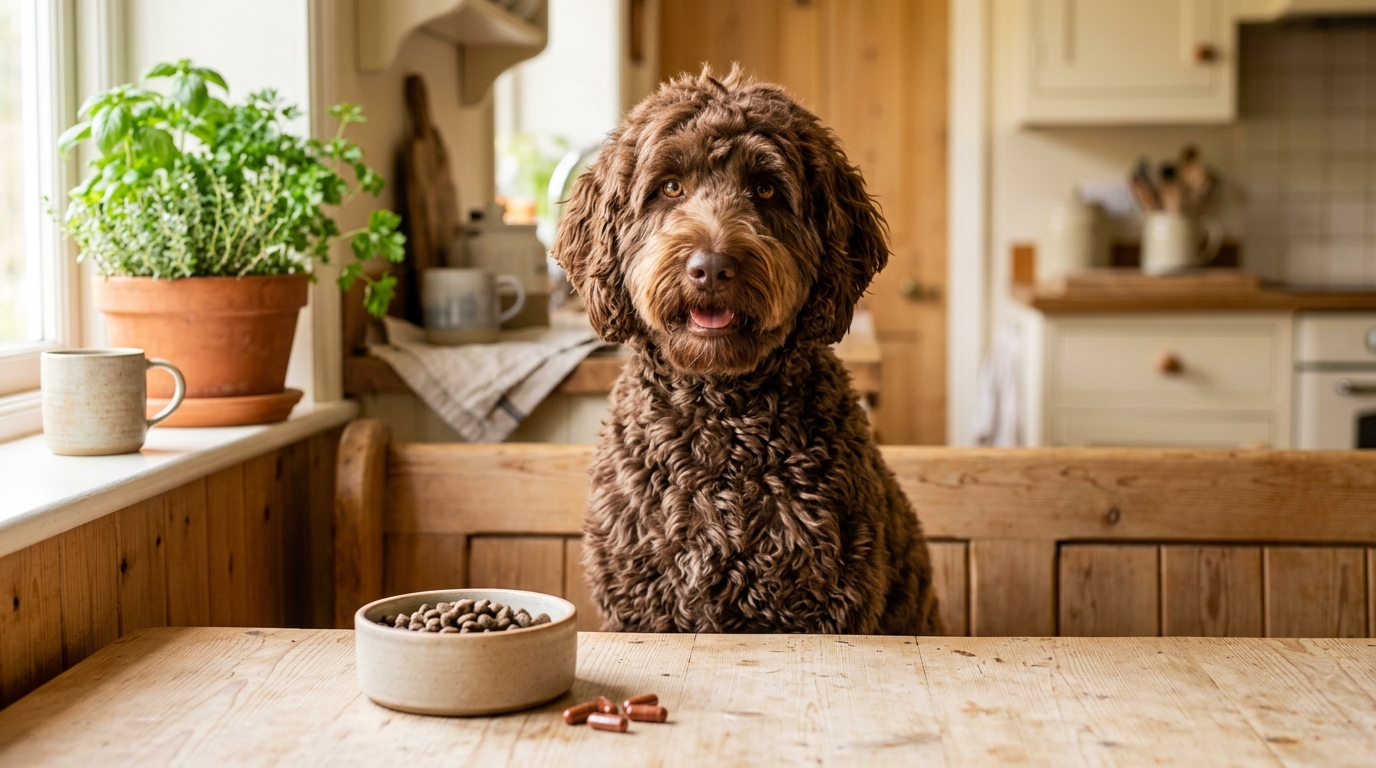
The best limited ingredient dog food for doodles uses a single novel protein (like duck or salmon), a short ingredient list, and no chicken, wheat, soy, corn, or dairy. For most doodles with food allergies, itchy skin, or soft stools, ACANA Singles Duck & Pear or Zignature Duck are the strongest true LID picks. Always double-check for hidden chicken fat and shared-facility cross-contamination, those are the two most common reasons a "limited ingredient" food still triggers a reaction.
If you're here, chances are your doodle is dealing with something frustrating: chronic paw-licking, recurring ear gunk, soft or slimy stools, or that "off" digestion that never seems to fully settle. Doodles inherit a genetic double-whammy, the poodle line's tendency toward food sensitivities plus a curly coat and floppy ears that hide (and trap) the fallout. A real limited ingredient diet is one of the most effective, lowest-risk tools you have.
We feed our three, Sven, Gunnar, and Gösta, raw at home, but we've leaned hard on quality LID kibble for travel and elimination trials, and we've helped a lot of doodle families sort the genuinely useful formulas from the marketing. Below is what actually matters, followed by our honest top picks.
What makes a "real" limited ingredient diet for doodles
The phrase "limited ingredient" isn't regulated, so plenty of foods slap it on the bag without earning it. A true LID for a doodle with suspected food allergies hits all of these:
- One single animal protein. Duck OR salmon OR lamb, not a blend. Multiple proteins defeat the entire purpose of figuring out the trigger.
- A novel protein your doodle hasn't eaten before. If they've had chicken and beef their whole life (most doodles have), duck, salmon, or venison give the immune system a clean slate.
- A short, readable ingredient deck. One protein, one or two carbs, a fat source, vitamins and minerals. If you can't pronounce or count the ingredients easily, it's not really "limited."
- No common allergens: chicken, beef, wheat, soy, corn, dairy, and egg are the usual suspects in doodles.
- No hidden chicken fat. This is the big one people miss, more below.
We cover the full breakdown in our limited ingredient dog food for doodles explained guide, so I'll keep the theory tight here and focus on choosing and comparing.
Why doodles specifically benefit
Poodle-line genetics carry a real tendency toward food sensitivities and atopic (itchy) skin, and that trait passes down into Goldendoodles, Bernedoodles, Labradoodles, and the rest. On top of that, the coat hides early skin changes and the ears trap moisture, so a low-grade food reaction can quietly snowball into a yeasty ear infection before you even spot it. Simplifying the diet removes variables, and with doodles, fewer variables is almost always better. The Merck Veterinary Manual notes that a strict elimination diet trial is the most reliable way to diagnose a food-related skin reaction.
If you're not sure whether you're dealing with a true allergy or an intolerance, that distinction changes your approach, see allergy vs food intolerance in doodles.
The hidden red flags that ruin a "limited ingredient" food
This is where most generic best-of lists stop short. Star ratings won't tell you these things, read the label.
1. Hidden chicken fat. A duck or salmon formula can still list "chicken fat" as its fat source. Chicken fat contains trace protein, and for a genuinely chicken-allergic doodle that can be enough to keep the itch going. Look for the fat to match the protein (duck fat with duck, salmon oil with salmon) or a neutral source like sunflower oil.
2. Shared-facility cross-contamination. Some LID brands are made on the same lines as chicken and beef formulas. For a mildly sensitive doodle this rarely matters; for a severely allergic one it can. If your dog is reacting to a "clean" food, contact the manufacturer and ask about dedicated lines.
3. "Natural flavor" and vague meals. Undefined "natural flavor" or "meat meal" can hide the very proteins you're trying to avoid. Skip them during an elimination trial.
4. Too many carbs pretending to be variety. Peas, lentils, chickpeas, potato, sweet potato, a food that stacks several of these isn't wrong, but it isn't as "limited" as it sounds, and legume-heavy diets have drawn scrutiny. One clean carb is plenty. The FDA has publicly investigated a possible link between certain grain-free, legume-heavy diets and canine heart disease.
Top Picks
A good LID pick for a doodle checks three boxes: a single novel protein, a genuinely short ingredient list, and no hidden chicken fat or common allergens. We prioritized formulas with clean labels, a trusted track record with sensitive dogs, and proteins that are actually novel for most doodles. Prices below are typical for the small (4-4.5 lb (1.8-2 kg)) bags, buy small first to test tolerance before committing to a big bag.
| Product | Best For | Rating |
|---|---|---|
| ACANA Singles Duck & Pear | Best Overall / Confirmed Allergies | ★★★★★ |
| Zignature Duck LID | Best Novel-Protein Value | ★★★★½ |
| Canidae Pure Salmon & Sweet Potato | Best for Skin & Coat | ★★★★½ |
| Natural Balance Reserve Duck & Potato | Best Vet-Recommended Line | ★★★★½ |
On price. Limited ingredient formulas cost more per pound than standard kibble, and the gap is widest on small bags, so once a food has proven itself, the larger size is where the saving is. Prices move week to week, so it pays to check the current ones before you re-order.
For more allergy-specific formula guidance, our best food for Goldendoodle with allergies roundup goes deeper on breed-specific picks, and the best products hub collects everything we recommend.
Dry, wet, or freeze-dried: which format for your doodle?
Format matters more for doodles than people expect, coat health, gut sensitivity, and how picky your dog is all come into play.
| Format | Best for | Doodle considerations |
|---|---|---|
| Dry kibble (LID) | Everyday feeding, budget, travel | Easiest to keep strict and consistent; watch kibble size for standard doodles; most economical |
| Wet / canned LID | Picky eaters, extra hydration, dental-sensitive dogs | Great for coat-supporting moisture, but check that the canned formula matches the same single protein |
| Freeze-dried raw LID | Sensitive guts, coat & skin, minimal processing | Gentlest on digestion and best for skin/coat, but pricier; a natural step toward raw |
Because we feed raw, our own bias is toward minimally processed food for skin and coat, but honestly, a well-chosen LID kibble is the most practical starting point for most families, especially during an elimination trial when consistency beats everything. If you're curious about the freeze-dried route as a middle ground, we walk through it in the freeze-dried transition plan for doodles.
How to pick the right protein for YOUR doodle
The "best" protein is simply the one your doodle hasn't already eaten a lot of. Sit down and list every food and treat they've had. If chicken and beef dominate the list (very common), then duck, salmon, lamb, or venison are strong novel candidates.
- Duck, excellent novel protein, rarely used in mainstream foods, well-tolerated by most doodles.
- Salmon / fish, great for skin and coat thanks to natural omega-3s, but skip it if your dog has eaten lots of fish-based treats.
- Lamb, was once "novel" but is now common, so check your dog's history.
If you've already confirmed a specific trigger, say, a beef allergy in your Goldendoodle or a chicken allergy, pick a protein that has zero overlap with it.
When Gunnar went through a fussy stretch, keeping his food to a single novel protein for travel weeks made it obvious, obvious, which weeks he did well and which he didn't, that clarity is the whole point. You lose it the moment you mix proteins.
What to expect once you switch
Set your expectations by symptom type, they clear on different timelines:
- Soft stools and digestion: often improve within 1-3 weeks on a clean single-protein LID.
- Ear infections and yeast: usually follow the skin, so several weeks as the underlying reaction quiets.
- Itchy skin and paw-licking: the slowest, expect 8-12 weeks of strict feeding before you judge results.
If your doodle is licking their paws right after meals specifically, that pattern is worth reading up on in doodle licking paws after eating. And if digestion is the main issue, a good probiotic can shorten the rocky early days, see best probiotics for doodles with digestive issues.
Persistent vomiting, blood in stool, lethargy, or symptoms that get worse rather than better are call-your-vet situations, not food-experiment situations. Our guides on when to see the vet for doodle vomiting and how long doodle diarrhea lasts will help you judge when to stop tinkering and pick up the phone.
FAQ
A genuine limited ingredient diet (LID) uses one novel animal protein, one main carbohydrate, and a short overall ingredient list with no common allergens like chicken, beef, wheat, soy, corn, or dairy. For doodles it should also avoid hidden chicken fat and be made without cross-contamination in a shared facility. If the label lists multiple proteins or vague terms like "meat meal," it is not a true single-protein LID.
It depends on what your doodle has already eaten. The point of a novel protein is that your dog has never been exposed to it, so their immune system has not built a reaction. If your doodle has had a lot of salmon or fish-based treats, choose duck instead, and vice versa. Both duck and salmon are excellent novel proteins for doodles because they are far less common than chicken and beef in everyday foods.
Digestive improvements like firmer stools often show up within 1-3 weeks, but skin, ear, and paw-licking issues from a food allergy can take 8-12 weeks of a strict elimination diet to fully clear. During that window you must feed the LID exclusively, no other treats, chews, or table scraps, or you cannot trust the result.
Not during an elimination trial. While you're identifying the trigger, stick to one protein for the full 8-12 weeks. Once your doodle is stable and you know their safe foods, gentle protein rotation between 2-3 tolerated single proteins can support gut diversity and reduce the risk of developing new sensitivities, but reintroduce one protein at a time and watch for reactions.
Not quite. Limited ingredient food reduces the number of possible allergens, while true hypoallergenic (hydrolyzed) food breaks proteins into pieces too small for the immune system to recognize. LID works for most doodles with sensitivities; hydrolyzed diets are usually reserved for severe, confirmed allergies under vet guidance.
Your next step
If you're fairly sure food is the culprit, the smart move is to pick one novel-protein LID from the picks above, buy the small bag first, and run a strict elimination trial rather than casually switching foods. That's the difference between guessing and actually solving it.
Start with our elimination diet for doodles step-by-step guide to run it properly, and if you're still gathering evidence that food is even the problem, read signs your doodle has a sensitive stomach first. You've got this, and your doodle's coat, ears, and gut will thank you for the patience.