If your doodle has soft stool, gas, vomiting or a bloated belly after meals, overfeeding is one of the most common and most overlooked causes. Too much food, too fast, overwhelms the digestive system before it can keep up, and the result looks a lot like a sensitive stomach. Most adult doodles need only about 2-3% of their ideal body weight in food per day, split into two meals, with treats kept under 10% of daily calories.
Here's the frustrating part: overfeeding upset mimics the exact symptoms doodle owners already worry about, so people reach for special foods and supplements when the real fix is a smaller, slower meal. We've watched Sven go through phases of "mysterious" tummy trouble that turned out to be nothing more than a heaping bowl.
If you've already ruled portions out and you're fairly sure it's the food that's wrong for your dog, and you just want the shortlist, see our roundup of the best dog food for a doodle with a sensitive stomach. Otherwise, keep reading, for most dogs the fix is smaller and slower, not different.
This guide walks through how overfeeding specifically wrecks a doodle's digestion, the warning signs, real portion numbers by weight and life stage, how to tell overfeeding apart from a true food allergy, and the red-flag bloat symptoms that mean go to the vet now.
Why Overfeeding Causes Stomach Issues in Doodles
A doodle's gut works best with a predictable, moderate load. When you overfeed, food moves through the system faster than the stomach and intestines can properly break it down and absorb it. The consequences show up at the other end: Our free portion calculator does the arithmetic.
- Soft or loose stool, undigested food and excess water push through quickly.
- Excess gas, undigested carbs and protein ferment in the gut.
- Vomiting undigested food, the stomach simply can't hold what went in.
- A visibly swollen belly after eating.
Doodles are especially prone to this for a few breed-specific reasons. The poodle line often brings a genuinely sensitive digestive system, so the margin for error is smaller than in a hardy mixed-breed farm dog. Their curly coats and food-motivated personalities also make it easy to miss weight creep, a fluffy doodle can carry an extra pound or two before you notice the ribs disappearing.
And doodles are, frankly, enthusiastic eaters. Gunnar would happily eat his portion, then Sven's, then look at us like we'd forgotten to feed him all week.
Signs of Overfeeding in Dogs (and Doodles Specifically)
Some signs are digestive, others are about body condition over time. Watch for the pattern, not one bad day.
Digestive signs:
- Consistently soft, pudding-like or shiny stool
- Frequent, smelly gas
- Occasional vomiting of whole, undigested food shortly after eating
- A bloated stomach after eating that goes down within an hour or two
- Straining or extra-large volume of stool
Body-condition signs:
- You can't easily feel the ribs under a light layer of fat
- No visible waist when you look down from above
- No tummy tuck from the side
- Gradual weight gain over weeks
If you're seeing these signs plus itching or paw-licking, read our full signs your doodle has a sensitive stomach guide to sort out what's what.
How Much to Feed a Doodle: Portion Guidance by Weight
Here's where doodle-specific advice matters. Mini, medium and standard doodles span a huge weight range, from 15-pound (6.8 kg) minis to 70-pound (32 kg)-plus standards, so a single feeding rule is useless. The starting point most raw and fresh-feeders use is a percentage of ideal adult body weight, then adjust for your individual dog.
For adult doodles, start around 2-3% of ideal body weight per day. Use the lower end for calm, easy-keeper dogs and the higher end for lean, active ones. These numbers are for total daily food, split across two meals.
| Ideal weight | 2% (easy keeper) | 2.5% (average) | 3% (active) |
|---|---|---|---|
| 15 lb (6.8 kg) (mini) | 4.8 oz (135 g) | 6 oz (170 g) | 7.2 oz (205 g) |
| 25 lb (11 kg) | 8 oz (225 g) | 10 oz (285 g) | 12 oz (340 g) |
| 40 lb (18 kg) (medium) | 12.8 oz (365 g) | 16 oz (455 g) | 19.2 oz (545 g) |
| 55 lb (25 kg) | 17.6 oz (500 g) | 22 oz (625 g) | 26.4 oz (750 g) |
| 70 lb (32 kg) (standard) | 22.4 oz (635 g) | 28 oz (795 g) | 33.6 oz (955 g) |
Portions by life stage
- Puppies need a higher percentage, often 5-8% of current body weight, dropping as they grow, split into three or four meals a day.
- Adults settle into the 2-3% range on two meals.
- Seniors and less active dogs often need the lower end or slightly below, since metabolism slows.
Always start at a sensible number, then let body condition and stool quality be the judge over two to three weeks.
Feeding Frequency and How to Measure Correctly
Two meals a day suits most adult doodles and keeps the digestive load steady, better than one giant meal, which is harder on the stomach and can encourage gulping. Puppies do best on three to four.
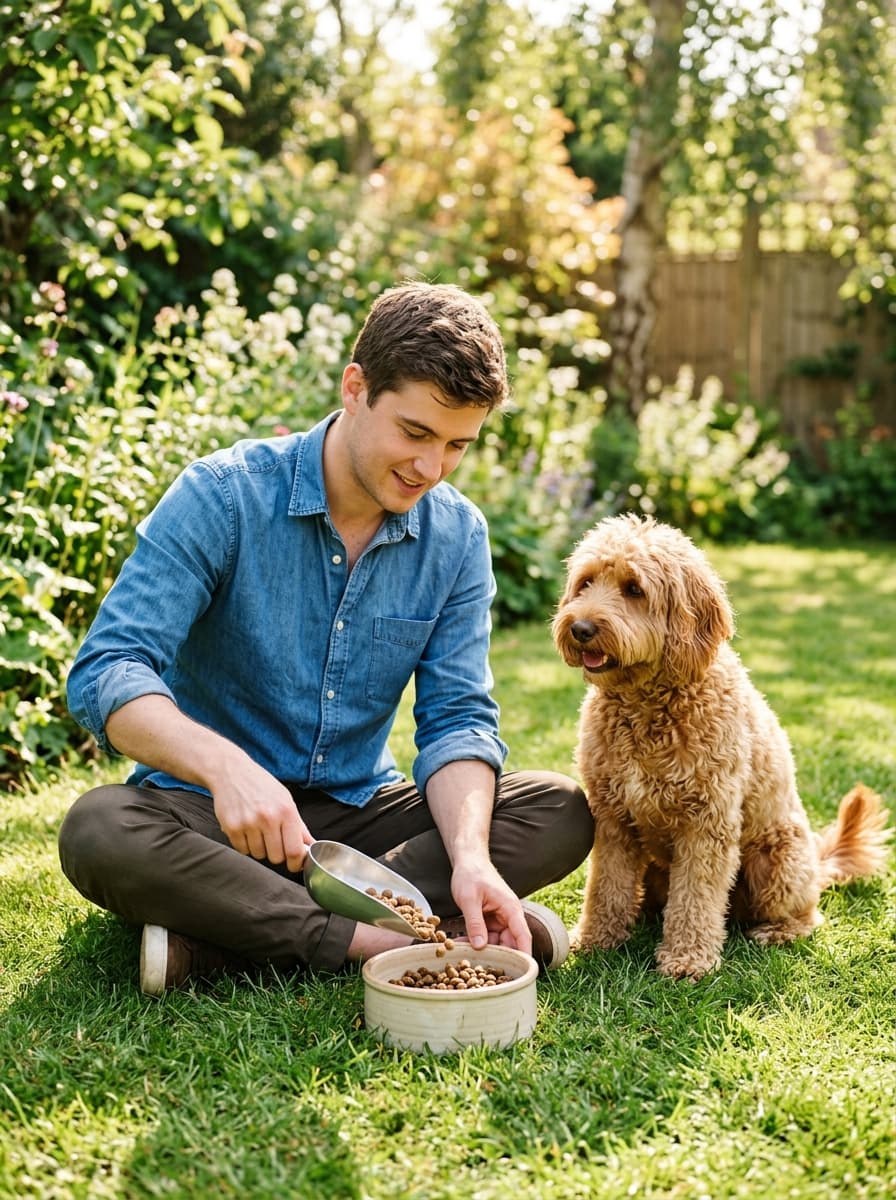
The single biggest source of accidental overfeeding is measuring by eye. A "scoop" and a heaping cup are not the same thing twice in a row.
- Use a kitchen scale for raw and fresh food, it's the only accurate way.
- Use a proper measuring cup (leveled, not heaped) for kibble.
- Don't top up "just a little", those little bits add up fast across a week.
In our house with three doodles, we weigh each portion into labeled containers. It takes two minutes and completely removes the guesswork, nobody gets shorted, and nobody quietly gets a double serving. If you want the full daily workflow, we lay it out in our 5-minute daily kitchen routine for raw-feeding households.
Treats, Table Scraps and the Hidden Calories
You can measure meals perfectly and still overfeed through treats and scraps. The rule of thumb: treats should stay under 10% of daily calories, and that ten percent has to come out of the meal, not on top of it.
Common hidden culprits:
- Training treats during a long session
- Chews and dental sticks
- Bits of "safe" human food handed out through the day
- One family member feeding without telling the others
That last one is real. We keep a small container of the day's treat allowance on the counter, when it's gone, it's gone. It stops the classic "wait, did you already give him something?" problem when three people share dog duty.
Rich table scraps are a double threat for doodles: they add calories and introduce fatty, novel ingredients that a sensitive gut may not tolerate. A sudden greasy scrap is a common trigger for a bout of soft stool or bile vomiting.
Feeding Speed: The Doodle Gulping Problem
Even the right amount of food causes trouble if it goes down in fifteen seconds. Fast eating means swallowed air, a rapidly stretched stomach, and the classic doodle throwing up after overeating, a whole, undigested lump brought back up minutes later.
Ways to slow a fast eater:
- A slow-feeder bowl with ridges and mazes
- A puzzle feeder or lick mat (great for raw and wet food)
- Portion the meal into several small bowls around a room
- Feed dogs separately so there's no competition-fueled inhaling
Sven used to eat like the bowl was going to be repossessed, and a simple maze bowl turned his meal from fifteen seconds into a few minutes, the post-meal vomiting stopped almost immediately. Feeding him in a separate spot away from the other two helped just as much, because half the rush was about beating his brothers to it.
Overfeeding vs. a True Sensitive Stomach or Food Allergy
This is the distinction that saves doodle owners money and worry.
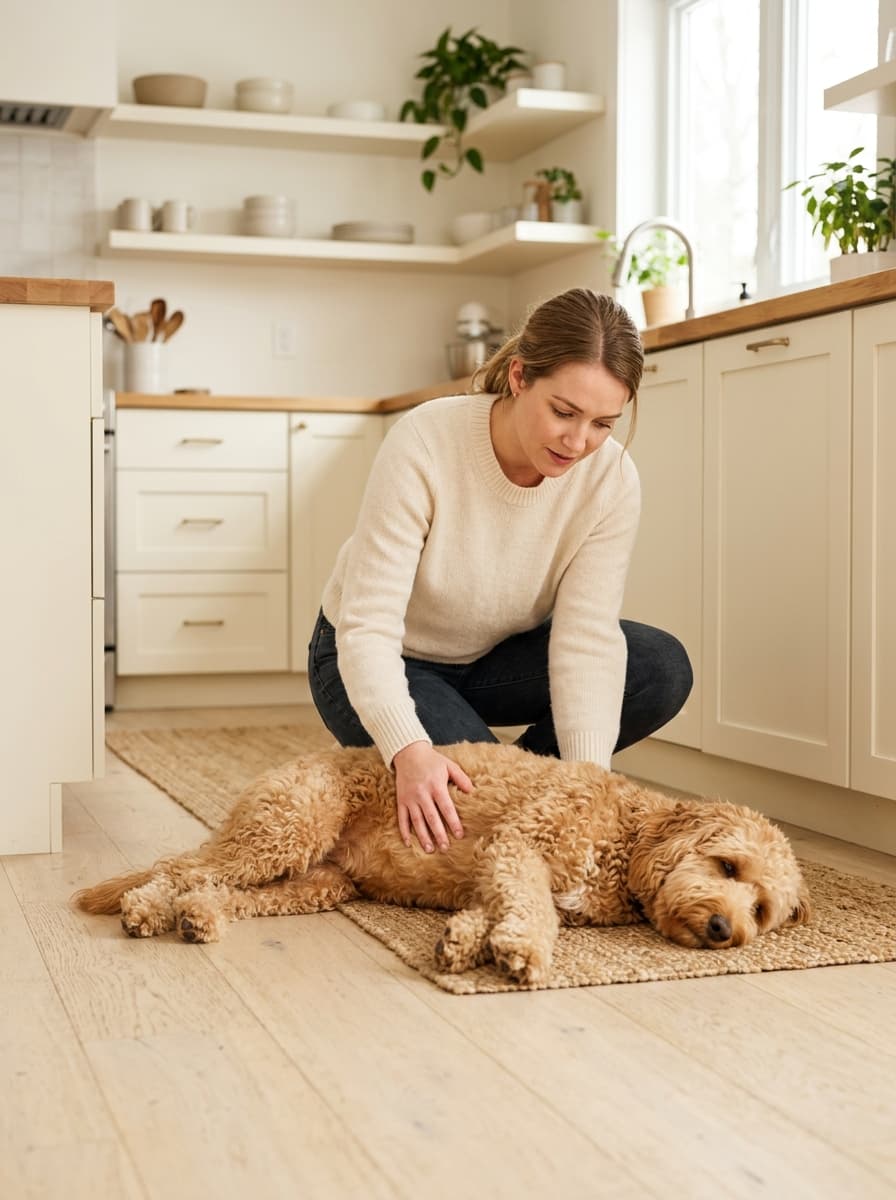
Overfeeding upset typically:
- Improves within a few days of cutting portions and slowing meals
- Is tied to meal size and speed, not specific ingredients
- Comes with weight gain and a full belly after eating
A true food sensitivity or allergy typically:
- Persists even on correct portions and the same food
- Often pairs digestive signs with itching, paw licking, ear issues and skin problems
- Points to a specific ingredient like chicken or beef
If your doodle stays symptomatic after you've dialed in portions, look into the difference between a food allergy and a food intolerance, or work through a structured elimination diet. And if you're wondering whether doodles are simply wired for this, our breed-specific allergy guide is a good primer.
For a fussy but otherwise happy dog, doodle soft stool but acting normal covers when soft stool alone is genuinely nothing to panic about.
Red-Flag Bloat: When It's an Emergency
Most bloated stomach after eating is harmless, a full belly that settles within a couple of hours. But doodle owners, especially those with larger, deeper-chested standard doodles, need to know the difference between a full tummy and true bloat (gastric dilatation-volvulus, or GDV), which is a genuine, fast-moving emergency. The Merck Veterinary Manual describes GDV as a life-threatening condition that develops rapidly and requires immediate veterinary care.
To lower risk in vulnerable doodles: feed two smaller meals instead of one big one, slow the eating down, and avoid heavy exercise right before and after meals.
For everyday vomiting that isn't an emergency, our guide on when to take your doodle to the vet for vomiting will help you judge whether a single episode is worth a call.
Supporting the Gut While You Fix Portions
Correcting portions is the fix, but you can smooth the transition. A little plain pumpkin helps firm up soft stool, see can pumpkin help a doodle's stomach. A quality probiotic supports the gut microbiome, especially after a stretch of digestive upset; our best probiotics for doodles roundup walks through options.
These are supports, not substitutes. If your doodle is genuinely overfed, no supplement replaces the smaller, slower bowl.
FAQ
The clearest signs are consistent soft or pudding-like stool, lots of gas, occasional vomiting of undigested food, a visibly bloated belly after meals, and steady weight gain over weeks. If you can't easily feel your doodle's ribs and their waist has disappeared from above, portions are probably too high. Cut back gradually by about 10% and watch the stool firm up over a few days.
Most adult goldendoodles need roughly 2-3% of their ideal body weight in food daily, split into two meals. A 40-pound (18 kg) doodle at 2.5% eats about 1 pound (0.5 kg) of raw or the kibble-bag equivalent by calories. Puppies eat a higher percentage across three or four meals. Use these as starting points and adjust based on body condition, not the number on the bag.
Gulping air along with food stretches the stomach quickly, and the body's simplest response is to bring some of it back up, often as a whole, undigested lump. Doodles are notorious inhalers. A slow-feeder bowl or puzzle feeder, smaller portions, and feeding calmly away from other dogs usually stops it. Persistent vomiting despite these changes deserves a vet check.
A mildly full belly after a big meal is normal and passes within an hour or two. True bloat (gastric dilatation-volvulus) is a life-threatening emergency: a hard, distended abdomen, unproductive retching, drooling, restlessness and pacing. Larger and deep-chested standard doodles carry more risk. If you see those signs, treat it as an emergency and go to a vet immediately.
It's possible. Overfeeding upset usually improves within days of cutting portions and slowing meals. If symptoms persist on correct portions, or you also see itching, paw licking and ear issues, a food sensitivity or allergy is more likely and worth investigating with an elimination diet.
Where to Go From Here
Start simple: weigh your doodle's food, split it into two meals, slow the eating down, and account for treats. Give it two to three weeks and watch the stool, energy and waistline. Most "sensitive stomach" mysteries clear up right there.
If symptoms hang on after you've dialed in the portions, it's time to look deeper at diet, our guide to doodle sensitive stomach causes, symptoms and solutions is the best next read, and the sensitive stomach hub collects everything else in one place.