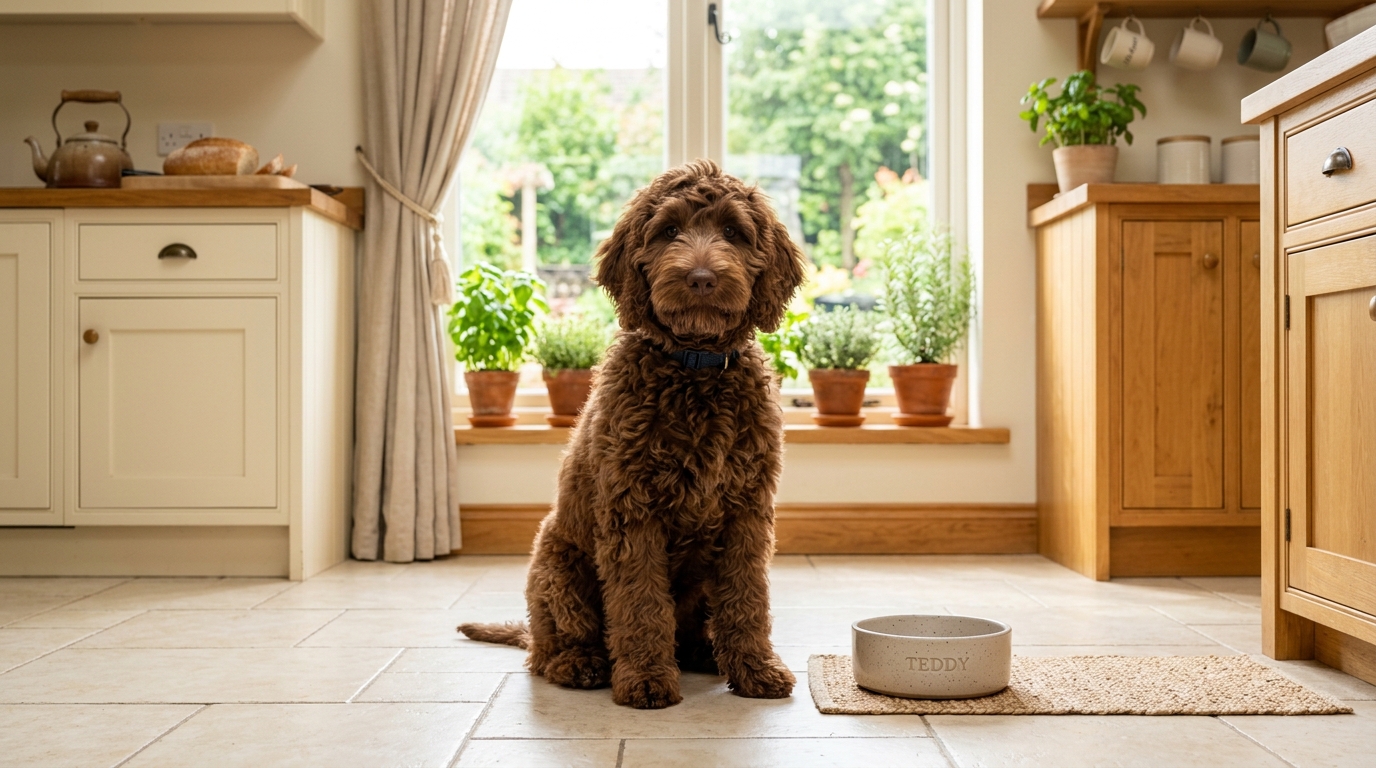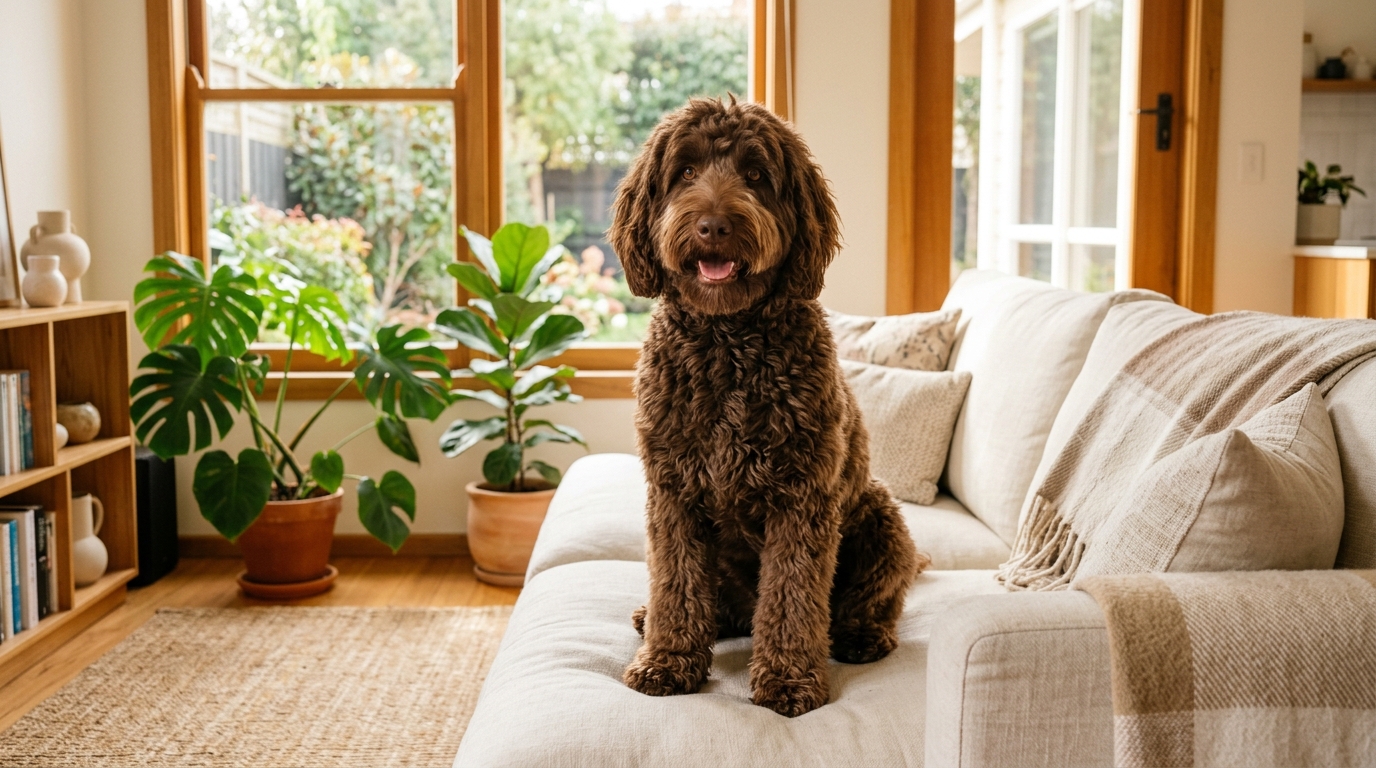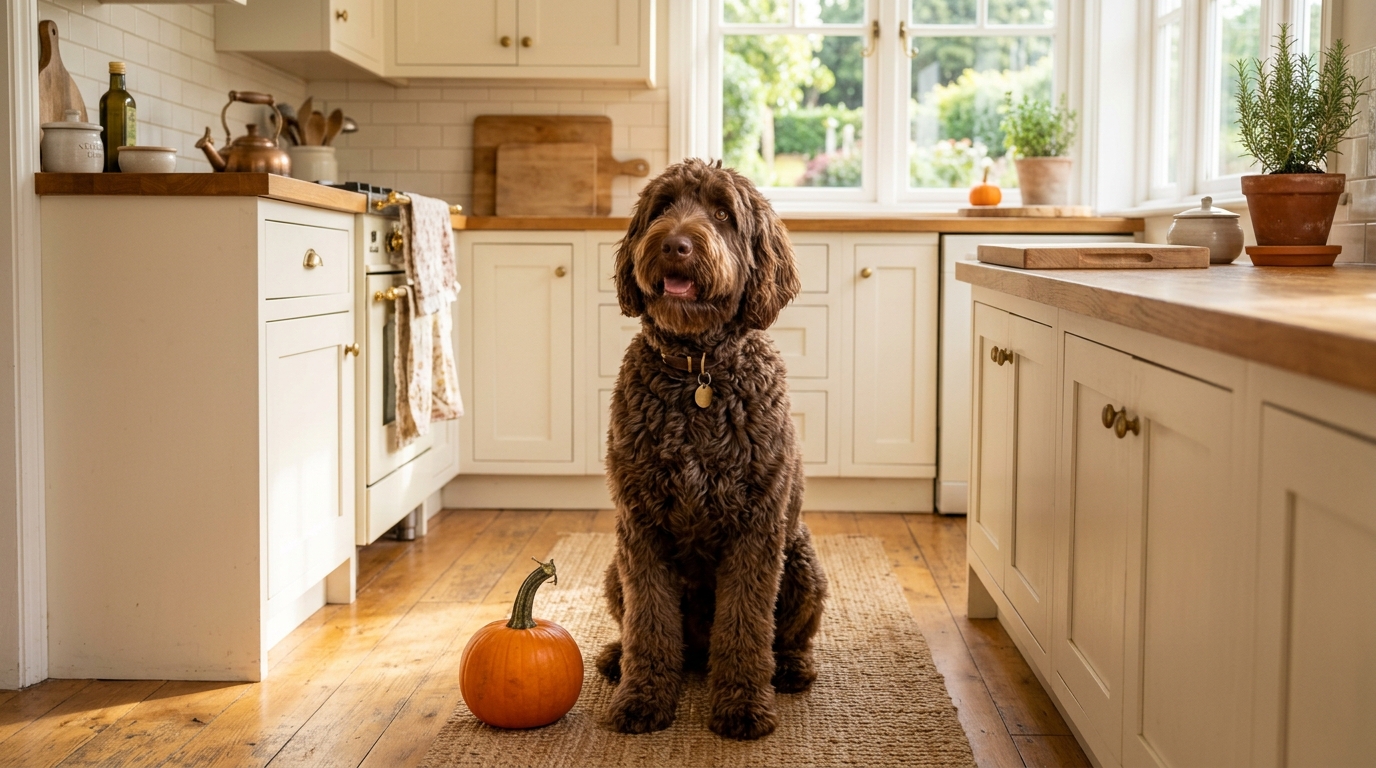
Gösta has eaten freeze-dried raw on every flight, road trip, and weekend kennel stay since he was a puppy. It's not what he eats at home, but it's what we hand the kennel staff and what fits in our suitcase. For most doodle owners, that flexibility — raw nutrition without the freezer — is exactly the reason to choose freeze-dried in the first place.
What this guide covers. This is the kibble-to-freeze-dried-raw transition plan — the bridge between the kibble tier and a fully raw diet, and the path most doodle owners actually reach for first. It's faster than a kibble-to-raw transition (weeks instead of months), slower than a kibble-to-kibble switch (10–14 days instead of 7), and it solves most of the friction that stops owners from going raw — handling, freezer space, travel — without giving up most of the gut, skin, and immune benefits. The site's feeding philosophy ranks the three tiers raw → freeze-dried raw → better kibble — and the goal is the best version of whatever tier fits your life.
Why Freeze-Dried Is the Easiest Step Up from Kibble
Of the three tiers in our feeding philosophy, freeze-dried raw is the one that asks the least from the owner without asking the least of the dog. Five practical reasons it's the path most owners reach for first.
The user experience is close to kibble. Open the bag, scoop a portion, add warm water for ten minutes, serve. There's no thawing window, no separate freezer drawer, no countertop logistics. An Australian Labradoodle, Goldendoodle or Bernedoodle owner who's been on kibble for years can adopt freeze-dried without rebuilding their kitchen routine.
No freezer logistics. Fresh raw lives in the freezer and has to be thawed in advance. Most owners who try fresh raw and quit do so because the freezer math doesn't work for their household — apartment-sized freezers, multi-dog homes, or a partner who isn't on board. Freeze-dried sits in the pantry next to where the kibble used to live. Same shelf, same routine.
Travel-friendly. This is where freeze-dried earns its place even in a household that feeds fresh raw at home (which is exactly what we do for Gösta). A bag of freeze-dried can ride along on a flight, fit in a suitcase, sit in a hotel room without refrigeration, and survive a kennel stay where the staff can't be expected to handle frozen meat. The portion goes from bag to bowl with water in ten minutes. There's no compromise on tier — your doodle is still eating real raw nutrition, just in a more portable form.
The hydration shift is gentler. Fresh raw is around 70% moisture; kibble is around 10%. Freeze-dried, dry, is similar to kibble. Freeze-dried, rehydrated, is similar to fresh raw. That means you can ease into the moisture shift over the transition window — start with a shorter rehydration time, work up to fully rehydrated by day 14. The gut adapts gradually, the same way it does with everything else.
The cost sits in the middle. Per calorie, freeze-dried is more expensive than kibble and less expensive than fresh commercial raw. For most doodle owners, this is the tier where the budget math actually works long-term. Owners who price-out fresh raw and decide it's not sustainable often end up on freeze-dried as the durable answer.
Where Freeze-Dried Sits in the Hierarchy
Understanding what you gain and trade by choosing freeze-dried makes the rest of the transition more intuitive.
What you gain over kibble. Real meat, real organ, real bone, in proportions that match how dogs actually evolved to eat. Single-protein and novel-protein options that are easy to find (lamb, venison, duck, rabbit, fish — usually as named single proteins, not "meat meal"). Less processing than kibble — freeze-drying involves freezing followed by sublimation under vacuum, which is far gentler than the high-temperature extrusion that turns kibble into pellets. A microbiome and immune-system response that's measurably closer to fresh raw than to kibble.
What you trade vs. fresh raw. A small amount of moisture content (recovered when you rehydrate). A slightly higher cost per calorie than buying fresh meat in bulk. The very last bit of raw-feeding's edge for severe cases — fresh raw remains the strongest tool when a doodle needs maximum nutritional support during an active recovery, like Gunnar's first year off kibble.
When freeze-dried is the right choice. Travel-heavy households. Apartments without a chest freezer. First-time raw eaters whose owners want to try the tier without committing to a full fresh-raw kitchen rebuild. Owners who're squeamish about handling raw meat. Multi-pet households where one dog is on a different diet. Households where one partner cooks and the other doesn't want to manage a separate dog-food protocol.
When fresh raw is the better choice. A doodle in active recovery from severe gut, skin, or immune issues — the kind that took years on kibble to develop, the kind that needs every advantage for the recovery to hold. An owner who has decided long-term raw is the goal and has the freezer space and bandwidth for fresh logistics. A doodle who has tried freeze-dried and isn't quite getting the results their owner expected (rare, but it happens — usually solved by rotating proteins, not by jumping to fresh).
For most doodle owners reading this guide, freeze-dried is the right tier. It captures most of what raw can do without asking for the whole-life adjustment that fresh raw demands.
Before You Start: The Three Things to Get Right
A successful freeze-dried transition is mostly decided in the first three choices.
First: pick a freeze-dried product that's complete and balanced. Not all freeze-dried is equal. Some products are formulated as "complete and balanced" meals (correct ratios of muscle meat, organ, bone, micronutrients for long-term feeding). Others are "toppers" or "mixers" — meant to enhance a base food, not replace it. The distinction is on the label. For a transition off kibble, you need a complete-and-balanced product. The TopPicks below all qualify.
Second: choose a novel protein for the introduction. This is the same advice as the kibble-to-raw transition, for the same reason. If your doodle has been eating chicken-based kibble — extremely common — and shows any sensitivity signs, the first freeze-dried protein should be something the immune system has likely never encountered. Lamb, venison, duck, rabbit, and fish are the usual choices. Run the entire transition on one protein; rotation comes later, after the gut is stable.
Third: plan to rehydrate during the transition. Some doodles eat freeze-dried dry over the long term, and that can be fine in maintenance. During the transition specifically, rehydrate with warm water for ten minutes before serving. The warmer texture is more appealing, the moisture content matches what the gut would receive from fresh raw, and the slower water absorption helps avoid the gulp-and-bloat pattern some dogs fall into when freeze-dried is fed dry. Once the transition is complete, you can experiment with dry feeding if the dog tolerates it.
The 10–14 Day Plan
Freeze-dried sits between a kibble-to-kibble switch (7 days) and a kibble-to-raw switch (months), so the schedule reflects that. Each ratio is held for two to three days instead of the single day the standard 7-day plan calls for, giving the gut time to adapt without dragging the timeline into raw territory.
The standard plan looks like this:
- Days 1–3 — 25% freeze-dried, 75% kibble. Rehydrate the freeze-dried portion fully. Mix into the kibble or serve alongside in the same bowl. Watch for: appetite, any reluctance to approach the bowl, normal stool by day 2 or 3.
- Days 4–6 — 50% freeze-dried, 50% kibble. Halfway point. Most digestive signals (if any) show up here. Mild stool softening on day 4 or 5 is common and usually resolves by day 6. Watery stool or vomiting means hold the ratio, simplify the meal, and wait for stability.
- Days 7–9 — 75% freeze-dried, 25% kibble. Now the freeze-dried is dominant. Watch for: any reappearance of soft stools, changes in energy, any reluctance to eat. If symptoms appear here that weren't there at 50/50, the freeze-dried itself may be the issue — pause and consider a different protein.
- Days 10–14 — 100% freeze-dried. Complete transition. Hold here for the rest of the window even if the dog is doing well at day 10. The extra days give the gut time to settle into the new food without one foot in the old.
For sensitive doodles with significant history, stretch each ratio by an extra day (3 days instead of 2) and run the plan as a 16–18 day schedule. There's no penalty for going slower.
For doodles who tolerate the early ratios easily, the plan can compress to 10 days — but don't compress just because you can. The benefit of the extra days is robustness, not speed.
The 10–14 day plan at a glance
| Days | Freeze-dried | Kibble | Watch for |
|---|---|---|---|
| 1–3 | 25% | 75% | Appetite, approach to the bowl, stool by day 2–3 |
| 4–6 | 50% | 50% | Most digestive signals appear here; mild softening is normal |
| 7–9 | 75% | 25% | New symptoms here point at the food, not the pace |
| 10–14 | 100% | — | Hold the full ratio even if day 10 looks good |
Rehydrate with warm water throughout. For a doodle with significant sensitivity history, stretch each step by one day and run it as 16–18 days.
What to Watch For During the Transition
The signals that matter and what they tell you. Most are familiar from any food transition; a few are specific to freeze-dried.
Stool quality. Firm and formed is the goal. Volume drops compared to kibble (less filler, more bioavailability) — this is normal and expected, not a sign of malnutrition. Watery, mucousy, or unusually colored stool means hold the ratio. Three soft stools across two days is a signal; one isolated soft stool usually isn't.
Vomiting. Any vomiting during the transition is a stop signal. Hold position, simplify the meal, and contact your vet if it continues. Vomiting on freeze-dried specifically often points to too-fast rehydration (gulping water-bloated food) or a protein the dog reacts to. If you've ruled out rehydration, switch protein.
Appetite. Most doodles eat freeze-dried enthusiastically once they're past the texture novelty. Reluctance at the 25/75 ratio is unusual unless the rehydrated texture is off-putting (try warmer water, longer rehydration, or a small splash of low-sodium bone broth instead of water). A doodle who refuses freeze-dried entirely after several days has a strong texture or flavor preference — switch to a different brand or protein rather than forcing the issue.
Water intake. This often drops on freeze-dried because rehydrated food provides moisture that kibble didn't. Make sure water is always available, but a 30–50% drop in bowl drinking is normal and expected. A doodle who has stopped drinking entirely is a separate concern; call your vet.
Stool volume and frequency. Smaller stools, sometimes less frequently than on kibble. Usual range is one to two stools per day on freeze-dried (vs. two to three on kibble). This is a feature, not a bug.
Skin and ears. Less likely to change in 14 days, but a doodle whose skin and ear issues began responding to a kibble change will often see continued improvement on freeze-dried over the following four to eight weeks. The transition is the start; the full benefit unfolds over the months that follow.
Top Picks: Freeze-Dried Foods That Work for Sensitive Doodles
The right freeze-dried product makes the transition straightforward. These are the brands that consistently work for sensitive doodles — complete-and-balanced formulations, named single proteins, novel-protein options for the elimination angle, and reasonable rehydration behavior.
The right starting product depends on what your doodle has eaten before and what the goal is. Stella & Chewy's lamb is the safest first choice for most doodles. Primal's turkey & sardine is the best choice if skin issues are part of the picture. Vital Essentials duck is strong for doodles reactive to common proteins. Northwest Naturals turkey is the budget-friendly entry point. Sojos lamb is the cleanest option for chicken-sensitive doodles who want a complete one-bag freeze-dried recipe.
Frequently Asked Questions
Plan on ten to fourteen days for most sensitive doodles, holding each ratio for two to three days instead of the one day the standard 7-day plan calls for. Some doodles handle a faster transition — seven to ten days — without issues. Doodles with significant sensitivity history sometimes need three weeks. The schedule is paced to what the dog shows you, not the calendar.
For most sensitive doodles, rehydrating with warm water for ten minutes before serving is the better choice. Rehydration restores the moisture content closer to fresh raw (around 60–70%), supports digestion, and reduces the risk of the dog gulping water afterward. Some doodles prefer dry as a topper or for travel meals; that's fine, but make sure water is always available. During the transition specifically, rehydrate — it gives the gut the gentlest version of the new food.
Try three things in order: warmer water (just-warm to the touch, not hot), a longer rehydration time (15–20 minutes for fully softened texture), and a small amount of low-sodium bone broth instead of water. If refusal continues, try the food dry mixed into a small portion of the old kibble. Some doodles have strong texture preferences, and a brand swap (different protein, different format) often solves what looked like a flat refusal.
Nutritionally, freeze-dried raw retains most of the nutrients of fresh raw — typical retention is around 95% of vitamins and 100% of macronutrients. The processing is minimal: freezing followed by sublimation under vacuum to remove water. What you trade vs. fresh is a small amount of moisture content (you add it back with water) and a slightly higher cost per calorie. What you gain is shelf-stability, no freezer logistics, and travel-friendly portability. For most sensitive doodles, the practical difference between fresh raw and well-prepared freeze-dried is negligible.
Yes — and many sensitive doodles do well on a long-term mix. The ratio depends on goals: if you're trying to upgrade nutrition without going fully raw, a 50/50 mix of freeze-dried and a clean kibble can work indefinitely. If you're transitioning fully off kibble, the kibble portion drops to zero by the end of the 14-day plan. The risk in long-term mixing isn't medical — it's that the digestive benefits of freeze-dried get partially offset by the kibble it's served alongside. Better-quality kibble in the mix means smaller offset.
The Bottom Line
A kibble-to-freeze-dried transition is the easiest tier-jump in our feeding philosophy — but easy isn't the same as automatic. The 14-day plan works for most sensitive doodles when three things are in place: a complete-and-balanced freeze-dried product (not a topper), a novel protein the dog hasn't reacted to before, and rehydration with warm water through the transition window.
Day 1 is small. Day 5 is the first real test. Day 10 is when the freeze-dried becomes dominant. Day 14 is the start of a longer adjustment that runs another two to four weeks before you see the full skin, gut, and energy benefits.
Most doodle owners who go from kibble to freeze-dried stay there. That's a reasonable outcome — freeze-dried captures most of what raw can do at a fraction of the household friction. If you want to take the next step, the kibble-to-raw guide is the playbook (and freeze-dried is a good first stop on the way). If you're staying in the kibble tier, the 7-day plan covers brand-to-brand switches.
Whatever tier fits your life, the goal is the best version of that tier — and a doodle whose food matches their gut.
Other transition guides
This freeze-dried plan is one of three transition paths on the site:
- Kibble → kibble is the 7-day plan for owners changing brands within the kibble tier.
- Kibble → freeze-dried raw (this guide) is the easiest step up and the bridge most owners reach for first.
- Kibble → raw is the longest path and the one with the strongest gut, skin, and immune results when done right.
All three live under the same feeding philosophy: raw → freeze-dried raw → better kibble, with the goal of the best version of whatever tier fits your household.