Probiotics are beneficial live bacteria that help balance the population of microbes living in your doodle's gut, and many doodles benefit from them because the breed mix behind doodles is prone to sensitive stomachs, food sensitivities, and yeast-driven itchy skin. Look for a multi-strain product with at least 1-5 billion CFU, ideally paired with a prebiotic (making it a synbiotic), introduce it slowly over several days, and see your vet for red flags like blood in the stool, repeated vomiting, or weight loss.
If you've landed here, chances are you're tired of the cycle: soft stool one week, gas the next, a doodle who won't stop licking their paws, or ears that smell a little too yeasty. Probiotics for doodles get recommended constantly online, but before you buy anything, it's worth understanding what they actually do, which doodles genuinely benefit, and where they fall short.
If you already know a probiotic is what you need and just want the shortlist, you can skip ahead to our best probiotics for doodle digestive issues roundup, otherwise, stick with me and I'll walk you through how to choose the right one.
In our house we live with three doodles, Sven, Gunnar, and Gösta, and probiotics have earned a permanent spot in our routine, but not for the reasons the marketing suggests. This guide walks through the real science in plain language, the doodle-specific angle most articles skip, and a practical decision framework so you're not just throwing money at a shiny jar.
What probiotics actually are (and what prebiotics do)
Probiotics are live, beneficial bacteria that, given in adequate amounts, support the balance of your dog's gut microbiome, the huge community of microbes living in the digestive tract. A healthy microbiome helps break down food, produces useful compounds, crowds out troublemaker bacteria, and plays a surprisingly big role in the immune system. The Merck Veterinary Manual covers how the digestive tract and its resident microbes support overall health.
Prebiotics are different. They aren't live organisms, they're specific fibers and compounds that feed the good bacteria already present. Think of probiotics as planting seeds and prebiotics as fertilizer. Common prebiotics you'll see on labels include inulin, chicory root, FOS (fructooligosaccharides), and MOS.
When a product combines both live bacteria and the fiber that feeds them, it's called a synbiotic, and for most doodles, a synbiotic is the more sensible buy. We break the two down in more detail in our dedicated prebiotics vs probiotics for doodles guide if you want to go deeper.
Do doodles need probiotics? The breed-specific case
Here's the honest answer: not every doodle needs a daily probiotic. A doodle with firm stool, a shiny coat, no gas, and no skin drama probably doesn't need one on a permanent basis.
But doodles as a group are unusually good candidates, and it comes down to the genetics behind the "doodle" label:
- Sensitive stomachs are common across the poodle and retriever lines that make up most doodles. This shows up in Goldendoodles and Labradoodles especially, since both carry a heavy dose of Poodle genetics, and Bernedoodles often show a similar pattern. If you've noticed your dog reacting to new foods or treats, you're not imagining it, see our full signs your doodle has a sensitive stomach guide.
- Food sensitivities and allergies show up often in these breeds. Poodle lines in particular seem to carry a tendency toward reactive skin and gut. Our are doodles prone to allergies breakdown covers why.
- Yeast-driven itchy skin, paws, and ears are a signature doodle complaint. Those gorgeous curly coats hide skin, and those floppy ears trap moisture, perfect conditions for yeast to flourish.
That third point is where probiotics get genuinely interesting for doodle owners, and it deserves its own section.
The gut-skin axis: why gut health affects itchy, yeasty doodles
If you've ever wondered why a digestive supplement gets recommended for skin problems, the answer is the gut-skin axis, the two-way communication between the gut microbiome and the skin.
A large share of the immune system lives in and around the gut. When the microbiome is out of balance (a state called dysbiosis), it can drive systemic inflammation and change how the immune system responds, and that can show up on the outside as itchiness, recurring hot spots, or yeasty skin and ears.
For doodles this matters because so many of their skin complaints have an internal component:
- Chronic itching that never fully resolves with topical treatment alone, more in our chronic itching in doodles guide.
- Yeast infections on the paws, which many owners battle for months. Our yeast infection on doodle paws article covers the full picture.
- Paw-licking after meals, which can point to a food connection, see doodle licking paws after eating.
Signs your doodle might benefit from probiotics
Here's a practical checklist. The more of these that fit your doodle, the stronger the case for trying a probiotic:
- Recurring soft stool or loose stool while otherwise acting normal (more here)
- Frequent gas or a rumbling, gurgly stomach
- Diarrhea after diet changes or new treats (timeline here)
- Recently finished a course of antibiotics (these wipe out good bacteria along with bad)
- Itchy, yeasty skin or ears with no obvious external cause
- Ongoing food sensitivities or you're working through an elimination diet
- Stress-related tummy upset, travel, boarding, a new baby (stress and digestion here)
When Sven was younger, he was our "gurgly stomach at 5am" doodle, a low rumble and reluctance to eat breakfast. Adding a daily synbiotic to his routine, alongside sorting out his food, made those noisy mornings far less common. It wasn't a magic switch; it was one useful piece of a bigger routine.
When to give a doodle probiotics: timing scenarios
When to give a doodle probiotics depends on your goal. Here are the common scenarios:
| Scenario | Approach | Duration |
|---|---|---|
| Daily maintenance (sensitive doodle) | Once daily with food | Ongoing |
| During a food transition | Start 3-5 days before, continue through | Transition + 1-2 weeks |
| After antibiotics | Start during/right after the course | 4-8 weeks minimum |
| Acute soft stool / minor upset | Once or twice daily short course | Until stool firms + a few days |
| Travel / boarding / stress | Start a few days before the event | Through the stressful period |
| Gut-skin / yeast support | Once daily, consistently | 8+ weeks to judge results |
For travel specifically, we lean on probiotics to buffer the switch from raw at home to kibble on the road, our travel feeding for raw-fed doodles playbook explains how we manage it without the digestive drama.
How to choose a quality probiotic for doodles
The supplement aisle is a mess of vague claims. Here's what actually matters when you're shopping for the best probiotics for doodles.
1. CFU count (but bigger isn't automatically better)
CFU means colony-forming units, roughly, how many live organisms you're getting. For most doodles, a range of 1 to 5 billion CFU per serving is a sensible starting point, with some products going higher. A sky-high number on the label means nothing if the strains are wrong or the bacteria are dead by the time you open the jar, so don't just chase the biggest figure.
2. Named, multi-strain formulas
Look for specific named strains, not just "probiotic blend." Multiple strains tend to cover more bases than a single one. Common, well-researched canine strains include:
- Enterococcus faecium, widely studied for canine diarrhea and gut support
- Bifidobacterium animalis, studied for stool quality and transit time
- Lactobacillus species, broad digestive support
- Bacillus (spore-forming) strains, notably shelf-stable
3. Shelf stability
This is where many products quietly fail. Live bacteria die with heat, moisture, and time. Options that hold up better:
- Spore-forming strains (like Bacillus) that survive shelf conditions and stomach acid well
- Guaranteed CFU "through end of shelf life," not just "at time of manufacture"
- Products stored and shipped sensibly (some benefit from refrigeration)
4. Synbiotics beat probiotics alone (usually)
As covered above, a product that includes a prebiotic fiber to feed the bacteria generally gives better value for most doodles.
5. Clean ingredient list for sensitive doodles
Because so many doodles are food-reactive, read the inactive ingredients too. Avoid products loaded with common triggers or fillers if your doodle is sensitive, a chicken allergy doodle doesn't need chicken-flavored chews sneaking the allergen back in.
We keep our full product breakdown separate so this guide stays focused, if you want specific recommendations, head to best probiotics for doodles with digestive issues or the broader gut health supplements hub.
Dosing and how to introduce probiotics safely
Two rules matter most: follow the product's weight-based dosing, and introduce slowly.
Start low and go slow
Even though probiotics are low-risk, adding a burst of new bacteria to a sensitive gut can cause temporary gas or looser stool for a few days as things adjust. To avoid that:
- Days 1-3: give about a quarter to half the recommended dose
- Days 4-6: move to about half to three-quarters
- Day 7 onward: full label dose
If your doodle gets a little gassy at first, that's usually normal and settles within a week. If stool gets dramatically worse or stays that way, back off and reassess.
Give it with food
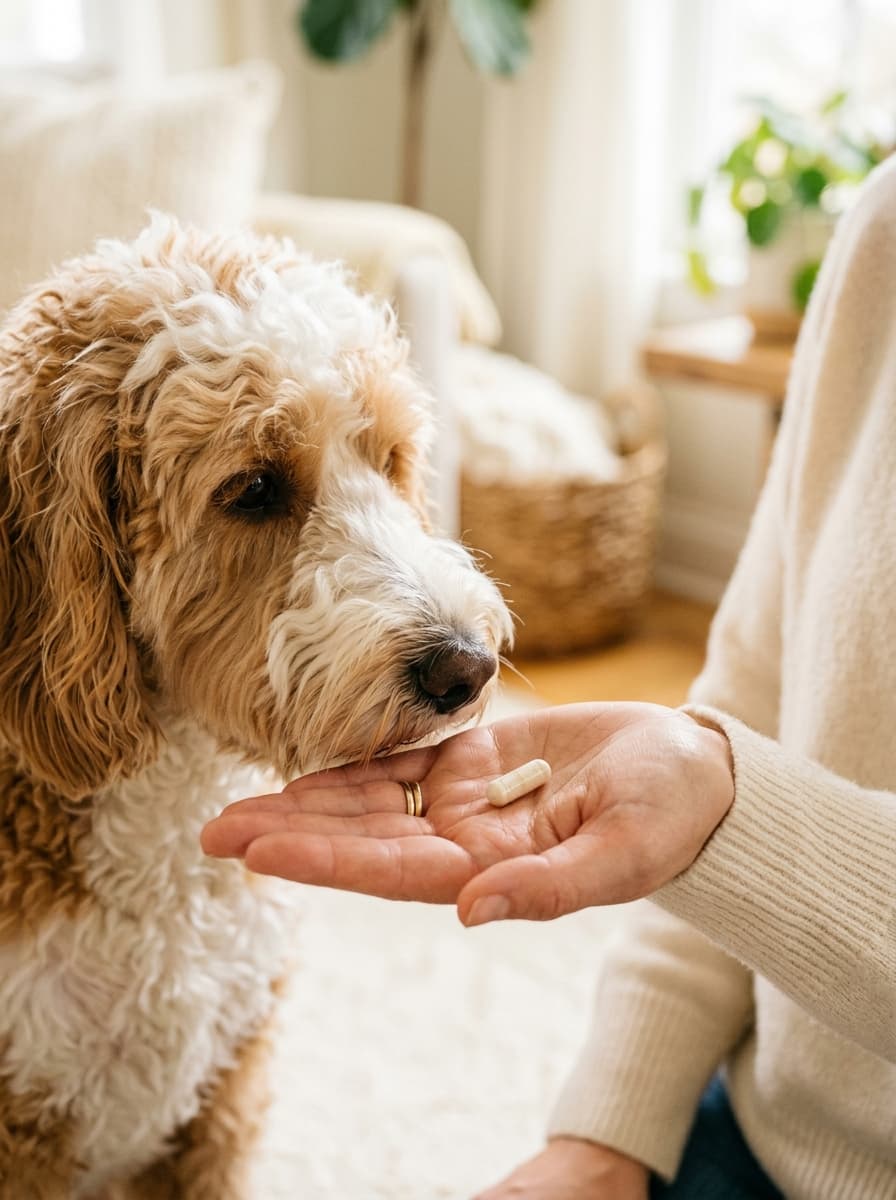
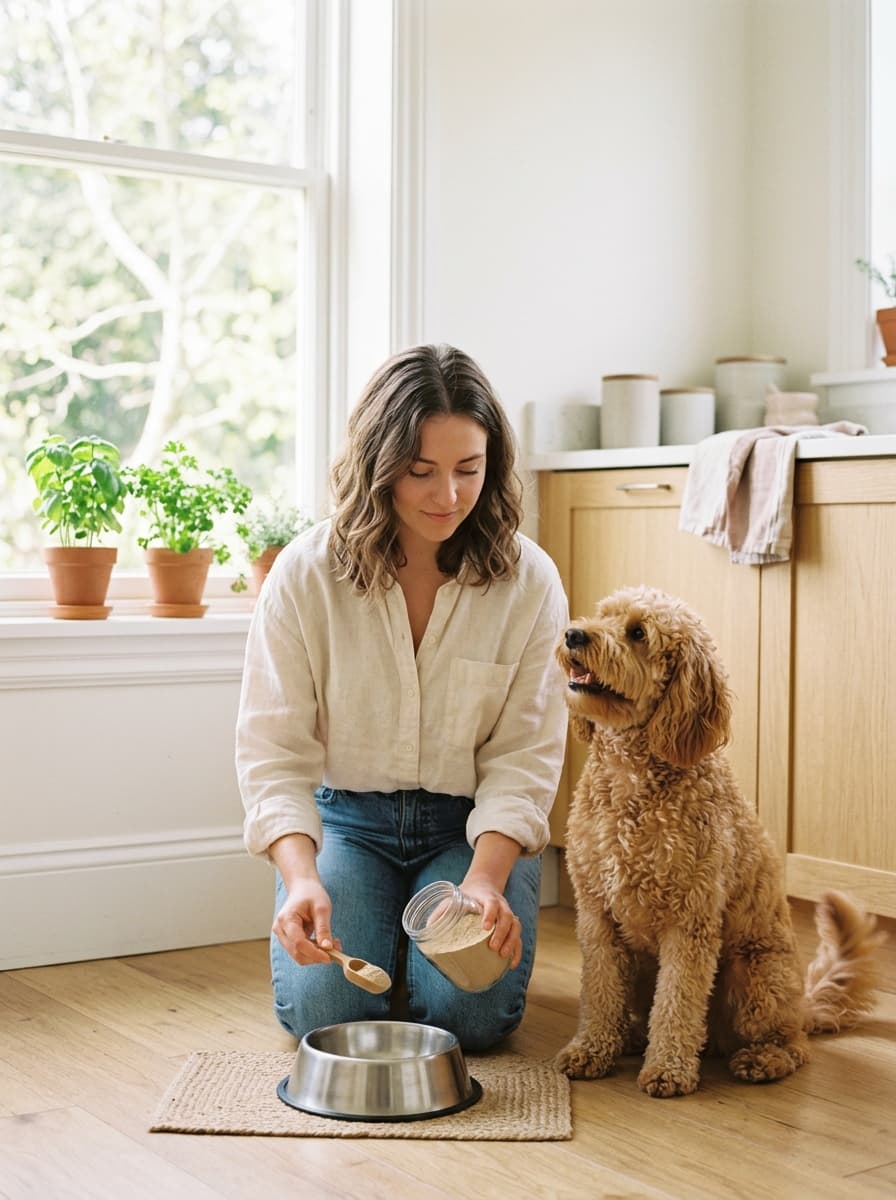
Most probiotics are best given with a meal, food buffers stomach acid and helps more bacteria survive the trip. Powders and opened capsules mix cleanly into raw or wet food. In our house we just stir the powder into the morning bowls, and with three dogs a consistent routine is everything, miss a day and someone always notices the other two get a "special" bowl.
How long to give it
- Simple digestive upset: a few days to 2 weeks
- Gut-skin / yeast support: commit to a full 4-8 weeks before judging
- Maintenance: ongoing, for doodles who clearly do better on it
What probiotics help: and what they don't
Setting honest expectations is the single most useful thing this guide can do.
Probiotics genuinely help with:
- Recovery from antibiotics, repopulating the gut after it's been wiped
- Transient diarrhea and soft stool, often firming things up faster
- Diet transitions, smoothing the switch to new food
- Stress-related upset, travel, boarding, changes at home
- General gut resilience in doodles with chronically sensitive stomachs
- Supporting (not curing) gut-skin and yeast issues as part of a plan
Probiotics won't fix:
- A true food allergy, that needs identifying and removing the trigger. Start with our food allergies in doodles complete guide.
- An active, established yeast or ear infection, that needs veterinary treatment
- A serious underlying condition causing vomiting, weight loss, or blood in stool
- Chronic overfeeding or a fundamentally unsuitable diet (overfeeding and stomach issues)
Think of probiotics as a supporting player, not the star. For doodles whose problems are food-driven, the real fix is dietary.
Pairing probiotics with diet: the combination that works
For most of the doodles we hear from, probiotics work best alongside a diet strategy, not instead of one.
If you suspect a food allergy or intolerance
The gold-standard way to identify a food problem is an elimination trial. Probiotics can ride along to support the gut while you do the detective work, they won't interfere with the trial. Our elimination diet for doodles step-by-step plan lays out exactly how, and food allergy vs food intolerance in doodles helps you understand what you're actually dealing with.
For doodles with confirmed sensitivities, a limited-ingredient or hydrolyzed diet is often the foundation, see limited ingredient dog food for doodles and, for tougher cases, hydrolyzed dog food for doodles.
If skin and coat are the main concern
Probiotics support the gut side of the gut-skin axis, but omega-3 fatty acids address the skin from another direction, and the two pair well. Our best omega-3 for doodle skin guide covers dosing, and can diet fix doodle skin problems gives the honest, no-hype view of what food can and can't do.
If the issue is acute upset right now
For a doodle with a sudden bland-tummy day, gentle add-ins like pumpkin and slippery elm can help settle things while probiotics work on the microbiome. See can pumpkin help a doodle's stomach and slippery elm for doodle digestive issues.
Putting the whole system together, probiotics, prebiotics, enzymes, diet, and routine, is exactly what our gut health routine for sensitive doodles walks through.
A simple decision framework
Not sure whether to start? Run through this:
- Are there red-flag symptoms (blood, repeated vomiting, lethargy, weight loss, prolonged diarrhea)? → See your vet first. Skip the supplement decision for now.
- Is the problem clearly food-driven (reacts to specific foods, itchy after eating)? → Start a diet strategy and add a probiotic as support.
- Is it recurring mild upset, gas, soft stool, or post-antibiotic recovery? → A synbiotic is a low-risk, sensible try.
- Is it gut-linked skin or yeast? → Probiotics plus diet work plus appropriate skin care, and commit to 8 weeks.
- Is your doodle totally healthy? → You probably don't need a daily one, though short courses around stress or diet changes still make sense.
FAQ
Not every doodle needs a daily probiotic, but many benefit from one because the poodle, retriever, and other lines behind doodles are prone to sensitive stomachs, food sensitivities, and yeast-driven skin and ear issues. If your doodle has recurring soft stool, gas, itchy skin, or repeated antibiotic courses, a probiotic is a low-risk thing to try. A healthy doodle with firm stool and no skin problems may not need one, though short courses during stress or diet changes can still help.
For simple digestive upset like gas or soft stool, you may see improvement within a few days to two weeks. For gut-linked skin and yeast issues, give it a full 4 to 8 weeks, because the gut-skin axis takes longer to shift. If you see no change at all after 8 weeks of consistent daily dosing, it may be the wrong strain or the wrong problem, and it is worth talking to your vet.
It's better to use a dog-specific probiotic. Dogs and humans host different bacterial species, and dog products use strains researched in dogs at dog-appropriate doses. Human probiotics are not usually dangerous in small amounts, but they may not colonize a dog's gut effectively and the dosing is a guess. For consistent results, choose a canine product with named strains and a guaranteed CFU count.
They can help as part of a bigger plan, not as a standalone cure. Because of the gut-skin axis, a healthier gut can reduce inflammation and support the immune system, which sometimes eases itchy skin and yeast in doodles. But if the root cause is a food allergy or an active yeast infection, probiotics alone won't fix it. Pair them with diet work and, when needed, veterinary treatment.
See your vet rather than reaching for probiotics if your doodle has blood in the stool, black tarry stool, repeated vomiting, lethargy, a fever, sudden weight loss, refuses food for more than a day, or has diarrhea lasting longer than about 48 to 72 hours. Very young puppies, seniors, and immune-compromised dogs also warrant a vet conversation before starting any supplement.
Your next step
If your doodle fits the profile, sensitive stomach, recurring soft stool, or gut-linked itchy skin, a well-chosen synbiotic is one of the lowest-risk, highest-value additions you can make to their routine. Start slow, give it a fair trial, and pair it with the right diet rather than expecting it to work alone.
Ready to pick one? Head to our hands-on best probiotics for doodles with digestive issues roundup for specific recommendations, or build the full system with our gut health routine for sensitive doodles. And if you're still not sure whether food is the real culprit, start with our signs your doodle has a sensitive stomach guide.