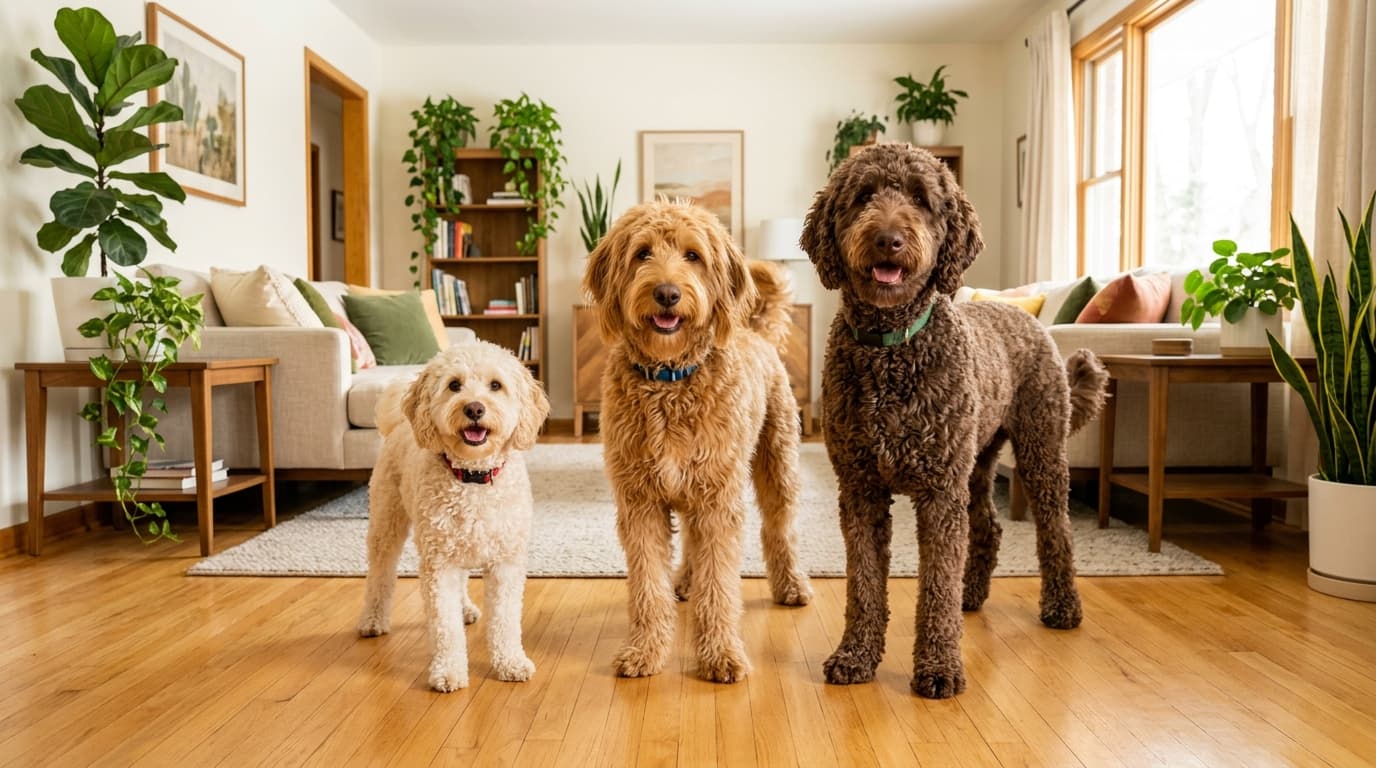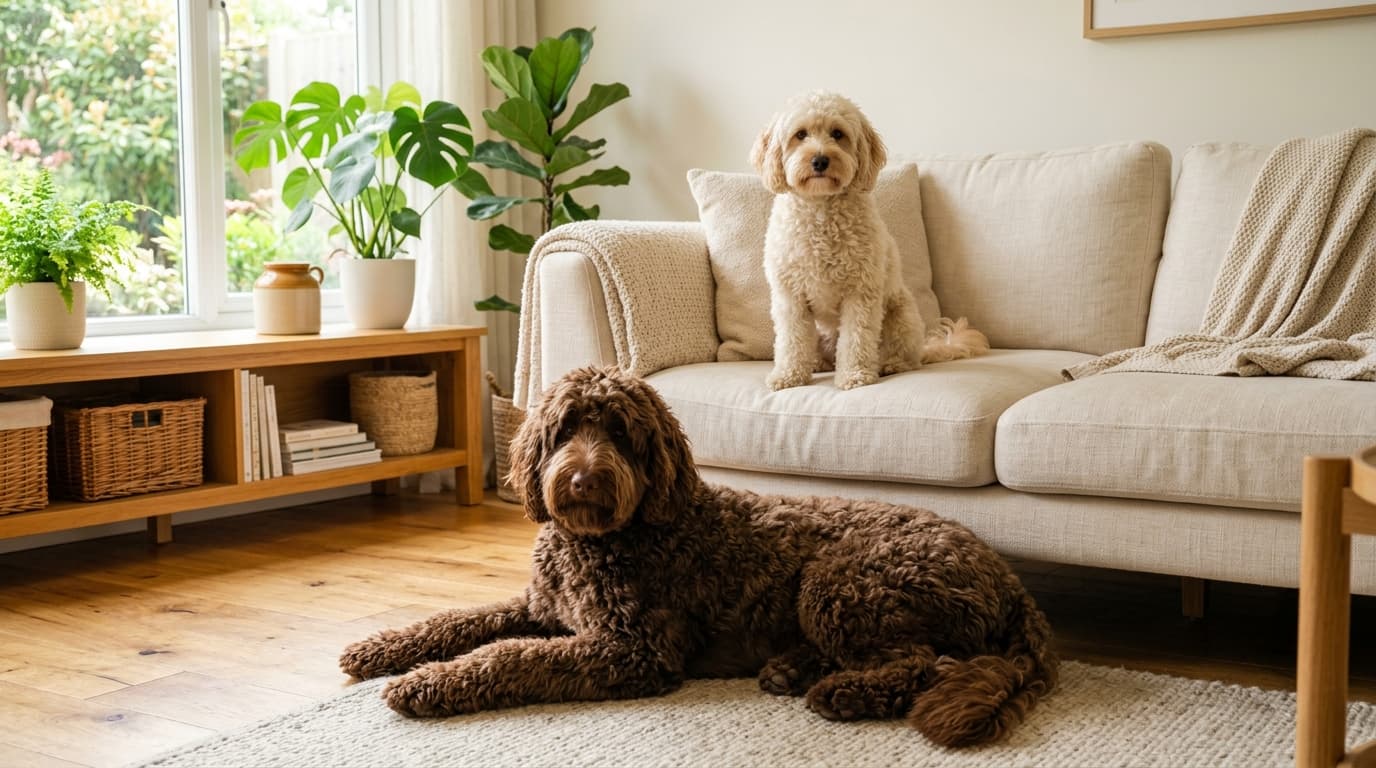
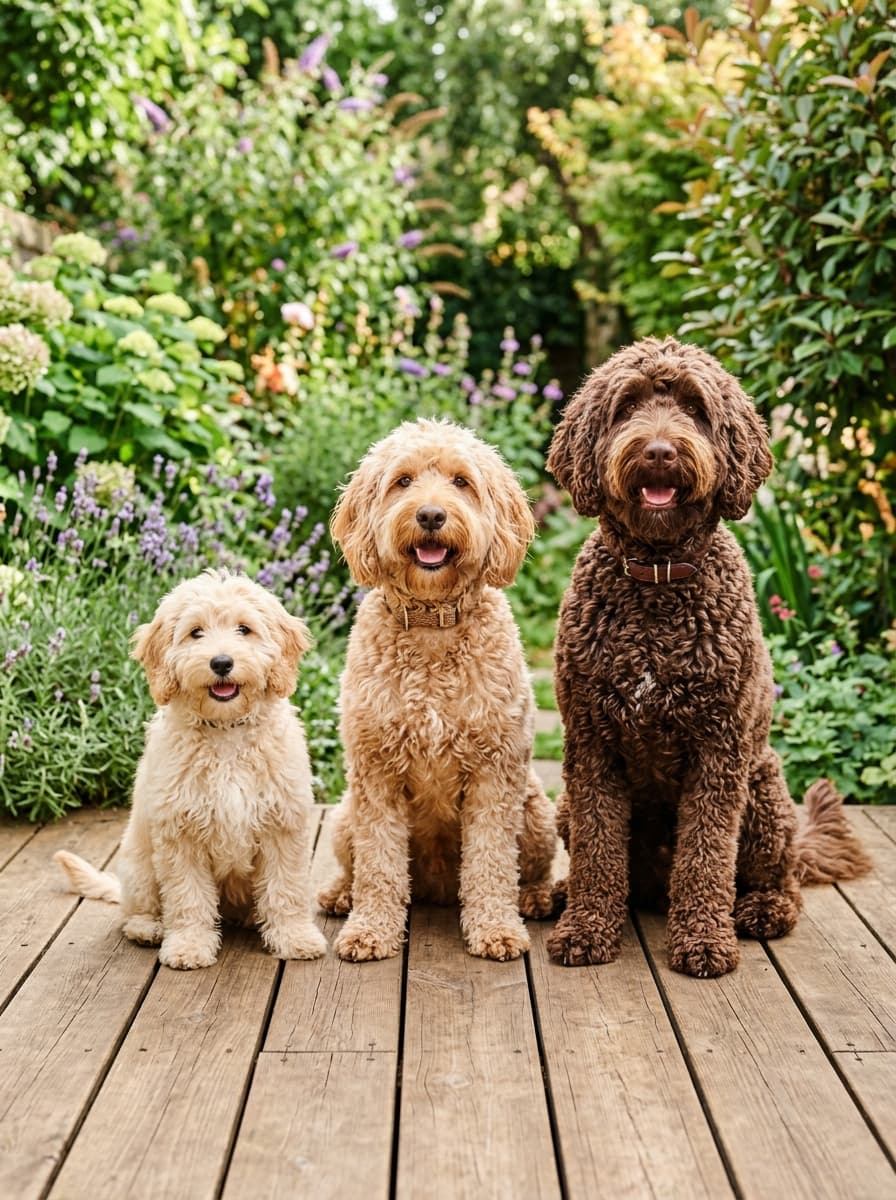
Minis suit small homes and travel but are more delicate and often more excitable than people expect. Standards are calmer indoors and more robust, but cost noticeably more to feed, groom and board, and carry a real bloat risk. Mediums are the compromise most families end up happiest with, which is why they have become so popular.
The brackets cut across the breeds, and the breed still matters at the top end: a Standard Bernedoodle or Sheepadoodle can reach 90 pounds (41 kg), where a Standard Goldendoodle or Labradoodle usually stops nearer 75. An Australian Labradoodle tends to be the most predictable of the lot, because the line has been bred for consistency.
If you are trying to work out which bracket your own puppy is heading for, our adult size predictor gives you a range from their age and weight, or from the parents'.
The three brackets
| Mini | Medium | Standard | |
|---|---|---|---|
| Adult weight | Under 25 lb / 11 kg | 25-45 lb / 11-20 kg | 45-90 lb / 20-41 kg |
| Height at shoulder | 14-17 in / 36-43 cm | 17-22 in / 43-56 cm | 20-29 in / 51-74 cm |
| Daily exercise | 45-60 min | 60-90 min | 60-90+ min |
| Food per day | Roughly 1× | Roughly 2× a Mini | Roughly 2.5-3× a Mini |
| Full grown at | 10-12 months | 12-14 months | 15-18 months |
| Groom appointment | Shortest, cheapest | Middle | Longest, priciest |
The exercise row is the one that surprises people. It is not proportional to size, because energy level is not a function of weight. A Mini is not a low-exercise dog, it is a dog that covers less ground per walk.
What each size is actually like to live with
Mini
Good for: apartments and smaller homes, people who travel, anyone who wants a dog that fits in a car footwell and can be picked up when needed. Cheaper to feed, faster and cheaper to groom, and easier to manage physically if you are not confident handling a strong dog on a lead.
The trade-offs people underestimate: Minis are more fragile. A stumble from a child, a jump off the back of the sofa, a bigger dog playing too hard, all carry more consequence at 18 pounds (8.2 kg) than at 60. They are also frequently more excitable rather than less, and small dogs get away with behaviour that would never be tolerated from a Standard, which quietly turns into a training problem.
They are also easier to overfeed than any other size, because a handful of treats is a much larger share of a small dog's daily calories. Working out the actual daily portion matters more here, not less.
Medium
Good for: most families. Big enough to be robust around children and to walk properly on a lead, small enough to lift into a car, fit in a normal-sized home, and not eat a fortune. Grooming and boarding costs sit in the middle. This is the bracket where the compromises are smallest, which is exactly why it is the one most people are happiest with in practice.
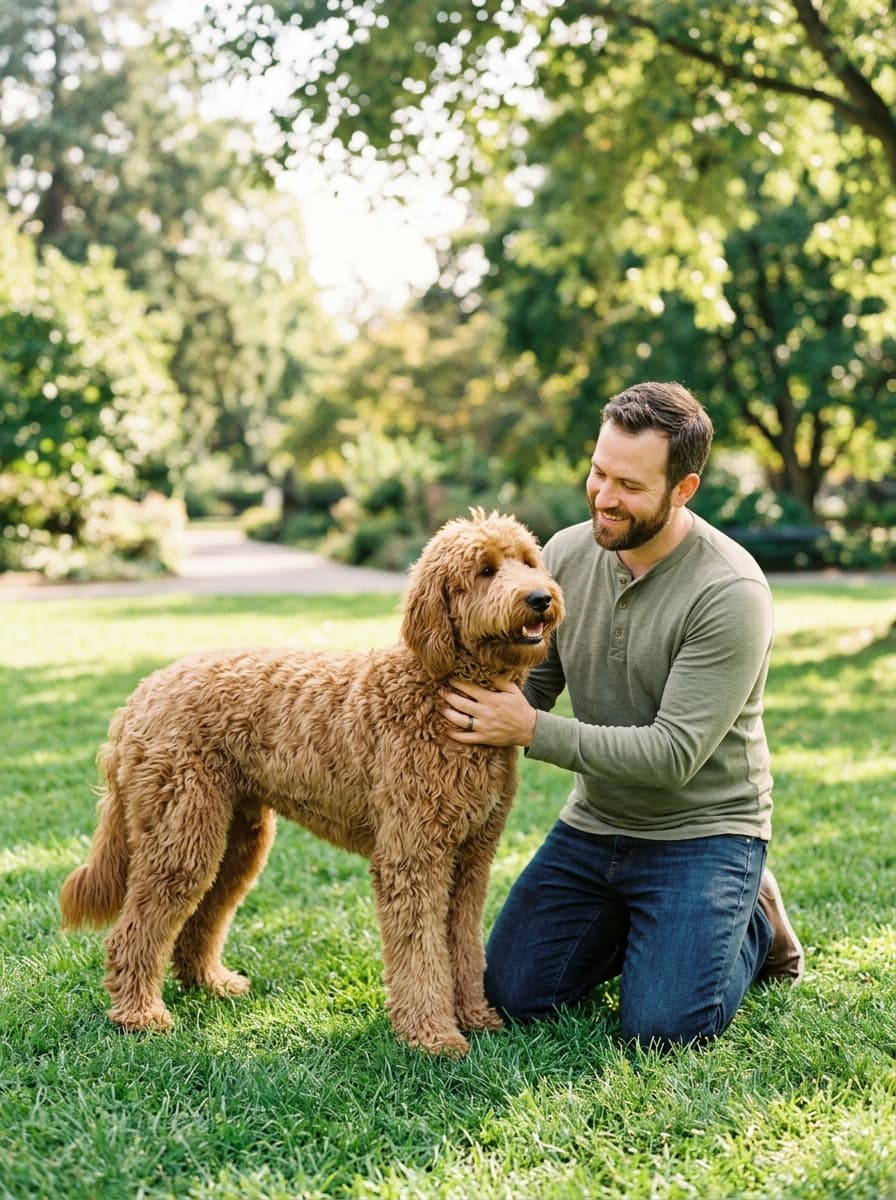
The trade-off: none especially dramatic, which is the point. If you have no strong constraint pulling you to one end or the other, this is the sensible default.
Standard
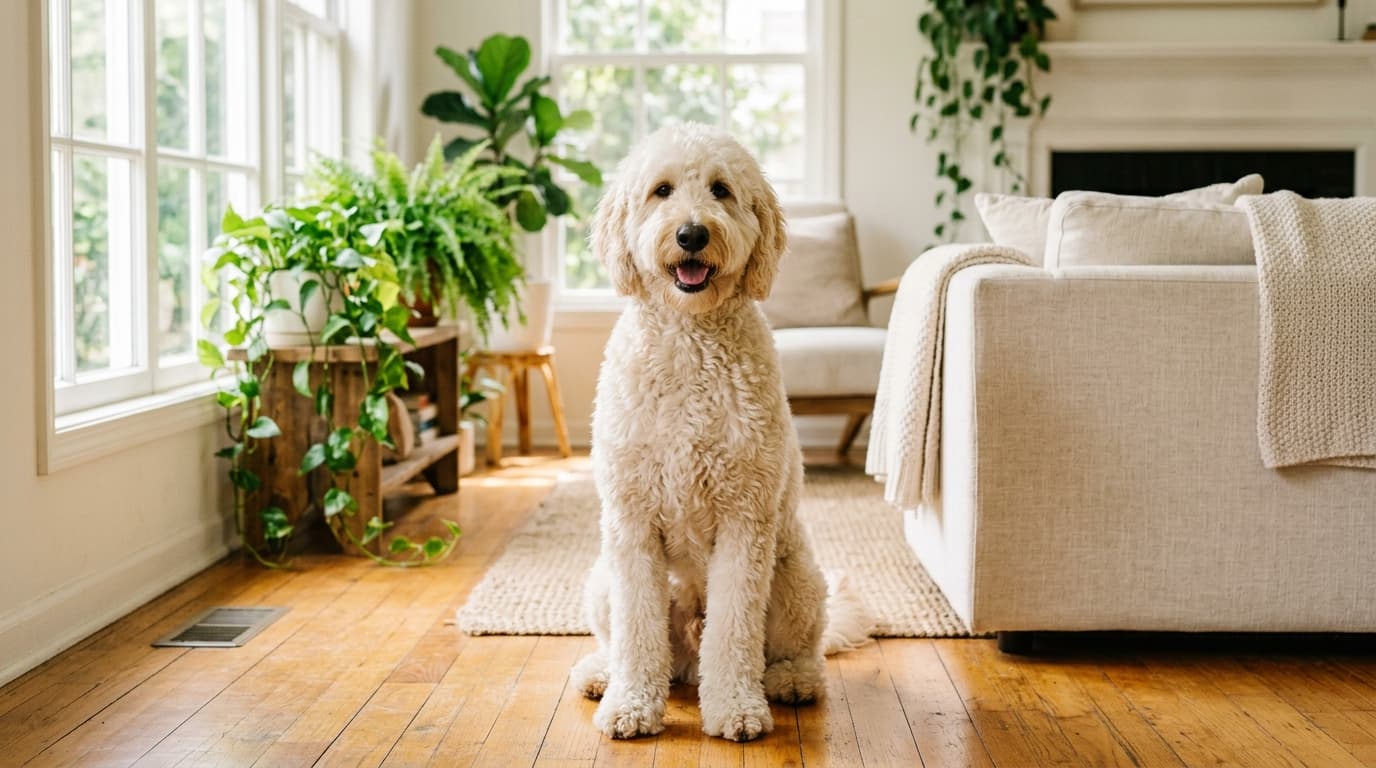
Good for: houses with space, active households, families with young children, and anyone who wants a dog to walk and hike properly with. Standards are frequently the calmest of the three indoors once mature, a grown Standard Goldendoodle will happily sleep most of the day between real exercise sessions, and Bernedoodles in particular have a reputation for being steady, low-key housemates.
The trade-offs: cost, and it is not just food. A Standard eats two to three times what a Mini does, and grooming, boarding, flea and worm treatments and most medications are all priced by weight. Across a year the difference is substantial and permanent.
They also take longer to mature, 15 to 18 months to full height, which means a longer adolescence and longer on puppy food. And a large, deep-chested dog carries a real bloat risk, which makes meal management a genuine health matter rather than a convenience.
What size does not change
Three things people expect to differ by size, that mostly do not.
Coat and grooming frequency. A Mini needs the same brushing routine as a Standard, just less of it per session. Coat type is set by generation and breeding, not by size. Doodle generations explained covers what actually drives it.
Shedding and allergy suitability. Also a coat question, not a size one. A Mini is not more allergy-friendly for being small.
Sensitive stomachs. This is the one we get asked about most, and size is not the variable. The Poodle line carries a documented predisposition to food sensitivities and allergic skin disease, and that runs through crosses at every size. If you are dealing with it, start with signs your doodle has a sensitive stomach, not the weight.
How to choose
Ask three honest questions.
Can you afford the largest size comfortably, every year? Not the purchase price, the running cost. Food, grooming, boarding, and vet bills all scale with weight. If a Standard would be a stretch, a Medium is not a downgrade.
Who else lives in the house? Young children generally do better with a Medium or Standard, which are robust enough to handle clumsy handling. Older or less steady adults often do better with a Mini they can physically manage.
How much space do you genuinely have, including the car? People plan the house and forget the car, the crate, the boot and the lift. A Standard in an apartment is more workable than people assume; a Standard in a small hatchback is a daily annoyance.
FAQ
For families with young children, a Medium or Standard is often the easier choice. Larger doodles are more robust when handled clumsily and tend to be steadier in a busy house, while Minis are more delicate and can be injured by a well-meaning toddler. Minis suit smaller homes, older children and adults who want a dog they can carry and travel with. Neither is a safety guarantee on its own, supervision and how the dog was raised matter more than the weight.
Less than people expect. A Mini needs shorter walks in terms of distance, but the energy level is not proportional to the size, and Mini doodles are often more excitable rather than less. A Standard is frequently the calmer dog indoors once mature. Plan on real daily exercise plus mental work at any size, and treat the size difference as a matter of distance rather than of need.
Meaningfully more, and food is only part of it. A Standard eats roughly two to three times what a Mini does, and grooming, boarding, flea and worm treatments and most medications are priced by weight too. Across a year the difference is substantial and it does not go away, so it is worth working out honestly before choosing a size rather than after.
They differ rather than one being simply worse. Standards, being large and deep-chested, carry a genuine risk of bloat and gastric torsion, which is an emergency. Minis are more prone to dental crowding and luxating patella, and small dogs are easier to overfeed because a few extra treats are a large share of their daily calories. Health testing of the parents matters more than the size bracket in either case. The American Veterinary Medical Association makes the same point about the value of screening breeding dogs for inherited conditions.
Yes, more comfortably than most people assume. A mature Standard tends to be a calm indoor dog and will happily sleep most of the day, provided the daily exercise and mental stimulation are genuinely happening. The practical constraints are usually stairs, lifts, car space and whether the building allows a large dog, rather than the square metres themselves.
Where to go next
If you already have your puppy, work out which bracket they are heading for with the adult size predictor, then use that number to pick the right Goldendoodle puppy food and the right daily portion.
If you are still choosing, how big do doodles get has the size ranges by breed, and doodle generations explained covers the coat and shedding side of the decision.