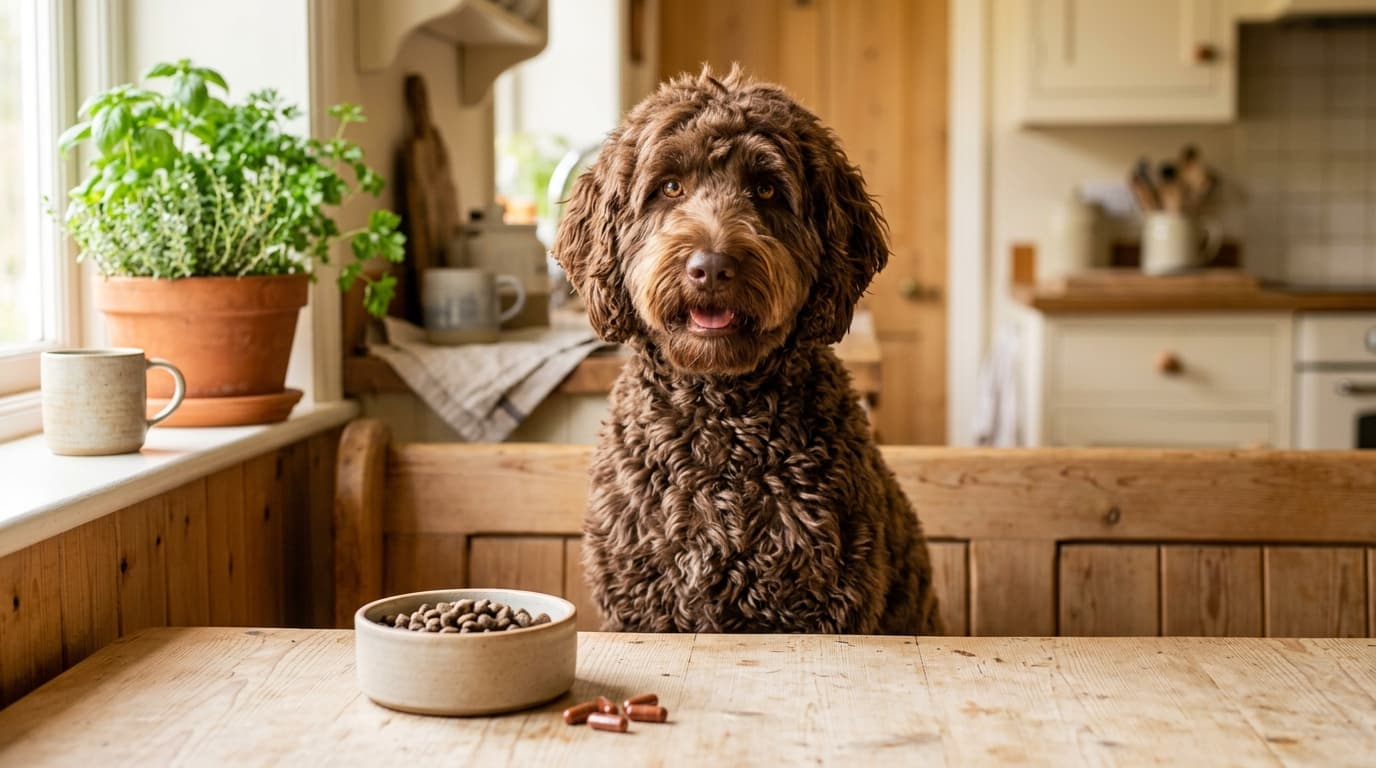
The best food for a Bernedoodle with allergies is a limited-ingredient or novel-protein diet that removes your dog's specific trigger, most often chicken, beef, or dairy. Run a strict 8-12 week elimination trial on one new protein (salmon, lamb, or a hydrolyzed formula) with no other foods, treats, or table scraps. For confirmed or complex allergies, a vet-prescribed hydrolyzed diet is the most reliable option.
If your Bernedoodle is scratching, licking paws raw, developing recurring ear infections, or leaving you soft, unpredictable stools, food is a fair place to start looking, but "hypoallergenic dog food for Bernedoodles" isn't one product off a shelf. It's a strategy. The right food depends entirely on which ingredient is causing the trouble.
Below, we compare the four diet types that actually matter, limited ingredient, novel protein, hydrolyzed, and fresh/raw, give you a decision framework tied to your dog's symptoms, and walk through four real food picks we'd feel comfortable recommending to a fellow doodle owner.
If you already know what you're dealing with and just want the shortlist, our overall pick for elimination trials is the Natural Balance Limited Ingredient Salmon & Sweet Potato, the rest of this guide explains how to tell whether it's the right one for your dog.
Why Bernedoodles Are Prone to Food Allergies
The honest version is narrower than most articles make it. The Poodle line carries a documented predisposition to allergic skin disease and food sensitivities, and that predisposition runs through the crosses, it is the part with real evidence behind it. The Merck Veterinary Manual covers the mechanisms behind allergic skin disease and food reactions in dogs. The Bernese Mountain Dog side is often described as bringing its own gut and immune weakness, but that is folklore rather than an established finding, and repeating it does not help you feed your dog. What a Bernedoodle reliably does inherit from the Bernese side is size, and as you will see below, size changes this problem more than anything in the pedigree.
That coat matters more than people think. On a short-haired dog you'd spot a red belly or a hot spot early. On a Bernedoodle, the fur masks it, so by the time you notice the red belly rash or a developing hot spot, things have often been brewing for a while. Their floppy, hair-filled ears also trap moisture, and food allergies are a classic driver of the recurring ear infections so many Bernedoodle owners battle.
What Bernedoodles React To Most
Before you buy anything, it helps to know the usual suspects. In doodles, the most common food allergens are animal proteins, not grains, the opposite of what most marketing implies.
- Chicken, one of the most common triggers, and it's in most everyday kibble. See chicken allergy in doodles.
- Beef, in the studies, the most frequently reported protein allergen in dogs overall. Owners of the Goldendoodle side of the family tree see this too; the beef allergy signs are the same across doodles.
- Dairy and eggs, frequent secondary offenders.
- Wheat, corn, soy, real but less common than protein allergies.
Because chicken is the default protein in so many foods, switching to a novel protein food for Bernedoodles, one their immune system has never met, like salmon or lamb, is often the single most useful move. For the full list, our common ingredient triggers guide is the deep dive.
Can Bernedoodles Eat Chicken?
Yes, most Bernedoodles can eat chicken without any problem. Chicken is only an issue for a dog that is actually allergic or intolerant to it, and the signs of that are year-round itching, paw licking, recurring ear infections and soft stool that don't clear up. Bernedoodles are not "allergic to chicken" as a breed. If you suspect it, remove chicken completely for 8 weeks, including chicken fat, chicken broth and "poultry" in treats, and watch whether the symptoms fade. If they do and return when chicken comes back, you have your answer.
The Four Diet Types Compared
Here's how the main options stack up for an allergic Bernedoodle. There's no single "best", the right one depends on how severe and how complex your dog's allergies are.
| Diet type | How it works | Best for | Trade-off |
|---|---|---|---|
| Limited ingredient (LID) | One protein + one carb, short ingredient list | Suspected single-protein allergy; DIY elimination trials | Not truly hypoallergenic if protein is still one they react to |
| Novel protein | A protein the dog has never eaten (salmon, lamb, venison, rabbit) | Dogs reacting to chicken/beef; first-line food switch | Once used, it's "burned" as a future novel option |
| Hydrolyzed (prescription) | Proteins broken into pieces too small to trigger the immune system | Confirmed or multiple allergies; failed OTC trials | Vet-prescribed, pricier, less palatable to some dogs |
| Fresh / raw | Whole-food ingredients, full control over what's in the bowl | Owners who want total ingredient control | Cost, prep time, and it must be balanced correctly |
Limited ingredient food for Bernedoodles
A limited ingredient diet (LID) strips the recipe down to a handful of components, typically one protein and one carbohydrate. That short list is what makes LID the workhorse of allergy management: fewer ingredients means fewer things that could be the problem. It's also the easiest food type to run a DIY elimination trial on. We cover the category in depth in limited ingredient dog food for doodles explained and rounded up broader picks in best limited ingredient dog food for doodles.
Hydrolyzed food for Bernedoodles
If over-the-counter foods keep failing, hydrolyzed diets are the next step. The proteins are chemically broken down so small that your Bernedoodle's immune system can't recognize them as a threat. It's the most reliable option for complex, multi-protein allergies, but it's prescription-only and a bigger commitment. Whether it's worth it is a real question, and we answer it honestly in hydrolyzed dog food for doodles.
Fresh and raw options
We feed raw at home for all three of our doodles, and one honest benefit is total control, you know exactly which proteins are in the bowl, which makes rotating away from a trigger straightforward. But raw is a commitment, and it has to be balanced properly to be safe. If you're curious, start with our feeding philosophy and the kibble-to-raw transition plan. For allergy testing specifically, a simple cooked or commercial novel-protein diet is often easier to keep truly "clean."
Top Picks
A good food for an allergic Bernedoodle does three things: it uses a limited or novel protein to sidestep the usual triggers, it supports skin and coat with omega fatty acids, and it's gentle enough on a sensitive doodle gut to survive a slow transition. We chose these four to cover different budgets and different levels of allergy severity, so you can match one to your dog rather than guessing.
| Product | Best For | Main protein |
|---|---|---|
| Natural Balance LID Salmon & Sweet Potato | Best Overall for elimination trials | Salmon |
| Purina Pro Plan Sensitive Skin & Stomach Salmon | Best Vet-Trusted for skin + gut | Salmon |
| Wellness CORE Grain Free Whitefish, Herring & Salmon | Best for Itchy-Skin Flare-Ups | Whitefish, herring, salmon |
| Zignature Duck Limited Ingredient Formula | Best Fish-Free Protein Rotation | Duck |
Before you order. A Bernedoodle gets through a bag fast, which makes the bulk size tempting, but buy the smallest bag of a new formula first and only size up once your dog has been on it for a few weeks without a flare. Bag prices shift constantly, so it is worth comparing what the larger sizes actually cost right now before you commit. For a broader, doodle-tested shortlist that goes beyond food, probiotics, supplements, and health tools for sensitive skin and digestion, see our Best Products for Sensitive Doodles guide.
The Bernedoodle problem nobody puts a number on
Every allergy article tells you to run an 8 to 12 week elimination trial on a single novel protein. Almost none of them mention what that actually means for a dog this size.
A Bernedoodle is the largest of the common doodle crosses, a Standard finishes around 60 to 90 pounds (27 to 41 kg), where a Standard Goldendoodle usually stops nearer 75 and a Mini lands under 25. Run the same trial protocol across those weights and the amount of food you have to buy, store and commit to looks like this:
| Bernedoodle size | Daily amount | 8-week trial | 12-week trial |
|---|---|---|---|
| Mini (~25 lb / 11 kg) | ~190 g | ~23 lb / 10.5 kg | ~35 lb / 16 kg |
| Medium (~45 lb / 20 kg) | ~290 g | ~36 lb / 16 kg | ~54 lb / 24 kg |
| Standard (~80 lb / 36 kg) | ~450 g | ~55 lb / 25 kg | ~83 lb / 38 kg |
Amounts use the standard resting-energy calculation for a neutered adult on dry food; our portion calculator does the same arithmetic for your dog's actual weight.
A full 12-week trial on a Standard Bernedoodle takes about 83 pounds (38 kg) of one single food, roughly two and a half times what the same trial costs a Mini owner, in a household that has to store it and commit to it before knowing whether it works.
That is the real reason elimination trials fail in big doodles. Not that the protocol is wrong. Owners abandon them at week five or six, switch to something else, and lose the answer, because the remaining two-thirds of a very large purchase is riding on a food that has not visibly helped yet. The AVMA makes the same point that an elimination diet trial is the gold standard for diagnosing food allergies, which you can read more about at avma.org.
Your Decision Framework
Match the food to the symptom picture:
-
Mostly loose stools, gas, occasional vomit, skin mostly fine? Start with a highly digestible sensitive-stomach salmon-and-rice formula. This may be intolerance more than allergy. See signs your doodle has a sensitive stomach and Bernedoodle stomach problems explained.
-
Itchy skin, paw licking, ear infections, the classic allergy trio? Go straight to a limited-ingredient novel protein (salmon or lamb) and run a full elimination trial.
-
Already tried two or three OTC foods with no improvement? It's time to talk to your vet about a hydrolyzed prescription diet.
-
Want maximum control and willing to do the work? A balanced fresh or raw rotation lets you eliminate proteins cleanly.
-
Standard-sized and unsure? Order by trial size, not by review score. Two foods that look equally good on paper are not equal when one commits you to 83 pounds (38 kg) of it, start with whichever novel protein is easiest to buy in a small bag first.
Food isn't always the whole answer, either, environmental allergies (pollen, dust mites) cause identical itching. Our honest take on how much diet can actually fix is in can diet fix doodle skin problems.
How to Run the Elimination Trial
This is the part most owners rush, and rushing is why food trials "fail."
- Pick ONE new protein your dog has never eaten.
- Feed it and nothing else for 8-12 weeks. No flavored treats, no table scraps, no dental chews, no flavored medications if avoidable.
- Transition slowly, over 7 days for a sensitive Bernedoodle, to avoid the digestive upset a fast switch causes. Our 7-day food transition plan walks through the ratios, and if you've already switched too fast, doodle diarrhea after switching food covers the recovery.
- Track symptoms weekly. Gut signs settle first (1-2 weeks); skin and ears are slow and can take the full 6-8+ weeks.
- Reintroduce (challenge) the old protein at the end. If symptoms return, you've confirmed the trigger.
Our full step-by-step is in the elimination diet for doodles guide, worth reading before you start so you don't accidentally contaminate the trial.
Because gut and skin often flare together, pairing the food trial with a probiotic and an omega-3 supplement can speed up how quickly the coat calms down, just don't add them mid-trial, or you won't know what's helping. Our honest supplement roundup is here.
FAQ
The best food is one that removes your Bernedoodle's specific trigger, usually chicken, beef, or dairy. A limited-ingredient salmon or lamb diet works for most dogs, while a vet-prescribed hydrolyzed formula is the most reliable choice for confirmed or complex allergies. The only way to know for sure is an 8-12 week elimination trial on a single new protein.
Yes, most Bernedoodles can eat chicken without any problem. Chicken is only an issue for a dog that is actually allergic or intolerant to it, and the signs are year-round itching, paw licking, recurring ear infections and soft stool. Bernedoodles are not allergic to chicken as a breed. To test it, remove chicken completely for 8 weeks, including chicken fat, broth and poultry in treats, and see whether the symptoms fade.
The most common food allergens in Bernedoodles are animal proteins, chicken and beef are the most common, followed by dairy, eggs, and sometimes wheat, corn, or soy. Because the Poodle line carries a documented predisposition to allergic skin disease, and Bernedoodles carry Poodle genetics, they can inherit skin and gut sensitivities from either line, so chicken (the most common protein in everyday kibble) is often the first ingredient worth removing.
Gut symptoms like loose stools often improve within 1-2 weeks of finding the right food, but skin and coat allergy signs are slower, itching, paw licking, and ear issues can take 6-8 weeks or longer to calm down. That's why a proper elimination trial runs a full 8-12 weeks before you judge whether a food is working.
Not necessarily. Grain allergies are far less common than protein allergies in doodles, so grain-free only helps if grains are your dog's actual trigger. Grain-free diets are often built around novel proteins, which is the real reason they can help. If your Bernedoodle reacts to chicken, switching to a grain-inclusive salmon or lamb food may work just as well.
Not always. Many Bernedoodles do well on an over-the-counter limited-ingredient or novel-protein diet. Hydrolyzed food, where proteins are broken down too small for the immune system to recognize, is worth the extra cost and vet visit when over-the-counter foods haven't worked or when your dog reacts to multiple proteins.
Your Next Step
Pick the food that matches your Bernedoodle's symptom picture, commit to a clean 8-12 week trial, and resist the urge to change three things at once. If the itching is severe or you're not sure whether you're dealing with food, yeast, or environmental allergies, start with why is my doodle so itchy all the time to narrow it down, then come back and run the trial with confidence.
For the complete roadmap, our food allergies in doodles complete guide ties everything together, and the food allergies hub has the rest of the cluster when you're ready to go deeper.