Gunnar spent his first two years on a perfectly normal kibble — and built up two years of recurring ear infections to match. We didn't move him to raw because we were ideologues about it. We moved him because nothing else had worked, and we'd run out of softer options.
What this guide covers. This is the kibble-to-raw transition plan — the path for owners who've decided their doodle needs to be off kibble entirely. If you're switching from one kibble to another, that's a different protocol. Same for the freeze-dried path, which sits between kibble and raw and is what most doodle owners reach for first. The site's feeding philosophy ranks the three tiers raw → freeze-dried raw → better kibble — and the goal is the best version of whatever tier fits your life.
Which Path Applies to You: Healthy Doodle or One with Symptoms?
Not every kibble-fed doodle needs the same kibble-to-raw protocol, whether they're an Australian Labradoodle, a Goldendoodle or a Bernedoodle. The right pacing depends on what state the gut is in when you start.
Path A — A healthy doodle with no gut issues. Firm stools, normal energy, no recurring skin or ear problems, no history of food sensitivities. For this dog, kibble to raw can be done directly — no cooked-stage middle step required. The pacing is slower than a 7-day kibble switch (the gut still has to adapt to a fundamentally different food category), but the timeline runs in weeks, not months.
The Path A protocol in brief:
- Two-week probiotic prep before any food change starts.
- Pick a novel protein your doodle hasn't reacted to before — lamb, venison, duck, rabbit, or fish are common starting points.
- Move at the standard 7-day plan ratios (25/75 → 50/50 → 75/25 → 100), but hold each ratio for two to four days instead of one. Most doodles complete the transition in three to six weeks.
- Watch stool quality, vomiting, energy, skin/ears, drinking habits. If anything wobbles, hold the ratio. If symptoms appear that didn't exist before, you may actually be on Path B — pause and reassess.
- After full transition, hold at 100% raw for two to four weeks before introducing new proteins. Then build a rotation across two or three proteins.
The Top Picks below cover raw products that work for Path A as well. The cooked-stage detail in the rest of this guide isn't required for healthy doodles — skip ahead unless you want to understand why the slower path exists for the dogs that need it.
Path B — A doodle with existing gut issues. Recurring soft stools, vomiting, food intolerances, skin or ear problems that won't clear up, or any history of significant digestive sensitivity. For this dog, going straight from kibble to raw is asking too much of an already inflamed gut. The cooked-stage middle step — cooked meat plus gentle vegetables for several months before any raw is introduced — is the bridge that makes the eventual raw transition stick. The full timeline runs six to twelve months.
If you're not sure which path fits, the conservative choice is Path B. There's no penalty for pacing too slowly; the cost of pacing too fast on a sensitive doodle is a failed transition that can take longer to recover from than the original problem.
The rest of this guide is the Path B playbook in depth — the cooked-stage middle step is what most raw-feeding articles skip entirely, and it's what made the difference for our two recovering doodles.
Why a Kibble-to-Raw Transition Is Different from Any Other Food Switch
A kibble-to-kibble switch is a small adjustment to a system that already knows how to do its job. The gut sees a different brand of essentially the same kind of food. Microbiome shifts a little. Enzyme output stays roughly the same. Hydration stays the same. Stool volume stays the same. The 7-day plan works because the changes are small.
A kibble-to-raw switch is not a small adjustment. It's a redesign of the digestive system, and it has to be paced accordingly.
Microbiome reset. A gut that has eaten kibble for years has bacterial flora optimized for processed carbohydrates, plant-based proteins, and synthetic supplements. A raw-fed gut runs on a flora optimized for animal proteins, fats, organ meat, and bone. These are not the same populations. The shift takes weeks at minimum, often months. There is no shortcut, because bacterial populations don't sprint — they reproduce, compete, and stabilize at their own pace. The cooked-stage middle step (more on that below) is the bridge that gives the new flora time to grow.
Enzyme adaptation. Kibble is cooked, extruded, and stripped of most naturally occurring enzymes. The pancreas and intestinal wall have learned to produce enough enzymes to break down what kibble contains — no more, no less. Raw food contains its own enzymes and demands a different production curve from the dog's own systems. Asking a kibble-adapted pancreas to handle raw protein and fat overnight is the digestive equivalent of going from a desk job to a marathon without training. The cooked stage is the training.
Hydration shift. Kibble is roughly 10% moisture. Fresh raw is closer to 70%. The whole digestive rhythm changes. Stool volume drops dramatically — sometimes by half — because raw is so much more bioavailable. Water intake usually goes down, not up, because the food itself is hydrating. Owners who don't expect this often think their doodle is sick. They're not. Their stool is just a fraction of the size, and they don't need as much water from the bowl.
Fat metabolism. Most commercial raw diets are higher in fat than the kibble they replace. Sensitive doodles — especially those with any history of digestive sensitivity — sometimes need a slower fat ramp-up to avoid pancreatitis-adjacent symptoms (vomiting after meals, lethargy, watery stool). The cooked stage uses leaner proteins on purpose, building tolerance before fattier raw cuts get added.
None of this is hypothetical. Gunnar and Sven both went through the full transition. Both had moments where stool got softer, energy dipped, or appetite changed. None of those moments were emergencies — they were the system rebalancing itself, exactly the way it was supposed to.
What Goes Wrong When Raw Transitions Fail
Most "raw didn't work for my dog" stories trace back to one of five mistakes — and not to raw itself.
The instant switch. An owner reads that "dogs evolved to eat raw" and dumps the kibble overnight. By day two, the dog has diarrhea, has vomited at least once, and is refusing the new food. The owner concludes raw doesn't agree with their dog. What actually happened: a gut that had no time to adapt was overwhelmed, and the dog now associates raw food with feeling terrible. The fix isn't a different brand of raw. It's pacing.
Skipping the cooked stage when symptoms are already present. This is the most common version of the same mistake for Path B doodles. Even owners who pace the transition over a few weeks often go straight from kibble to raw with no cooked-meat-and-vegetables bridge — and for a doodle whose gut is already showing symptoms (recurring soft stools, ear infections, skin reactivity, food intolerances), that's asking too much. The cooked stage is what makes raw stick when the gut needs to heal first. Healthy doodles without symptoms can often skip this step (Path A); doodles with symptoms generally can't (Path B).
Wrong starting protein. A doodle whose recurring problems trace back to chicken in their kibble — extremely common — gets transitioned to chicken-based raw, because chicken is the cheapest and most available raw protein. The dog reacts to the raw the same way it reacted to the kibble, and the owner concludes raw doesn't work. The fix is a novel protein for the first raw introduction: lamb, venison, duck, rabbit, or fish — something the dog hasn't eaten before.
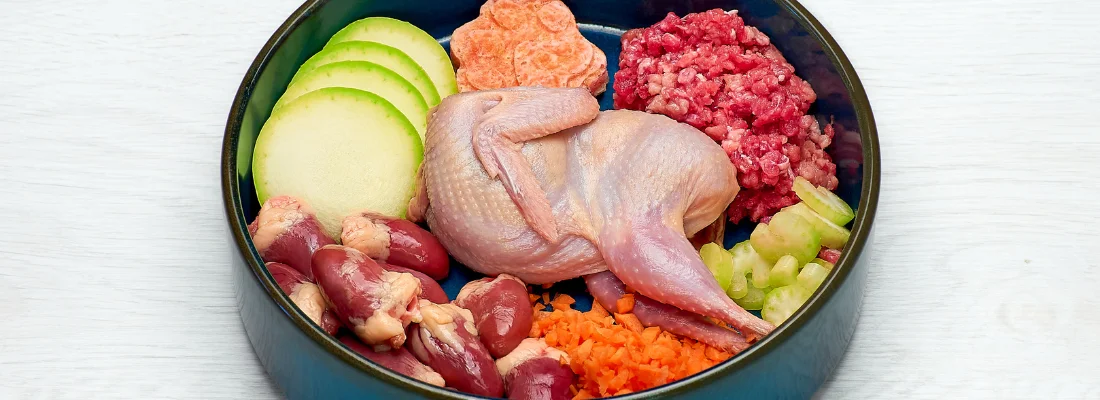
Bone overload too early. A common mistake when owners transition to raw using a high-bone ground product (often 30% bone or more by weight). Constipation, white powdery stool, vomiting, and reluctance to eat are the signals. A kibble-adapted gut needs time to learn how to handle bone. Start with boneless or low-bone (≤10%) raw for the first month or two, then introduce bone gradually.
Treating raw as a monodiet. Some owners pick one protein, find it works, and stay there forever. This works against most of the benefits of raw. A diet that doesn't rotate provides less microbiome variety than the kibble it replaced. Raw should rotate across at least three or four proteins on a regular cycle — that's where the long-term gut and immune benefits come from.
The protocol below is built to avoid all five.
The Cooked-Stage Middle Step (the Differentiator Most Raw Guides Skip)
This section covers the Path B protocol — the protocol for doodles who already have gut symptoms before the transition starts. If your doodle is healthy (Path A), you can skip ahead to Top Picks; the cooked stage isn't required for a gut that's already in good shape.
For Path B, take this one thing from the guide if nothing else: a kibble-fed doodle with existing gut issues needs a cooked-stage middle step before any raw is introduced. This is the part almost every other raw-feeding article either ignores or dismisses, and it's the part that determines whether the transition holds.
Why it works. The cooked stage is anti-inflammatory by design. A kibble-fed gut that has built up chronic low-grade inflammation — recurring soft stools, reactive skin, ear infections that come and go — usually can't handle raw protein right away. The bacterial environment is wrong, the enzyme output is wrong, and dropping raw meat onto an inflamed gut often makes symptoms worse before they get better. Cooked meat is more digestible than raw for a kibble-adapted gut: proteins are partially denatured and easier to break down with the enzyme output the dog already has. Cooked sweet potato and carrot provide gentle fiber and prebiotics that feed the new bacterial populations the gut needs to grow. Removing kibble removes the inflammation triggers — chicken by-products, corn, wheat, soy, synthetic preservatives — that drove the original problems. Bones, organ meat, eggs, and fully raw protein are deferred until the gut is ready for them. This is exactly why our two recovering doodles spent a year on the cooked stage before any raw was reintroduced — the inflammation took that long to settle.
What goes in the bowl during the cooked stage. Cooked meat as the primary protein, in our case horse and occasionally reindeer — both lean, both novel for most dogs, both readily available where we live in Finland. For US-based readers, the closest equivalents are venison, elk, bison, or lean cuts of grass-fed beef — anything novel and lean enough to be anti-inflammatory. The meat is simmered or boiled, not pan-fried, with no added fats during this phase. Cooked sweet potato is the main vegetable, boiled until soft and mashed, in small amounts. Boiled carrot occasionally — same preparation, fully cooked and soft, never blanched or steamed. That's it. The cooked stage is intentionally minimal: one protein, one or two cooked vegetables, no extras. A measured calcium source if the cooked stage runs more than a few weeks (eggshell powder is the simplest). A canine multivitamin to cover trace minerals the cooked-and-veg meal doesn't reliably provide. Salmon oil for omega-3 (one pump per 10 kg of body weight, daily) — added once stools are stable.
What stays out of the cooked stage entirely. Raw bones (introduced in phase 4, raw only — never cooked). Organ meat (liver, kidney, spleen — phase 4, raw only). Eggs (phase 4, raw, once the gut is stable). Beef fat trim or other high-fat cuts (build tolerance gradually in the raw phases). Onions, garlic, grapes, raisins, macadamia, anything in the standard "toxic to dogs" list. Treats containing the protein you've removed (e.g. chicken treats if you've removed chicken). Generic dog treats during the transition window — use small pieces of the cooked-stage protein as treats instead.
How long the cooked stage runs. For Gunnar and Sven, the full cooked-stage window — fully off kibble, fully on cooked meat plus vegetables — was about a year before any raw was introduced. That's the conservative end. For doodles with less severe history, six to ten weeks is often enough. The signal that the gut is ready for raw is consistent: firm stools at every meal for at least four weeks, stable energy, no skin or ear flare-ups, and a calm reaction to any minor variations in the cooked recipe.
Before You Start: The Three Things to Get Right
A successful raw transition is mostly decided before any raw food enters the bowl. Three preparations matter more than the schedule itself.
First: find a vet who understands raw — or at least doesn't reflexively oppose it. Not all vets are raw-friendly, and a hostile vet can derail a transition that's actually going fine. Before you start, make a phone call or send an email to ask: do you have other patients on raw diets? Are you comfortable with raw-fed reference values on bloodwork? Will you support the transition or push back on it? You're not asking for permission — you're identifying whether this is a clinic you can use as a partner. If the answer is no, find another vet before you start, not after the first soft-stool episode.
Second: pick the cooked-stage protein your doodle hasn't reacted to before. This is non-negotiable. If chicken has been in the rotation, take it out. Same for any other suspected trigger. The safest first cooked-stage protein is something the dog has never eaten — turkey, white fish, lamb, or duck for most doodles raised on chicken-based kibble. Run the entire cooked stage on one or two proteins; introducing variety comes later, after the gut is stable.
Third: plan for six to twelve months, not for a fast result. This is a marathon, not a sprint. The transition includes two to four weeks of pre-transition prep, eight to twelve weeks of moving onto cooked food, eight to twelve weeks of stable cooked-only feeding, and another two to three months of introducing raw piece by piece. If your timeline is tighter than that, raw probably isn't the right choice right now — freeze-dried is the better next step, and you can always come back to raw later.
The Transition Timeline (Phase by Phase)
Here is the full arc, from first day of pre-transition prep to full raw rotation. Treat the week ranges as floors, not ceilings — most doodles need the longer end, and a transition that takes longer is doing exactly what it should.
Phase 1 — Pre-transition prep (weeks 1–2). Probiotic added daily. Stop all treats containing the protein you're about to remove. Stop human-food scraps. Note baseline: stool quality, energy, drinking habits, skin and ear status. Order the cooked-stage proteins and vegetables. Don't change the food itself yet — just stabilize everything around the dog so the next change starts from a clean baseline.
Phase 2 — Moving onto cooked (weeks 3–8). Begin with 25% cooked meat plus vegetables, 75% kibble. Hold each ratio for at least one week before moving up — not seven days, but a full week of consistently firm stools. Move to 50/50 when the dog is stable at 25/75. Move to 75/25 when stable at 50/50. Move to 100% cooked when stable at 75/25. For most sensitive doodles, this phase runs four to six weeks. For doodles with severe history, it runs eight or more.
Phase 3 — Stable cooked-only feeding (weeks 9–20+). Once the dog is fully on cooked meat plus vegetables, hold for at least eight weeks before any raw is introduced. This is not wasted time — it's where the microbiome rebalances and the inflammatory load from years of kibble subsides. During this window, you can rotate proteins (one new one every two weeks), add a second vegetable or two, and adjust portion sizes if weight is shifting. The signal that you're ready for phase 4 is consistent: firm stools at every meal for four weeks straight, stable energy, no flare-ups, no reactivity to small recipe changes.
Phase 4 — Raw introduction (months 5–7). Start with a single boneless raw meal once a week, replacing one cooked meal. Same protein the dog has been eating cooked. Watch for 48 hours. If everything's normal, do two raw meals a week. Hold there for a week, then three. Move to 50% cooked / 50% raw over four weeks. Move to fully raw over the following four to eight weeks. Add bones (start with soft ones — chicken neck, duck wing — small amounts, supervised) in month 6. Add organ meat in month 7, starting at 5% of total intake and working up to 10%.
Phase 5 — Full raw and rotation (month 8+). By now, the dog is on a fully raw diet. The work shifts to maintenance: rotating across at least three or four proteins, adjusting portion sizes seasonally, watching for any new sensitivities, and rotating organ meat (liver, kidney, spleen, sometimes heart and lung). A well-built raw diet at this stage looks like 70–80% muscle meat, 10% raw meaty bone, 10% organ (half of that should be liver), and 5–10% vegetable matter (optional, more important for some doodles than others). Our three doodles currently eat raw muscle meat rotated across several proteins, raw vegetables, raw eggs a few times a week, and liver in measured portions — the kind of diet that took years to build but takes about ten minutes a day to maintain once it's set up.
The whole process takes six to twelve months from the day you remove the first 25% of kibble to the day you have a stable rotation. There is no real shortcut. There are very real consequences to trying to find one.
The five phases at a glance
| Phase | When | What happens | Move on when |
|---|---|---|---|
| 1 — Prep | Weeks 1–2 | Probiotic daily, remove the suspect protein and scraps, record baseline | Baseline is stable, cooked-stage food ordered |
| 2 — Onto cooked | Weeks 3–8 | 25 → 50 → 75 → 100% cooked meat and vegetables | A full week of firm stools at each ratio |
| 3 — Cooked only | Weeks 9–20+ | Microbiome rebalances; rotate proteins every two weeks | Four straight weeks of firm stools and stable energy |
| 4 — Raw introduced | Months 5–7 | One raw meal a week, building to fully raw; bones month 6, organ month 7 | No reaction across 48 hours at each step |
| 5 — Full raw | Month 8+ | Maintenance: rotate 3–4 proteins, seasonal portion adjustments | — |
What to Watch for at Each Phase
Stool quality is still the single most important indicator. Firm and formed at every meal is the goal. A change in volume is normal and expected — raw-fed dogs produce roughly half the stool of kibble-fed dogs. White, powdery, or chalky stool means too much bone (back off bone content). Watery or mucousy stool means hold the ratio and simplify the meal.
Vomiting during the cooked stage is unusual and usually points to too much fat or a vegetable the dog can't tolerate. Drop the variable in question and try again in a week. Vomiting during the raw phase often points to bone introduced too early or too much organ meat at once. Pull both back and rebuild more gradually.
Energy and behavior. Most dogs see an energy lift in phase 3 (stable cooked) and again in phase 4 (introducing raw). A doodle who seems sluggish during the cooked stage may be undereating — caloric density of cooked meat plus vegetables is lower than kibble, and portions often need to be 25–50% larger by weight than the equivalent kibble portion. Check that the dog isn't losing weight. If they are, increase volume.
Skin and ears. Long-standing skin and ear issues — Gunnar's signature problems — usually start to clear during phase 3 or early phase 4. This is the slowest signal, often taking three to four months from the day kibble is fully removed. Don't expect dramatic improvement in the first month; do expect a steady, quiet change over many months.
Drinking habits. Water intake almost always drops on a raw or cooked-meat-and-vegetables diet. This is normal. Make sure water is always available, but don't worry if the dog is drinking less than they used to. If they've stopped drinking entirely, that's different — call your vet.
Weight. Track weight every two weeks during phases 2–4. Doodle weight on raw can be higher or lower than on kibble, depending on activity and metabolism. A weight loss of more than 10% from baseline is a signal to increase portions; a gain of more than 5% is a signal to cut back.
Top Picks: Raw Foods That Make Transitions Easier
The right raw products lower the barrier. These are commercial premade raw brands that consistently work for sensitive doodles starting their first raw rotation — clean ingredients, complete and balanced formulations, novel protein options, and reasonable bone content.
The right rotation depends on your doodle's specific history. A first-time raw eater with a chicken-based kibble background usually does best starting with lamb or turkey. A doodle with broader sensitivities often does best with novel proteins (venison, duck, rabbit). Whichever protein you start with, plan on building to a rotation of three to four within the first six months — that's where the long-term gut and immune benefits come from.
Frequently Asked Questions
For a healthy doodle with no gut symptoms (Path A), three to six weeks is usually enough — same novel-protein and probiotic principles as a kibble switch, just paced more slowly. For a doodle with existing gut issues (Path B), plan for six to twelve months from start to fully raw, with a cooked-stage middle step running eight to twelve weeks before the first raw protein is introduced. The Path B timeline isn't slow for the sake of slow — it matches how an already inflamed gut actually heals and adapts. Pushing faster on Path B is the single most common reason raw transitions fail.
Yes — that's Path A in our two-path framing. A doodle with firm stools, no recurring skin or ear issues, no food sensitivities, and no history of digestive problems is in good enough shape to go from kibble to raw without a cooked-meat-and-vegetables middle step. The pacing still needs to be slower than a 7-day kibble swap (three to six weeks rather than seven days), but the cooked stage isn't required. If your doodle has any symptoms — recurring soft stools, ear infections, food intolerances — Path B with the cooked stage is the safer choice.
Hold the ratio at the previous step until stool firms up. Mild softness during the first week of any new ratio is common and usually resolves within two to three days. Watery stool, frequent stools, or any vomiting means hold position, simplify the meal (one protein, one vegetable, no extras), and wait for the gut to settle. If diarrhea lasts more than 48 hours, contact your vet — and check that you haven't accidentally introduced two new ingredients in the same week.
Raw food handling follows the same rules as raw chicken in your kitchen: separate cutting boards, hot soapy water for any surface that touched it, hands washed thoroughly, no cross-contact with foods that won't be cooked. A doodle eating raw isn't a public health risk to a household that practices basic kitchen hygiene. The bigger risks involve sourcing, thawing protocol, and how long food sits in the bowl — see our complete raw food safety guide for the sourcing standards, freezing rules, kitchen hygiene, and feeding protocol we use in our own household.
You don't need approval, but you do need a vet who understands what raw feeding is and what to look for if something goes wrong. Some vets are openly hostile to raw; others are neutral; a few are actively supportive. Find a clinic in the second or third group before you start. Tell your vet what your doodle is eating so blood panels and stool tests are interpreted in the right context — raw-fed dogs often have slightly different reference values, and a vet who doesn't know that may misread normal labs as concerning.
The Bottom Line
A kibble-to-raw transition is paced to the doodle in front of you, not to a calendar. The right timeline depends on which path your doodle is on.
For a healthy doodle (Path A), three to six weeks of slow ratio increases without a cooked-stage middle step is usually enough. For a doodle with existing gut symptoms (Path B), the full timeline is six to twelve months and the cooked-stage middle step is the bridge that makes the transition stick.
The non-negotiable parts on either path: a starting protein your doodle hasn't reacted to before, a probiotic that runs through the whole transition, and a vet who is at least neutral about raw before you start. For Path B specifically, add the cooked-stage middle step that runs at least eight weeks for a long-term kibble eater with symptoms.
The optional parts: which premade brand you choose, what vegetables you include in the cooked stage, exactly how long you stay at each ratio. These are calibration knobs you turn based on what your doodle actually shows you.
The most common mistake on Path B is rushing through the cooked-stage middle step or skipping it entirely on a doodle whose gut isn't ready. Don't make that mistake on a Path B dog. Gunnar's two-year ear-infection cycle broke after a year of cooked-stage feeding followed by a careful raw introduction. The patience is what made it stick.
If raw feels like too big a project right now, that's a fair read. The freeze-dried path gets most of the benefits with a fraction of the friction, and it's where most doodle owners eventually start. Whatever tier fits your life, the goal is the best version of that tier — and a doodle whose food matches their gut.
Other transition guides
This raw plan is one of three transition paths on the site:
- Kibble → kibble is the 7-day plan for owners changing brands within the kibble tier.
- Kibble → freeze-dried raw is the easiest step up — closer to a regular transition than to a full raw switch, and the bridge most owners reach for first.
- Kibble → raw (this guide) is the longest path and the one with the strongest gut, skin, and immune results when done right.
All three live under the same feeding philosophy: raw → freeze-dried raw → better kibble, with the goal of the best version of whatever tier fits your household.