Slippery elm is a gentle herbal remedy that coats and soothes an irritated gut, and it genuinely helps many doodles with digestive issues like diarrhea, mild colitis, nausea, and acid reflux. The typical dose is about 1/4 teaspoon of powder per 10 lbs (4.5 kg) of body weight, given 2-3 times daily with food and spaced at least 2 hours apart from any medications. It's a bridge for acute flares, not a cure for chronic problems.
If you're reading this at 11pm with a doodle who has runny stool and a rumbling belly, you're in the right place. We keep slippery elm in our supplement cupboard alongside pumpkin and probiotics, and it's one of the few "natural remedies for a doodle upset stomach" we actually reach for. If you already know the flares keep coming back and you just want the shortlist of what to keep on hand, see our picks for the best probiotics for doodle digestive issues. Below is exactly what it does, how to dose it by weight, how to prepare it, the 2-hour medication rule that trips people up, and, just as importantly, when to skip the home care and call your vet.
What slippery elm actually is
Slippery elm (Ulmus rubra) is the inner bark of a North American tree. When the powdered bark meets water, it forms a slick, gel-like substance called mucilage. That's the whole magic: mucilage coats the lining of the mouth, throat, esophagus, stomach, and intestines with a soothing, protective film.
Think of it as a gentle internal balm. It doesn't kill bacteria or "fix" anything at the root, it calms irritated tissue and buys the gut time to settle. It also adds soluble fiber, which helps firm up loose stool by absorbing excess water in the intestine.
You'll find it as loose powder, capsules, and pre-made syrups. For dogs, the plain powder is the most flexible and economical option, and it's what we use.
How slippery elm soothes the digestive tract
Because it works mechanically (by coating) rather than pharmacologically, slippery elm is remarkably gentle, which is exactly why it suits doodles. The Poodle line carries a real, documented predisposition to allergic skin disease and food sensitivities, and that can show up as a reactive gut in some dogs, though not all inherit it. Just as importantly, sensitivity varies between individual dogs at least as much as it varies between crosses: an Australian Labradoodle, a Goldendoodle, a Labradoodle, and a Bernedoodle are different mixes with different other-parent breeds, and no single "doodle gut" applies to all of them. A soothing, low-risk option that doesn't shock the system is a nice tool to have whichever cross you share your home with.
Here's what that coating action helps with:
- Diarrhea, the soluble fiber absorbs water and firms stool while the coating calms inflamed intestinal lining.
- Mild colitis (inflammation of the large intestine, often showing as mucus or a little blood streaking in soft stool), the mucilage soothes the irritated colon.
- Nausea and acid reflux, the coating buffers the esophagus and stomach against stomach acid.
- General upset stomach after a diet slip or a stressful day. If it keeps happening, read up on why some doodles have sensitive stomachs.
If your doodle's tummy troubles trace back to nerves rather than food, it's worth reading our piece on stress and digestive problems in doodles, slippery elm soothes the symptom, but the trigger still needs addressing.
How much slippery elm for dogs: weight-based dosing
The most common, widely-cited guideline for slippery elm dosage for dogs is 1/4 teaspoon of powder per 10 lbs (4.5 kg) of body weight, given 2 to 3 times daily. Start on the low end and only increase if your doodle tolerates it well.
| Doodle weight | Powder per dose | Frequency |
|---|---|---|
| 10 lbs (4.5 kg) (toy/tiny) | ~1/4 tsp | 2-3x daily |
| 25 lbs (11 kg) (mini) | ~1/2 tsp | 2-3x daily |
| 40 lbs (18 kg) (medium) | ~1 tsp | 2-3x daily |
| 55 lbs (25 kg) (large) | ~1.5 tsp | 2-3x daily |
| 70 lbs (32 kg) (standard) | ~1.75 tsp | 2-3x daily |
For capsules, a standard 400 mg human capsule roughly corresponds to a smaller dog dose; many owners give one capsule per 25-30 lbs (11-14 kg), but powder is easier to dose precisely. For pre-made syrups, follow the product's per-weight label since concentrations vary.
How to prepare slippery elm for a doodle upset stomach
You've got three practical options. We use the syrup method during an active flare because it's gentlest, and stir powder straight into food for milder days.
Method 1: The cooled syrup (best for active flares)
This is the classic prep for slippery elm bark for a dog's upset stomach.
- Whisk 1 teaspoon of powder into 1 cup of cool water in a small saucepan.
- Bring it to a gentle simmer, stirring constantly, for 2-3 minutes until it thickens slightly.
- Remove from heat and let it cool completely, it thickens further as it cools.
- Dose by the syrup's volume relative to your dog's weight (a rough guide: 1-2 tablespoons of finished syrup per 25 lbs (11 kg), 2-3x daily), given 15-30 minutes before meals when possible.
- Refrigerate leftovers and use within 2-3 days.
The pre-meal timing helps coat the gut before food arrives, which is especially useful for nausea or reflux.
Method 2: Powder straight into food (easiest for daily use)
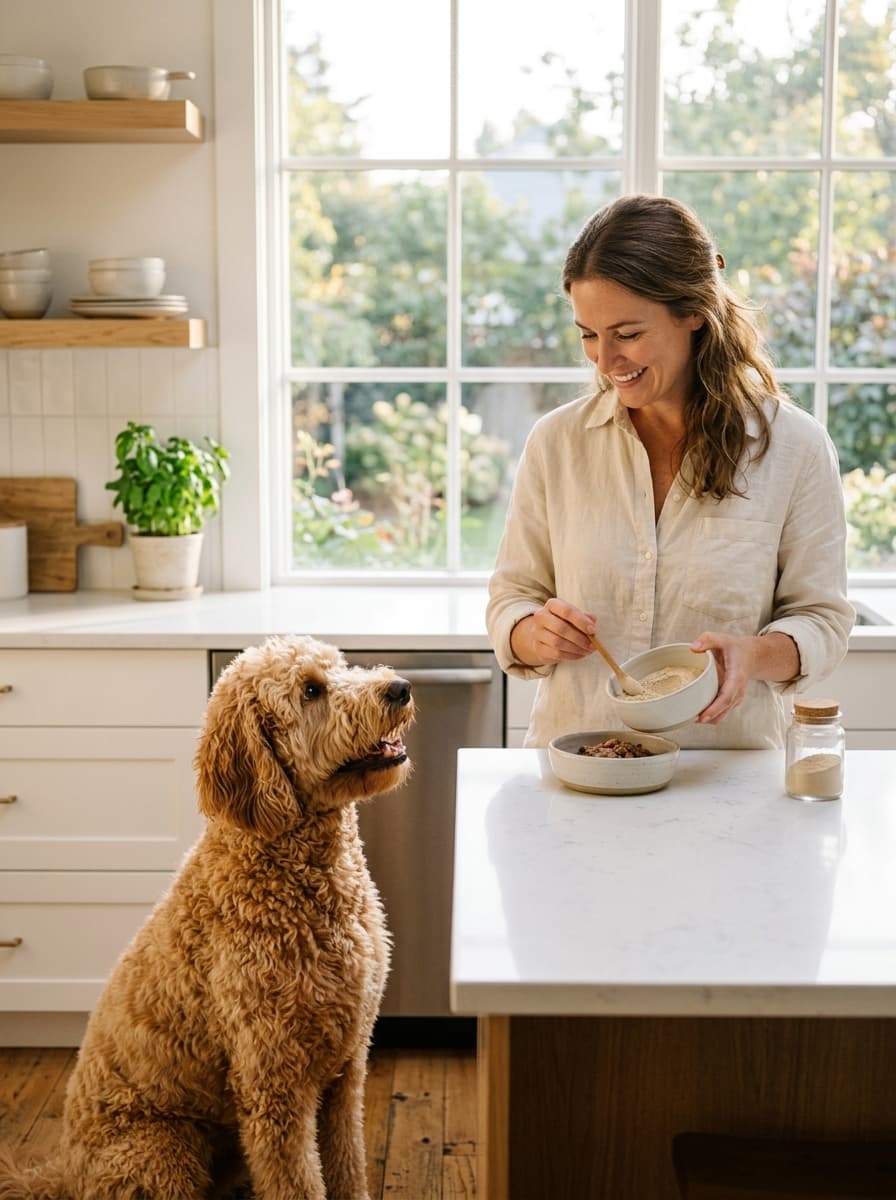
For milder soft stool or maintenance, simply stir the weight-appropriate amount of powder into a little wet food, plain pumpkin, or bone broth. Add a splash of water so it hydrates rather than clumping. This is our everyday approach with three dogs, no saucepan required.
Method 3: Capsules (convenient for travel)
Capsules are handy when we're on the road feeding kibble instead of raw. They're less flexible for precise dosing, but fine for a known, stable dog. If your doodle refuses food, open the capsule and mix the powder into a spoon of something tasty.
When to combine it with a bland diet and probiotics
Slippery elm works best as part of a small, calm gut-reset routine rather than a solo act.
With a bland diet: During diarrhea, pairing slippery elm with a simple, easily digested meal (cooked lean protein and plain rice, or plain canned pumpkin) gives the gut less to work with while it heals. If you want the pumpkin angle specifically, we cover it in can pumpkin help a doodle's stomach, pumpkin and slippery elm actually complement each other nicely.
With probiotics: Once the acute flare eases, probiotics help rebuild healthy gut flora. Give them a little separately from slippery elm so the coating doesn't interfere. For the doodle-specific picks and why gut flora matters so much for this breed mix, see our guide to the best probiotics for doodles with digestive issues. For the fuller picture on which probiotics, digestive enzymes, and omega-3s actually help a sensitive doodle gut, see our Doodle Gut Health & Supplements guide.
Slippery elm played a small role when we transitioned Sven's diet a while back. His stool got a little loose partway through the switch, and a couple of days of powder-in-food alongside slowing the transition down kept things comfortable while his system caught up. Nothing dramatic, which is exactly what you want from a gut soother.
Safety cautions for sensitive doodles
Slippery elm is one of the lower-risk remedies out there, but "gentle" isn't the same as "no rules." A few things to keep in mind:
- Spacing from meds and supplements, the 2-hour rule applies to everything oral, including heartworm preventatives and other supplements.
- Pregnant or nursing dogs, evidence is thin, so check with your vet first.
- Puppies and seniors, start low and confirm the dose with your vet.
- Diabetic doodles, the soluble fiber can affect how food is absorbed; loop in your vet.
- Large, deep-chested doodles, big Bernedoodles from a Standard Poodle and Bernese Mountain Dog cross carry genuine bloat/GDV risk from their build, so a hard, distended belly is always a call-the-vet situation, not a slippery-elm one.
- Quality matters, buy plain, human-grade slippery elm bark powder with no additives, xylitol, or sweeteners. Xylitol is toxic to dogs, so read syrup and capsule labels carefully. The ASPCA lists xylitol among the substances toxic to pets.
- Don't mask a real problem, if you're reaching for it more than occasionally, something underlying needs attention.
If your doodle's soft stool keeps returning but they otherwise seem fine, our guide on doodle soft stool but acting normal helps you decide how concerned to be. And if diet changes seem to be the trigger, doodle diarrhea after switching food walks through fixing it.
When to skip slippery elm and call your vet
This is the part generic articles gloss over. Slippery elm is for mild, self-limiting tummy trouble in a dog who's otherwise bright and drinking normally. It is not the right call, and can dangerously delay treatment, in these situations:

- Diarrhea or vomiting lasting more than 48 hours, or that's severe/frequent
- Blood in stool or vomit, or black tarry stool
- Repeated vomiting, especially with a bloated or painful belly
- Lethargy, weakness, or refusing water
- A hard, distended, painful abdomen (a possible emergency)
- Puppies, seniors, or dogs with existing conditions who go downhill quickly
For a clear decision framework on the vomiting side, read when to take your doodle to the vet for vomiting, and for diarrhea specifically, how long does doodle diarrhea last gives you a realistic timeline so you know when "wait and soothe" has run out of road.
FAQ
The common guideline is about 1/4 teaspoon of slippery elm powder per 10 lbs (4.5 kg) of body weight, given 2 to 3 times a day mixed into food or as a cooled syrup. A 40 lb (18 kg) mini goldendoodle would get roughly 1 teaspoon per dose, and a 70 lb (32 kg) standard doodle around 1.75 teaspoons. Start on the lower end and always confirm with your vet, especially for puppies, seniors, or dogs on medication.
Many owners see firmer stool within 24 to 48 hours when slippery elm is paired with a bland diet and a calm routine. If diarrhea hasn't improved after 48 hours, contains blood, or comes with vomiting, lethargy, or a painful belly, stop home care and call your vet instead of waiting.
Yes, potentially. Because slippery elm forms a slick mucilage coating in the gut, it can slow or reduce the absorption of other oral medications or supplements. Space slippery elm at least 2 hours apart from any other oral medication, and check with your vet before combining it with prescription drugs.
For short GI flares it's generally considered gentle and low-risk. For ongoing or chronic digestive issues, slippery elm should be a bridge, not a permanent fix, persistent symptoms mean there's an underlying cause (food sensitivity, stress, or illness) that needs diagnosing. Talk to your vet before using it for more than a week or two at a time.
Yes, they work well as a team for doodle gut health, but timing matters. Give slippery elm with meals and offer probiotics separately if possible, since the mucilage coating could theoretically slow how well other supplements are absorbed. Many families give slippery elm during an acute flare and lean on probiotics for daily maintenance.
The bottom line
Slippery elm is a genuinely useful, gentle tool for the occasional doodle upset stomach, it coats and soothes, firms up loose stool, and calms nausea and reflux, all with minimal risk when you dose by weight and respect the 2-hour medication rule. But it soothes symptoms; it doesn't diagnose causes. If your doodle's gut keeps flaring, the real work is figuring out why.
If sensitive-stomach episodes are becoming a pattern in your house, start with our overview of signs your doodle has a sensitive stomach, then build a longer-term plan with our gut health routine for sensitive doodles. A soothed gut today is great, a resilient one is the goal.