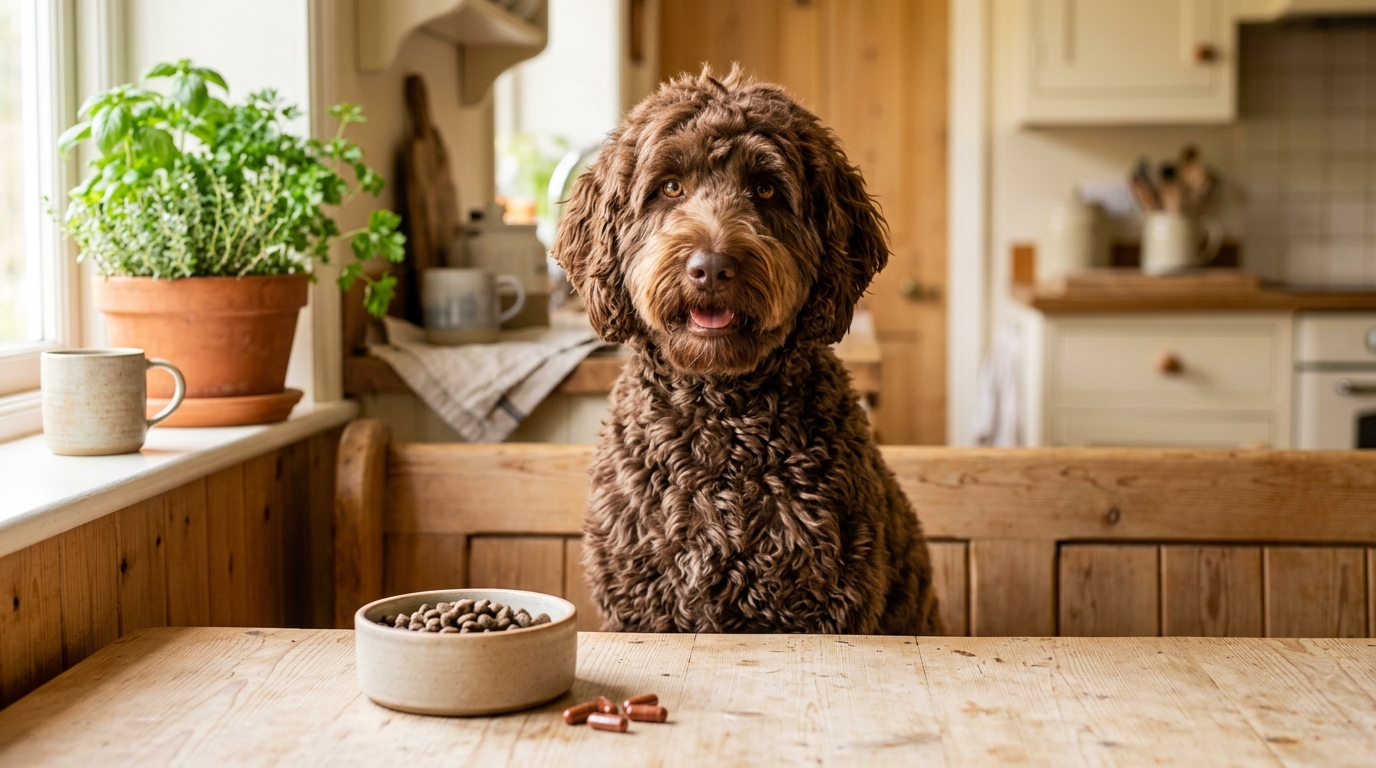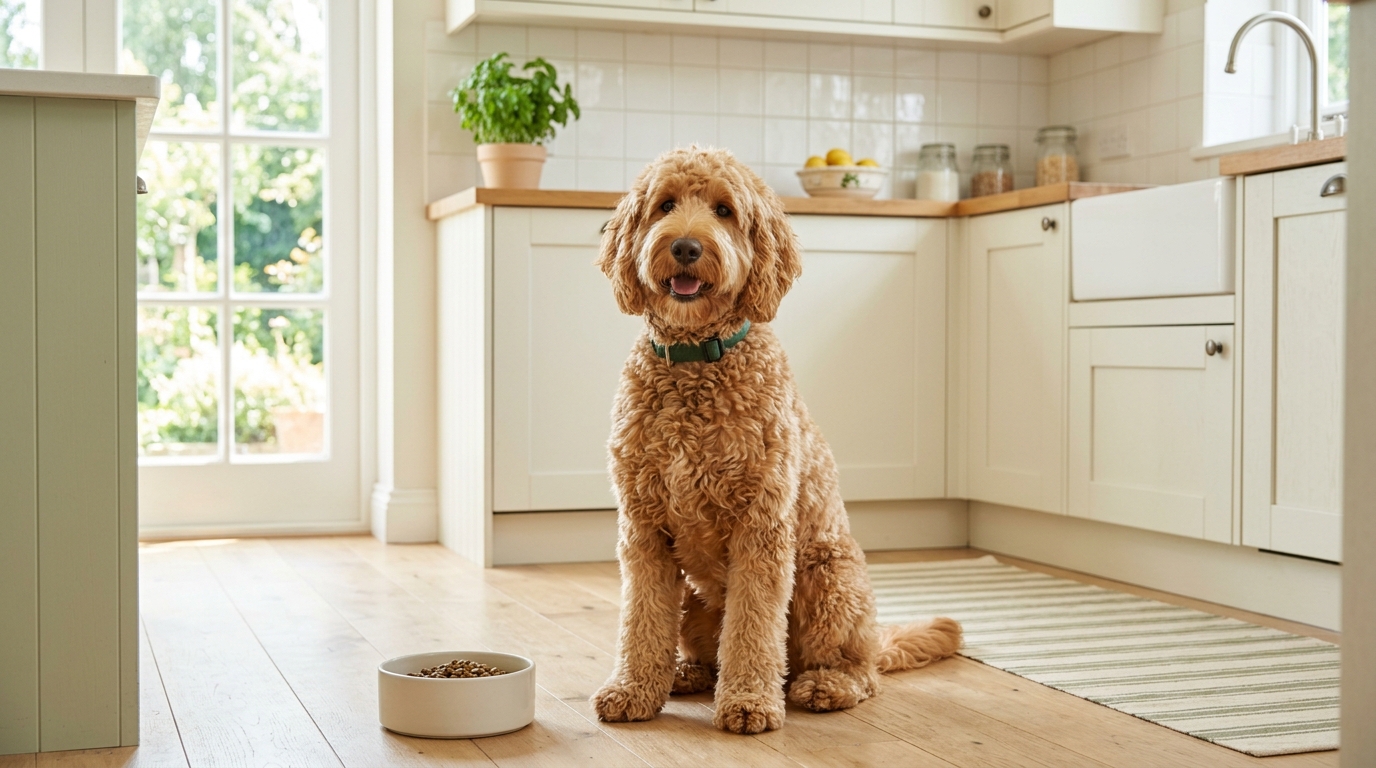
The best beef-free dog food for doodles names a single protein that is not beef (salmon, whitefish, lamb, duck or turkey) and lists no "animal fat" or unnamed "meat meal" that could sneak beef back in through the side door. For most doodles with a beef allergy, a salmon-based limited-ingredient formula is the smartest starting point, and a true switch should always be confirmed with your vet and introduced over at least 7 days.
If your doodle has been itchy, cycling through ear infections, or passing soft stools and you have landed on beef as the suspect, you are in the right place. This is a buying guide, not a diagnosis: below we compare specific beef-free formulas by protein source, show you exactly how beef hides on a label, and help you match a food to your particular doodle (sensitive stomach versus itchy skin).
We feed raw at home for our three Australian Labradoodles, and we use premium kibble and freeze-dried raw for travel. So we read a lot of labels. The biggest mistake we see owners make is swapping the headline protein and never checking the rest of the ingredient list, which is where beef tends to reappear.
Why Beef Is a Common Trigger in Doodles
Beef is one of the most frequently reported food allergens in dogs, right alongside dairy and chicken. That is not a doodle-specific quirk, but doodles do carry a relevant inheritance: the Poodle line has a documented predisposition to allergic skin disease (atopy) and to food sensitivities. The Merck Veterinary Manual describes cutaneous adverse food reactions as showing up mainly as itchy skin and recurrent ear or skin infections, often with some gut signs too. Poodles appear on breed-association lists for exactly this. It is a predisposition, not a guarantee: some doodles inherit it and some never show a thing.
What makes beef tricky in an Australian Labradoodle, Labradoodle, Goldendoodle or Bernedoodle is the coat. A curly or fleece coat hides the skin underneath, so by the time you notice flaky, pink or greasy skin, the reaction has usually been building for a while. Floppy doodle ears make it worse by trapping warmth and moisture, which is why a food reaction so often shows up first as yet another ear infection.
If you are still at the "is it even beef?" stage, read beef allergy in Goldendoodles and food allergy vs food intolerance in doodles first. A true allergy and a simple intolerance both improve on a beef-free diet, but they are not the same thing.
How Beef Hides on a Dog Food Label
Here is the part generic roundups skip. Picking a bag that says "Salmon Recipe" on the front is not enough, because beef can hide in the small print. Learn these terms and you can clear a label in thirty seconds.
- "Animal fat" is an unnamed fat source. It can legally come from beef (or any mixed rendered source). Avoid it for a beef-allergic doodle and look for a named fat instead, like salmon oil or sunflower oil.
- "Meat meal" and "meat and bone meal" are unnamed protein sources. "Salmon meal" or "lamb meal" is fine because the animal is named. Plain "meat meal" is not.
- "Natural flavor" is often where rendered beef or pork ends up. On a strict elimination run, this matters.
- Cross-reactivity: a doodle allergic to beef can sometimes also react to other ruminant proteins or to dairy. This is why a clean fish or poultry protein is often a safer swap than lamb when you are first starting out.
So the rule we use: the protein and the fat should both be named, and nothing on the list should be vague. If in doubt, our common ingredient triggers guide breaks down the usual suspects, and the label-reading section of our limited ingredient explainer goes deeper than we can here.
If you already know you want a clean, short ingredient list and just want the shortlist, jump to our best limited ingredient dog food for doodles roundup.
Top Picks
A good beef-free pick for a doodle does three things: it names a single, clearly identified protein that is not beef; it keeps the fat source named too (no "animal fat"); and it keeps the overall ingredient list short enough that you can actually see what is in it. We have deliberately leaned toward salmon and fish-based formulas, because fish is both beef-free and a relatively novel protein for most doodles, and because (per our no-chicken house rule) none of these picks use chicken or chicken fat as a hidden co-trigger.
| Product | Best For | Rating |
|---|---|---|
| Blue Buffalo Life Protection Salmon | Best overall, grain-inclusive | 4.6 / 5 |
| Zignature Whitefish Limited Ingredient | Best single-protein fish kibble | 4.6 / 5 |
| ZIWI Peak Air-Dried Lamb | Best meat-first, small bag to trial | 4.6 / 5 |
One practical buying note before you pick: bag size matters more than owners expect during an elimination trial. A 4-5 lb (1.8-2.3 kg) bag is perfect for testing a new food on a single doodle without committing to a huge sack that goes stale if it does not suit them, but a standard-size doodle around 55 lb (25 kg) will burn through a small bag fast, so buy a big bag only once you know the food works. You can compare current sizes and prices across the Amazon pet food section before you buy.
Matching the Food to Your Doodle
Beef-free is the starting filter, but the right pick depends on whether your doodle's main problem is the gut or the skin.
For the itchy-skin, ear-and-yeast doodle
This is our Gunnar's world. He spent his first two years on a food that did not suit him, and it drove recurring ear infections and a yeast cycle (for him, chicken is the trigger). Changing his protein was what finally broke the pattern. If your doodle is itchy, licking paws, or cycling through ear infections, a clean named-fish protein like salmon is usually the most useful first move, because it removes beef and gives a genuinely different protein at the same time.
Skin takes time to answer. Give any new food a solid 8 to 12 weeks before you judge it, because the coat and skin turn over slowly. Pair the food change with the rest of the picture: an omega-3 fish oil supports the skin barrier, and if the ears are already flaring you will want a good ear cleaner in the routine too. And learn to tell an allergy from a yeast infection, because they look alike and need different handling.
For the sensitive-stomach doodle
This is Sven, the most sensitive stomach of our three. He had morning bile vomiting through his whole first year and loose stool after every single food change. For a doodle like him, the protein matters less than the transition speed and the simplicity of the recipe. A short limited-ingredient formula gives the gut fewer things to argue with. If soft stools are your main sign, read our doodle sensitive stomach guide alongside this, and keep expectations realistic: some gut upset is the transition itself, not the new food failing.
Not every doodle is a worrier, of course. Our Gösta has eaten raw at home, premium kibble and freeze-dried raw when travelling, and never had a gut-driven problem in his life. He is the reminder that sensitivity is an individual thing, not a doodle rule.
How to Transition to a Beef-Free Food
Go slow. A rushed switch causes exactly the soft stools you are trying to fix, and then you can't tell whether it was the food or the speed. Our standard is a 7-day transition, and for a sensitive doodle we stretch it longer. With Sven we have gone to 10 days or more and paused whenever his stool softened rather than pushing ahead.
| Day | New food | Old food | What to watch for |
|---|---|---|---|
| Day 1 | 25% | 75% | Normal digestion, appetite, energy |
| Day 2 | 25% | 75% | Stool consistency, any vomiting |
| Day 3 | 50% | 50% | Halfway point — watch for soft stools |
| Day 4 | 50% | 50% | If soft stools, stay here an extra day |
| Day 5 | 75% | 25% | Any change in digestion, energy |
| Day 6 | 75% | 25% | Digestion should be stable |
| Day 7 | 100% | 0% | Complete transition — allow 2–4 weeks for full benefits |
Day 1
New food
Old food
What to watch for
Normal digestion, appetite, energy
Day 2
New food
Old food
What to watch for
Stool consistency, any vomiting
Day 3
New food
Old food
What to watch for
Halfway point — watch for soft stools
Day 4
New food
Old food
What to watch for
If soft stools, stay here an extra day
Day 5
New food
Old food
What to watch for
Any change in digestion, energy
Day 6
New food
Old food
What to watch for
Digestion should be stable
Day 7
New food
Old food
What to watch for
Complete transition — allow 2–4 weeks for full benefits
Watch the stool at every step. If it goes soft, hold at the current ratio for a day or two before increasing the new food again. A little pumpkin or slippery elm can steady a wobbly gut through the change, and a probiotic during the switch is a reasonable support. Our full 7-day food transition plan for sensitive doodles walks through it step by step.
What a Beef-Free Food Will Not Fix
Removing beef is powerful when beef is genuinely the problem, but it is not a cure-all. If your doodle also reacts to grain, dairy or another protein, swapping to salmon alone will only get you part of the way, which is why confirming the trigger with an elimination diet matters. A food change also will not clear an active ear or skin infection on its own, that usually needs your vet.
And if the problem turns out to be environmental atopy rather than food (pollen, dust mites, seasonal flares), diet changes help the baseline but will not stop the itch entirely. Our honest take on that is in can diet fix doodle skin problems.
FAQ
For most doodles a single-named-protein, limited-ingredient formula is the safest starting point, and salmon is the most useful first swap because it is both beef-free and a fresh novel protein for many dogs. Choose a food that names its protein clearly and lists no "animal fat" or unnamed "meat meal", because those terms can hide beef. Confirm the allergy with your vet through an elimination diet before committing long term.
Yes. "Animal fat", "meat meal" and "meat and bone meal" are unnamed ingredients, which means the source is not specified and can legally include beef. If your doodle is beef-allergic, skip any food with these vague terms and choose one that names every protein and fat source, for example "salmon oil" rather than "animal fat". Named sources are the whole point of a limited-ingredient diet.
Not automatically. Beef is a protein trigger and grain is a separate question, so going beef-free does not require going grain-free. The FDA has an ongoing advisory looking at a possible link between certain grain-free diets and dilated cardiomyopathy, so unless your doodle also reacts to grain, a grain-inclusive beef-free food is a reasonable and often safer default. Discuss it with your vet.
Go slowly over at least 7 days, mixing a little more new food into the old food each day, and go even slower for a sensitive doodle. Our Sven got loose stool after every fast change, so with him we stretch transitions to 10 days or more. Watch stool quality at each step, and pause at the current ratio for a day or two if things get soft rather than pushing ahead.
Next Step
Pick one clean, beef-free formula, confirm the trigger properly, and transition slowly. If you want to be sure beef really is the culprit before you spend on a new bag, start with our step-by-step elimination diet for doodles, then come back and choose from the picks above. For the wider picture on doodle food reactions, the food allergies hub pulls all of it together.