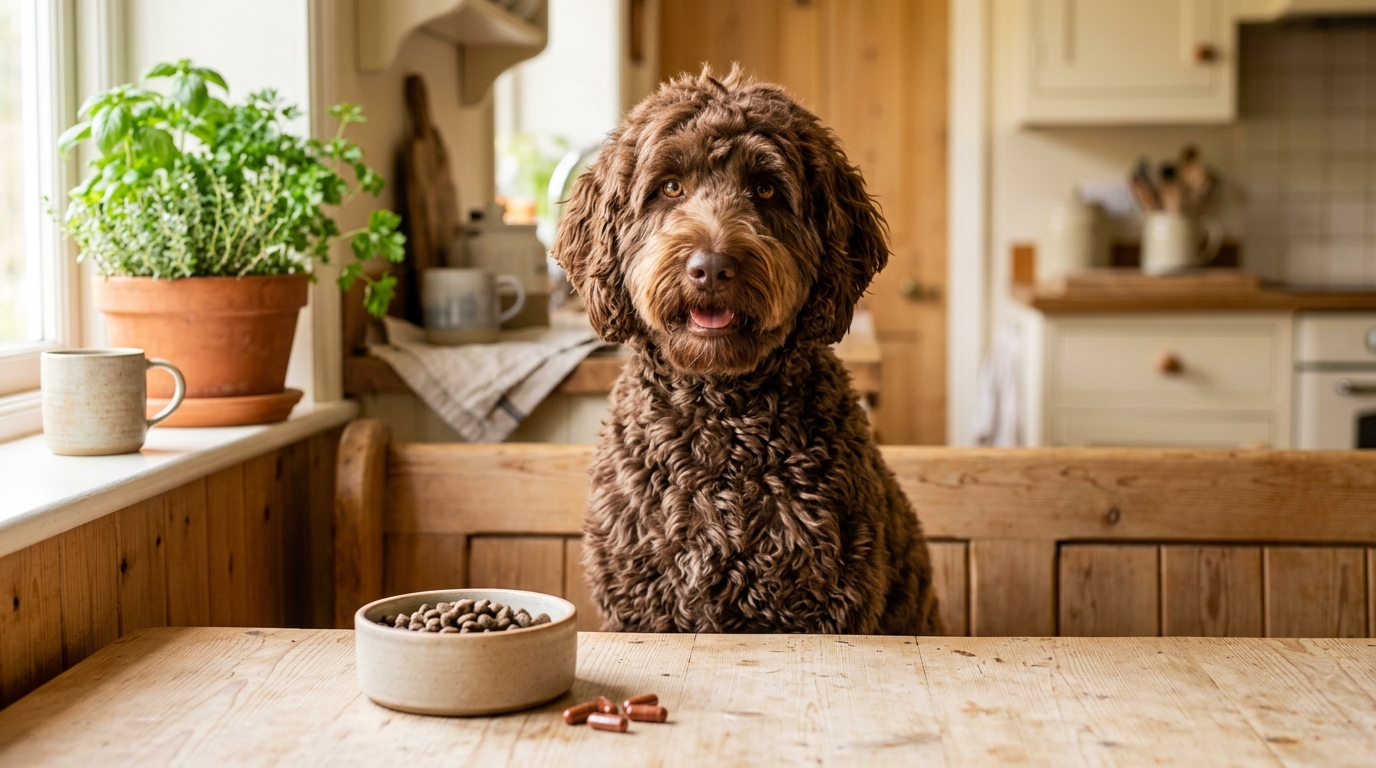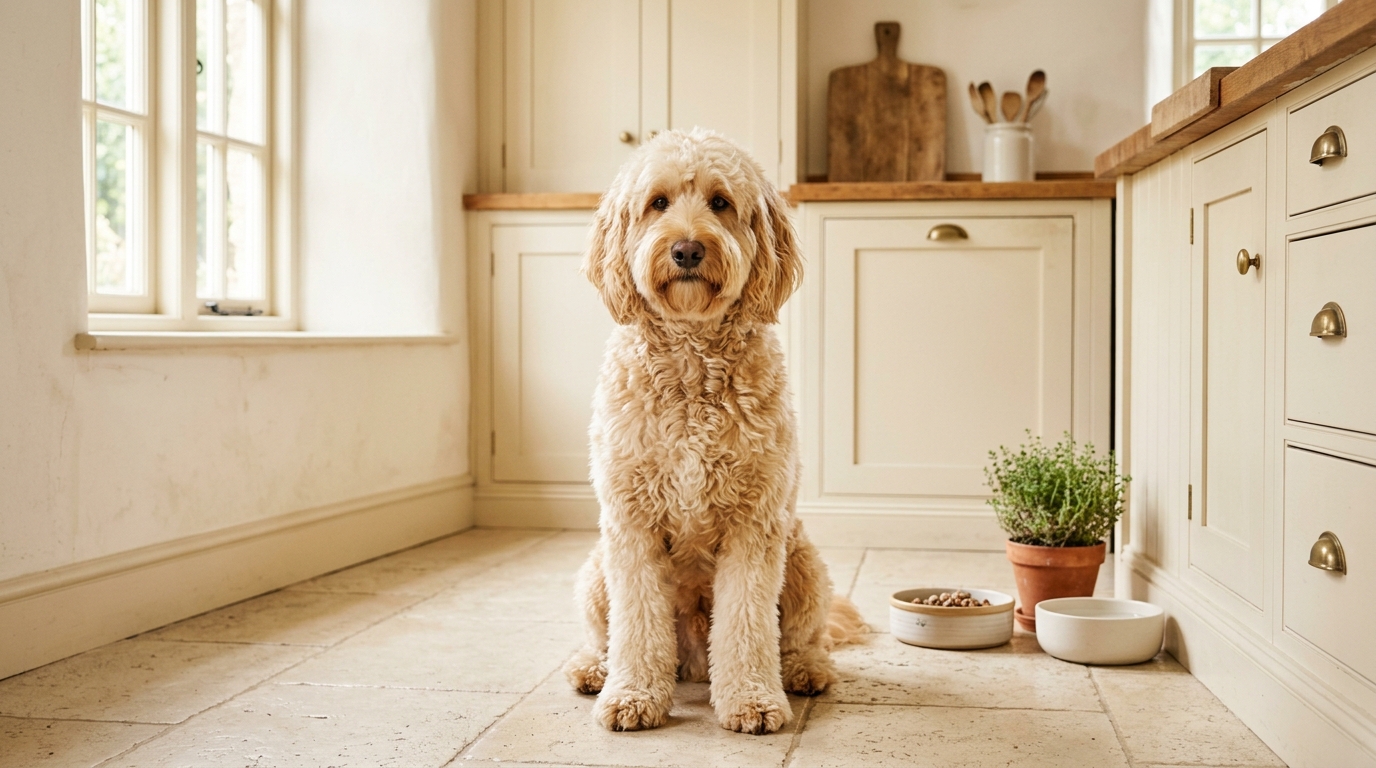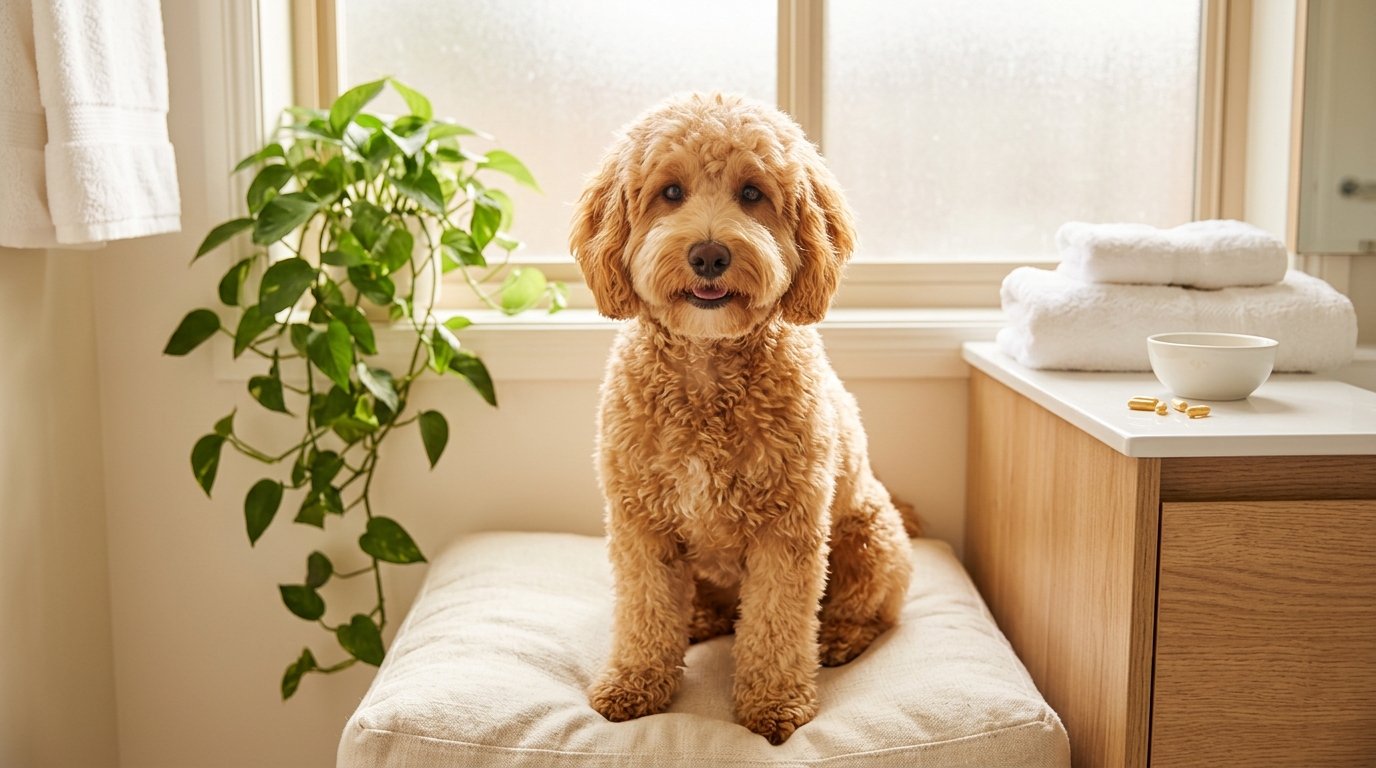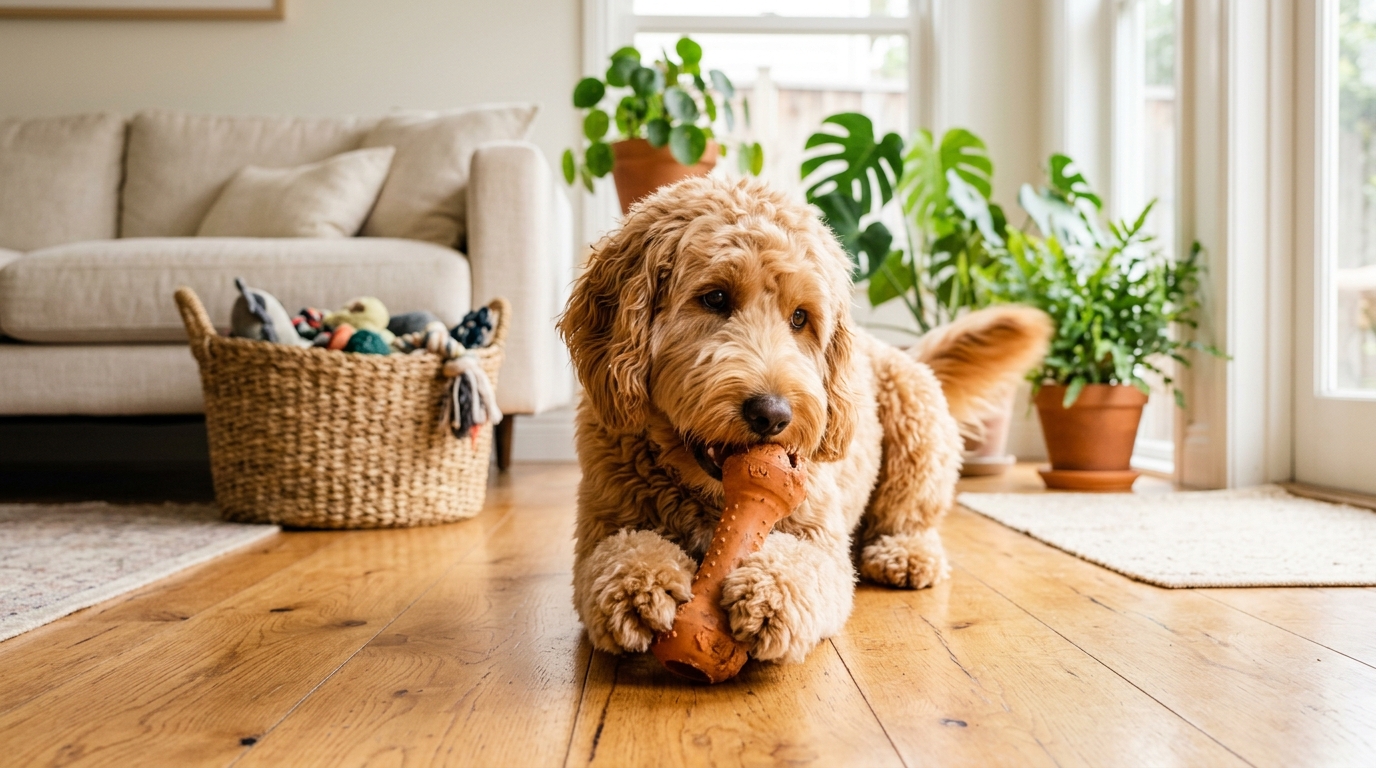
The best dog toys for when your doodle is home alone are fillable and chew toys, never puzzle games. Leave a frozen West Paw Toppl, a bully stick loaded into a Qwizl, a lick mat, or a fillable activity bone, self-directed work that buys roughly 30 to 60 minutes of calm chewing without needing you in the room. Puzzle games are supervised brain work and should never be left with a dog alone.
That's the short version, and it's exactly what we do in our house with three Australian Labradoodles. Everything below is built on toys we actually own and use, where we have honest complaints, we'll tell you.
The other honest thing first: a toy is not a cure for separation anxiety. A clear, consistent routine is what genuinely works. We'll come back to that, because it matters more than any product on this page.
What can I leave my doodle with when I go out?
The rule we live by is simple: home-alone toys are fillable or chewable, and they work by themselves. The dog does not need you there, cannot hurt themselves, and cannot destroy the toy into swallowable pieces.
That splits toys into two clean categories:
- Home-alone toys, stuffable toys, chew holders, lick mats, fillable bones. Self-directed, safe to leave, quietly absorbing.
- Supervised brain work, puzzle games. These are training and thinking tools you do with your dog. They are not feeders, and they are not for leaving a dog alone, because an unsupervised doodle can chew or break pieces off.
We use the Nina Ottosson puzzles constantly, but always with us in the room, Gunnar is clever enough to do the level 4 ones and truly loves them, while Sven does a little and asks to be excused. Great fun; never a home-alone toy. If puzzles are what you're after, that's a separate topic, see our best puzzle feeders for doodles, ranked by difficulty.
For the impatient reader who already knows they want a stuffable toy and just wants the shortlist, our whole home-alone rotation is built on the West Paw range below, jump to the Top Picks.
For vet-reviewed background on dog behavior and anxiety, the ASPCA is a reliable place to start.
What makes a good home-alone toy for a doodle?
A doodle is smart and busy, so the toy has to hold attention on its own. Here's what we actually look for:
- It's fillable or holds a chew, the work is in the eating, not in you refilling it.
- It's freezable. This is the single biggest lever on how long a toy lasts. A frozen filling turns a five-minute snack into a 30-60 minute job.
- It's tough enough to leave unsupervised once you know your dog won't demolish it.
- The right size for your dog so nothing can be gulped whole. Mini doodles and standards need different sizes of the same toy.
- A filling that suits a sensitive doodle, limited-ingredient, and for us, never chicken, which is Gunnar's trigger and hides in broths and fats.
Top Picks
We're only recommending toys we own and use. Our whole home-alone rotation leans on West Paw Zogoflex because it's genuinely tough, it's freezable and dishwasher-safe, and the sizes let us match the toy to the dog. Below are the three we reach for most, chosen so you can pick by your dog's size and by what you want to stuff or hold.
| Product | Best For | Rating |
|---|---|---|
| WEST PAW Zogoflex Toppl X-Large | Best overall for standard & large doodles | Freezable, roomy, tough |
| WEST PAW Qwizl Large | Best for slowing down chews & bully sticks | Slows gulpers right down |
| WEST PAW Zogoflex Toppl Small | Best for mini doodles & puppies | Portion-controlled, freezable |
One buying tip before you choose a size: buy a Toppl one size up from what looks right, then buy a small one too. A smaller Toppl nests inside a larger one and closes it off, which turns two toys into a harder, longer-lasting puzzle, that's the West Paw trick worth knowing, and it's why owning both sizes is genuinely useful rather than duplicate. If you want to browse the wider category first, here's Amazon's pet section.
The other home-alone toys we actually use
The West Paw picks are the ones you can buy today, but they aren't the whole rotation. A few more we own and rate:
- West Paw Rumbl, we put raw food balls in it. Not strictly what it's designed for, but it works really well.
- West Paw Tux, another sturdy stuffable that earns its place.
- Starmark Everlasting Groovy Ball, honest verdict: "everlasting" it was not with Gunnar, more like one-hour-lasting. We liked it anyway.
- A spinning lick bowl and ordinary lick mats, great for a calm, quiet job; we cover these in our best lick mats for doodles.
- Our best home-alone trick: a fillable activity bone. It takes almost no filling, we slice a hot dog in half and push it into the slots, and it keeps a dog chewing for about an hour. We don't otherwise feed sausage, but this one toy earns the exception.
Every kind of KONG lives in our cupboard too, if you want the deep dive on stuffing, see our best stuffable dog toys for doodles.
How long does a stuffed toy actually last?
In our house, a well-packed frozen Toppl runs 30 to 60 minutes. The fillable activity bone with half a hot dog gets about an hour. A bully stick in a Qwizl varies wildly, sometimes a long, happy chew, sometimes the dog gives up when it jams.
The variable that changes everything is freezing. A room-temperature stuffing is a snack; a frozen one is a job. Pack it tight, freeze it solid, and hand it over as you walk out the door.
Safety: how to leave a toy the right way
None of this works if the toy isn't safe to leave. Our rules:
What a toy will not fix
Here's where we have to be honest, because this is a health page as much as a shopping one. A toy will not fix separation anxiety. A calm dog left with a good frozen toy has a pleasant hour. A genuinely panicking dog often won't touch the toy at all, and if a toy is being used to paper over real distress, it isn't solving anything.
Our Gunnar is the sensitive, deeply attached one of our three, and he had real separation anxiety. It resolved, but through a clear, consistent routine and calm departures, not through toys. We've tried every kind of toy for time alone, and in our experience the routine is what works; the toy is just a nice extra on top of a dog who is already okay being left.
We follow the principles of calm consistency, clear routines, and never rewarding anxious behavior with attention (and never punishing). The practical side of that is what turned things around for us; if you want the fuller picture, see the method we use. And for severe cases, a dog who panics, destroys, or house-soils when alone, please involve your vet or a qualified behaviorist. Stress also shows up in the gut, and if your doodle gets stress diarrhea around departures, that's a sign the anxiety needs addressing, not another toy.
FAQ
Fillable and chew toys, not puzzle games. A frozen West Paw Toppl, a bully stick loaded into a Qwizl, a lick mat or a fillable activity bone all give quiet, self-directed work that keeps a doodle busy without needing you there. Puzzle games are supervised brain work, they are for training sessions with you, not for leaving a dog alone.
In our house, roughly 30 to 60 minutes for a well-packed frozen toy, and about an hour for a fillable activity bone with half a hot dog pushed into the slots. Freezing the filling makes it last much longer than a room-temperature stuffing. A Starmark Everlasting Groovy Ball lasted our Gunnar about an hour despite the name, so treat "everlasting" as marketing and judge by your own dog.
No. A toy can make a normal, calm departure more pleasant, but it will not fix true separation anxiety, and a genuinely panicking dog often will not touch the toy at all. What works is a clear, consistent routine and practicing calm departures. Our Gunnar had real separation anxiety and it resolved through routine and calm consistency, not through toys. Severe cases need a vet or a qualified behaviorist.
Never use cooked bones, and skip anything with chicken if your doodle reacts to it, chicken is our Gunnar's trigger, and it hides in broths and fats. Size the toy to your dog so nothing can be swallowed whole, and supervise any new toy or chew a few times before you leave it. Check every toy for damage and retire it once it starts to break down.
We wouldn't. Puzzle feeders like the Nina Ottosson range are supervised brain-work tools, not home-alone toys, a dog can chew or break pieces off when no one is watching. Keep puzzles for training sessions with you and leave fillable, chewable toys when you go out.
The next step
Pick one fillable toy sized to your dog, freeze the filling, and pair it with a calm, predictable departure routine, that combination is what actually keeps a doodle settled when you're out. If your real question is supervised brain work rather than time alone, head to our best puzzle feeders for doodles, and if you want quieter, licking-based enrichment, our best lick mats for doodles is the companion guide.