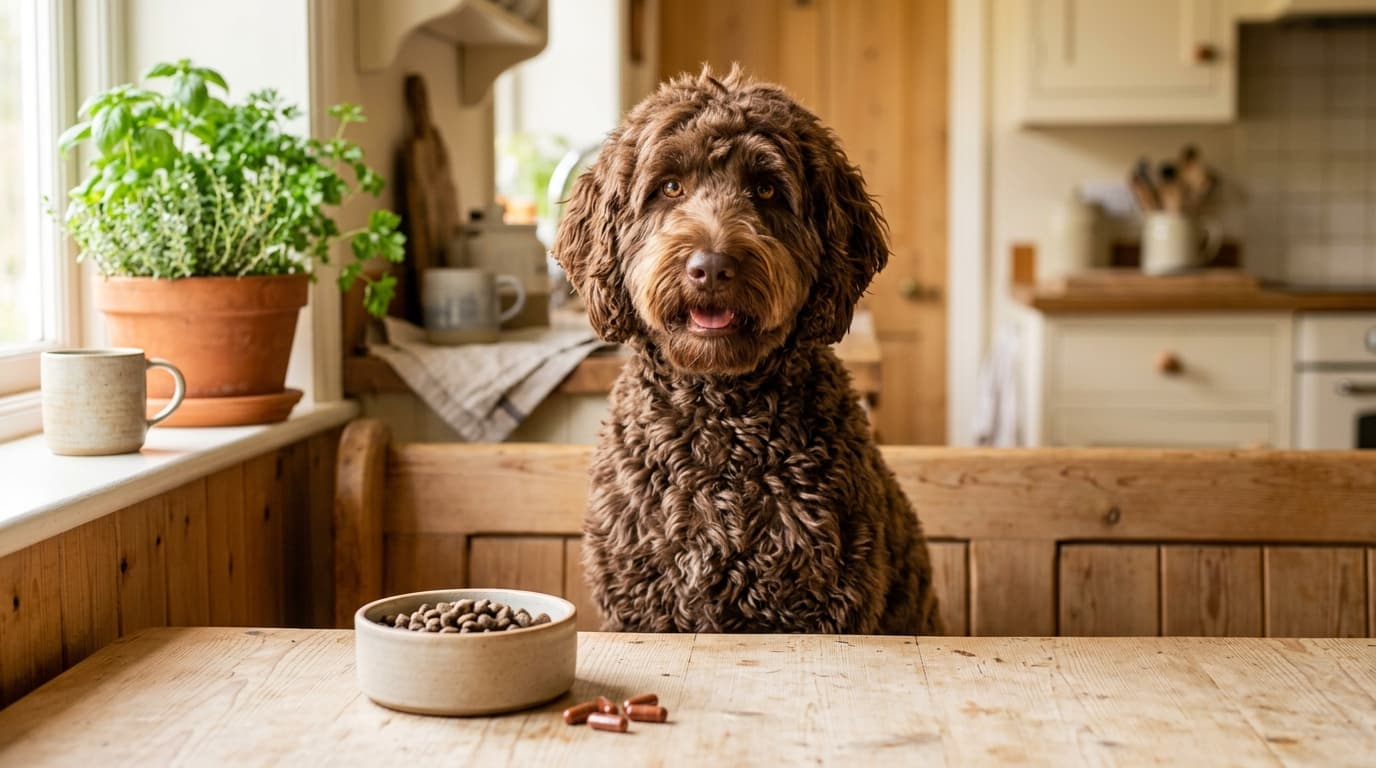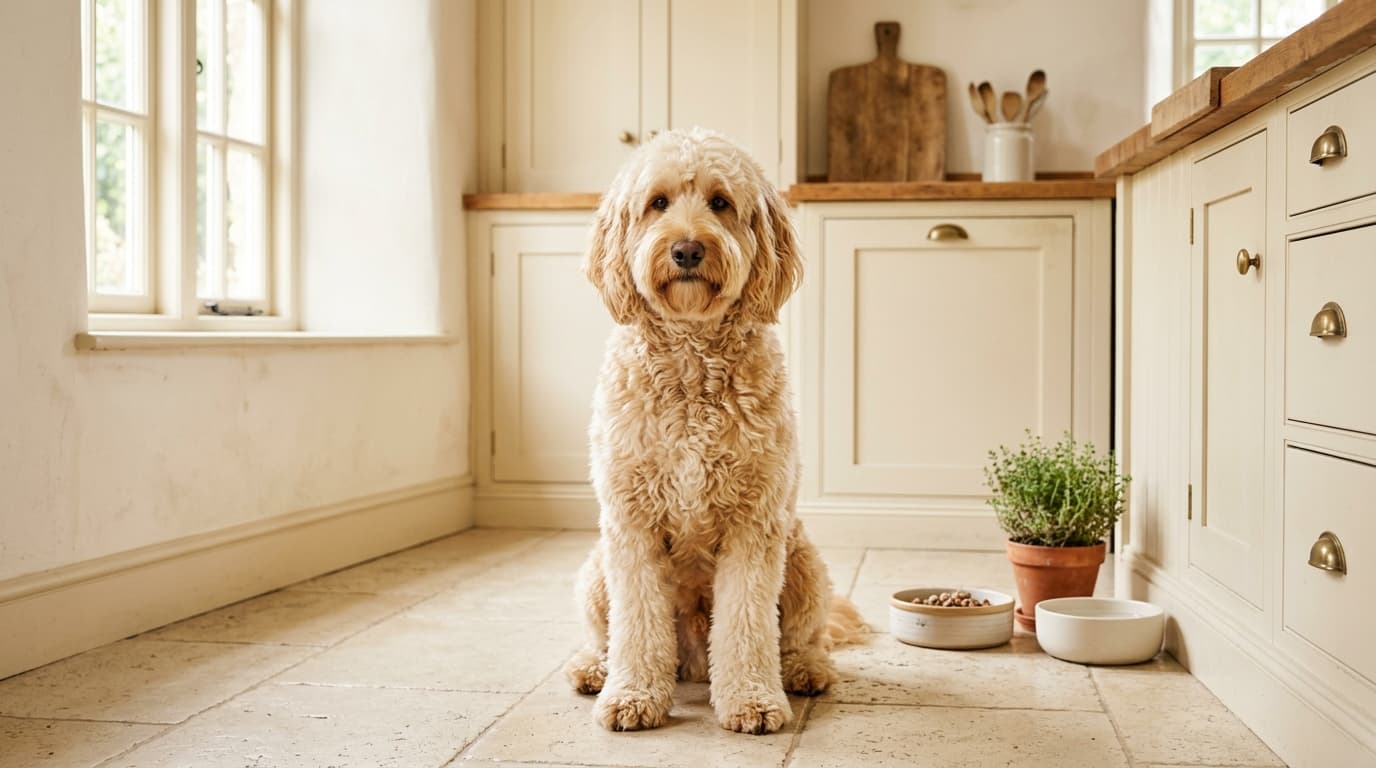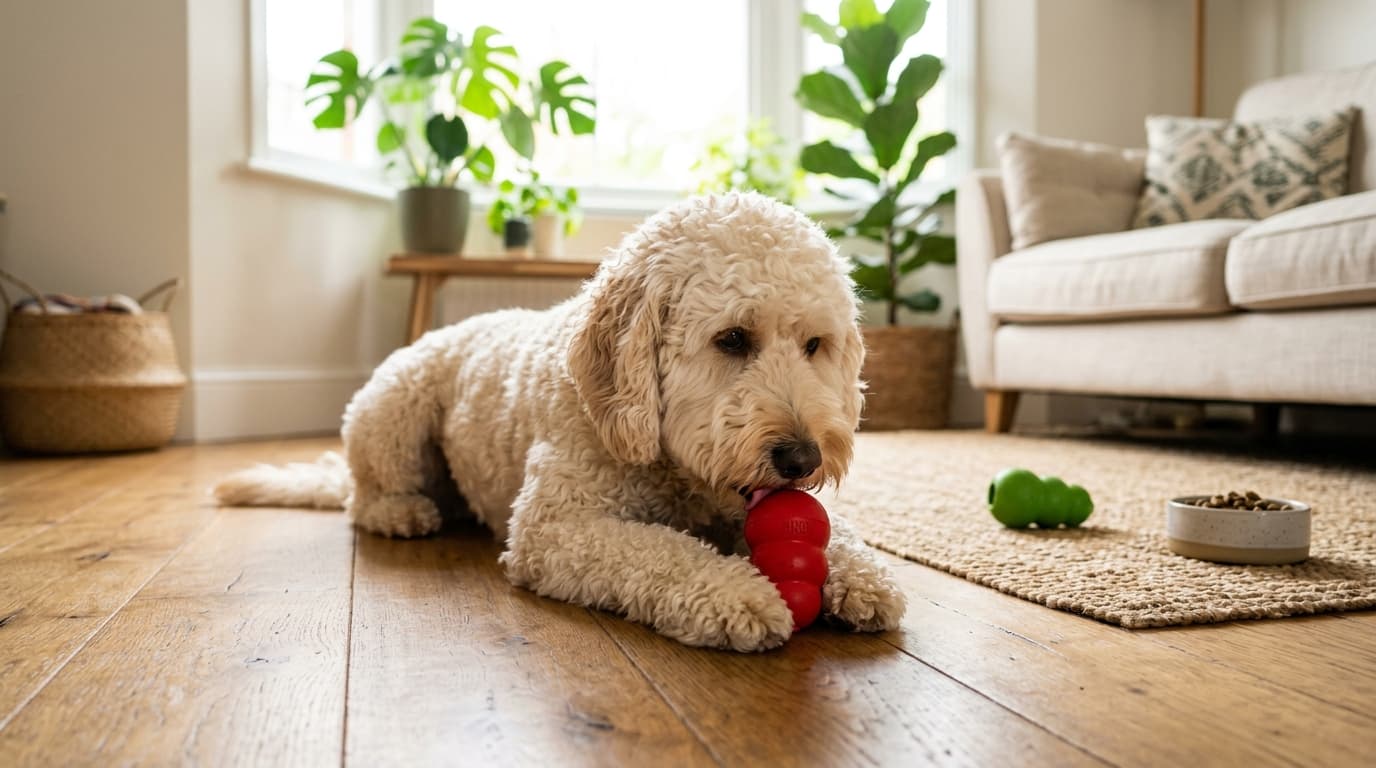
A stuffable rubber toy is the cheapest way to make a doodle work for their food. Pack it with their normal meal, freeze it overnight, and a two-minute dinner becomes thirty or forty minutes of quiet chewing. Choose red natural rubber for an average chewer, black extreme rubber for a power chewer, and size it to your dog rather than to the packaging picture.
This is the tool that does something a bowl cannot: it keeps a doodle occupied after the food is gone, because there is always a little more in there. That makes it useful for far more than mealtimes, crate training, a delivery driver at the door, an afternoon when the walk was too short.
If you already know you want one and just want the shortlist, the KONG Classic in the right size is the sensible first purchase for most doodles. Below is how to choose, what to fill it with, and where each pick fits.
Why it works better than it should
Three things happen at once, and only the first is about food.
The meal takes real time. Packed and frozen, a rubber toy stretches a portion further than any bowl or mat manages. That matters for a fast eater and it matters even more for a dog who finishes and then goes looking for trouble.
The licking settles them. Working food out of a narrow chamber is repetitive licking, and repetitive licking is self-soothing for most dogs. It also fits well into a home alone routine. A stuffed toy is a genuinely useful thing to hand a doodle before you leave the room.
It costs no extra calories. The filling comes out of the day's ration rather than on top of it, which is the difference between enrichment and a slow weight problem. Portion creep is quiet and a coat hides a waistline, more on that in slow feeder bowls and portion tools for doodles. The AVMA makes the same point about keeping dogs at a healthy weight.
Choosing: chew strength, then size
| Type | Rubber | Suits | Fill | Watch out for |
|---|---|---|---|---|
| Classic red rubber | Standard natural | Average chewers, most doodles | Anything, freezes well | Not enough for a determined power chewer |
| Extreme black rubber | Toughest natural | Power chewers | Anything, freezes well | Heavier and firmer; overkill for a gentle dog |
| Open bowl shape | Flexible, dishwasher safe | Raw and wet feeders | Raw, yoghurt, pumpkin | Emptied faster than a narrow chamber |
| Rolling dispenser | Hard plastic | A whole dry meal | Dry kibble only | Noisy on hard floors; not a chew toy |
Chew strength first, size second. A dog who destroys soft toys belongs on the black rubber from the start, and no size compensates for the wrong material. For a dog who simply needs to chew, see best natural chews.
On size: a Mini Australian Labradoodle or Mini Goldendoodle usually fits a small or medium, most Medium doodles take a large, and a Standard Goldendoodle, Bernedoodle or Sheepadoodle wants a large or extra-large. When a dog is between sizes, go up. A toy that is too small is a choking risk, and that is not a trade-off worth making for a slightly longer session.
Our picks
Best overall: KONG Classic
The default, and the one most doodles should own first. Standard red natural rubber suits an average chewer, the narrow hollow chamber is what makes a frozen filling last, and the erratic bounce means it doubles as a fetch toy on days when the food job is done. It has been the reference product in this category for decades, which also means every stuffing recipe you will ever read assumes this shape.
The con: the standard rubber is not enough for a genuinely destructive chewer, who will work the opening wider over time and eventually take pieces off it.
Buy two of whatever works. These toys are only really useful frozen, and with one you are always waiting for it to thaw before you can refill it. They are inexpensive enough to keep a pair in rotation, current prices here.
Best for power chewers: KONG Extreme
Same shape, black rubber, considerably tougher. This is the version for a doodle who has already destroyed a standard one, or who chews with real intent rather than working food out patiently. The material is the whole difference, the stuffing and freezing work identically.
The con: it is firmer and heavier than the red, which makes it less pleasant for a gentle or older dog, and it costs more. Buying it for a soft-mouthed doodle is money spent on durability you will never use.
Best for raw and wet food: West Paw Zogoflex Toppl
An open bowl shape rather than a narrow chamber, with internal prongs that hold food in place. That makes it far easier to pack with raw, wet food, yoghurt or pumpkin, and far easier to clean afterwards, it goes in the dishwasher properly rather than needing a bottle brush down a hidden cavity. It freezes well, and two sizes stack together if you want to make the job harder.
The con: the open shape empties faster than a narrow chamber, so a determined doodle clears it sooner unless you freeze it.
Best for a whole dry meal: KONG Wobbler
A different idea: a weighted, wobbling dispenser you fill with dry kibble, which the dog nudges to release a few pieces at a time. It takes a full meal rather than a snack, so it is the one to reach for if you want to replace a bowl outright for a kibble-fed doodle. It unscrews to fill and clean.
The con: hard plastic, so it is a food dispenser and not a chew toy, and it is genuinely loud clattering around on a tiled kitchen floor. It also handles dry food only.
What to fill it with
Use their normal food, and take it out of the daily ration:
- Soaked kibble packed firm, then frozen
- Raw or wet food, which freezes into the best long-lasting version
- Plain unsweetened yoghurt, alone or as the plug at the narrow end
- Plain canned pumpkin, which doubles as a fibre boost, see best pumpkin supplement for dogs
Check any peanut butter for xylitol before it goes near the toy. That sweetener is toxic to dogs and turns up in ordinary supermarket brands. The FDA has warned that xylitol can be dangerous for dogs.
When a stuffable toy is the wrong tool
It solves boredom and eating speed. It does not solve:
- A delicate stomach. Ongoing soft stool points at the food, start with signs your doodle has a sensitive stomach.
- Plain gulping in a dog who is not bored, where a ridged bowl is simpler, see best slow feeder bowls for doodles.
- A dog who needs the licking without the chewing, which is a mat's job, see best lick mats for doodles.
- Real separation anxiety, which needs a behaviour plan rather than a frozen toy.
If digestion, allergies or skin issues are the bigger picture behind the mess a toy is meant to distract from, our Best Products for Sensitive Doodles: Food, Supplements & Tools guide covers the food, probiotics and tools worth trying instead.
FAQ
Their normal food is the best filling, because it costs nothing extra and keeps the daily portion honest. Soaked kibble, wet food, raw, plain unsweetened yoghurt or plain canned pumpkin all pack well, and a spoonful of something sticky at the narrow end holds the rest in. Check any peanut butter for xylitol first, since that sweetener is toxic to dogs. Whatever goes in should come out of the day's ration rather than on top of it.
Freezing is the single biggest upgrade. A packed toy served straight away might last five minutes, and the same toy frozen overnight can take thirty to forty. Pack it, stand it narrow-end-down in a mug so the filling does not run out, and leave it overnight. Start an inexperienced dog on an unfrozen one first, because a frozen toy handed to a beginner is often too hard and they give up.
Size by weight and by mouth, not by how the toy looks on the shelf. A Mini Australian Labradoodle or Mini Goldendoodle usually fits a small or medium, most Medium doodles take a large, and a Standard Goldendoodle, Bernedoodle or Sheepadoodle wants the large or extra-large. A toy that is too small is a choking risk, so when a dog is between sizes, go up rather than down.
A solid natural-rubber toy in the correct size is one of the few enrichment items many owners are comfortable leaving with a supervised-then-trusted dog, but it is not automatic. Check the toy every time before it goes down, and retire it the moment you spot bite damage, chunks missing, or a widened opening. A power chewer should be on the tougher black rubber rather than the standard red.
Rinse it as soon as the dog is finished, because the narrow inner chamber is where food dries hardest and it is the part you cannot see. Most solid rubber toys are top-rack dishwasher safe, and a bottle brush reaches the inside better than anything else. If you feed raw into it, wash it every single time rather than at the end of the day.
Where to start
Buy the red rubber in the size that matches your doodle, fill it with their normal dinner, and freeze it overnight. That one change covers eating speed, boredom and the after-dinner restlessness in a single object, and it costs less than a bag of food.
Move to the black rubber if your dog damages the red, add the open bowl shape if you feed raw, and reach for the rolling dispenser if you want to retire the kibble bowl entirely. The wider comparison across every tool sits in slow feeder bowls and portion tools for doodles.