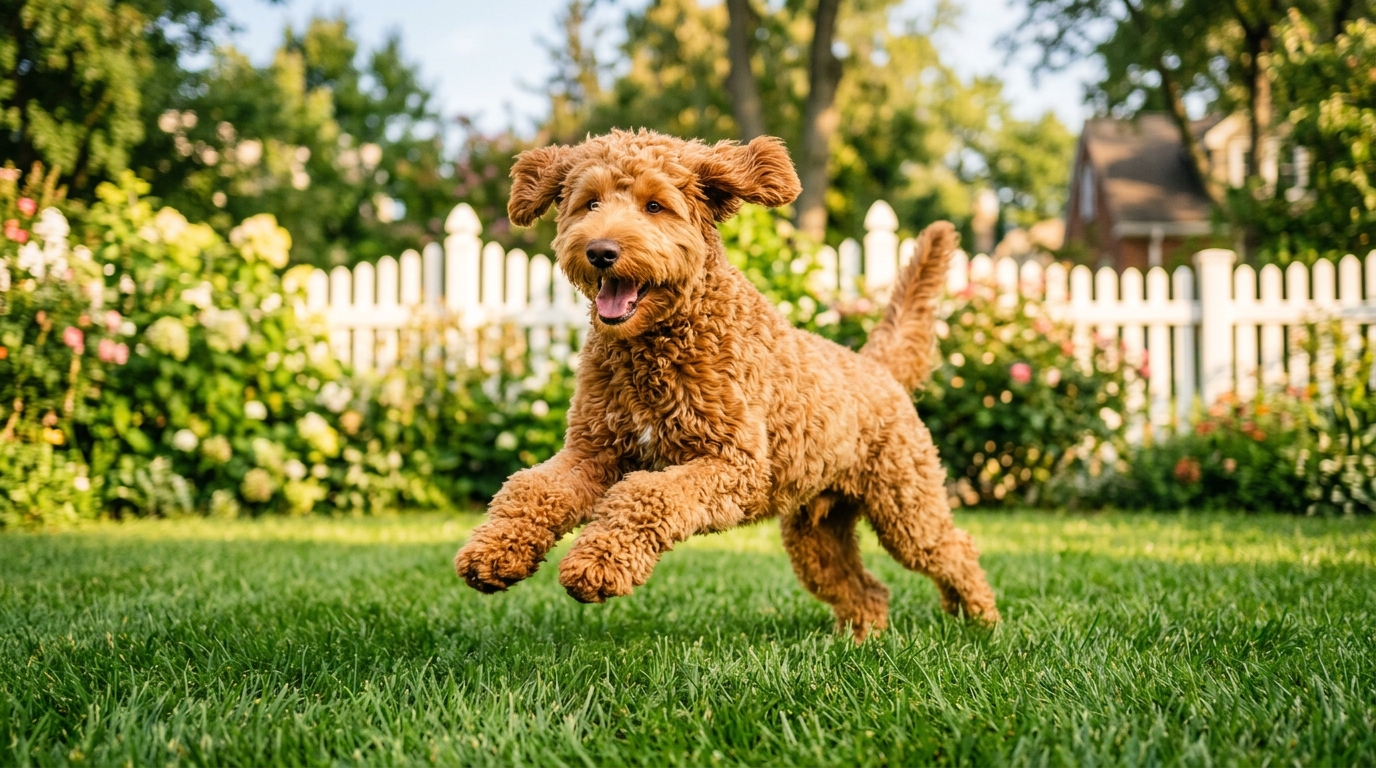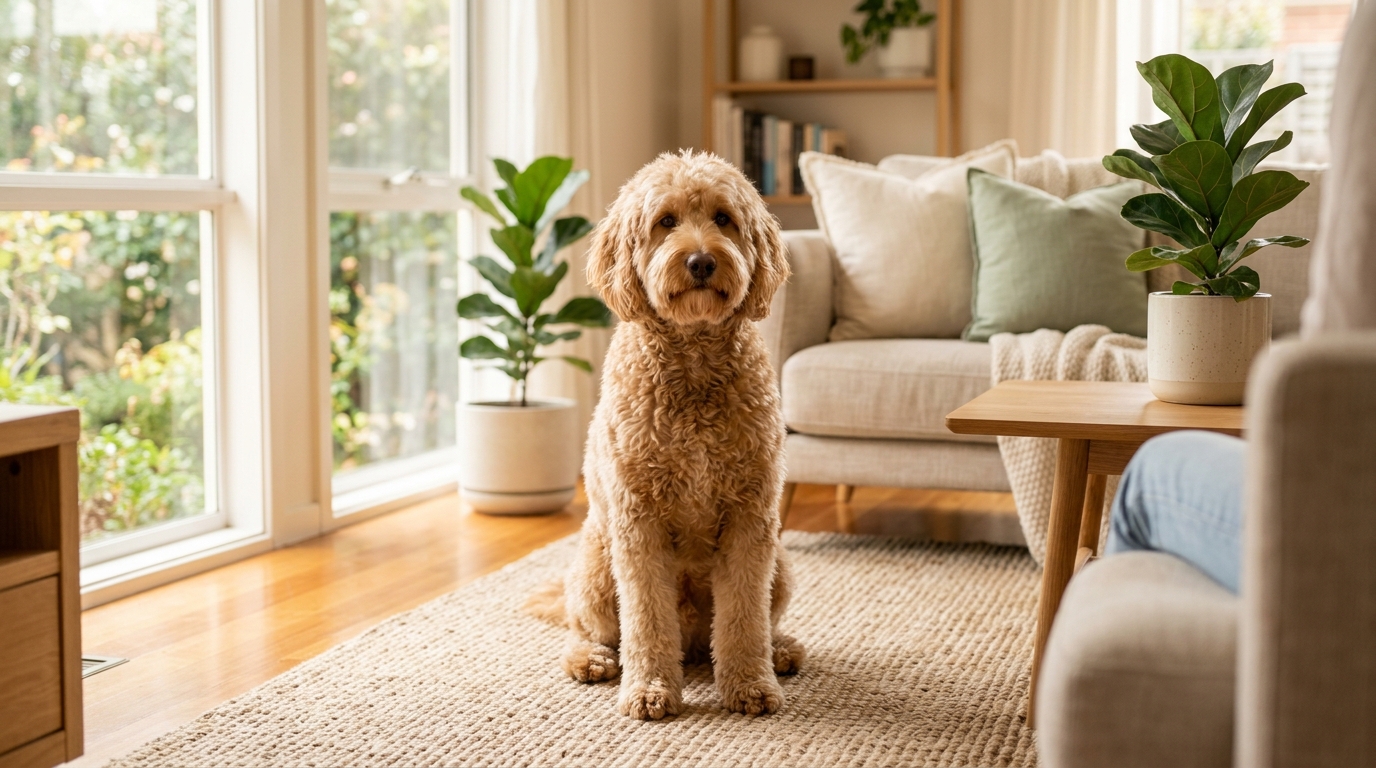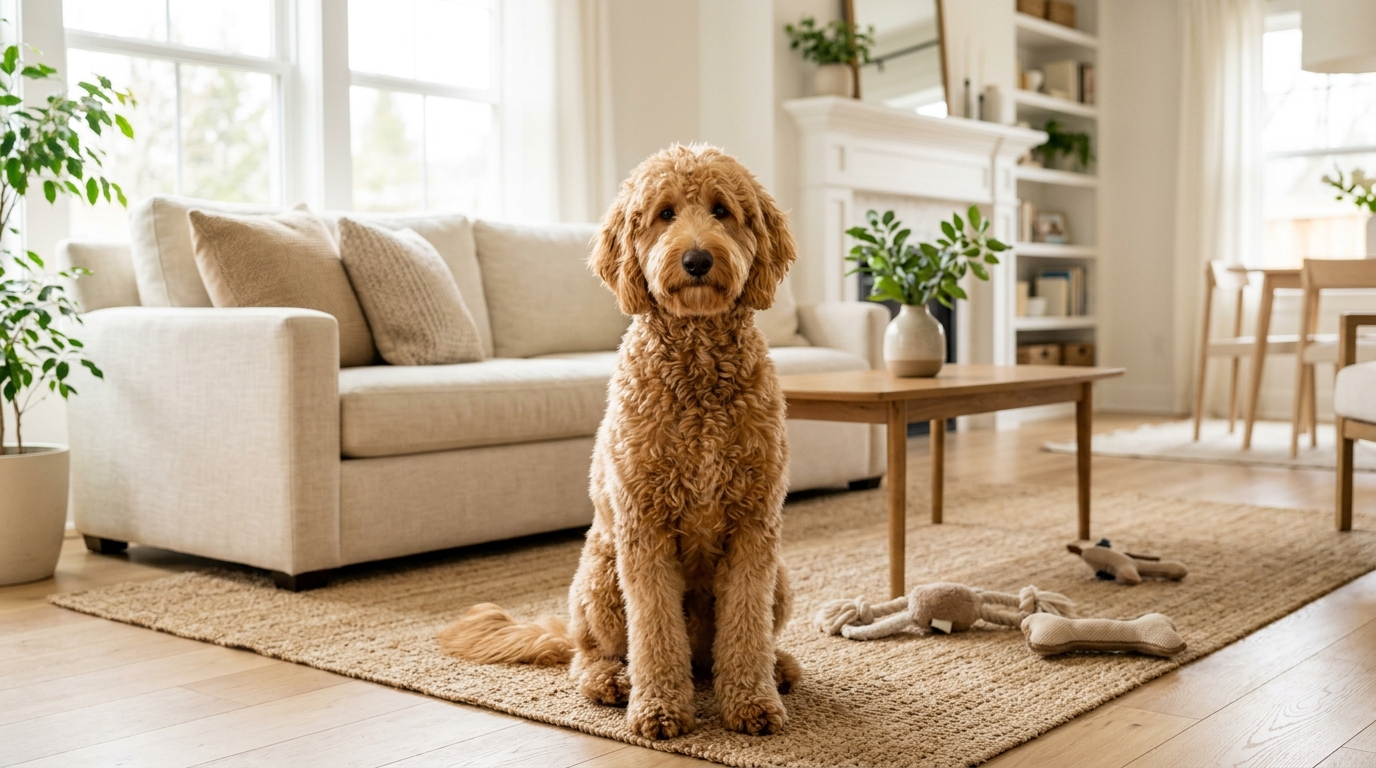
If your Goldendoodle panics the moment you pick up your keys, goldendoodle separation anxiety is real distress, genuine panic at being left alone, not stubbornness or boredom. You tell the two apart by watching what happens in the first few minutes: true anxiety shows up fast as pacing, drooling, nonstop vocalizing or frantic scratching at doors, while boredom builds slowly into chewing and mischief. The fix is gradual, systematic practice with short absences, never punishment and never sudden long departures, and severe cases need a vet or certified behaviorist.
Goldendoodles and Australian Labradoodles were bred to be right beside you, so being left home alone can genuinely be harder for some of them. But the single most important thing we've learned living with three is this: the most important thing you can train is relaxation itself. Settling down and switching off does not come by itself, it has to be practiced, and a dog who can genuinely relax copes with your absence far better than a dog you've simply tried to tire out.
If mental stimulation is where you want to start, don't, calm comes first, enrichment second. When you do add it, our tested best puzzle feeders for doodles round-up is how we do that part in our house, and it's a useful shortcut if you already know you need one.
Do Goldendoodles get separation anxiety more often?
Goldendoodles, Australian Labradoodles, standard Labradoodles, Bernedoodles and Sheepadoodles all trace back to breeds selected for close human partnership, the Golden Retriever, the Labrador, the Poodle. That people-focused temperament is exactly why they make such warm family dogs, and it's also why some of them struggle to switch off when the house empties.
This is a tendency, not a diagnosis. Plenty of Goldendoodles nap happily through a workday. The breed label matters far less than two things you can actually influence:
- Actively teaching relaxation, a dog who has never learned to settle can't suddenly do it the moment you leave.
- A predictable routine, dogs settle faster when departures and returns are calm and boring.
Of our three, Gunnar is the one who has had real anxiety. He is the sensitive, highly intelligent one, deeply attached to one person, and he had separation anxiety and some reactivity, both resolved now. His stress was tied to discomfort (his itching and his ears) and, honestly, to us not yet knowing how to communicate with him. He was about three when we started doing things differently, and it took longer with him because we didn't understand it at first. Sven and Gösta never had this, Sven is laid back and happy-go-lucky, and Gösta, our only hyper one, settled well as a pup despite wanting to be first in every queue.
For vet-reviewed background on dog behavior and anxiety, the ASPCA is a reliable place to start.
Rule out pain and discomfort first
Before you spend weeks on training, take a step back: hyper or restless behavior can be driven by pain, itching or discomfort, and so can anxiety. A dog who can't settle might not be "anxious" in the emotional sense at all, they might be uncomfortable.
This is exactly Gunnar's story. His stress rode on top of his physical discomfort, the itchy skin, the ears, and it eased a great deal once those were properly under control. If your doodle is scratching, licking paws, shaking their head, or seems generally unsettled, get the physical side checked before you assume it's purely behavioral. On doodles the coat hides a lot, so a skin or ear problem can simmer unseen. There's more on how discomfort and the gut interact in our guide to stress and digestive problems in doodles.
Calm first, stimulation second
Here's where our experience runs against the usual advice, and we'll be honest that it does. We do not believe more stimulation calms a hyper or anxious doodle. If you only add mental games, or walk a restless dog for hours a day, hyper tips straight into stress, stress makes them even more wound up, and behavior problems follow. First they learn to calm down. Then comes the enrichment.
Doodles are intelligent and do love a puzzle, but as a reward for a settled dog, not a fix for an unsettled one. We've worked through all the Nina Ottosson puzzles with ours:
- Gunnar is really clever and truly loves them, he can do the level 4 puzzles.
- Sven does a little and then asks to be excused; the treats are rarely good enough to keep him going.
- Gösta loves treats so much he'll do them purely for the food.
That range in one household is the point: enrichment is a bonus on a calm baseline, not the thing that creates calm.
How we actually train settling
Relaxation is a skill you practice. Indoors, we use a slip lead when we need to: one of us holds the lead while we work, and the dog learns that in that moment they stay close to us and settle in place. It's practice, not punishment, short, calm, repeated. Over time it becomes automatic; now when one of us works at home, the dogs lie down beside us, and when we move around they usually come along because they want to follow what we're doing.
Our whole approach is gentle communication and a genuine connection, communicating in a way the dog understands, not drilling obedience. In our house the behavior problems came from failing to communicate, not from a "bad" dog. If that resonates, our dog listener method for doodles guide walks through it in more detail.
Sleep is part of the plan
A doodle needs a lot of sleep, roughly 12-15 hours a day or more, puppies more still. Ours sleep through the night, and whenever we sit still to work, they sleep too. A chronically under-slept doodle is a restless doodle, and a restless doodle struggles to be left alone. If your dog never seems to switch off, protect their sleep as deliberately as you'd protect a puppy's.
Is it boredom or true doodle separation anxiety?
This is the single most useful question to answer before you spend weeks training the wrong problem. Boredom and separation anxiety can both wreck a living room, but they need different fixes.
Point a phone camera at your dog for the first 20-30 minutes after you leave. What you see decides everything.
| Boredom / under-exercised | True separation anxiety | |
|---|---|---|
| When it starts | Slowly, often 30+ min in | Within minutes of you leaving |
| What it looks like | Chewing, digging, trash-raiding, napping in between | Pacing, drooling, panting, trembling |
| Vocalizing | Occasional | Frantic, sustained howling or barking |
| Target of damage | Random (shoes, furniture) | Exits, doors, windows, crate bars |
| House-soiling | Rare in a trained dog | Common, even when recently toileted |
| Between episodes | Settles, rests | Cannot settle at all |
If the camera shows a dog who mooches around, chews a slipper, then falls asleep, that's boredom and under-stimulation, and enrichment plus enough real exercise usually solves it. If the camera shows a dog who never stops moving, drools onto the floor, and throws itself at the door, that's separation distress, and it needs the gradual plan below.
Exercise still matters, calm doesn't mean idle
Teaching calm first does not mean a dog who sits around all day. Ours get plenty of movement: we have a big yard where they run free several times a day, and they usually follow us out. We do 1-2 walks a day, usually a 30-60 minute walk (we need the exercise too) and a short 5-15 minute walk before bed so everyone pees, poops and sleeps peacefully.
The distinction is important: exercise fills a genuine physical need, but it is not a sedative you can dose to fix anxiety. A well-exercised dog who has also learned to settle is the goal, not a dog run into the ground in the hope that exhaustion passes for calm.
How to leave a doodle alone: the gradual plan
Learning how to leave a doodle alone the right way comes down to one principle: never let your dog rehearse panic. Every absence that pushes past your dog's threshold makes the fear stronger. So we work below the point of distress and stretch it slowly.
Start with the puppy: short, daily and no fuss
The best separation anxiety plan is the one you start before there is any anxiety. From the very first weeks with a puppy, practice being alone in small moments, regularly, every single day: a few minutes behind a closed door, a quick trip out to the mailbox, a short errand. Make it so ordinary that it never becomes an event. A puppy who learns early that people leave and come back as a normal part of the day has far less reason to panic later.
Step 1, Make departures and returns boring
Big emotional goodbyes and ecstatic hellos teach your dog that your comings and goings are a huge deal. This is what we do with all three of ours:
- When you leave, say nothing to the dog. No goodbye speech, no "be a good boy". You just go, very low-key.
- When you come back, keep it just as low-key. Walk in, put your things down, carry on.
- Don't talk to the dog or greet them until they are calm. The attention comes once they have settled, not while they are bouncing off the walls.
We know this feels hard, because doodles are so delighted when you walk in and it seems unkind not to answer that. But true separation anxiety is genuinely exhausting and distressing for a dog. We see the low-key way as the kinder one: when your leaving and returning are no big deal, your dog doesn't have to stress about them.
Step 2, Break the association with your leaving cues
Pick up your keys, put on your shoes, touch the door handle, then sit back down and do nothing. Repeat these "fake outs" until the cues stop triggering a reaction. This defuses the anticipatory dread that starts before you're even out the door.
Step 3, Build duration in tiny steps
Start with absences so short your dog doesn't react, sometimes just stepping outside and coming back in. Then extend gradually. Below is the shape of a typical build; your dog's pace, not the calendar, sets the speed.
| Phase | Absence length | What you're watching for |
|---|---|---|
| Warm-up | 5-30 seconds | Dog stays relaxed, no fixation on door |
| Foundation | 1-5 minutes | Settles quickly, no pacing |
| Building | 10-30 minutes | Rests or chews calmly during absence |
| Consolidating | 45-90 minutes | Handles most short outings |
| Real-world | 2+ hours | Comfortable through routine absences |
If your dog reacts at any step, you've moved too fast, drop back to the last length they handled calmly and build again more slowly. Progress is rarely a straight line, and a rough day means you shorten the next rep, not push harder.
What enrichment helps before you leave?
Enrichment doesn't cure separation anxiety on its own, remember, calm comes first, but for a dog who has learned to settle, a mentally satisfying activity right as you leave starts the absence from a better place. And for a genuinely bored dog, it's often the whole answer.
Before a departure:
- A real walk or sniff session. Sniffing is mentally tiring in a way that a quick potty break isn't.
- A long-lasting, appropriate treat. A frozen puzzle feeder or a smeared lick mat gives a settling, licking activity right as you leave, licking is naturally calming for dogs. Our best lick mats for doodles round-up covers the ones we use.
- Puzzle work earlier in the day so your dog is genuinely rested by departure time.
One important nuance: for a dog with true separation anxiety, a food toy can backfire if the dog is too anxious to eat, or if it becomes a "she's leaving" cue that raises alarm. Watch the camera. If your dog happily works the lick mat and then settles, brilliant. If the toy sits untouched, the anxiety is above the level food can reach, go back to shorter absences first.
What not to do
A few well-meant reactions make separation anxiety worse:
- Don't punish the mess, the chewing or the barking. Your dog is panicking, not misbehaving, and punishment adds fear to an already frightened dog.
- Don't crate an anxious dog who fights the crate. Some dogs feel safer in a crate; others injure themselves on the bars. If yours panics in the crate, use a safe room instead.
- Don't rely on a second dog as the cure. Separation anxiety is usually about your absence specifically, so another dog often doesn't help.
- Don't skip the discomfort check. Pain, itching or an underlying medical issue can look like or worsen anxiety, and stress itself upsets a doodle's gut, which is its own cascade.
When to involve a vet or behaviorist
Home training resolves a lot of mild-to-moderate cases, but some situations need professional help, and reaching for it isn't failure, it's the right call.
Book a vet visit if your dog:
- Injures itself trying to escape (bloody paws, broken nails, chipped teeth)
- Soils the house in panic despite being fully housetrained
- Drools, pants or trembles to the point of exhaustion
- Shows no progress after several weeks of consistent, correct training
Your vet can rule out pain, itching or other discomfort driving the behavior and, for severe cases, discuss anti-anxiety medication that lowers the panic enough that training can actually work. Medication is a bridge, not a substitute for the training. Your vet can also refer you to a certified separation-anxiety trainer or veterinary behaviorist, the specialists who do this work every day.
FAQ
Goldendoodles and other Poodle crosses are people-oriented, social dogs bred for close companionship, which can make being left alone harder for some individuals. That is a tendency, not a guarantee, plenty of Goldendoodles settle happily alone. Early, gradual alone-time practice and actively teaching relaxation matter far more than the breed label, and true clinical separation anxiety is diagnosed by behavior, not by pedigree.
Boredom builds slowly and looks like chewing furniture, digging or getting into trash spread across a long absence. True separation anxiety starts within minutes of you leaving and looks like panic: frantic pacing, drooling, nonstop howling or barking, scratching at doors and windows, or house-soiling in a housetrained dog. A phone camera pointed at your dog for the first 20 minutes tells you which one you have.
A well-adjusted adult Goldendoodle can usually manage four to six hours alone once alone-time is trained; puppies need far shorter stretches roughly matching their age in months. But a dog with untreated separation anxiety cannot be safely left for the length of time that triggers panic, that only rehearses the fear. Build tolerance gradually before relying on any absence length.
Usually not. Separation anxiety is specifically about the absence of the person the dog is bonded to, so a second dog often does not fill that gap and you may simply end up with two anxious dogs. Add a dog because you want another dog, not as a treatment. Systematic desensitization to your absence is the reliable fix.
Call your vet if your dog injures itself trying to escape, breaks teeth or nails, soils the house in panic, or if home training stalls after several weeks of consistent effort. Your vet can rule out pain, itching or other discomfort that drives restlessness, discuss anti-anxiety medication for severe cases, and refer you to a certified separation-anxiety trainer or veterinary behaviorist.
Your next step
Start today with two things: the discomfort check and the camera test. Rule out pain and itching first, then take 20 minutes of footage to see whether you're training boredom or genuine distress, that decides your whole plan. Then teach settling deliberately, pick the lowest absence length your dog handles calmly, and build from there, slowly.
When your dog is genuinely settling and you're ready to add the mental side, our tested best puzzle feeders for doodles round-up will help you do it the way we do, as a reward for a calm dog, not a substitute for calm.