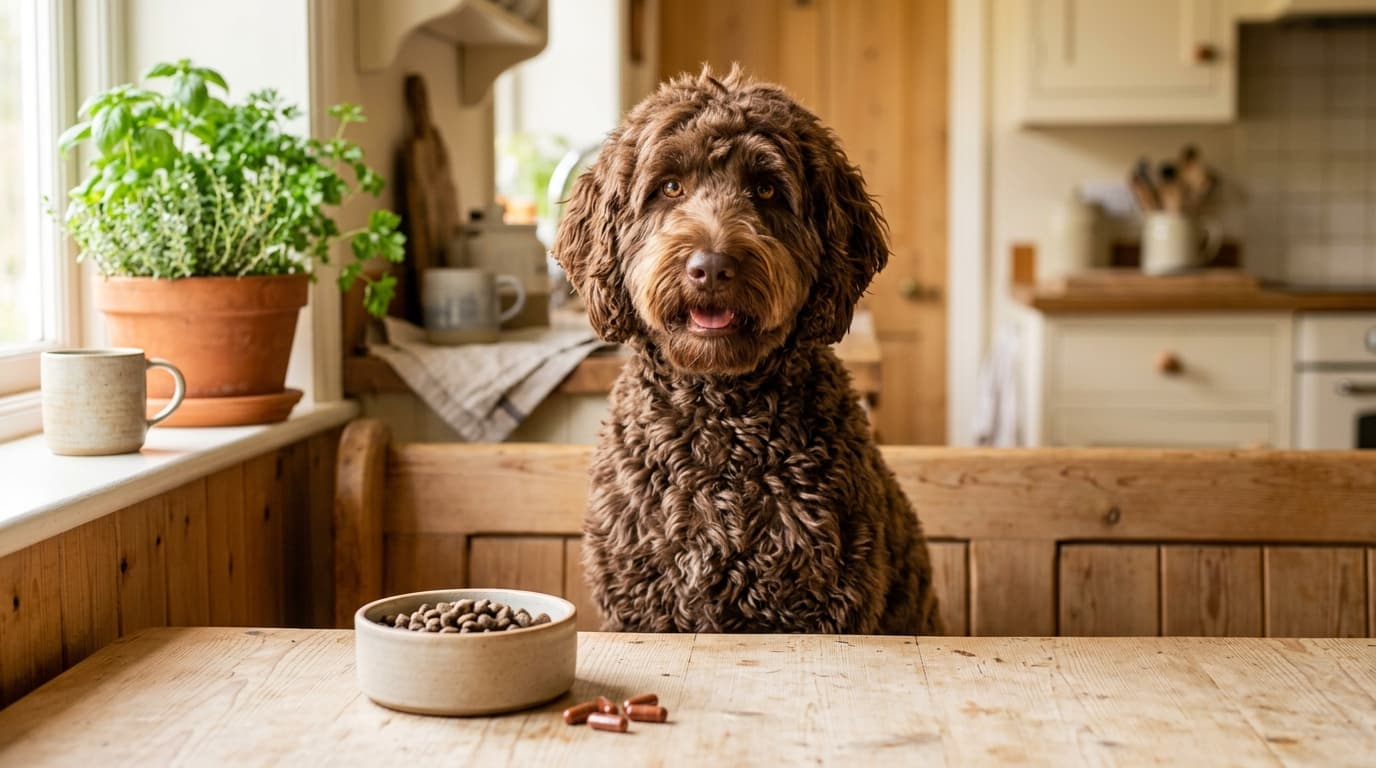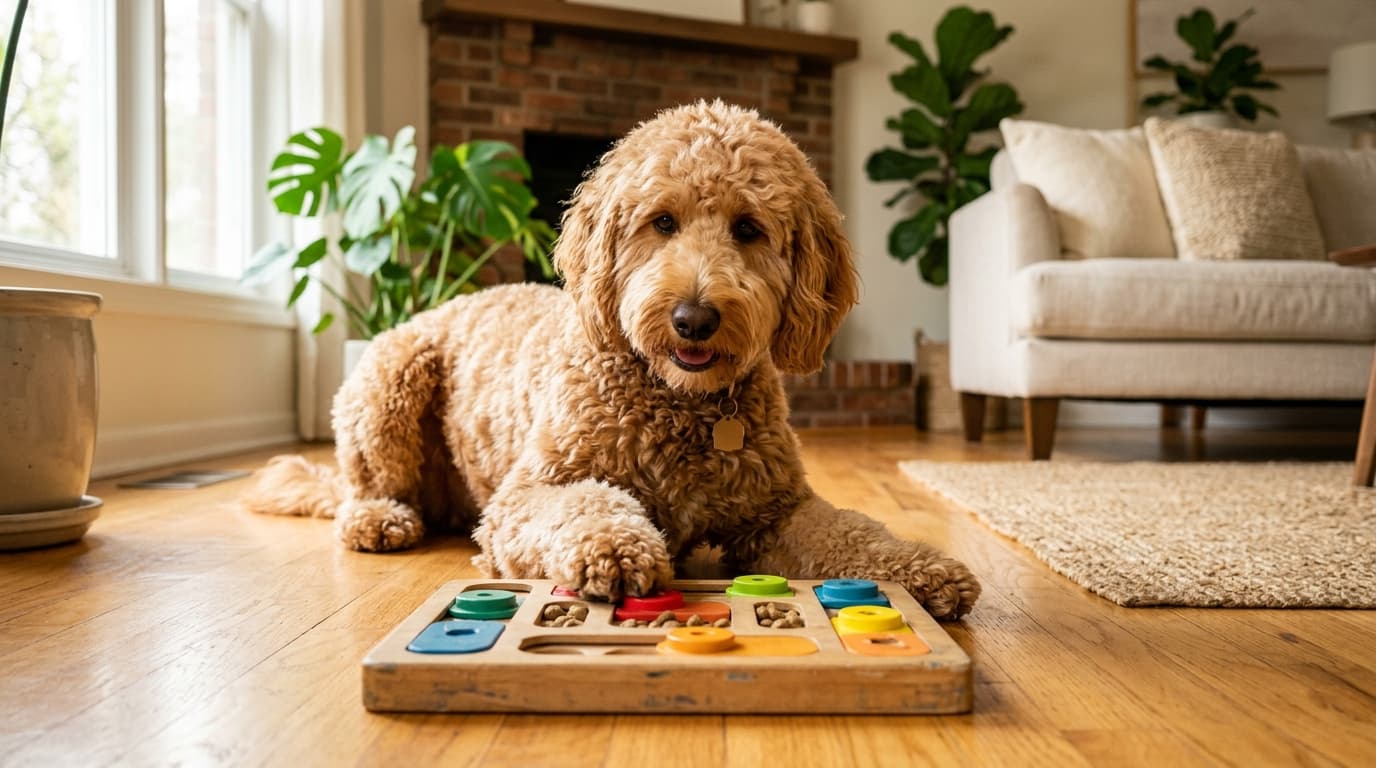
Pick a puzzle feeder by difficulty rather than by size. Start a doodle on a Level 1 sliding puzzle, move up to Level 2 flip-and-slide once they solve it in under five minutes, and save the expert multi-step puzzles for dogs who have already mastered the easier ones. A puzzle that is too hard gets abandoned, or chewed.
Doodles are clever, and a clever dog with nothing to do eats fast because eating is the most interesting thing available. (If restlessness goes beyond mealtimes, see why is my doodle so hyper?) Goldendoodles, Labradoodles and Bernedoodles all tend to come from working- or sporting-line parents that are used to having a job, so a bowl of food alone rarely gives them enough to think about. That is a different problem from a dog with a delicate stomach, and it needs a different tool. A ridged bowl slows the mouth; a puzzle occupies the brain. The ASPCA makes the same point about the value of enrichment and mental stimulation for dogs.
If you already know you want one and just want the shortlist, the Nina Ottosson Dog Brick is the right first purchase for most adult doodles. Below is how the levels work and where each pick fits.
How the difficulty levels work
Puzzle feeders are graded, and the grading is genuinely useful rather than marketing.
- Level 1, beginner. Single-action puzzles: slide a block, lift a lid. The dog learns the basic idea that working produces food.
- Level 2, intermediate. Combined actions: flip a lid, then slide, then remove a peg. Most adult doodles land here.
- Level 3-4, advanced and expert. Multi-step sequences where one action unlocks the next. Only worth buying for a dog who reliably clears Level 2.
The mistake is buying up. A puzzle that is too hard produces a frustrated dog who either walks away or resorts to chewing (a dog who needs to chew is better served by a natural chew), and neither teaches anything useful.
Comparing the six
| Puzzle | Level | Capacity | Actions involved | Best for |
|---|---|---|---|---|
| Dog Smart | 1 | Small, treats | Lift bone covers | First puzzle, puppies, seniors |
| Puppy Hide N' Slide | 2 | ¼ cup, 14 compartments | Slide and lift | Puppies ready for a second puzzle |
| Dog Brick | 2 | ~1½ cups, full meal | Flip lids, slide, remove bones | Most adult doodles |
| Challenge Slider | 3 | Treats or kibble | Multiple steps to uncover treats | The step up from the Brick |
| Dog Worker | 3 | Treats or kibble | A series of actions in order | Rotating with the Challenge Slider |
| MultiPuzzle | 4 | Multi-stage | Sequenced steps in order | Dogs who have mastered Level 3 |
Our picks
We own every puzzle on this list, and all three of our doodles have worked through them. There are plenty more good ones in the Nina Ottosson range, but these six give a clear path from a first puzzle to an expert one.
Best first puzzle: Nina Ottosson Dog Smart (Level 1)
The right place to start, including for a dog you are certain is clever. Bone-shaped covers lift out of shallow wells to reveal treats, a single, obvious action that teaches the whole concept in one session. It is also the puzzle we would pick for a puppy or an older doodle whose patience is shorter.
The con: it holds treats rather than a full meal, and a quick adult doodle will have the pattern within a few sessions, so it is a stepping stone rather than a long-term purchase.
Start with one, not a set. Some dogs take to sliders and others only ever engage with a snuffle mat, so buy a single puzzle and watch what your doodle actually works at before building a collection. Sets are rarely the saving they look like, current prices here.
Best second puzzle for a puppy: Nina Ottosson Puppy Hide N' Slide (Level 2)
Once a puppy has the Level 1 idea, this is a gentle step up sized for small mouths and paws. Fourteen hidden compartments behind sliders and lift-out pieces, holding about a quarter cup of kibble or treats, so it suits a training-treat session rather than a full meal.
The con: a quarter cup is a snack for an adult doodle, so this one is outgrown along with the puppy months.
Best overall: Nina Ottosson Dog Brick (Level 2)
The one most adult doodles should own. Twenty compartments sit behind a combination of flip-open lids, sliding covers and removable bone pieces, so there are three different actions to work out rather than one repeated twenty times. It holds around a cup and a half, which is a full meal for most Medium doodles, and roughly fifteen minutes of solving replaces a meaningful chunk of mental exercise.
We reach for the puzzle on days when the dogs have had less exercise than usual. A doodle who has not had enough to do is a doodle who eats too fast and then goes looking for the next thing.
The con: it needs supervision, and the sliders and bone pieces are the parts a frustrated dog will chew. It is also slower to clean than a plain bowl.
Best next step: Nina Ottosson Challenge Slider (Level 3)
For the doodle who clears the Brick quickly and wants more. Level 3 puzzles need several steps before the treats appear, so the dog has to work out an order rather than repeat one move. In our house this is one of the most fun puzzles we own, and a far better next step than jumping straight to an expert one.
The con: a dog who has not mastered Level 2 will find it frustrating, so earn your way here.
Best rotation partner: Nina Ottosson Dog Worker (Level 3)
Same difficulty band as the Challenge Slider, but a different series of actions to complete in order, which is exactly what makes the two good to rotate. A doodle who has memorised one gets a genuinely new problem with the other.
The con: like every Level 3, it needs supervision and a dog who already understands the easier puzzles.
Best for expert solvers: Nina Ottosson MultiPuzzle (Level 4)
For the doodle who has worked through Level 3 and looks at you expectantly. This is a genuine multi-stage puzzle where one action unlocks the next, so the dog has to work a sequence rather than repeat a move. It is the only one here that will occupy a properly clever dog for a sustained stretch.
The con: it is expensive, and it is genuinely too hard for a beginner, a dog who has not worked through the easier levels will give up on it. Buy it once Level 3 is easy, never as a first.
When a puzzle is the wrong tool
A puzzle feeder solves boredom-driven fast eating. Calm comes first, as our calm doodle guide explains. It does not solve:
- A delicate stomach. Ongoing soft stool needs a look at the food, start with signs your doodle has a sensitive stomach.
- Plain gulping in a dog who is not bored. A ridged bowl is simpler and cheaper, see best slow feeder bowls for doodles.
- Raw or wet meals. Those clog the mechanism; use a mat instead, covered in best lick mats for doodles.
- Portion creep, which needs a scale. The portion tools guide covers that side.
If several of these apply at once, the Best Products for Sensitive Doodles: Food, Supplements & Tools guide rounds up doodle-tested food, probiotics and tools worth trying alongside, or instead of, a puzzle feeder.
FAQ
Start at Level 1 even with a clever dog. A first puzzle should be solvable within a few minutes so the dog learns that working at it produces food, which is the behaviour you want to build. Move up when they consistently clear it in under five minutes and look for more. Handing a beginner a Level 4 expert puzzle usually produces a dog who gives up, or one who decides chewing the puzzle is faster than solving it.
It can for one meal a day, but daily use for every meal is rarely practical. Puzzles need supervision, take real cleaning, and lose their novelty once a dog has the pattern memorised. Most households get more value using a puzzle for one meal or a portion of one, and a slow feeder bowl for the rest. Rotating between two or three puzzles keeps the challenge alive longer than using one every day.
No. A puzzle feeder is a supervised activity, not a boredom toy to leave out. Sliders, lids and removable bone pieces can be chewed and swallowed by a dog who decides brute force is quicker than problem solving, and a determined doodle will try that. Stay in the room, and put the puzzle away once the food is gone rather than leaving it as a chew.
Mental work genuinely takes something out of a dog, and problem-solving sessions leave many doodles calmer afterwards than a short walk does. It does not replace physical exercise, but it is a useful addition on days when a long walk is not possible, and for a clever, under-stimulated doodle that fast eating and general restlessness often improve once the brain has something to do.
Take out any removable pieces and wash them separately, because food collects under sliders and inside compartments where it is easy to miss. Most are top-rack dishwasher safe. Use dry food or dry treats if you want cleaning to stay simple, since wet and raw food gets into the mechanism and needs a proper wash every single time.
Where to start
If this is your doodle's first puzzle, buy the Level 1 and spend a week on it even if it looks too easy. Move to the Brick once they clear it quickly, step up to the Challenge Slider and Dog Worker as a Level 3 pair, and only reach for the expert puzzle when Level 3 has stopped being interesting.
If the fast eating turns out not to be boredom at all, the simpler fix is a ridged bowl and an honest portion, both covered in slow feeder bowls and portion tools for doodles.