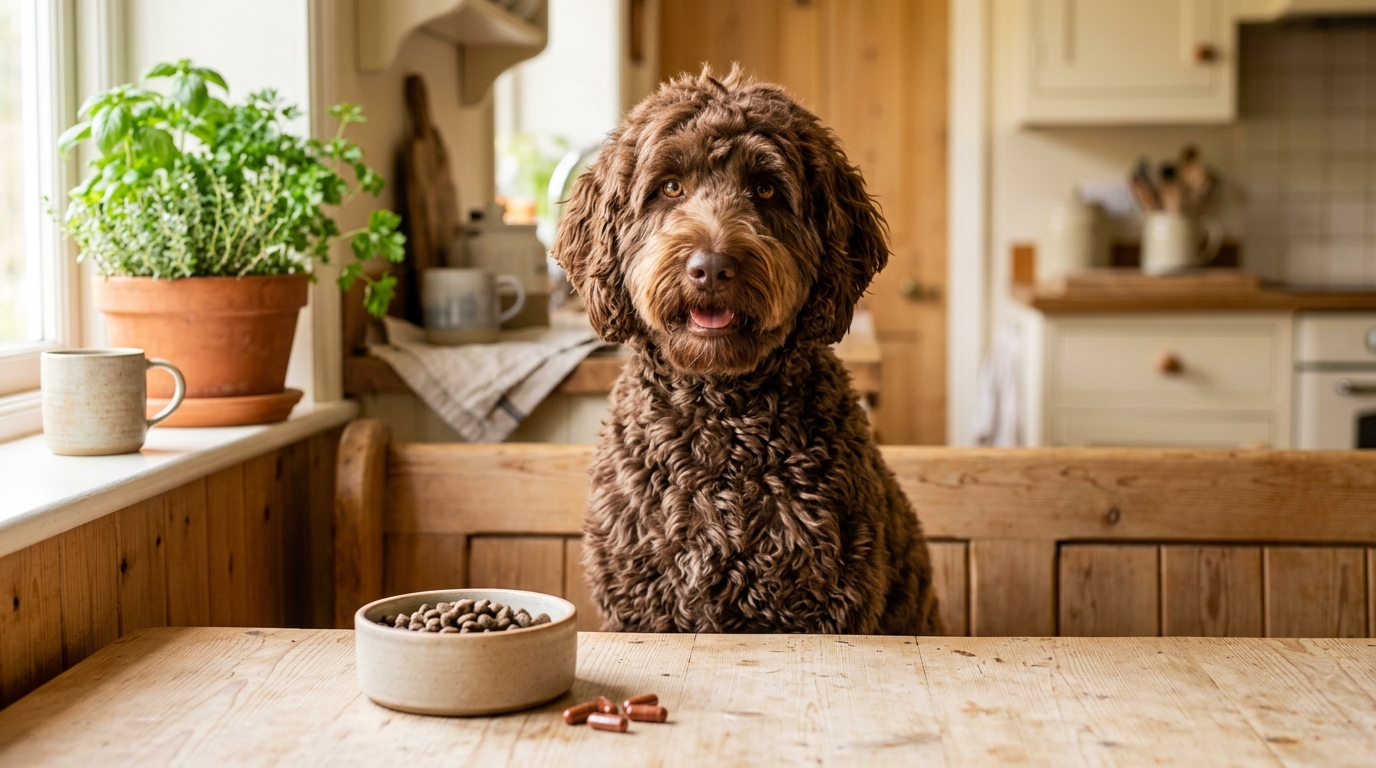
For most doodles, the best-supported joint supplement is a high-EPA/DHA fish oil, followed by glucosamine/chondroitin and green-lipped mussel; UC-II collagen is promising but newer. Supplements support comfort and mobility, they do not treat hip dysplasia, so confirm the full ingredient list is chicken-free and talk to your vet before starting.
That is the honest short answer, and it matters because the joint supplement aisle is full of confident marketing and thin evidence. The best joint supplement for a Goldendoodle is not the one with the longest ingredient list, it is the one with the actives that actually have research behind them, in a form your dog will take, with nothing in it that triggers their gut or skin.
Below we walk through what the evidence really says, then our two picks (both checked chicken-free on the full label), then how to use them and, just as importantly, what they will not do.
What the Evidence Actually Says About Joint Actives
Doodles come from two lines that make joints worth paying attention to. The Standard Poodle side and, in Bernedoodles, the Bernese Mountain Dog side are both large, deep-chested builds, and larger dogs carry more joint load over a lifetime (our doodle hip dysplasia guide covers the structural side). Whether you have an Australian Labradoodle, a Goldendoodle, a Labradoodle or a Sheepadoodle, the same actives apply, but the honest picture is that they are not all equal.
If you already know you want a joint supplement and just want to see what we test and rank, the best products hub is the shortcut.
Omega-3 (EPA/DHA), the strongest evidence
If you only add one thing, make it a marine omega-3 with real EPA and DHA. Fish oil has the most consistent research behind it for canine joint comfort of any of these actives, because EPA in particular helps calm the low-grade inflammation that makes stiff joints hurt. It is also the one supplement that pulls double duty for the itchy, coat-hiding skin so many doodles have. We cover dosing and product choice fully in our guide to omega-3 fish oil for doodle skin health, worth reading alongside this one.
Glucosamine and chondroitin, modest and mixed
These are the classic joint ingredients, and the evidence is genuinely mixed: some dogs seem more comfortable, others show little measurable change. They are very safe, which is why a trial is reasonable, just go in with realistic expectations rather than expecting a miracle.
Green-lipped mussel, a promising natural option
Green-lipped mussel (GLM) delivers naturally occurring omega-3s plus other joint-supporting compounds, and the small studies that exist are cautiously encouraging. It is a nice middle ground for owners who want a whole-food source.
UC-II collagen and HMB, newer, worth watching
UC-II (undenatured type II collagen) has some interesting research at very small doses, and HMB is a newer muscle-support addition. Both are promising but have a shorter track record than fish oil, so treat them as a bonus rather than the foundation.
For a vet-written reference on the conditions mentioned here, the Merck Veterinary Manual is a reliable place to check.
Top Picks
A good joint pick for a doodle clears three bars: the actives are ones with real research behind them, the dose is meaningful, and the full ingredient list is clean enough for a sensitive dog. We prioritized minimal formulas, verified the labels, and flagged the honest downside of each, because a real con is more useful than a five-star pitch.
| Product | Best For | Rating |
|---|---|---|
| Nutramax Dasuquin MSM Soft Chews, 84ct | Best Glucosamine Blend | 4.7 |
| Nordic Naturals Omega-3 Pet Liquid, 8 oz | Strongest Evidence / Fish Oil | 4.7 |
One practical note before you pick: joint supplements are a months-long commitment, not a one-time buy, so count the doses per container against your dog's daily amount before comparing anything. A 60-count of chew tabs goes fast for a standard-sized dog on two a day, while a 180-count or a 30-scoop powder stretches much further. Buy the smallest size first to confirm your dog will take it, then size up once you know it works, and if you want to browse the wider range, the Amazon pet supplements section lists current options and sizes.
Why only two picks? We checked the full ingredient list of every joint product we considered, and most failed for a chicken-sensitive doodle. Popular glucosamine chew tabs and soft chews list dried chicken or dried chicken liver among the inactive ingredients, even when the front of the pack just says "joint support". UC-II collagen, one of the newer actives, is typically made from chicken sternum cartilage. For a dog like Gunnar, those are out, so we would rather show you two clean picks than four with a hidden trigger.
What to Look For in a Doodle Joint Supplement
Once you know which actives matter, the buying decision comes down to a few practical checks, and one hard rule for doodles.
- Chicken-free, verified on the full label. This is non-negotiable for a chicken-sensitive dog. Many joint soft chews use chicken liver flavor, chicken cartilage or chicken fat even when "chicken" is nowhere on the front. Our Gunnar's whole ear-and-yeast cycle traces back to chicken, so we read the entire ingredient list every time.
- Meaningful doses of proven actives, not a fairy-dusted sprinkle to justify a longer list.
- A form your dog will actually take, chews are convenient, but a plain oil or unflavored powder avoids the flavor binders that can hide triggers.
- A brand with quality control, ideally one that participates in the National Animal Supplement Council program.
- Sized to your dog. A mini and a standard need different amounts; if you are unsure where your dog lands, our doodle size chart helps.
How to Add a Joint Supplement (Without Upsetting the Gut)
Even a joint product can cause loose stool if you dump a full dose in on day one, and with three doodles, we have learned to go slowly. Sven, our most sensitive stomach, gets loose stool after almost any change, so anything new goes in over about a week, the same slow logic as our 7-day food transition plan.
| Days | Amount | Watch for |
|---|---|---|
| 1-3 | ¼ dose | Appetite, stool consistency |
| 4-6 | ½ dose | Any gas or soft stool |
| 7-9 | ¾ dose | Willingness to take it |
| 10+ | Full label dose | Steady stool, normal energy |
Give it with food, keep the rest of the diet steady while you introduce it, and give it a fair 8-12 week trial before deciding whether it helps. Joint supplements work gradually, they are not painkillers, and week-one judgments are unfair to both the product and your dog.
Gösta, who has eaten raw at home and freeze-dried raw on the road without a single gut problem, takes anything we add without noticing. But we still transition him at the same pace, because the point of going slow is to catch a reaction early, not to fix one after the fact.
What a Joint Supplement Will Not Do
This is the part the marketing skips. A supplement will not:
- Cure or reverse hip dysplasia or arthritis. Those are structural and need a veterinary plan.
- Replace weight management. Keeping your doodle lean does more for their joints than any scoop of powder, a genuinely overweight dog carries that load on every joint, every step. A lean body is the free half of this equation: check where your dog sits with our healthy weight for a doodle guide, and size meals with the free tools.
- Fix a limp overnight. Sudden lameness is a vet visit, not a supplement decision.
- Undo a lack of exercise or over-jumping in a young dog. For an older dog, senior doodle care covers the wider picture.
The best outcomes we have seen come from stacking the boring, proven things: lean body weight, sensible exercise, an omega-3 with real EPA/DHA, and a joint supplement as one supporting layer, under a vet's guidance for any dog with actual joint disease.
FAQ
There is no single winner for every dog, but the most evidence-backed starting point is a high-EPA/DHA fish oil, then a vet-formulated glucosamine/chondroitin blend like Dasuquin. The best pick for your Goldendoodle depends on their sensitivities, whether they take chews or powder, and what your vet recommends after examining their joints.
The evidence for glucosamine and chondroitin is mixed and modest, some dogs show improved comfort, others show little change. It is very safe, so it is a reasonable trial, but omega-3 fish oil has stronger research behind it for canine joint comfort. Give any supplement a fair 8-12 week trial before judging it.
No. Joint supplements support comfort, lubrication and mobility, but they do not treat, reverse or cure hip dysplasia or arthritis. Dysplasia is a structural problem that needs a veterinary diagnosis and a real management plan, which may include weight control, physical therapy, pain medication or surgery. Supplements are one supporting piece, not the treatment.
Only if you read the full ingredient list. Many joint soft chews use chicken liver flavor, chicken cartilage or chicken fat even when chicken is not the headline ingredient. For a chicken-sensitive dog like our Gunnar, we choose a plain powder or a chew we have verified to be chicken-free rather than trusting the front of the bag.
Give it 8-12 weeks. Joint supplements build up gradually and work by supporting cartilage and reducing low-grade inflammation over time, not by acting like a fast painkiller. If you see no change at all after three months, talk to your vet about a different active or a fuller workup.
Your Next Step
If you are choosing a joint supplement because you are worried about your doodle's joints, start with the strongest evidence: our best omega-3 fish oil picks for doodles covers dosing and clean sourcing for the one active with the most research behind it. Keeping your dog lean matters just as much, and the senior doodle care guide covers the exercise and body-condition side as joints age. For everything else we test and rank, browse the best products hub.