The best homemade dog food toppers for a sensitive doodle are plain, low-fat and single-ingredient: pumpkin, skimmed onion-free bone broth, white fish, plain egg, steamed zucchini or carrot. Keep toppers under 10% of daily calories and add only one new ingredient every 3 days.
Most topper recipes online are built for a dog with an iron stomach. They blend five ingredients, cook in butter, use fatty ground meat or chicken broth, and leave you guessing which part caused the soft stool the next morning. That is fine for some dogs. It is a bad plan for a doodle whose gut already tells you about every change.
Below you will find seven easy, chicken-free recipes, each with prep, portions by size and storage notes, plus the rule we use to introduce them, the kitchen foods that never go in the bowl, and the signs that a topper is not working.
Why sensitive doodles need a different kind of topper
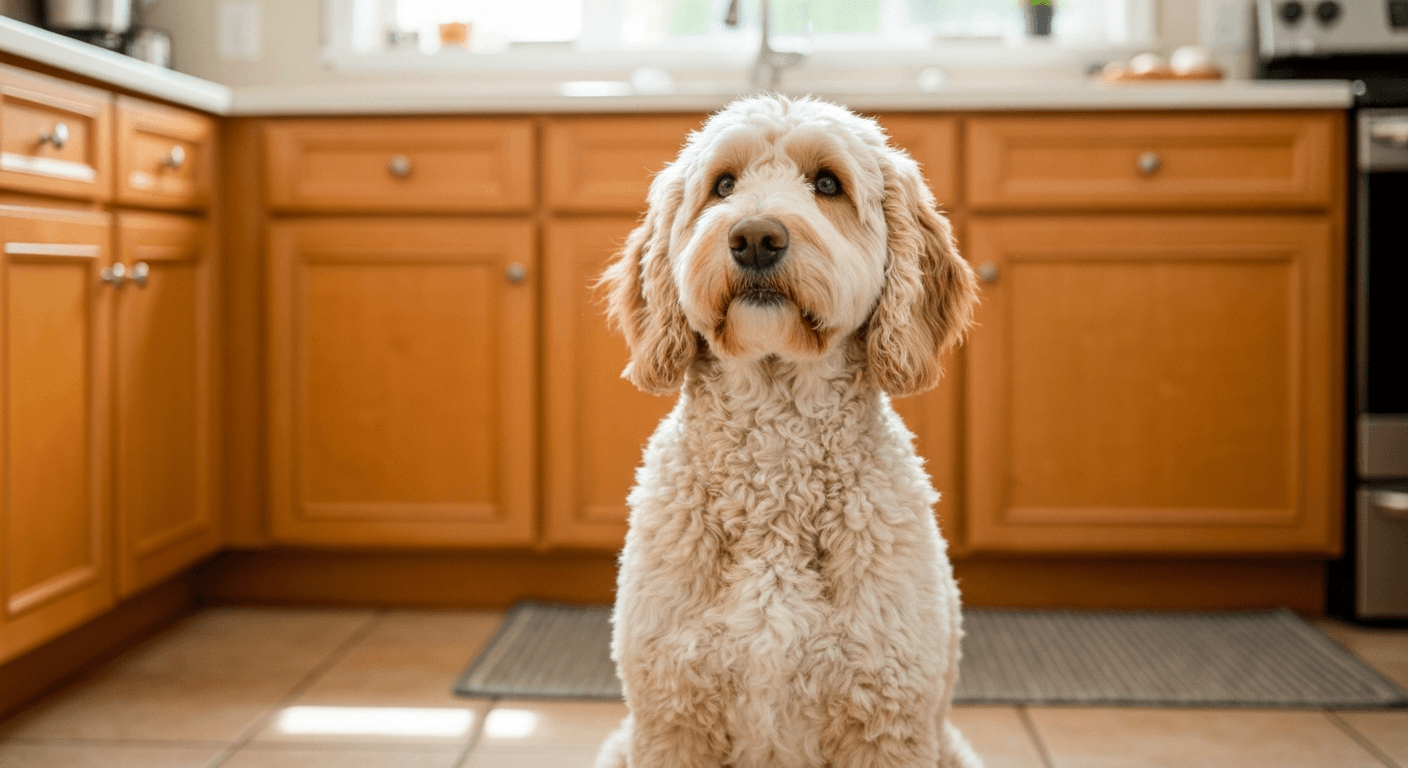
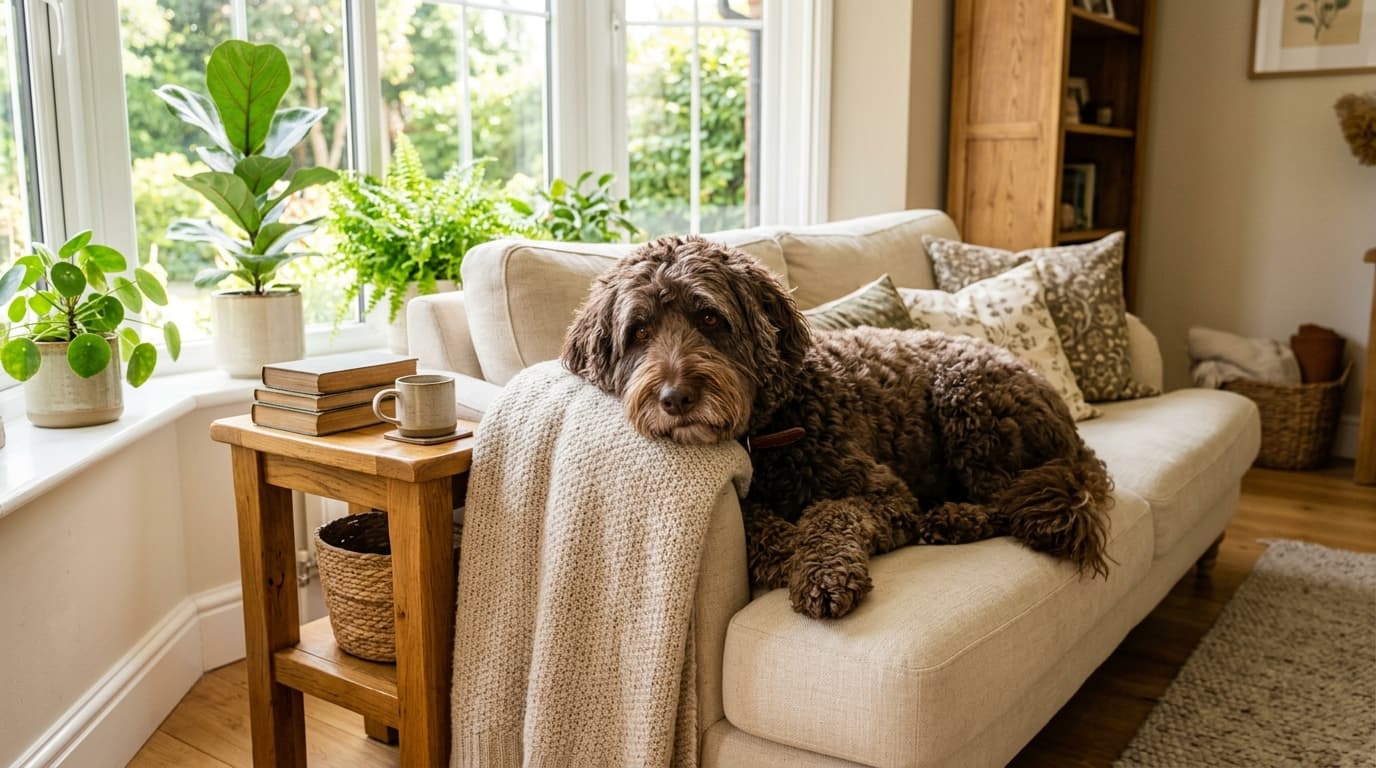
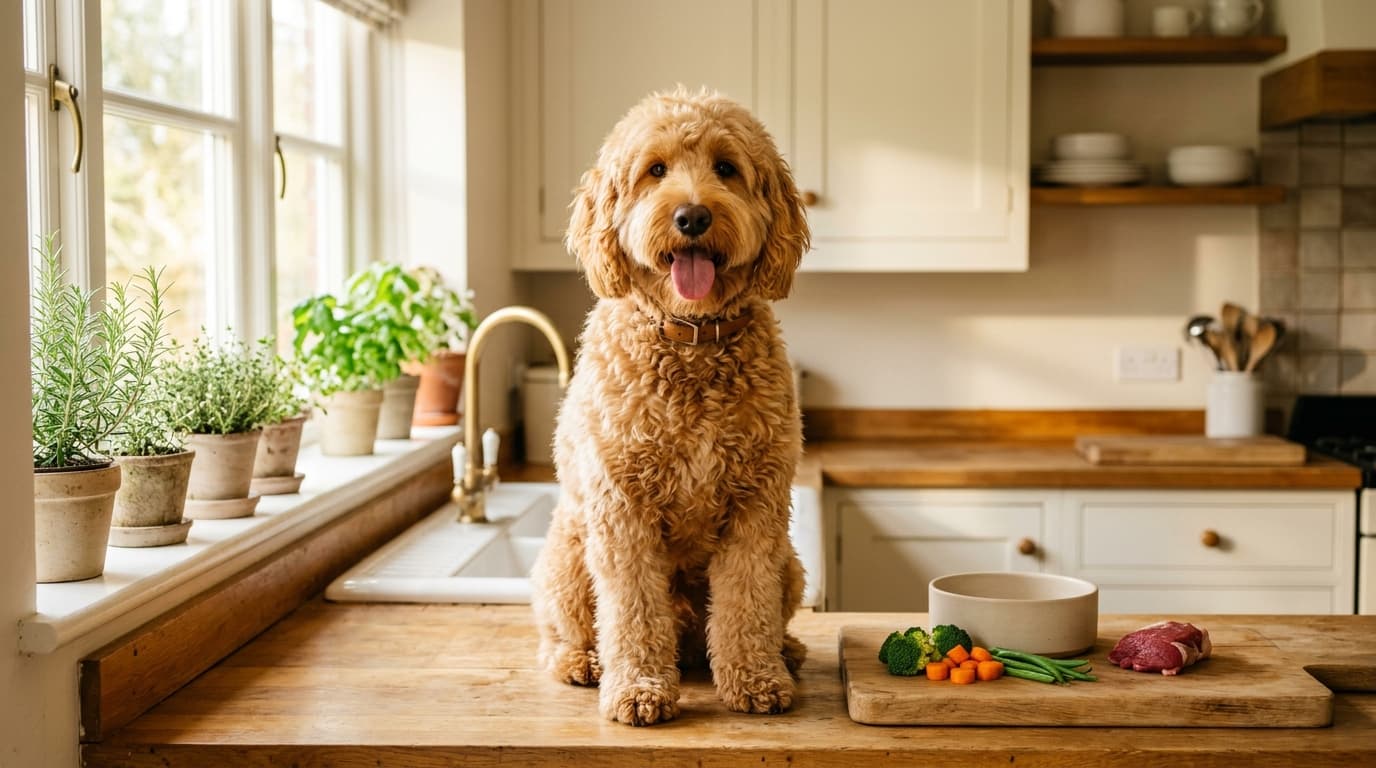
We live with three multigenerational Australian Labradoodles, and each of them explains one rule in this article.
Sven is the reason toppers here are low-fat and single-ingredient. He is the sensitive stomach of the three: through his whole first year he vomited bile every morning, and every single food change showed up as loose stool. With a dog like Sven, a rich add-on is not a treat, it is an experiment, and you only learn something from an experiment if you change one thing at a time.
Gunnar is the reason every recipe is chicken-free. Chicken is his trigger (for him it shows up in the ears and skin, not the stomach), and chicken hides in a lot of kitchen staples: broth cartons, stock cubes, "meat" gravy. If you suspect the same in your dog, our guide to chicken allergy in doodles covers the signs and the alternatives.
Gösta is the reason we call toppers variety, not a fix. He has never had a gut-driven problem and will eat anything you put in front of him. For him a spoon of fish on a travel day is simply nice. That matters: a topper should make a good meal more interesting, not cover up a base food that does not suit the dog. If you suspect the base food is the real problem, our shortlist of the best dog food for a doodle with a sensitive stomach is the faster fix.
If you already know you would rather buy a ready-made topper and just want the shortlist, our comparison of the best dog food toppers for picky doodles sorts the liquid, powder and gravy options. The rest of this guide is for the kitchen route.
The 10% rule, turned into spoons
The common rule of thumb is that treats and extras together stay under 10% of a dog's daily calories, so the complete food still provides the other 90% and the diet stays balanced. Toppers count as extras. So do training treats, chews and the crust someone dropped.
To use the rule, look up how many calories your doodle's daily portion of food provides (it is on the bag or the brand's website), then take 10% of it. As an example only, an active standard doodle around 55 lb (25 kg) eats very roughly 1,200 to 1,400 calories a day, which leaves about 120 to 140 calories for all extras combined.
That number explains why the recipes below are not equal:
- Pumpkin, zucchini, carrot and skimmed broth are so low in calories that the 10% limit is rarely the problem. Fiber is the limit with pumpkin.
- Egg, fish and lean turkey are real food with real calories. One large egg is about 70 calories, so two eggs nearly fill a standard doodle's daily extras.
- Fat is the hidden cost. A greasy topper is both calorie-dense and the most common reason a sensitive gut rebels.
If your doodle is already carrying a little extra, the honest move is to cut the main portion slightly when you add a topper. Our healthy weight guide shows how to check, and the guide to overfeeding and stomach issues explains why too much food, not the wrong food, is sometimes the whole story.
7 homemade dog food toppers that are gentle on the gut
Every recipe here is plain: no salt, no butter, no oil, no seasoning, no onion or garlic. Portions are per day for a dog who already eats a complete diet, so split them between meals.
1. Plain canned pumpkin
- Prep: none. Use 100% pumpkin, never pie filling (it is sweetened and spiced).
- Portion: about 1 teaspoon per 10 lb (4.5 kg) of body weight, once or twice a day.
- Storage: an open can turns quickly in the fridge. Spoon the rest into an ice cube tray and freeze.
Pumpkin is the classic gut-friendly topper, and we have a full guide to pumpkin for an upset doodle stomach with the reasons it firms soft stool and the cases where it does not help. Short version: start low, because too much fiber loosens stool instead of firming it.
2. Turkey or beef bone broth (no onion, no garlic)
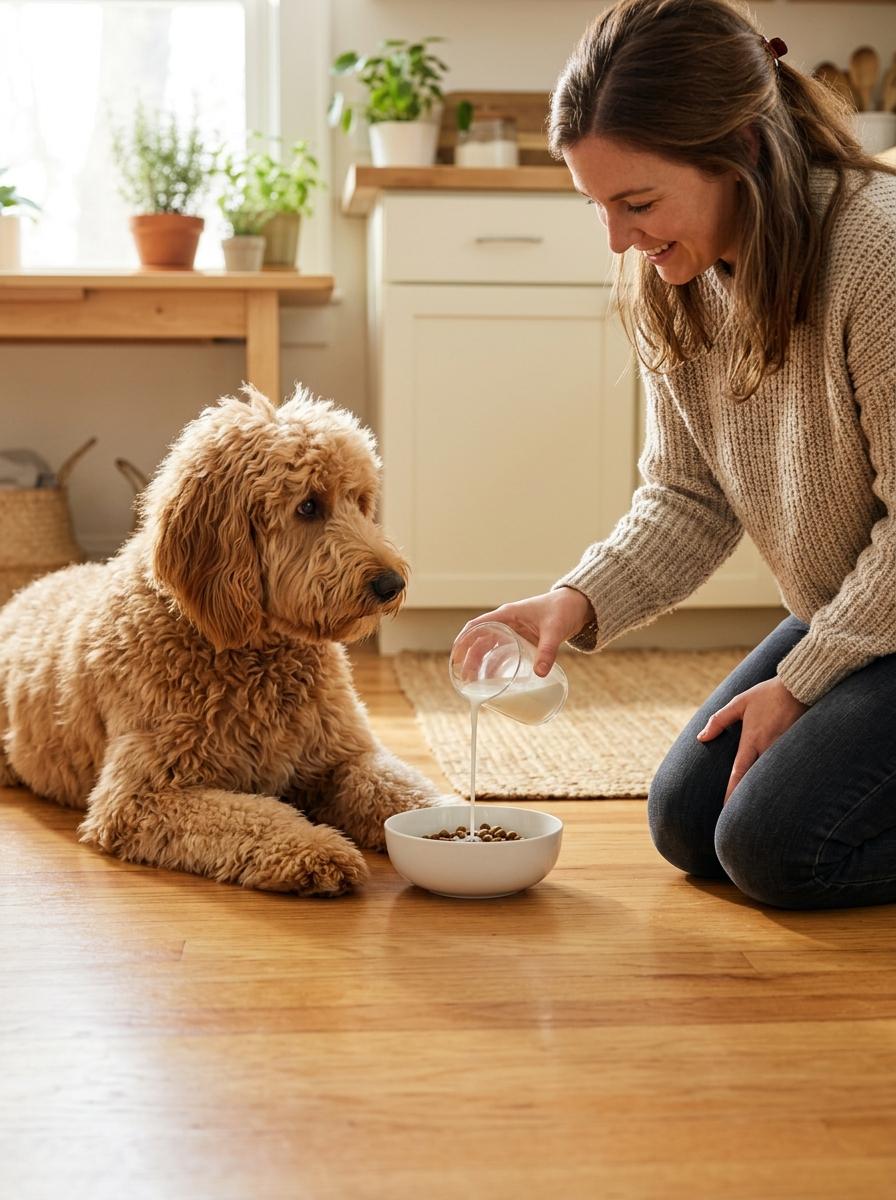
This is the bone broth topper for dogs we use most, because it adds smell and moisture with almost no calories once it is skimmed.
- Prep: cover turkey necks or beef marrow bones with water and simmer gently for 12 to 24 hours. Add nothing else. Strain carefully, then chill overnight. A hard layer of fat sets on top: lift it off and throw it away. That step is what makes broth suitable for a sensitive stomach.
- Portion: mini 1 to 2 tablespoons, medium 2 to 4 tablespoons, standard about 1/4 to 1/2 cup, poured over the food.
- Storage: 3 to 4 days in the fridge, or freeze in an ice cube tray for about two to three months.
Never feed the cooked bones from the pot. Cooked bones turn brittle and can splinter.
3. Cooked white fish
- Prep: poach a plain fillet of cod, pollock or haddock in water for 8 to 10 minutes until it flakes. Cool, flake with a fork and check carefully for bones.
- Portion: mini about 1 oz (30 g), medium 1 to 2 oz (30 to 55 g), standard 2 to 3 oz (55 to 85 g). White fish is lean, roughly 30 calories per ounce.
- Storage: 3 days in the fridge; freezes well flaked in small portions.
White fish is the topper we reach for first after broth: it is a single animal protein, mild in smell to us but very interesting to a dog, and easy on a sensitive gut.
4. Plain scrambled egg
- Prep: whisk an egg and cook it in a nonstick pan with a splash of water instead of butter or oil. Cook it through; always cook eggs for a dog.
- Portion: mini about 1/4 egg, medium 1/2 egg, standard up to 1 egg a day.
- Storage: 3 days in the fridge. Egg goes rubbery when frozen, so cook small amounts fresh.
5. Steamed zucchini or carrot
- Prep: steam zucchini or carrot until soft, then mash or grate finely. Dogs digest soft, broken-down vegetables far better than raw chunks.
- Portion: mini 1 to 2 teaspoons, medium 1 to 2 tablespoons, standard 2 to 3 tablespoons.
- Storage: 4 days in the fridge; freezes well in cubes.
Zucchini is the gentlest of the two. Carrot is a little higher in natural sugar, so it stays a small amount.
6. Plain kefir, in small amounts
- Prep: none. Use plain, unsweetened, unflavored kefir only. Flavored versions add sugar, and anything "sugar-free" must be checked for xylitol.
- Portion: start with 1 teaspoon for any size. Work up slowly to mini 1 to 2 teaspoons, medium 1 tablespoon, standard 1 to 2 tablespoons.
- Storage: keep it in the fridge and use it before the date on the carton.
Kefir is fermented, so it carries live cultures and less lactose than milk, but it is still dairy, and many dogs digest dairy poorly. It is the one recipe here we would leave out entirely for a dog who has reacted to dairy before. For how fermented foods compare with a proper supplement, see our complete guide to probiotics for doodles.
7. Lean ground turkey
- Prep: use the leanest ground turkey you can find (at least 93% lean). Simmer it in water, breaking it up, until fully cooked, then drain it and pour off the fat.
- Portion: mini about 1 oz (30 g), medium 1 to 2 oz (30 to 55 g), standard 2 oz (55 g). Turkey is richer than white fish, so keep it smaller.
- Storage: 3 to 4 days in the fridge; freezes well in portions.
Turkey is a different bird from chicken and is fine for Gunnar, but some chicken-allergic dogs also react to turkey. If your dog's allergy is confirmed, treat turkey as a new protein and introduce it slowly.
Topper portions by size: mini, medium and standard Australian Labradoodles and Goldendoodles
Doodles come in very different sizes, and a portion that suits a 55 lb (25 kg) standard Goldendoodle or Australian Labradoodle will upset a 20 lb (9 kg) mini. Use this table as a starting point and stay at the low end for the first week.
| Topper | Fat level | Mini, 15-30 lb (7-14 kg) | Medium, 30-45 lb (14-20 kg) | Standard, 45-65 lb (20-30 kg) | Fridge / freezer |
|---|---|---|---|---|---|
| Plain pumpkin | Very low | 1-3 tsp | 3-4 tsp | 1-2 tbsp | 3 days / 3 months |
| Skimmed bone broth | Low once skimmed | 1-2 tbsp | 2-4 tbsp | 1/4-1/2 cup | 3-4 days / 3 months |
| Cooked white fish | Low | 1 oz (30 g) | 1-2 oz (30-55 g) | 2-3 oz (55-85 g) | 3 days / 2-3 months |
| Plain scrambled egg | Moderate | 1/4 egg | 1/2 egg | 1 egg | 3 days / not ideal |
| Steamed zucchini or carrot | Very low | 1-2 tsp | 1-2 tbsp | 2-3 tbsp | 4 days / 3 months |
| Plain kefir | Low to moderate | 1-2 tsp | 1 tbsp | 1-2 tbsp | Carton date / no |
| Lean ground turkey | Moderate | 1 oz (30 g) | 1-2 oz (30-55 g) | 2 oz (55 g) | 3-4 days / 2-3 months |
Pick one row to start with, not three. The table is a menu for the coming weeks, not a mix for tonight.
How to introduce a topper one ingredient at a time
This is the part that most homemade toppers for dogs with a sensitive stomach skip, and it is the part that matters most. Our rule is simple:
- One new ingredient. Nothing else changes: same base food, same treats, same routine.
- A small amount for 3 days. Use the low end of the table, or half of it for a very sensitive dog.
- Check the stool every day. Firm and normal for 3 days means the topper stays, and you may slowly increase it.
- Soft stool 2 days in a row means it goes. Stop it, go back to what worked, and wait until stool has been normal for 3 days before you try anything new.
When Sven was young, anything new in his bowl showed up in his stool within a day, so this rule was never optional in our house. The slow pace feels fussy. It is also the only way to know which ingredient caused a problem. If you are changing the base food itself, use our 7-day food transition plan and keep toppers out of the picture until the switch is finished.
When a store-bought topper makes more sense
Homemade is not automatically better. Our own three eat raw at home (here is our honest take on the pros and cons of a raw diet for doodles), so at home a topper for us is usually a spoon of skimmed broth or fish. Where a ready-made topper earns its place is on the road, when Gösta is eating premium kibble and freeze-dried raw and there is no stove to poach a fillet on.
A store-bought topper also makes sense if you will not realistically cook every few days, or if you want a consistent product with a printed ingredient list you can check for chicken. If you are still deciding between kibble and fresher food as the base, our kibble vs fresh food guide for sensitive doodles may settle the bigger question first.
Kitchen ingredients that are unsafe in a topper
Some foods that taste good to us are genuinely dangerous for dogs, and they turn up in human leftovers and store-bought broth all the time:
- Onion, garlic, leeks and chives, fresh, cooked or powdered. The Merck Veterinary Manual describes how garlic and onion toxicosis damages red blood cells, often with signs appearing days later, and notes that garlic is more toxic than onion.
- Grapes and raisins, in any amount. The ASPCA includes them in its list of people foods to avoid feeding your pets, along with onion, garlic and very salty foods.
- Xylitol, a sweetener found in some peanut butters, yogurts and "sugar-free" products. The FDA warns that xylitol is dangerous for dogs because it can cause a rapid, severe drop in blood sugar.
- Fatty trimmings, skin, bacon and pan drippings. Not toxic, but a large dose of fat is a classic trigger for vomiting and diarrhea, and a vet concern in its own right.
- Seasoned or salted broth and stock cubes. These often contain onion, garlic, salt and chicken all at once.
- Cooked bones of any kind.
Signs a topper is not agreeing with your doodle
Most reactions to a new topper are mild and show up within a day or two:
- Soft or loose stool, or more frequent poops than usual
- Gas and a gurgling belly
- Vomiting, or licking lips and gulping after meals
- Itchy skin, red ears or paw licking over the following weeks, which points more toward a protein reaction than a digestive one (this is how Gunnar's chicken problem showed itself)
A single soft stool in an otherwise bright dog usually just means "stop that topper and go back to plain food", and our guide to soft stool in a doodle who is acting normal walks through what to watch. Repeated vomiting, blood in the stool, lethargy or a dog who will not eat at all is different: see when to take your doodle to the vet for vomiting and do not keep experimenting.
What can I put on my dog's food to make him eat it?
Warm water first, then a spoon of skimmed broth or flaked white fish. That answers the question for most picky doodles.
The harder question is why the dog needs it. Here is the trade-off we have learned to name: the toppers a dog finds most exciting are usually the fattiest ones, and the fattiest ones are the most likely to upset a sensitive stomach. If you find yourself adding richer and richer toppers to get every single meal eaten, the topper is no longer variety. It is a sign the base food does not suit the dog, or that something else is going on.
Our decision rule: if a doodle skips the occasional meal but is bright, playful and has normal stool, read our guide to a doodle not eating but acting normal. If the low appetite has lasted more than a day or two, or comes with tiredness, vomiting or weight loss, our guide to low appetite in doodles helps you tell a picky eater from a red flag, and it is a call-your-vet situation.
FAQ
Start with the plainest options: a teaspoon of plain canned pumpkin per 10 lb (4.5 kg) of body weight, a few spoonfuls of skimmed bone broth made without onion, garlic or salt, or a little steamed zucchini. They are low in fat, single-ingredient and easy to stop if the stool changes. Add cooked white fish or plain egg later, one at a time.
Keep all toppers and treats together under 10% of your doodle's daily calories. For an active 55 lb (25 kg) standard that is very roughly 120 to 140 calories a day, which is a lot of pumpkin or zucchini but only about two eggs or 4 oz (115 g) of cooked white fish. Check the calorie figure in your own food's feeding guide.
Often it is not. Many supermarket broths contain onion, garlic, salt or seasoning, and many are chicken-based, which matters for a dog like ours who reacts to chicken. Use a broth made for dogs with a short ingredient list, or make your own from turkey or beef bones with water only and skim the fat once it has chilled.
Cooked fish, meat, egg and vegetables keep about 3 to 4 days in a sealed container in the fridge. Broth, pumpkin, fish and vegetables freeze well in an ice cube tray for about two to three months; thaw a cube in the fridge overnight. Plain kefir is used straight from the fridge before its date.
Warm water is the first thing to try: it releases the smell of the food and costs no calories. Next, a spoonful of skimmed bone broth or a little flaked white fish usually does the job. If your doodle refuses meals for more than a day or two, or also seems tired or unwell, call your vet instead of adding more toppers.
The next step
Pick one topper from the table, start it small for three days and watch the stool. For a doodle who is sensitive, that slow, single-ingredient approach is what makes toppers safe. To understand the bigger picture behind a reactive gut, start at our sensitive stomach hub, which links every guide on causes, food and routine.