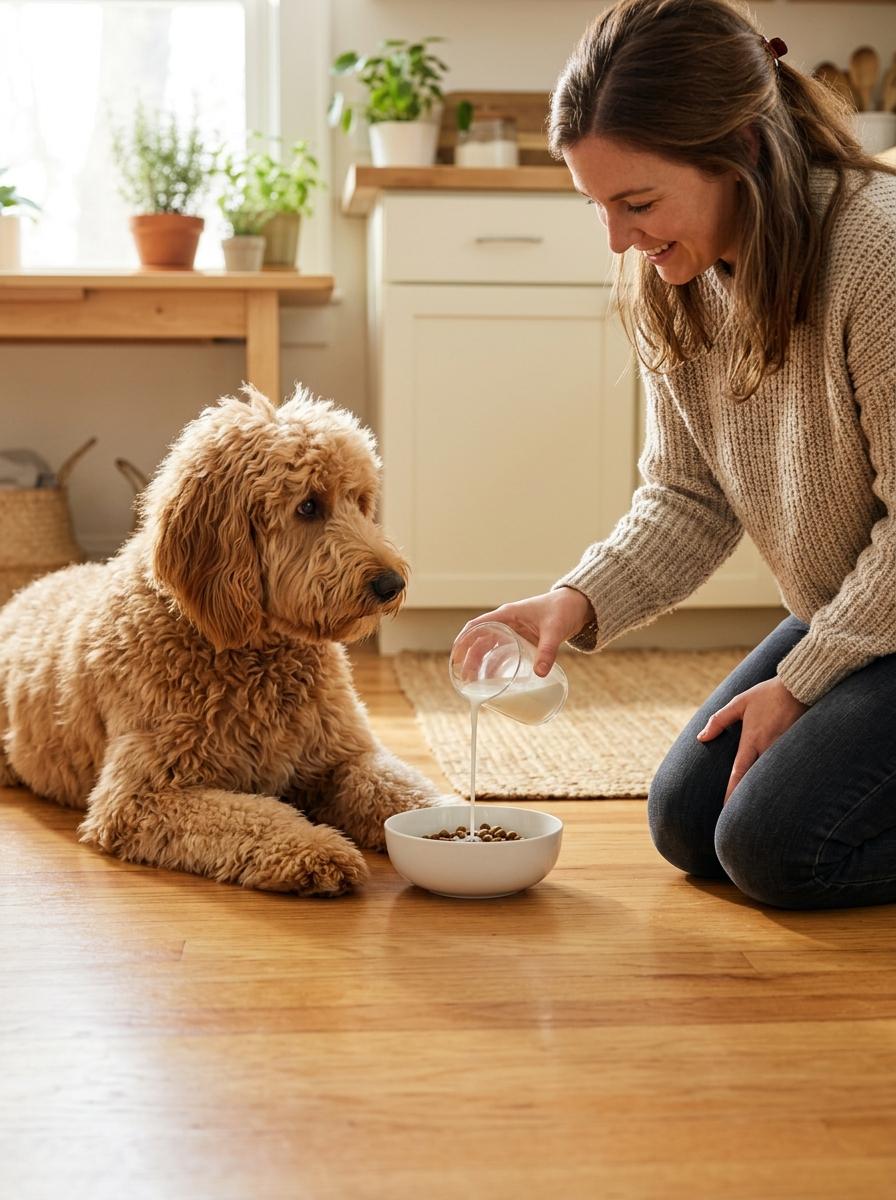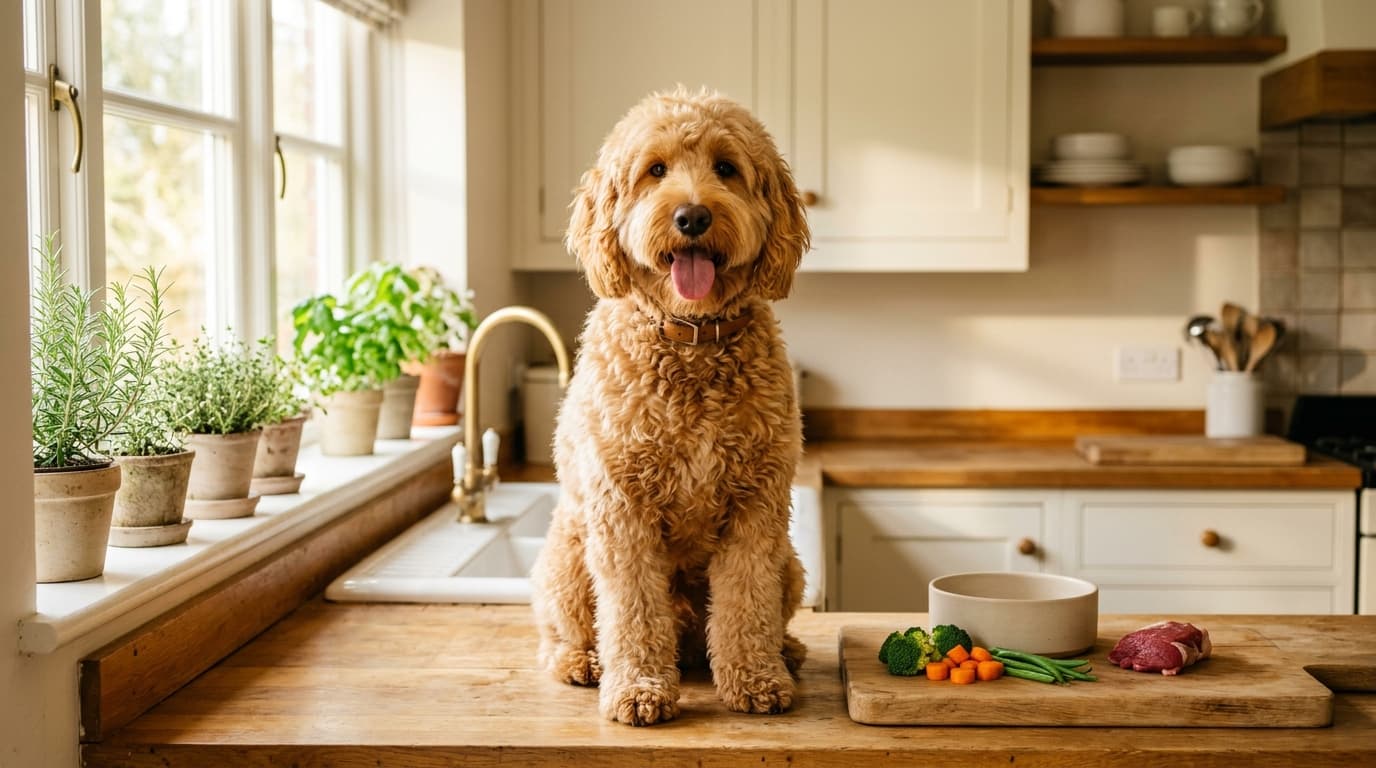
Dog food toppers are small add-ons that make a complete food more appealing, not a fix for it. Keep toppers and treats together under 10% of daily calories, add one new ingredient at a time, and check labels for hidden chicken. If a doodle only eats with a topper, look at the food first.
That is the whole answer in four sentences. The rest of this guide is the decision behind it: which type of topper suits which situation, when a topper genuinely helps, when it is quietly covering up a problem, and how to add one to a sensitive doodle's bowl without starting a week of loose stool.
We write this from a house with three Australian Labradoodles: Gunnar, whose trigger is chicken; Sven, our most sensitive stomach; and Gösta, who would eat anything you put in front of him. At home they eat raw, so in everyday life we rarely need a topper at all. That is exactly why we have strong opinions about when you need one. If you already know your doodle is a fussy eater and you just want the shortlist, our best dog food toppers for picky doodles compares liquid, powder and gravy options side by side.
What is a dog food topper?
A dog food topper is anything you put on or mix into your dog's regular meal to change its flavor, texture, moisture or nutrition. It is meant to be added to a complete and balanced food, not to replace it.
That distinction matters more than any brand choice. Most commercial toppers are not complete diets. The AAFCO guide to reading pet food labels explains that products which do not meet the standards for complete and balanced nutrition carry a statement such as "intended for intermittent or supplemental feeding only". On a topper, that line is a signal: this is a flavor and variety product, and the main food still has to do the nutritional work.
Toppers range from a spoonful of plain canned pumpkin to a commercial freeze-dried raw product, a pouch of gravy, a broth, a powder or a supplement oil. They answer different problems, so the first question is never "which brand" but "what am I trying to fix?"
The main types of dog food toppers
Here are the five families you will meet, what each does well, and where each one can trip up a doodle with a sensitive gut or a food allergy.
Homemade toppers
A homemade topper is a single plain food you prepare yourself: cooked white fish, plain cooked turkey, a spoon of plain canned pumpkin, a little cooked egg. The big advantage is control. You know exactly what is in it, which is gold for an allergy dog, and you can introduce it in tiny amounts.
The catch is that "homemade" is not automatically gentle. Fatty meat, seasoning, onion, garlic and leftovers from your own plate are classic causes of an upset stomach. Our homemade dog food toppers for sensitive doodles has the actual recipes and amounts, so we will not repeat them here.
Freeze-dried raw toppers
Freeze-dried raw toppers are pieces of raw meat, organ and sometimes bone with the water removed. You crumble them over the bowl, or rehydrate them with a little water. They are intensely meaty, light to carry and easy to portion, which is why so many picky eaters suddenly clear the bowl.
Two honest caveats. First, they are still raw meat, so handle them the way you would handle raw meat in your kitchen: clean hands, clean bowls, and a little extra care in a house with small children. The FDA's page on raw pet food diets sets out the bacterial risks, and our raw food safety playbook covers how we manage them in practice. Second, many freeze-dried toppers are chicken-based or contain chicken organ meat, so the label check below applies twice over. Our shortlist of chicken-free options is in best freeze-dried dog food toppers for doodles.
Wet food and dog food gravy toppers
A spoon of wet dog food or a pouch of gravy over kibble adds aroma and moisture, and for a dog bored of dry food that alone can be enough. Dog food gravy toppers are the most "tasty" category, and also the one where you most need to read the small print: thickeners, added flavors and a broth base that is often chicken. A plain wet food from the same brand and protein your doodle already eats is the gentlest version of this idea, and our guide to wet dog food for doodles with sensitive stomachs is a good place to find one.
Broth and liquid dog food toppers
Liquid dog food toppers include bone broths, meat "juices" and pour-over liquids. They are low in calories compared with most toppers and add water to the meal, which some dogs genuinely benefit from. They also release smell when warmed slightly, which is often all a reluctant eater needs.
Never use broth made for humans. Stock cubes and boxed broths usually contain salt, onion or garlic, and onion and garlic are not safe for dogs. A dog-specific broth or one you make yourself from a single protein is the safe choice.
Powders and supplement toppers
If you search for dog food toppers powder, you will find two very different things. One is a flavor powder, essentially dried meat or broth sprinkled on kibble to make it more appealing. The other is a supplement powder or oil: probiotics, digestive enzymes, fiber, omega-3. These are toppers in form but medicine-cabinet tools in purpose.
Supplements belong to a separate decision. All three of our dogs get an everyday maintenance supplement on their food, omega-3 above all, for general wellbeing. Targeted products such as probiotics, enzymes or fiber are for a specific problem, and you choose them because of that problem, not because the bowl looks boring.
A single-ingredient powder is the cleanest version of this. A good example is Dogevera's 100% New Zealand green-lipped mussel powder, which lists nothing but the mussel. It is a joint supplement, not a flavor booster, so it belongs in the bowl for joint support (we cover the evidence in our joint supplements guide). Two practical notes: powders sink to the bottom of dry kibble, so mix them into something moist, and a shellfish powder is not for a dog with a shellfish allergy.
| Topper type | Best for | Watch out for | Sensitive-gut friendliness |
|---|---|---|---|
| Homemade (single plain food) | Allergy dogs, total control over ingredients | Fat, seasoning, onion, garlic, table scraps | High, if one ingredient and small amounts |
| Freeze-dried raw | Picky eaters, travel, adding fresh protein | Raw meat handling, chicken organ or chicken base | Medium, introduce slowly |
| Wet food and gravy | Boredom with dry food, more aroma and moisture | Thickeners, flavorings, chicken broth base | Medium to high with a familiar protein |
| Broth and liquid | Low-calorie flavor, extra water | Human broth with salt, onion or garlic | High, if dog-specific and single protein |
| Powders and supplements | Flavor boost or a specific health goal | Supplements chosen for the wrong reason, mixed formulas | Varies, one product at a time |
When a topper genuinely helps
Toppers have a real place. These are the situations where we think a topper is the right tool rather than a crutch.
- The food is right but monotonous. Your doodle eats well, the stool is firm, the coat looks good, but meals have become a chore. A small, consistent topper adds interest without changing the diet.
- You want more fresh food in the bowl. Many owners feed a good kibble but like the idea of some fresh protein. A spoon of plain cooked fish or a few crumbs of freeze-dried raw is a gentle way to do that.
- Travel and routine changes. Unfamiliar places can put a dog off food for a day or two. When we travel, the bowl is premium kibble together with freeze-dried raw, which in practice works the way a generous topper does: familiar smell, easy to carry, easy to portion.
- Getting water into a dog who drinks little. Broth or water poured over the meal adds moisture without much fuss.
- A supplement your vet has suggested. An oil or powder mixed into food is the simplest way to give it, and the meal itself is the delivery system.
When a topper hides a problem
This is the part retailer roundups skip, because it does not sell toppers. A topper can make a bowl disappear while the reason the dog was not eating it is still there.
The food does not suit your dog. A doodle who walks away from a food, eats half and leaves the rest, or eats eagerly but then has soft stool, gas or an itchy face may be telling you the food is wrong. A topper fixes the eating and leaves the real issue untouched. With Gunnar, it was a protein change, not anything poured over his bowl, that made the difference to his ears and skin. A topper would only have made the wrong food easier to swallow.
The appetite drop is a symptom. Eating less can be pickiness, but it can also be nausea, mouth pain or the start of an illness. If your doodle is suddenly less interested in food, work through our low appetite in doodles guide before you reach for flavor. If your dog skips meals but is bright, playful and drinking normally, doodle not eating but acting normal explains how long you can safely wait.
The gut is already unsettled. A sensitive stomach that is having a bad week does not need extra ingredients. If your doodle has loose stool, mucus or vomiting, strip things back rather than adding to them. Our sensitive stomach hub is the starting point for that kind of problem.
The topper has become the meal. A doodle learns quickly that skipping the bowl makes something better appear. If the topper keeps getting bigger and the base food keeps getting smaller, the topper is not helping any more. It is negotiating on your dog's behalf.
The pickiness is not really about food. This is our own view, not veterinary advice. We follow the principles of Jan Fennell's The Dog Listener (Amichien Bonding), where food is one of the four pillars. In our experience a relaxed dog who does not feel responsible for the household eats its food when it is served, while a dog who feels it is in charge may leave the bowl, almost as a test. If fussiness comes together with other signs, such as a lot of barking, pulling on the lead or separation anxiety, the issue may not be the food at all but a dog who feels it has to be in charge. What helped us is the owner calmly taking that responsibility: low-key feeding, no coaxing, no hand-feeding. It is not about dominance or being the "alpha"; the method's pack and rank explanation is disputed by modern behavior science, and we say that openly. The practical part, calm and consistent routines, is what worked for us, and our Dog Listener method guide explains how we use it. Medical causes always come first: a sudden change in appetite, weight loss, vomiting, diarrhea or tiredness is a vet question, not a behavior one.
The 10% rule: how much topper is too much?
The simplest guardrail for any topper is the 10% rule: toppers and treats together should stay under about 10% of your dog's daily calories, so that the complete and balanced food still provides at least 90%. Veterinary sources use the same principle for treats, and it is the practical meaning of that "intermittent or supplemental feeding" label.
Why it matters:
- Balance. A complete food is formulated so that vitamins, minerals and fatty acids add up. Replace a big share of it with a topper and you dilute that balance.
- Weight. Toppers are often rich. A daily handful of freeze-dried raw or a generous gravy pour adds up fast, and extra weight is hard on doodle joints. Check where your dog sits on our healthy weight guide before you make a topper a daily habit.
- Reading the gut. If 30% of the bowl is a rotating cast of toppers, you can no longer tell which ingredient caused a soft stool.
How to apply it without a calculator: find the calories per cup or per can of your main food on the label, and the calories per serving on the topper. As an example, if your doodle's daily food provides around 1,200 calories, toppers and treats together stay under about 120. For many toppers that is a spoonful or two per meal. If you add a calorie-rich topper every day, reduce the main food slightly so the total stays the same.
Size changes the picture. A 15 lb (7 kg) mini doodle and a 55 lb (25 kg) standard doodle can be served "a spoonful" by the same owner, but for the mini that spoonful is a much bigger share of the day.
Why so many dog food toppers contain chicken
Spend ten minutes reading the backs of topper packs and you will notice a pattern: chicken is everywhere, even in products that do not say "chicken" on the front. There are some plain practical reasons.
- It is cheap and widely available. Chicken is one of the most affordable animal proteins, so it is a natural base for broths, gravies and flavor powders.
- It is used for palatability. Chicken broth, chicken fat and chicken liver are classic ways to make a product smell and taste appealing to dogs.
- It hides behind other names. "Poultry", "poultry fat", "natural flavor" with no named source, or a broth base listed further down the ingredients can all mean chicken. A "salmon" topper can still contain chicken fat or chicken broth.
For a dog like Gunnar, whose trigger is chicken specifically, that is why we never trust the front of a pack. Turkey, duck and egg are not chicken, and all three of our dogs eat turkey without trouble, but chicken itself is out. If your doodle has itchy paws, recurring ear trouble or a reaction you suspect is food-related, our guide to chicken allergy in doodles explains the signs and the alternatives.
A quick chicken-free screen for any topper
- Read the whole ingredient list, not just the protein named on the front.
- Look for chicken, chicken meal, chicken fat, chicken broth, chicken liver and any unspecified poultry ingredient.
- Treat an unnamed "natural flavor" as unknown until the manufacturer states its source.
- Prefer single-protein toppers: fish, lamb, turkey, duck or rabbit.
- Match the topper to the protein in your dog's main food where you can, so you are not adding a second variable.
The same screen works for the main bowl, which is why our chicken-free dog foods compared uses it too.
How to add a topper without upsetting a sensitive gut
For a sensitive doodle, a new topper is a food change, however small. Sven taught us that. Through his first years he had loose stool after every single food change, so in our house nothing new goes into a bowl casually. A topper gets the same respect as a new food.
Here is how we would introduce any topper to a dog like him:
One new ingredient at a time is the core rule. If you add a freeze-dried mix with three proteins, a vegetable blend and a probiotic all at once, and the stool goes soft, you have learned nothing. If you add plain cooked turkey alone and the stool stays firm, you have learned something you can build on.
This is also why a topper and a food switch should never happen in the same week. If you are changing your doodle's main food, finish that first using our 7-day food transition plan, let the gut settle, and only then think about a topper. If a change has already gone wrong, doodle diarrhea after switching food walks through what to do now.
If your vet has your doodle on an elimination diet, the answer is simpler still: no toppers at all unless your vet approves them. A single extra ingredient can undo weeks of a trial. Our elimination diet plan explains why the bowl has to stay that strict.
Do Australian Labradoodles, Goldendoodles and Bernedoodles need toppers differently?
Not in kind, but the details shift with the individual dog and its size. There is no "doodle stomach" shared by every Australian Labradoodle, Labradoodle, Goldendoodle, Bernedoodle and Sheepadoodle. They are different crosses and different individuals.
What is documented is that the poodle line carries a real predisposition to allergic skin disease and food sensitivities. Some doodles inherit it and some do not, but it is a good reason to be a careful label reader with any topper and to introduce new ingredients one at a time. Our three show the range inside one family of Australian Labradoodles: Gunnar reacts to chicken, Sven reacts to change, and Gösta has never had a gut-driven problem and would happily eat anything. A topper that is harmless for one dog can be a week of trouble for another.
Size matters more than breed for portions. A mini Goldendoodle needs a far smaller topper than a standard Bernedoodle, and deep-chested standard doodles do best without huge, fast meals, so a topper that makes a big dog gulp is not a win.
Coat matters in one practical way: a fleece or curly coat hides skin problems. If you add a new topper and your doodle starts licking paws or scratching a few days later, part the coat and look at the skin before you blame anything else.
Are vet recommended dog food toppers different?
"Vet recommended" on a pack or a retailer page usually means a veterinarian wrote or reviewed general advice, or a brand describes its own product that way. It does not mean a vet has looked at your dog's diet.
The truly vet-recommended topper is the one your own vet suggests for your doodle: a specific omega-3 for skin, a fiber product for anal glands, a probiotic during a gut upset, or a prescription diet's wet version used as a topper on the dry version. In those cases the topper has a job and a dose, and that is worth far more than a label claim.
For everyday toppers, healthy dog food toppers share the same simple traits whoever recommends them: short ingredient lists, a named protein, no chicken if your dog reacts to it, no onion or garlic, a clear calorie count, and an honest "supplemental feeding" statement that does not pretend to be a complete meal.
Our honest verdict from a raw-feeding home
We feed raw at home: mostly meat, liver and other organs, sometimes with a few berries, sweet potato or pumpkin. In our experience pickiness is actually rare on a raw diet, and a doodle who is fussy on kibble often stops being fussy once raw is in the bowl. Ours eat their food every day with nothing on top. We still use a few toppers, a cooked egg for example (egg is not chicken, so it suits Gunnar too), plus the daily maintenance supplement and travel, when kibble and freeze-dried raw replace the raw meals.
It was different when our dogs ate only kibble. Back then we used toppers far more, mostly cottage cheese and broth, because a dry bowl needed help to be interesting. So we understand exactly why kibble feeders reach for toppers, and we do not think it is wrong. We just learned that the food underneath matters more than what goes on top.
That experience shapes our advice to you:
- Fix the food before you flavor it. If your doodle needs a topper every single day to eat, ask whether the main food suits them. A food that agrees with your dog is usually eaten without help.
- Choose toppers that bring something real. Fresh protein, moisture or a targeted supplement is worth adding. Flavor powders that exist only to make a dull food palatable are the weakest option.
- Keep it small, single and chicken-free if needed. Under 10% of calories, one new ingredient at a time, and a full label read.
- Match the type to the job. Homemade for control, freeze-dried raw for appeal and travel, wet or broth for moisture, supplements for a specific need.
If your doodle is simply fussy and healthy, the picky-eater topper comparison is the practical next step. If you would rather make your own, start with the homemade topper recipes for sensitive stomachs.
FAQ
They can be, when they sit on top of a complete and balanced food and stay small. A good topper adds flavor, moisture or a little fresh protein. It becomes a problem when it replaces part of the diet, adds too many calories, brings in an ingredient your dog reacts to, or covers up a food that simply does not suit your doodle.
Keep toppers and treats together under about 10% of your doodle's daily calories, so the complete food still supplies at least 90%. In practice that is a spoonful or a small handful per meal, not a layer that covers the bowl. If you add a calorie-rich topper every day, reduce the main food slightly so your dog stays at a healthy weight.
Yes. To a sensitive gut a new topper is a food change like any other. Start with one new ingredient, in a small amount, and keep everything else in the bowl the same for several days. If the stool stays firm, you can keep it or increase slightly. If it turns loose, stop and go back to what worked.
Choose a single-protein topper built on fish, lamb, turkey, duck or rabbit, and read the whole ingredient list, not only the front of the pack. Chicken often hides in broth, fat, liver, flavoring or a vague poultry ingredient. A homemade topper from one plain ingredient you know is the easiest way to be certain.
Yes, if it is small, counted in the daily calories and agrees with your dog. Many owners add a daily omega-3 oil or a spoon of wet food without trouble. Rotating toppers constantly is a different matter for a sensitive doodle: every new ingredient is a fresh test for the gut, so keep the daily one boring and steady.
Your next step
Decide what the topper is for before you buy one. If it is to tempt a healthy but fussy eater, go to our picky-eater topper picks. If it is to add fresh food in a controlled way, try the homemade toppers for sensitive doodles. If it is to bring raw protein into a kibble bowl, see the chicken-free freeze-dried raw toppers. And if your doodle has stopped enjoying food altogether, start with the low appetite guide, because the bowl may be telling you something a topper cannot fix.