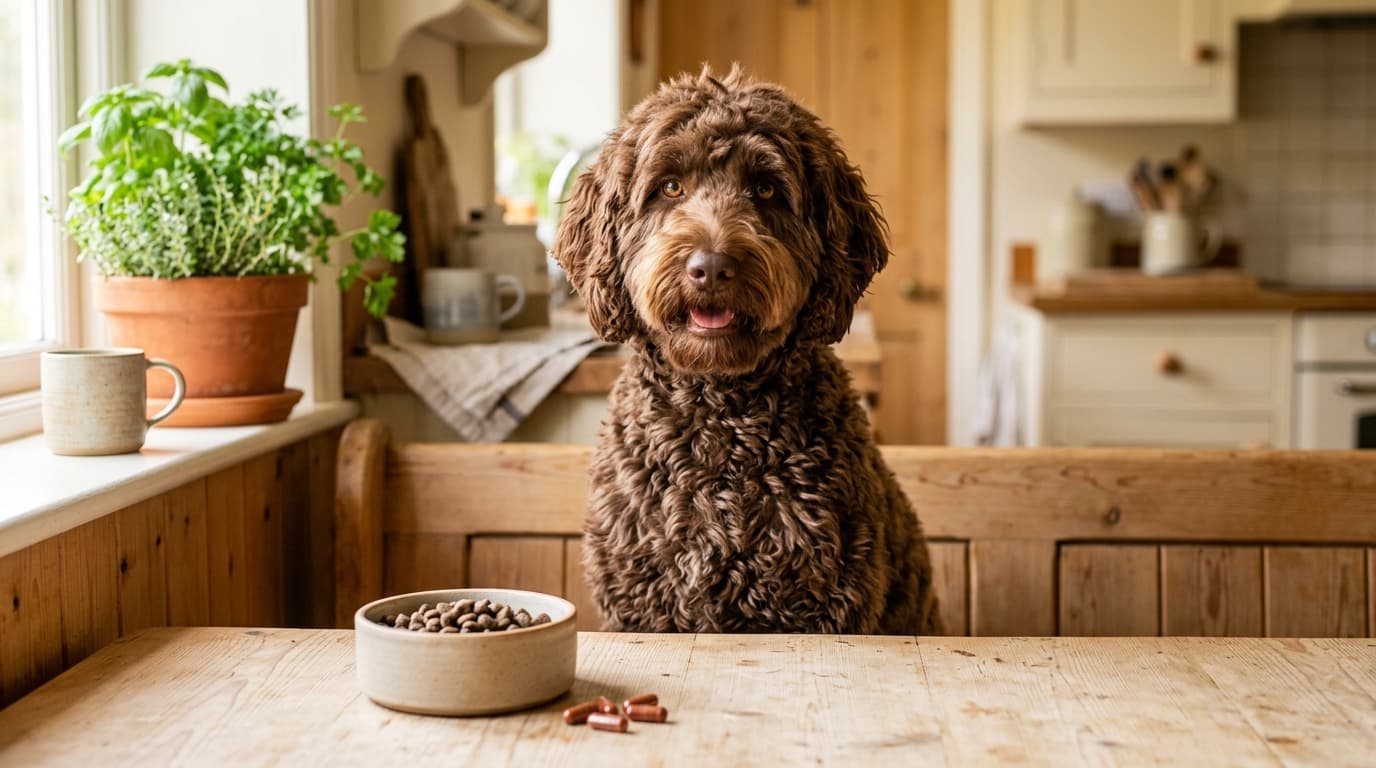
The best digestive enzyme supplement for most doodles is a broad-spectrum blend containing amylase, protease, lipase, and cellulase, ideally paired with probiotics. Enzymes help doodles with soft stool, gas, or undigested food in their poop by breaking food down more completely. Most quality options cost $20, $40 for a one to three month supply. If symptoms are severe or persistent, see your vet before reaching for a supplement.
If you're here, your doodle is probably leaving soft or shiny stool, passing a lot of gas, or dropping poop with visible chunks of food in it. Those are the everyday signs owners search for. How prone your dog is to them varies between individual dogs at least as much as between crosses, a Goldendoodle, an Australian Labradoodle, a Labradoodle, and a Bernedoodle are different mixes, and the poodle line in all of them carries a real, documented predisposition to allergic skin disease and food sensitivities that some dogs inherit and some don't.
Our pick right now: Prozyme Plus Powder. It's a concentrated, unflavored enzyme powder with all four core enzymes that mixes into food. This list used to be longer: we removed the enzyme chews and powders whose flavoring contains chicken or whose "natural flavor" source the maker doesn't disclose, because that doesn't fit a chicken-free plan. Below is the full breed-tailored buying guide: what enzymes do, when your doodle genuinely needs them (versus probiotics), the label details that matter, and a head-to-head comparison with honest picks by use case.
If you already know you need an enzyme supplement and just want the shortlist, jump to the head-to-head comparison below.
Quick note on how to read this guide: I feed our three doodles, Sven, Gunnar, and Gösta, raw at home, with premium kibble and freeze-dried raw on the road, so the routine and dosing advice comes from our kitchen. The product picks below are research-based, built from published labels, format, and price-per-dose math rather than a claim that every product here has passed through our own dogs. I've kept those two things clearly separate throughout.
What digestive enzymes actually do
Digestive enzymes are proteins that break food down into pieces small enough for the gut to absorb. Your doodle's pancreas and small intestine already make these, but supplements add extra to help digestion go more completely, which is where firmer stool and less gas come from.
The four that matter:
- Amylase, breaks down starches and carbohydrates (relevant for kibble-fed dogs)
- Protease, breaks down protein
- Lipase, breaks down fats (helps with greasy, shiny stool)
- Cellulase, breaks down plant fiber and cell walls (dogs don't make this on their own)
A good broad-spectrum blend includes all four. Many also add probiotics, which do a completely different job, more on that below.
Do doodles actually need digestive enzymes?
Honestly? Most healthy doodles make enough enzymes on their own and don't strictly need a supplement. But there are real situations where they help:
- Sensitive stomachs, how sensitive a given dog is varies from individual to individual; if your dog reacts to small diet changes, enzymes can smooth things out
- Chronic soft stool or lots of gas despite a decent diet
- Undigested food in the stool (visible kibble, veggie chunks)
- Food transitions, switching proteins or formats often causes a few rough days
- Senior doodles, whose enzyme production naturally declines
- EPI (exocrine pancreatic insufficiency), a genuine medical condition where the pancreas doesn't make enough enzymes
For the everyday sensitive doodle, an over-the-counter enzyme blend is a reasonable, low-risk thing to try. If you're not sure your dog's symptoms are minor, read our guide to the signs your doodle has a sensitive stomach first.
Best digestive enzymes for doodles: head-to-head comparison
These are widely available US options chosen for broad-spectrum coverage, doodle-friendly formats, and value. Enzyme and CFU figures below reflect the type of blend each product uses; exact potency numbers vary by formulation and lot, so always check the tub in front of you. Prices shift too, so treat the per-dose math as a rough snapshot at typical retail.
| Product | Format | Key enzymes | Probiotic | Approx. price per dose | Size options | Best for |
|---|---|---|---|---|---|---|
| Prozyme Plus Powder | Powder | Lipase, protease, amylase, cellulase (high activity per gram) | Probiotic blend (check the tub) | ~$0.40/serving | 200 g & 454 g | Seniors and poor nutrient absorption |
On tub sizes. Enzyme powders and chews are dosed by body weight, so the same tub lasts a mini doodle months and a standard one weeks. Price per dose matters more than the number on the label, which makes it worth comparing sizes and current prices before you re-order.
Prozyme Plus Powder
A long-standing enzyme powder known for high enzyme activity per gram, often chosen for dogs with absorption issues and older dogs whose enzyme output has dropped. The formula carries lipase, protease, amylase, and cellulase with concentrated activity, plus a probiotic blend (check the tub you buy). It's sold in 200 g and 454 g sizes; at roughly $0.40 per serving it's the most expensive per dose here, which reflects the concentration.
Cons: (1) the tiny per-meal scoops are easy to over- or under-measure without a gram scale, so dosing is fussier than the others; (2) the probiotic content isn't fixed the way a single named strain would be, making it harder to know exactly what you're giving day to day.
Best for: senior doodles or dogs your vet has flagged for poor nutrient absorption who need the strongest enzyme activity per scoop, not a substitute for prescription EPI treatment.
Enzymes vs probiotics: which does your doodle need?
This trips a lot of owners up. Here's the short version:
- Enzymes act on the meal in front of them, breaking food down at digestion. Effects show up fast.
- Probiotics are live beneficial bacteria that build up the gut microbiome over weeks. Slower, but foundational.
They're not competitors, they're teammates. Many sensitive doodles do best with both, which is why so many products combine them. If you want to go deeper on the bacteria side, we cover it in our best probiotics for doodles with digestive issues guide and our overview of prebiotics vs probiotics for doodles. For the general concept, our digestive enzymes for doodles explainer walks through the basics.
What to look for in a digestive enzyme supplement
Before comparing products, here's the checklist I use when I read a label:
- All four core enzymes (amylase, protease, lipase, cellulase), ideally with listed potency (FCC units)
- A named probiotic strain and a CFU count, "probiotics" with no strain or count on the label tells you little
- A powder for easy mixing into food, powders coat the meal better than pills for our doodles
- Weight-based dosing so you can dial it to your dog's size
- Short, clean ingredient list, important for allergy-prone doodles; watch for chicken or common fillers
- US-made with clear labeling and a batch/lot number
Honest picks by use case
Raw feeders: Prioritize a blend with strong lipase for the higher fat content, plus probiotics. A plain powder mixes right into raw. If you're mid-transition to raw, enzymes plus a slow schedule help, see our raw transition plan for doodles.
Kibble-fed doodles: Amylase matters more with starchy kibble. A powder like Prozyme mixes into lightly dampened kibble; if your dog refuses powder, read any chew's flavoring line carefully before buying.
Seniors: Enzyme output declines with age, so a potent powder like Prozyme can help with absorption. Pair with a joint and gut routine.
Suspected EPI: Stop shopping and call your vet. This needs diagnosis and prescription enzymes, full stop.
During a food switch: An enzyme powder plus a separate probiotic (see our probiotic picks) covers you while the gut adjusts. Pair with our 7-day food transition plan.
How to dose and introduce enzymes
Follow the product's weight-based instructions, but ease in:
- Days 1-3: roughly half the recommended dose, mixed into food
- Day 4 onward: work up to the full dose if stool looks good
- Give with every meal, enzymes act on the food that's present, so consistency matters
- Mix into wet or raw food so it coats evenly; for dry kibble, add a splash of water or bone broth
When we added an enzyme powder for Gunnar during a protein switch, we split it across both his meals and started low. His stool firmed up over the following week, and the gas that had been clearing the room settled down first. Nothing dramatic, just a steadier baseline. (For the record, that was a generic powder from our shelf, the four picks above are the ones I'd research and buy next, not products I'm claiming we've run head-to-head.)
When enzymes aren't the answer (see your vet)
Digestive enzymes are a tool for minor, chronic digestive sluggishness. They are not a fix for:
- Sudden, severe, or bloody diarrhea
- Repeated vomiting, see when to take your doodle to the vet for vomiting
- Weight loss with a big appetite (possible EPI)
- A food allergy or intolerance, that's a diet problem, covered in our food allergies in doodles complete guide
A quick word for Bernedoodle owners specifically: the Bernese Mountain Dog and Standard Poodle sides both bring a large, deep-chested build, and a big deep-chested body carries genuine bloat/GDV risk. Bloat is a sudden emergency, a distended, hard abdomen, unproductive retching, restlessness, and it is a straight-to-the-vet situation, not something any supplement addresses. The American Veterinary Medical Association makes the same point about GDV being a life-threatening emergency requiring immediate care.
If your doodle is otherwise bright and just has soft stool, our guide on doodle soft stool but acting normal helps you decide how worried to be. And if it's diarrhea, our how long does doodle diarrhea last timeline tells you when to stop waiting and call.
Enzymes as part of a bigger gut routine
Enzymes work best inside a consistent routine, the right food, probiotics, and steady feeding habits. If you'd rather bundle it all, we lay out a full plan in gut health routine for sensitive doodles. Two of the most common overlooked culprits, by the way, are simple ones: overfeeding and stress. See overfeeding and stomach issues in doodles and stress and digestive problems in doodles. For a wider view of food, supplements, and tools that work well for dogs with digestive, allergy, and skin issues, our Best Products for Sensitive Doodles: Food, Supplements & Tools roundup is a good next stop.
FAQ
Most healthy doodles produce enough of their own enzymes and don't strictly need a supplement. But doodles with sensitive stomachs, chronic soft stool, lots of gas, or visibly undigested food in their poop often benefit from a broad-spectrum enzyme blend, especially during food transitions or as they get older. Dogs with a diagnosed condition like EPI (exocrine pancreatic insufficiency) truly require prescription-strength enzymes and must be managed by a vet.
Digestive enzymes break down food into absorbable nutrients (protein, fat, carbs, fiber), while probiotics are live beneficial bacteria that support the gut microbiome. Enzymes work at the moment of digestion; probiotics build gut health over weeks. They do different jobs and work well together, which is why many supplements combine them. For sensitive doodles, pairing both often gives better results than either alone.
Yes, most digestive enzyme supplements are designed to be given with every meal since enzymes act on the food in front of them. Follow the product's weight-based dosing and mix the powder directly into food so it's evenly coated. Start with half the dose for a few days to let your doodle's system adjust, then work up to the full amount.
Look for the four core enzymes: amylase (breaks down starches and carbs), protease (breaks down protein), lipase (breaks down fats), and cellulase (breaks down plant fiber). A blend with all four covers most diets. If your doodle struggles with fatty meals or greasy stool, extra lipase helps; if you feed a lot of veggies or plant matter, cellulase matters more.
Because enzymes act on the current meal, you may notice firmer stool and less gas within a few days. Full improvement in stool consistency and less undigested food usually shows within one to two weeks. If you see no change after three to four weeks of consistent use, the underlying issue may be something enzymes can't fix, and it's worth talking to your vet.
The next step
If your doodle's main problem is soft stool, gas, or undigested food and they're otherwise happy, a broad-spectrum enzyme powder is a sensible, low-risk thing to try, start low, watch the poop, and pair it with probiotics for the best shot at a steady gut. For most doodles I'd start with the best-overall NaturVet powder for its clean formula and lowest per-dose cost; if symptoms are severe or you suspect a bigger issue, your vet comes first.
Ready to build the full picture? Read best probiotics for doodles with digestive issues next to complete your doodle's digestive routine.