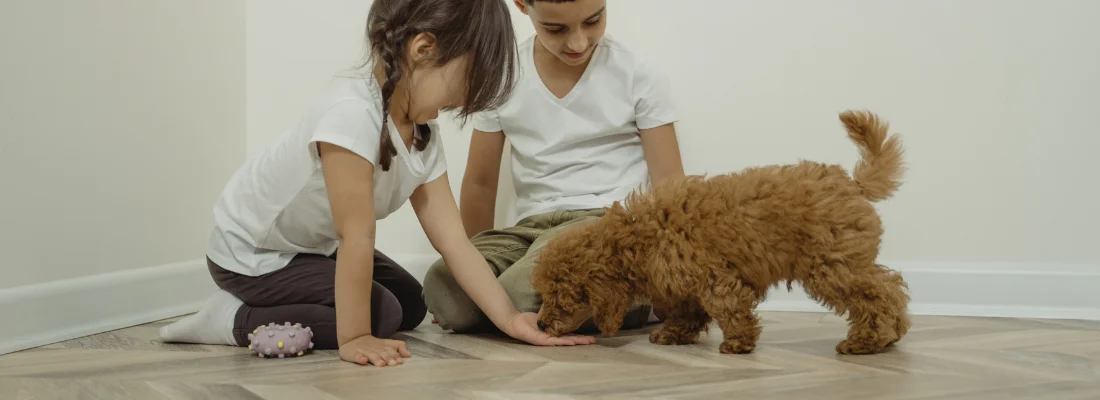
A common message we get from doodle owners considering raw: "We have small kids — is raw safe for our household, or do we have to wait until they're older?"
Good news: raw feeding and kids mix just fine. We've done it the whole time. You add a couple of common-sense habits — the same ones you'd use handling raw chicken with a toddler underfoot — and ease off a little during the baby year. That's really the whole story.
The simple version: the meat itself isn't the issue, the kitchen is. So you keep raw-meat prep and little hands apart, wash up the way you already do after handling any raw meat, and you're set. Younger kids and babies get a touch more care (their systems are still developing and little hands end up in mouths a lot) — so below we walk through what changes at each age, and it's less than you'd think.
What this guide covers. This is one of the guides in our Raw Food Safety series, focused specifically on how to scale the protocol up for households with children. For the broader playbook, see the main Raw Food Safety guide. For the cold-chain details (freezing, thawing), see Freezing and Thawing Raw Dog Food.
The two things to keep an eye on
There are really just two ways bacteria from raw food could reach a child — and both are easy to head off once you know them.
Direct contact: Child touches raw meat, surface contaminated by raw meat, or the dog's mouth/face right after a meal. From there, hand-to-mouth, hand-to-eye, hand-to-toy.
Cross-contact: Bacteria from raw meat ends up on a kitchen surface, utensil, or floor that the child later touches. The original raw meat is long gone; the bacterial residue isn't.
The habits below cover both — without turning your kitchen into a lab or making mealtime stressful.
Age-by-Age: How the Protocol Scales
The risk profile changes substantially across age windows. The protocol changes with it.
Infants (under 1 year)
The highest-stakes age. Infant immune systems aren't fully developed, gut microbiome is still establishing, and infants under 6 months especially shouldn't have any unnecessary bacterial exposure.
Our recommendation for households with infants under 1 year:
- Strongly consider switching to freeze-dried raw for the duration of the infant's first year. Freeze-dried raw is far easier to handle hygienically: it is shelf-stable, there is no thawing step and no meat juice on the counter. Be clear on what it is not — freeze-drying is not a reliable kill step, so the same handwashing and surface rules still apply. See our freeze-dried transition guide for the protocol.
- If staying on fresh raw, the parent who's not primarily responsible for infant care should manage the raw-feeding logistics, with strict separation between raw-meat handling and infant care.
- Don't allow the dog to lick the infant's face for at least 60 minutes after a raw meal — and consider a rule of "never, while the infant is under 1."
The infant's first year is short. The freeze-dried tier gets you most of the way to fresh raw's benefits with substantially less household risk. For our values-aligned recommendation: switch tiers for that year, switch back when the kid hits walking age.
Crawling-age (roughly 9-18 months)
Crawling-age children spend hours a day on the floor — hands on tile, in the carpet, in transition zones — and put their hands in their mouths nonstop. The feeding-area floor is the single biggest risk surface.
Crawling-age protocol:
- Feed the dog only when the child is not on the floor in the feeding area. Most households can sequence this around naps, high-chair meals, or playpen time. The dog eats while the child is contained or asleep; bowls are picked up before the child is back on the floor.
- Wipe the feeding area thoroughly after every meal. This is the one age range where "wipe the floor under the bowl" is non-negotiable, even if no spill is visible. Microscopic meat juice on tile is enough.
- Hand-wash the dog's mouth and beard area with a damp cloth after the meal. Doodles' coats trap residue. A 30-second wipe-down after the meal removes the bulk of it.
- Strict 60-minute rule between raw meals and dog-child face contact. No licking faces, no shared toys (the dog drops a slimy ball, the kid picks it up), no co-snuggling on the floor.
This is the age range where the protocol genuinely costs effort. It eases substantially after the child is walking.
Walking-age (roughly 18 months - 3 years)
Hands still go in mouths, but less constantly. The child is interactive; you can teach behaviour. Floor exposure drops because they're standing more.
Walking-age protocol:
- Continue separating dog-meal time from child-floor time when possible, but it doesn't have to be airtight.
- Teach the child not to touch the dog's bowl or food. They'll listen at this age.
- Hand-wash the child after any direct contact with the dog around mealtime — same routine as for adults.
- The 60-minute face-contact rule still applies but can be relaxed to 30 minutes once the dog has had a thorough beard wipe.
School-age (3-7 years)
Children at this age can understand and follow rules. The protocol shifts from physical separation to behavioural rules.
School-age protocol:
- Teach the child the household rules: don't touch the dog's food, wash hands after petting around mealtime, don't kiss the dog's mouth, don't share food with the dog.
- Children can help with kibble-only feeding (water bowls, dry treats) but never with raw meat handling.
- Standard household hand-washing rules apply — same as for adults.
Older kids (7+)
By this age, kids generally understand the why and can manage their own protocol. They can help with weekly tasks (washing bowls in the dishwasher, restocking dry items) but raw meat handling is still adults-only until the child is old enough to demonstrate consistent hand-washing discipline. Most families set this around age 12-13.
Protocol by child age
| Child's age | Main risk | What changes |
|---|---|---|
| Under 1 year | Immature immune system, floor contact | Consider freeze-dried raw for the year; no face contact after meals |
| 9–18 months (crawling) | Hands and mouth on the floor | Feed only when the child is not on the floor; wipe the area after every meal |
| 2–5 years | Wants to help, poor hand hygiene | Child may carry the sealed bag, never the raw meat; supervised hand-washing |
| 6+ years | Generally low | Can help with prep under supervision; same hand-washing rule as an adult |
The Kissing Rule
The single most-asked question from raw-feeding households with kids: "Is it okay if my dog kisses my child?"
The honest answer: usually fine, with timing.
- Right after a raw meal (first 60 minutes): No face contact. Don't allow the dog to lick the child's face, hands, or any exposed skin. The dog's mouth and beard carry residual meat for at least 30-45 minutes after eating; the floor of the dog's mouth carries bacteria for longer.
- An hour or more after a raw meal: Normal face contact is acceptable for adults and walking-age-and-up children. The dog has swallowed and groomed, so surface contamination around the mouth has dropped a great deal — not to a measured zero, but far below what it is straight after a meal. Infant face contact remains a separate, higher-bar question (we err conservative here).
- Routine cuddling at any time: Fine. Petting, snuggling, body-to-body contact is not the risk vector — face-to-mouth is.
We've kept this rule with our three Australian Labradoodles for years and have not had a single illness incident in a child or adult.
The Feeding Area: Designed for Households with Kids
A raw-feeding household with kids needs a more deliberate feeding area than one without.
Where the dog eats:
- Easy-to-clean flooring (tile, sealed concrete). Not carpet, not rugs, not upholstered.
- Out of high-traffic family routes. Not in the central kitchen.
- Visible from the food prep area so you can monitor without hovering.
- Geographically separate from where the child plays.
A practical setup: Mudroom, corner of a tile-floored kitchen, dedicated alcove. Some households use a baby gate to keep crawling-age kids out of the feeding area entirely during dog meals.
The feeding mat: Optional but useful. A waterproof, wipeable feeding mat under the dog's bowl catches any spillage and turns the post-meal floor wipe into a one-step wipe of the mat itself. We use a silicone mat that's dishwasher-safe; weekly run through the dishwasher resets it completely.
Hand Hygiene: The Habit That Has to Stick
Hand-washing is the single biggest control on cross-contact, and it's the habit that erodes fastest under daily pressure. Three things that help.
1. Soap within arm's reach of every raw-meat handling station. The kitchen sink is obvious; the laundry sink (if that's where bowl washing happens) is less so. A bottle of soap visible at every station eliminates the 5-second walk-across-the-kitchen friction that erodes compliance.
2. A dedicated hand towel for after-raw-meat handwashing. Different towel from the family hand towel. We use a separate towel that lives by the kitchen sink and gets washed with the dog bedding, not the family laundry. Color-coded if helpful.
3. The "before touching anything" rule, taught to everyone. Adults and older kids alike: before touching face, phone, fridge handle, child, or any surface that doesn't get cleaned daily — wash hands. The pattern transfers easily to children once it's normalised.
What Kids Can Do, What They Can't
Helpful breakdown of age-appropriate involvement.
Under 3: No raw-meat handling, no contact with the dog's bowl, no floor play during dog meals. Adults manage everything.
3-7: Can fill the dog's water bowl. Can give pre-prepared kibble or freeze-dried treats from a sealed container. Can pet the dog away from mealtime. Cannot touch raw meat or surfaces that recently held raw meat.
7-12: Above plus: can wash already-cleaned bowls in the dishwasher, can help with weekly inventory (kibble bag levels, treat supply), can sweep the feeding area floor at the weekly clean.
12+: Above plus: can portion freeze-dried with adult supervision, can manage the evening fridge-thaw if taught the protocol. Raw meat handling starts to be okay around this age, with parental judgement on individual readiness.
Pregnancy: A Separate, Tighter Protocol
A specific subcase. Pregnant household members face additional risk from Toxoplasma gondii and Listeria monocytogenes, both of which can cross the placenta.
Pregnancy protocol:
- Pregnant household members shouldn't handle raw meat directly during pregnancy. Have someone else manage the raw feeding for the duration.
- Switch the dogs to freeze-dried for the duration of the pregnancy if no other adult is available to manage fresh raw. Freeze-dried significantly reduces Toxoplasma and Listeria exposure paths.
- Same kissing-rule discipline applies, with a wider buffer (90 minutes post-meal rather than 60).
- After birth, see the infant section above.
This isn't a "give up raw feeding" call. It's a "redistribute who handles the meat" call for a defined window.
Immunocompromised Family Members
Adults or children with compromised immune systems (active chemotherapy, organ transplant recipients, autoimmune conditions on immunosuppressants, etc.) face the same elevated risk as infants. The protocol is the same:
- The immunocompromised person should not handle raw meat.
- Strict hand hygiene from anyone interacting with both the dog and the immunocompromised person.
- Consider switching to freeze-dried for the duration of the immunocompromised state.
- Discuss the household raw-feeding situation with the person's medical team — most will not flag it as a problem if hygiene is strict, but informed consent matters.
What to Do If a Child Gets Sick
Foodborne illness symptoms in a child within 6-72 hours of any raw-meat exposure are worth taking seriously.
Symptoms to watch for: Vomiting, diarrhea, fever, abdominal pain, lethargy.
What to do:
- Standard pediatric care. Hydration, fever management, contact the child's doctor if symptoms are severe or last more than 24 hours.
- Tell the doctor that you handle raw pet food. This affects the differential diagnosis. Stool cultures for Salmonella, E. coli, and Campylobacter become a priority test.
- Audit the household for the failure mode. Was a surface cross-contaminated? Did the dog lick the child's face within an hour of a raw meal? Did the child crawl on the feeding-area floor during a meal? Was hand-washing skipped at a key moment? Identify the gap.
- After recovery, tighten the protocol that failed. The point isn't to abandon raw feeding — it's to fix the specific gap. Pediatric foodborne illness is rarely from raw pet feeding specifically (kids get foodborne illness from many sources; raw pet food is one of dozens), but treat the diagnosis as actionable feedback.
In years of feeding three doodles raw with kids visiting our household frequently, we've not had a single linked illness incident. The protocol works when it's followed.
Frequently Asked Questions
Safe with caveats. Infants under 1 year are the highest-risk window — their immune systems aren't fully developed and their gut flora is still establishing. Many households with infants choose to switch to freeze-dried raw for the first year (no thawing, no meat juice, far easier to handle hygienically) and switch back to fresh raw when the child reaches walking age. If staying on fresh raw, the parent not primarily responsible for infant care should handle the raw-meat logistics, and the dog should not lick the infant's face at any point.
Yes — with timing. Outside the 60-minute window after a raw meal, normal face contact is fine. Within the first hour after a raw meal, no face-to-mouth contact. The dog's mouth and beard carry residual meat for 30-45 minutes after eating, and bacterial loads return to baseline after about an hour.
Switch to freeze-dried raw rather than stopping entirely. Freeze-dried retains most of the nutritional benefits of fresh raw with significantly lower household bacterial-handling burden. It's a better fit for the higher-risk infant window. Switch back to fresh raw when the child is walking and capable of basic hand-washing.
Children under about 12 should not handle raw meat directly. Older kids (12+) can be brought into raw-meat handling with adult supervision and once they've demonstrated consistent hand-washing discipline. Younger children (3-12) can help with kibble bowls, water bowls, and weekly bowl-washing tasks where the meat exposure is already cleaned up.
Not the same risk window as face-to-mouth. Hand licking is normal dog social behaviour; the protocol is to wash the child's hands afterward, especially if it happened within the post-meal window. The 60-minute rule applies to face contact specifically because face-to-mouth gives bacteria a direct path to mucous membranes; hand licking is mediated by hand-washing in between.
The Bottom Line
Raw feeding is compatible with households that have children. The protocol scales up — more deliberate feeding-area design, stricter hand-washing routine, the 60-minute kissing rule, age-specific separation between dog meals and child floor-time. Infants and immunocompromised family members are the highest-stakes window, where switching to freeze-dried raw is often the cleaner choice.
The two patterns we'd flag as most-skipped: hand-washing between handling raw meat and child contact, and the post-meal kissing rule. Get those two consistently right and the rest of the protocol is small adjustments to the main Raw Food Safety playbook.
For the everyday rhythm that ties all of this together, see The 5-Minute Daily Kitchen Routine. For the cold-chain detail, see Freezing and Thawing Raw Dog Food.