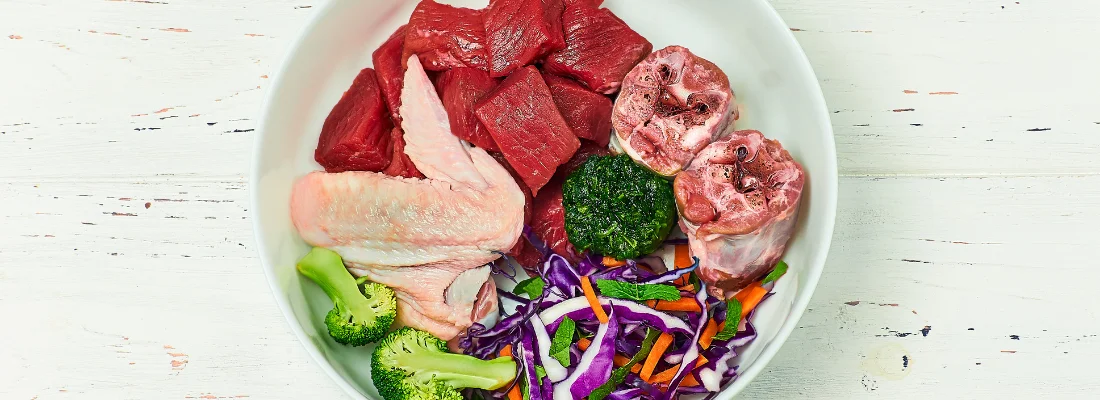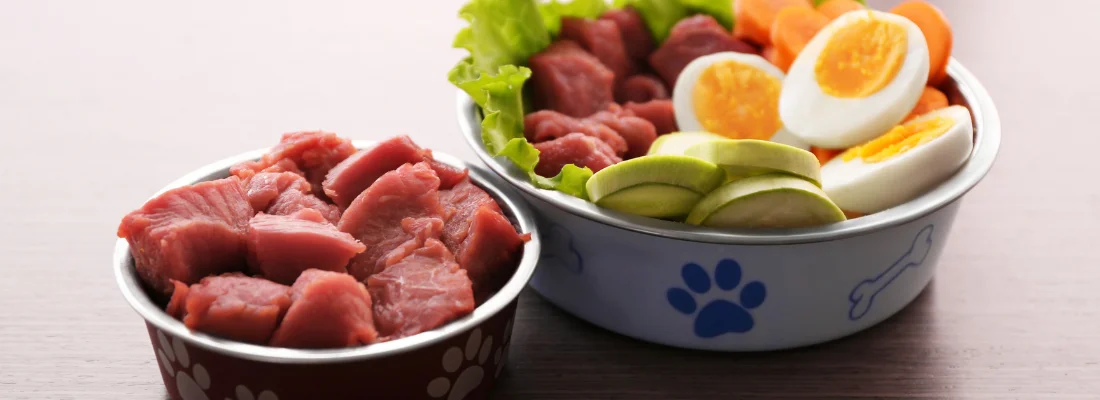
Bad sourcing is the single biggest reason raw-feeding goes wrong. Not bad protocol, not bad timing, not the wrong protein — sourcing. A perfect kitchen routine on cheap, badly stored meat is still going to land you in trouble. A modest kitchen routine on properly sourced meat is fine.
This is the guide on what "properly sourced" actually means.
What this guide covers. This is part of our Raw Food Safety series — the guide focused on the upstream end of the protocol, where the meat comes from before it ever reaches your kitchen. If you're starting raw feeding, read the main safety guide first for the full overview. If you've already started and want to upgrade your sourcing routine, this is the deep-dive.
In a hurry? If you want sourcing solved without building a supplier list, a vetted subscription box like We Feed Raw's Classic Box does the sourcing for you. The rest of this guide is how to judge any supplier yourself.
Why Sourcing Matters More Than Any Other Variable
In a layered safety protocol, no single layer is sufficient on its own. Sourcing, freezing, thawing, hygiene, and feeding all matter. But sourcing is the only layer where mistakes can't be corrected by anything that comes after.
You can rescue a bad freezing routine with stricter thawing rules. You can rescue a thawing mistake by tightening kitchen hygiene. You cannot rescue meat that was contaminated, mishandled, or stored badly before you bought it. By the time it's in your kitchen, the bacterial load is what it is, and your job becomes managing the consequences instead of preventing them.
This is why we treat the supplier choice as the most consequential decision in raw feeding. Get this right and the rest of the protocol becomes much more forgiving. Get it wrong and even the strictest kitchen rules are working against the wrong baseline.
The Six Things to Look For in a Raw Meat Supplier
Before any specific brand or shop, the questions you ask are the same. A supplier should be able to answer all six clearly. If they can't or won't, that's information.
1. Where does the meat come from? A specific answer. "Local farms" is too vague. "Sourced from grass-fed cattle ranches in Wisconsin and Minnesota, USDA-inspected" is the kind of answer you want. The supplier should know — and tell you — the country, the production type (factory vs. pasture-raised), and the inspection standard.
2. How is it processed for raw pet feeding? A reputable supplier separates raw pet food production from anything intended for human consumption, with dedicated equipment or strict cleaning protocols. They should be able to describe the process. "It's just regular meat" is the wrong answer; meat for raw pet feeding has different handling requirements than meat for cooking.
3. What's the freezing protocol? Freezing at -18 °C / 0 °F or lower for at least three days kills nearly all parasites relevant to pet feeding. A good supplier freezes immediately after processing, holds at the correct temperature, and ships in insulated packaging to maintain the cold chain. Ask: "What temperature is your freezer? How quickly is fresh meat frozen after processing?"
4. Is there pathogen testing? Larger commercial brands test for salmonella, listeria, and E. coli routinely. Smaller suppliers may not have an in-house testing program but should source from processors that do. The right answer is some version of "yes, here's our testing schedule" or "yes, our processor's protocol is X." The wrong answer is "we don't test" or evasive non-answers.
5. What's the inventory turnover? Frozen meat sitting in a freezer for a year is lower quality than meat moving through regularly. A supplier with steady throughput is freezing meat that was processed recently. A supplier with slow turnover may be feeding you long-frozen meat without saying so. "How long does meat typically stay in your freezer before it ships?" is a fair question; reputable suppliers answer it without hesitation.
6. How is the cold chain maintained? From their freezer to yours, the meat should never thaw. For local pickup, the supplier should hand it off frozen and stored in insulated packaging. For shipping, expect dry ice or gel packs designed to keep the package below freezing for 24–48 hours. If the box arrives partially thawed, the supplier should make it right — and you should question whether to use the rest of that order.
A supplier who can answer all six confidently is the kind worth building a long relationship with. One who deflects or sounds annoyed by the questions isn't.
Top Picks: Brands and Tools That Make Sourcing Easier
The right tier depends on your stage. New raw feeders should start with commercial premade. Experienced raw feeders often combine commercial brands for travel and convenience with co-op or butcher meat for daily feeding. The picks below cover both ends.
Budget for the kit, not just the meat. Good sourcing is wasted if the cold chain fails at home, and a sealer and a freezer thermometer cost a fraction of a month's meat. If you're setting up, price the storage kit alongside the food rather than adding it later.
The brand mix above is intentional. We Feed Raw represents the subscription tier for households without freezer-bulk capacity; Northwest Naturals the mid-market regional retail tier; Stella & Chewy's the most-available mainstream option. The two tools — vacuum sealer and freezer thermometer — handle the post-sourcing layer where many owners cut corners.
Three Sourcing Channels (and When Each Is Right)
There are three main ways to source raw meat for a doodle. Each has its place. Most experienced raw-feeders eventually use a mix.
Commercial Premade Brands
The safest starting point and the right choice for owners new to raw feeding, owners with vulnerable household members, or owners who want predictability over price.
Pros:
- Strictest testing protocols of any sourcing channel
- Standardized freezing and cold-chain handling
- Clear nutritional formulation (complete and balanced)
- Pre-portioned or easy-to-portion formats
- Available nationwide (US) through pet specialty retailers, online, or shipped direct
- Most predictable quality across batches
Cons:
- Highest cost per pound — often $5–9 per pound
- Less protein variety than direct sourcing
- Generic ratios that may not be optimal for every doodle
- Some brands rely heavily on muscle meat with limited bone and organ variety
When it's right:
- First three to six months of raw feeding
- Multi-pet households where standardization matters
- Households with infants, elderly, or immunocompromised members
- Owners who travel frequently and need shippable meals
- Owners who don't have the freezer space for bulk butcher purchases
Raw-Feeding Co-Ops
A co-op is a group of raw-feeders who pool orders to buy direct from processors at near-wholesale prices. The middle tier between commercial premade and direct butcher sourcing.
Pros:
- Lower cost than commercial premade — typically $3–6 per pound
- More protein variety (specialty cuts, novel proteins, exotic meats)
- Direct relationship with the processor
- Often higher-quality meat than retail commercial brands
- Community accountability — co-op members share quality reports
Cons:
- Variable quality control depending on the co-op's standards
- Bulk orders only — you need freezer space to absorb a 40 lb minimum
- Limited geographic coverage — many areas don't have an active co-op
- Self-portioning required (vacuum sealing, repackaging)
- More research required before committing
How to vet a co-op:
- Ask about their testing protocols and the processors they use
- Ask members directly about their experience with quality and consistency
- Look for co-ops that openly publish their sourcing standards
- Avoid co-ops that pressure you to buy without answering basic safety questions
When it's right:
- Six-plus months of raw feeding experience
- Adequate freezer space (chest freezer or large standing freezer)
- Willingness to handle and portion bulk meat
- Cost-sensitivity over convenience
Local Butchers and Farms
The deepest tier — direct relationships with butchers or farms who handle raw pet feeding either as a specialty or as part of their broader business.
Pros:
- Lowest cost per pound — sometimes $2–4 per pound for muscle meat
- Highest meat quality if the butcher is reputable
- Specialty cuts (organ meat, raw meaty bones) often available
- Personal relationship — quality issues can be addressed directly
- Most flexibility on protein, cut, and quantity
Cons:
- No standardized testing — you rely entirely on the butcher's reputation
- Quality varies dramatically by butcher
- Requires regular trips and careful cold-chain management
- Often the highest learning curve
- Risk of sourcing from a butcher who doesn't actually understand pet feeding requirements
How to vet a butcher:
- Visit the shop. Look at how they store and handle meat. Cleanliness matters.
- Ask if they handle raw pet feeding specifically and how they separate it from human-grade processing.
- Ask about their freezing standards and how long meat stays in their freezer.
- Start with a small order and observe quality before committing to bulk.
When it's right:
- Year-plus of raw feeding experience
- Established relationships in the local food community
- Strong understanding of what good meat looks and smells like
- Willingness to manage the safety protocol entirely on your own
For our household in Finland, this is the channel we use — direct from a wholesaler that specialises in raw pet feeding. Our three Australian Labradoodles rotate across horse, lamb, pork, venison, and turkey, all delivered pre-portioned in ready-to-freeze packaging that goes straight from the box into the freezer. Everything is produced under strict EU food-safety regulations even when sold for pet feeding. The relationship took months to build and several rounds of trial purchases before we settled into a reliable supply.
The three sourcing channels compared
| Channel | Strengths | Weaknesses | Right when |
|---|---|---|---|
| Commercial premade | Testing protocols, batch tracking, standardised freezing | Highest price per pound | You are starting out, or the doodle has a sensitive history |
| Raw-feeding co-op | Much lower cost, bulk access | Variable standards; you must vet the group yourself | You have freezer space and time to check the supply chain |
| Local butcher | Fresh, transparent, supports a local supplier | No pet-food testing regime; freezing is on you | The butcher freezes properly and answers sourcing questions openly |
What to Avoid: Sourcing Red Flags
Some supplier behaviors are reliable signals to walk away. None of these are dealbreakers in isolation; together they're a pattern to take seriously.
- Vague sourcing answers. "Local farms" without specifics. "Sourced from a great supplier" without naming them. "We test for pathogens" without saying which ones or how often.
- Pressure to buy without answering questions. A supplier who treats safety questions as an annoyance is telling you something about their priorities.
- Suspiciously low prices. Raw meat below $2 per pound is almost always lower-quality scrap meat or has storage problems. The economics of clean raw meat at scale don't go below a certain threshold.
- No batch tracking. Reputable suppliers can tell you when a specific bag was processed and frozen. Suppliers who can't are guessing about their own inventory.
- Inconsistent quality across orders. First order looks great; second order has unidentified bone fragments, off-color meat, or thawing during delivery. One bad order can be an anomaly; two is a pattern.
- Cold-chain failures. Packages arriving partially thawed, ice packs already melted, or "minor thaw is normal." It isn't. Refuse the delivery if it arrived warm.
- Marketing that sounds like a vitamin commercial. Heavy use of "premium," "all-natural," "veterinarian-formulated" without specific information. Real raw suppliers talk about sourcing, processing, and freezing — not lifestyle imagery.
Pricing Reality Check
Cheap raw meat is rarely safe raw meat. The economics of producing clean, properly handled, properly frozen raw pet food don't work below certain thresholds.
In the US, expect roughly:
- $2–3 per pound: Almost always low-quality scrap meat, storage red flags, or both. Avoid.
- $3–5 per pound: Reasonable for raw-feeding co-ops or trusted local butchers. Quality varies — vet carefully.
- $5–7 per pound: Standard commercial premade range (Stella & Chewy's, Primal, Vital Essentials, Steve's Real Food). Reliable.
- $7–10 per pound: Premium commercial brands (Open Farm, Smallbatch) or specialty cuts. Often worth it for sensitive doodles or specific needs.
- $10+ per pound: Specialty proteins (rabbit, elk, organic novel proteins). Used as part of a rotation, not as the primary protein.
For a 25 kg / 55 lb doodle eating 2.5–3% of body weight per day, that's roughly 1.5 lb of meat per day, or about 45 lb per month. At $5/lb that's $225/month; at $7/lb it's $315. The math is real, and budgeting honestly is part of choosing the right tier.
If raw feeding is straining the budget, freeze-dried raw is the right next step — see our freeze-dried transition guide for the practical alternative that delivers most of the benefit without the bulk-meat economics.
Once You've Sourced: The Immediate Handoff
The moment meat arrives at your home is where sourcing hands off to the next layer of the safety protocol. Three rules for the first hour.
Get it cold immediately. Frozen meat goes into the freezer within two hours of arriving. Don't let it sit on the counter while you decide what to do with it. If you're buying bulk that needs portioning, do the portioning fast and refreeze.
Portion before freezing. If you bought a 20 lb pack, don't freeze it as one block. Split into daily-use portions in sealed bags before it freezes solid. Vacuum sealing extends storage life and prevents freezer burn — a FoodSaver or similar is a worthwhile investment for anyone buying in bulk.
Mark and date. Every bag gets the date of freezing and the protein. We use a kitchen marker on the bag itself; some owners use a label maker. The system doesn't matter. Knowing what's been in the freezer how long does.
For the full freezing and thawing protocol, see the Freezing and Thawing Raw Dog Food guide.
Frequently Asked Questions
On average, yes — but not always. Commercial premade brands have testing protocols, batch tracking, and standardized freezing that most butchers don't. A reputable raw-feeding butcher who freezes properly and sources transparently can be just as safe, sometimes safer. The risk isn't the channel; it's whether the specific supplier has the standards in place. The premade route has fewer ways to go wrong, which is why it's the right starting point for owners new to raw.
'Human-grade' means the meat passed inspection for human consumption. It's a quality marker, but it doesn't automatically mean the meat is processed in a human-grade facility for pet food — that's a separate certification. For most doodle owners, the more important question is whether the supplier freezes properly and tests for pathogens. Human-grade meat that thawed during transport is no safer than pet-grade meat that didn't.
It's possible but not ideal. Grocery store meat is fresh — meaning it hasn't been frozen long enough to kill parasites. Freezing it yourself for at least three days at -18 °C / 0 °F before feeding addresses parasite risk. Bacterial contamination, however, is a coin flip — grocery meat is intended for cooking, not raw consumption, and quality control reflects that. For routine feeding, dedicated raw-feeding suppliers are a better choice. Grocery meat is fine for occasional supplementation if frozen first.
In the US, expect $5–9 per pound for commercial premade raw, $3–6 per pound for raw-feeding co-op or butcher meat in bulk, and $7–12+ per pound for grass-fed or organic specialty meat. The cheapest options ($2–3 per pound) are almost always lower-quality scrap meat or have storage red flags. Budget at least $4 per pound minimum for sensitive doodle feeding — below that, you're often paying for problems later.
Rotating across two to three trusted suppliers is the safer long-term practice. It diversifies bacterial exposure (a stable microbiome benefits from variety), it protects you against one supplier having a bad batch, and it keeps you tuned to which proteins your doodle does well on across sources. We rotate naturally based on what's available; we don't optimize for variety as a goal in itself.
The Bottom Line
Sourcing is the upstream end of every raw-feeding decision. The best protocol in the world can't compensate for meat that arrived in your kitchen already compromised. The cheapest meat is rarely the right meat. The supplier who answers safety questions confidently is worth ten of the one who deflects.
Most doodle owners new to raw should start with a commercial premade brand for the first three to six months. After that, the option to expand into co-op or butcher sourcing opens up — but only with the freezer space, the time, and the standards in place to handle it.
Whatever channel you choose, the same six questions apply: where does the meat come from, how is it processed, what's the freezing protocol, is there pathogen testing, what's the inventory turnover, and how is the cold chain maintained. A supplier who can answer all six is the kind worth keeping.
For the broader safety protocol that depends on this layer — freezing, thawing, kitchen hygiene, feeding hygiene — see the main Raw Food Safety guide. For the practical alternative when bulk fresh raw isn't realistic, see our freeze-dried transition guide. For getting started with raw feeding from a kibble baseline, the kibble-to-raw transition plan is the playbook.
Get the sourcing right and the rest of raw feeding becomes much more forgiving. Get it wrong and you're managing problems instead of preventing them.