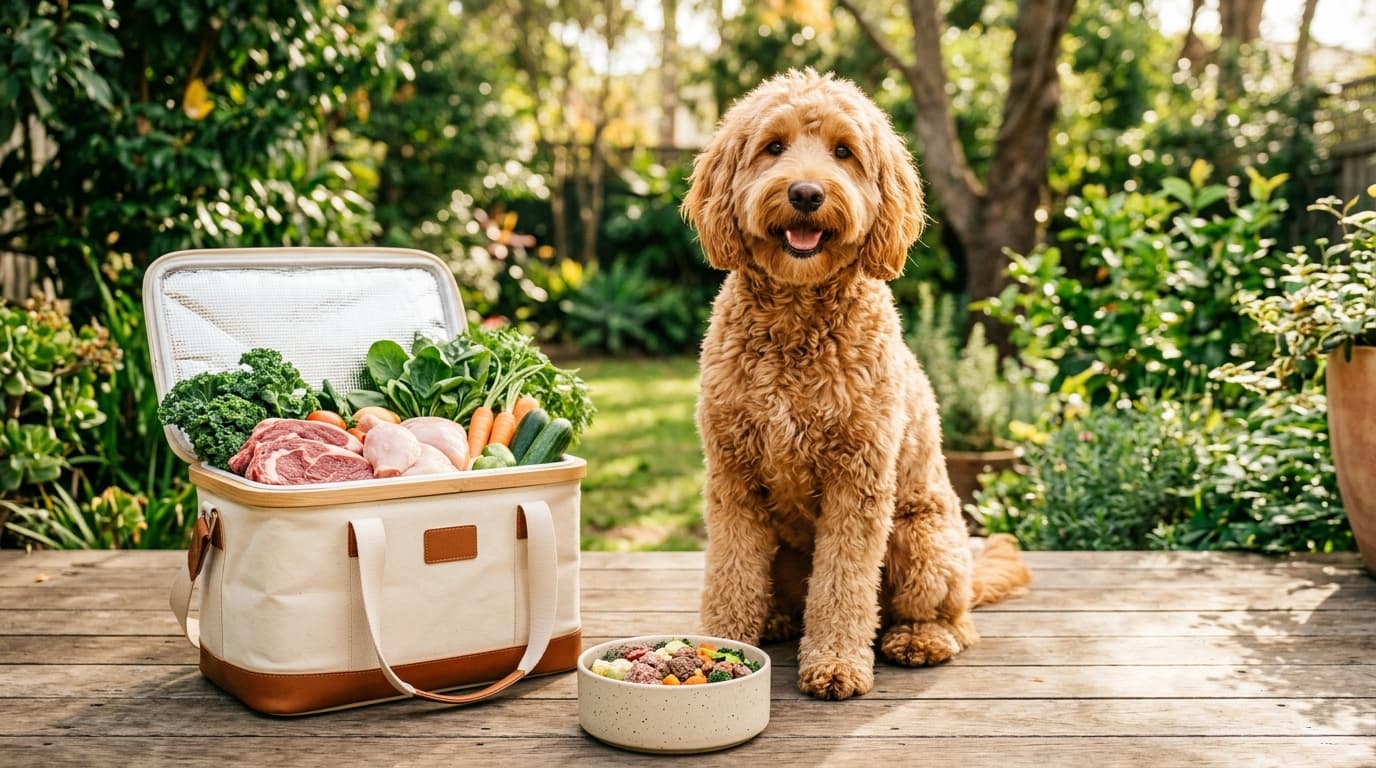
Most guides tell you what to look for in raw dog food. Fewer tell you where to actually go and buy it. This one is about the places: the independent pet store freezer, the big-box aisle, the courier box on your doorstep, the co-op pickup in a parking lot, the butcher's back room and the farm stand. Each one is good at something and bad at something else, and the right mix depends on your dog, your freezer and how long you have been feeding raw.
Once you have picked a place, the next step is judging the specific supplier. That is a different job, and we cover it in sourcing raw meat for dogs: the six things to look for. Read the two together: this guide gets you to the door, that one tells you whether to buy.
A note on where this comes from. We feed three Australian Labradoodles raw in the Nordic countryside, so the US shops and chains below are researched, not places we shop ourselves. Every retailer claim links to where we found it. What we can speak to from our own kitchen is the part that is the same everywhere: buying in bulk, freezer space, and portioning.
Where to Buy Raw Dog Food: The Quick Comparison
There are roughly eight places Americans buy raw. The first three sell finished food; the rest sell ingredients you turn into meals yourself.
| Source | What you get | Best for | Watch out for |
|---|---|---|---|
| Independent pet store | Complete frozen raw, often several brands | Starting out, trying proteins one bag at a time | Limited freezer space, uneven stock |
| Big-box chain or grocery | Mostly freeze-dried raw, some frozen | Topping up, travel food, convenience | Frozen range varies a lot by store |
| Online retailer (e.g. Chewy) | Frozen raw shipped in insulated boxes | No good local store, autoship | Delivery delays, someone home to unpack |
| Direct-to-consumer brand | Pre-portioned complete meals on subscription | Households short on freezer space | Highest cost; chicken in some recipes |
| Raw feeding co-op | Bulk cases from a supplier at near-wholesale prices | Experienced feeders with a chest freezer | Minimum orders, fixed pickup windows |
| Butcher or meat processor | Hearts, organs, trim, bones | Filling a DIY recipe cheaply | You portion it; no pet-food testing |
| Ethnic or Asian market | Organs, hearts, unusual cuts | Organ meat and variety | Stock changes weekly; sold for cooking |
| Farm, ranch or farmers' market | Bulk meat, shares, bones and offal | Traceability and bulk price | Big volumes; "Not for Sale" custom meat rules |
If you only remember one line: finished complete raw from a store or courier while you learn, ingredients from co-ops, butchers and farms once you know what your doodle does well on.
Pet Stores: Independents vs. Big-Box Chains
Independent pet stores
For complete frozen raw, the independent pet store is still the center of the US market. Some brands deliberately keep their frozen lines there. When Stella & Chewy's announced its Petco partnership, it said it would keep an exclusive line, including its frozen raw, for neighborhood pet stores. Regional brands work the same way: Northwest Naturals frozen nuggets, for example, are listed by the Illinois chain Two Bostons as in-store pickup only, because the frozen product isn't shipped.
What independents are good for: buying one bag of a single protein to test it, asking staff what sells fast (fast turnover means fresher stock), and local knowledge. The person restocking the freezer often knows which co-ops run in your area and which butcher sells pet trim. Ask.
What to check in the store: the bags should be frozen hard, not soft at the corners, and the freezer should not be crammed so full that the lid stays open. If a bag has a pool of frozen liquid inside, it has thawed and refrozen at some point. Put it back.
Big-box chains and grocery stores
The big chains have moved into raw, but mostly into freeze-dried. PetSmart sells fresh and frozen food on its site with pickup and delivery options, and in 2025 Stella & Chewy's launched freeze-dried meals, toppers and treats in PetSmart stores. Petco has carried Stella & Chewy's since January 2023. Pet Supplies Plus stocks freeze-dried raw from Vital Essentials in more than 725 stores, and announced frozen raw from Oma's Pride for around 200 of its locations. Grocery chains such as Publix now carry freeze-dried raw too.
The practical upshot: a big-box store is a fine place to buy freeze-dried raw for travel or topping, and sometimes frozen. It is a poor place to plan on for your doodle's daily frozen meals, because the range changes from one location to the next. Search the store's website by ZIP code, or call, before you make the trip.
Online: Frozen Delivery and Direct-to-Consumer Brands
If there is no good store nearby, frozen raw can come to you.
Online pet retailers. Chewy sells frozen raw, including chicken-free options such as Stella & Chewy's lamb morsels, with listings that say the food is packed to stay frozen in transit and that delivery windows may shift to protect it. Good for autoship and for brands your local store doesn't carry.
Direct-to-consumer brands. Some raw companies sell pre-portioned meals on subscription. We Feed Raw, for example, lists beef, turkey, duck and lamb alongside chicken in its frozen range. For a chicken-sensitive doodle, choose the non-chicken recipes when you build the box rather than taking a default mix. Subscriptions cost the most per pound but solve the freezer problem: a few weeks of food arrives portioned and goes straight in.
Bulk raw suppliers. These ship cases of ground blends, muscle meat, organs and bones by courier. They sit between commercial raw and a co-op on price and effort. Before you order, read the shipping policy word for word. Some bulk suppliers state in their shipping policies that product may arrive thawed yet cold and can be refrozen. Our own line is stricter: in our freezing and thawing guide we refreeze only meat that stayed fridge-cold, once, and never thawed ground meat. Decide your threshold before the box arrives, not while you are standing over it.
Delivery tips that apply to every courier order: order early in the week so the box doesn't sit in a depot over a weekend, be home on delivery day, and have the freezer space cleared before you click buy. Check the inside of the box with a thermometer if anything feels soft.
Freeze-Dried Raw: The Easiest Thing to Find
Freeze-dried raw is sold almost everywhere: independents, big-box chains, grocery stores and online, including Amazon. It is shelf-stable, needs no freezer, and travels well, which is why we use it on trips. It costs more per meal than frozen, and it is still raw meat, so the same handling rules apply once you rehydrate it.
If freezer space is what stops you from feeding raw, freeze-dried is a reasonable way to start. Our freeze-dried transition plan covers how to switch, and travel feeding for raw-fed doodles covers using it on the road.
DIY Ingredients: Butchers, Ethnic Markets and Farms
This is where raw gets cheaper, and where it asks more of you. You are buying ingredients, not meals, so you are responsible for the recipe: bone, organ and muscle in the right proportions. Work from a formulated recipe, not guesswork.
Butchers and meat processors
A butcher who breaks down whole animals has hearts, livers, kidneys, trim and bones that most customers never ask for. Call and say it plainly: "I feed my dogs raw. Do you sell organs, trim or bones for pet feeding, and is there a better price on a bulk order?" Ask which day they cut, so you collect fresh rather than whatever has been sitting. Bring a cooler.
Ethnic and Asian markets
Raw feeders often report that Asian and Hispanic markets carry organ meats and cuts mainstream grocers don't stock, often at low prices, though stock is hit or miss from week to week. Two cautions. This meat is sold for cooking, so treat it like any grocery meat: inspect it, keep it cold, freeze before feeding. And the tripe you find at a meat counter is cleaned and bleached for human cooking, not the green tripe raw feeders talk about. For a chicken-sensitive dog like our Gunnar, ask exactly what species is in anything ground or mixed.
Farms, ranches and farmers' markets
The USDA keeps free Local Food Directories for on-farm markets, farmers markets and CSAs, searchable by ZIP code. Farms that sell meat often have organs, bones and soup cuts they struggle to retail. At a farmers' market, talk to the meat vendor at the end of the day, when they would rather sell than pack the cooler back up.
One rule to know before buying a farm share. Custom exempt processing, the kind many small farms use, is for the animal's owner and their household, which is why farms sell a quarter or half of a live animal rather than packaged cuts. That meat is not inspected for retail and can't be resold, and the share rules differ by state. Ask the farm how its meat is processed before you split an animal with friends.
What to skip
Two DIY sources we would leave alone. Wild game from hunters: freezing does not reliably kill the Trichinella found in wild animals, unlike in pork. And raw salmon or trout from the Pacific Northwest, which can carry a fluke linked to salmon poisoning disease, a condition that is often fatal to untreated dogs.
Raw Feeding Co-ops: How to Find One and What to Ask
A co-op is a group of raw feeders who pool orders to buy bulk direct from a supplier. A coordinator collects orders, usually monthly, the order arrives frozen at one drop point, and members pick up within a set window. It is the cheapest legitimate way to feed raw in the US, and the most demanding on planning.
How to find one:
- Start with ThatMutt's raw dog food co-op list by state. It was last updated in March 2023, so treat it as leads, not a directory, and confirm each group is still running.
- Search Facebook for "raw feeding co-op" or "raw feeders" plus your city or state. Most groups live there.
- Ask at an independent pet store with a freezer section, or a raw-friendly vet or breeder.
What to ask before joining:
- Who is the supplier, and is the meat USDA-inspected?
- What is the minimum order, and will it fit your freezer?
- When and where is pickup, and how long is the window?
- Does the group split cases for one-dog households?
- What is in each blend, species by species? Ask for the full list, not the product name.
- What happens if a delivery arrives short or soft?
Then run the supplier through the six vetting questions before your first order. Start small: one month for one dog, even if the co-op lets you buy far more.
Which Source Fits Your Doodle
The right place to buy depends less on price than on where you are in raw feeding.
New to raw. Buy complete frozen raw from an independent store or a courier, one protein at a time. Let the formula handle the nutrition while you learn storage and handling. Our kibble-to-raw transition plan walks through the first weeks.
A sensitive stomach. Our Sven had loose stool after every food change, so for a dog like him we would keep one reliable commercial source and one protein during any switch. Changing protein, supplier and format all at once makes it impossible to tell what caused a bad week.
A chicken trigger. Gunnar reacts to chicken, though turkey suits him fine. For a dog like that, every source needs a full species list, and mixed grinds from co-ops and markets are where chicken most often slips in unnoticed.
An easy, settled raw feeder. Gösta has eaten raw since puppyhood and has never had a stomach or skin problem. A dog like him, once established on raw, is the one who can move to co-op cases and butcher organs to bring the cost down.
Short on freezer space. Subscription delivery or freeze-dried. A 55 lb (25 kg) doodle eating raw goes through roughly 40 lb (18 kg) a month, and that needs real freezer room.
At home we buy in bulk and freezer space is the real limit, not price. We portion everything flat in daily bags on delivery day, label protein and date, and keep a thermometer in the freezer. Whatever you buy, budget the freezer before the food. For realistic per-pound costs by source type, see the pricing section of our sourcing guide.
Before You Buy Anywhere
The FDA found raw pet food more likely than other pet food to carry Salmonella and Listeria, and it recommends keeping raw products frozen until use, thawing them in the fridge, and keeping them apart from human food. That applies whether the meat came from a premium brand or a farm stand. Where you buy changes the price and the effort; it doesn't change the handling. Our raw food safety playbook covers the full routine.
Frequently Asked Questions
Start with independent pet stores that have a freezer section, because they carry the widest range of complete frozen raw. Big-box chains and many grocery stores mostly stock freeze-dried raw, which needs no freezer. For bulk and DIY ingredients, look for a raw feeding co-op in your state, a butcher who sells pet trim and organs, or farms listed in the USDA Local Food Directories.
Both sell raw in some form, but the range varies by store. PetSmart has a fresh and frozen food category online with pickup and delivery options. Stella & Chewy's said in 2022 that its frozen raw line would stay with independent pet stores when it launched at Petco, so big-box shelves lean toward freeze-dried. Check the store's website or call before you drive.
Yes. Chewy ships frozen raw packed to stay frozen in transit, and several brands sell direct to consumers on subscription. Bulk raw suppliers also ship nationwide by courier. Read the shipping policy before you order: some suppliers say product may arrive thawed but cold, so decide in advance what you will accept at the door.
A raw feeding co-op is a group of raw feeders who pool orders to buy bulk meat near wholesale prices. A coordinator collects orders, the supplier delivers frozen to one drop point, and members collect within a set pickup window. Most US co-ops run through Facebook groups; a state-by-state list on ThatMutt.com is a starting point, but confirm each group is still active.
It can be a good source of hearts, organs and unusual cuts, but it is sold for cooking, not for raw feeding. Treat it like any grocery meat: check it looks and smells fresh, keep it cold on the way home, and freeze it before feeding. Ask what species is in any mixed or ground product, which matters for a chicken-sensitive dog.
A pet store or delivered commercial raw. Complete commercial formulas have the bone and organ ratios worked out, so a beginner only has to manage storage and handling. Butcher and farm meat makes sense later, once you know which proteins your doodle does well on and you have freezer space and a balanced recipe to work from.
The Bottom Line
There is no single best place to buy raw dog food, only the best place for where you are now. Independent pet stores and frozen delivery give you complete food while you learn. Big-box and grocery stores are easiest for freeze-dried. Co-ops, butchers, ethnic markets and farms bring the cost down once your doodle is settled and your freezer can take a case.
Pick the place first, then vet the supplier with the six sourcing questions, and keep the handling the same wherever the meat came from.