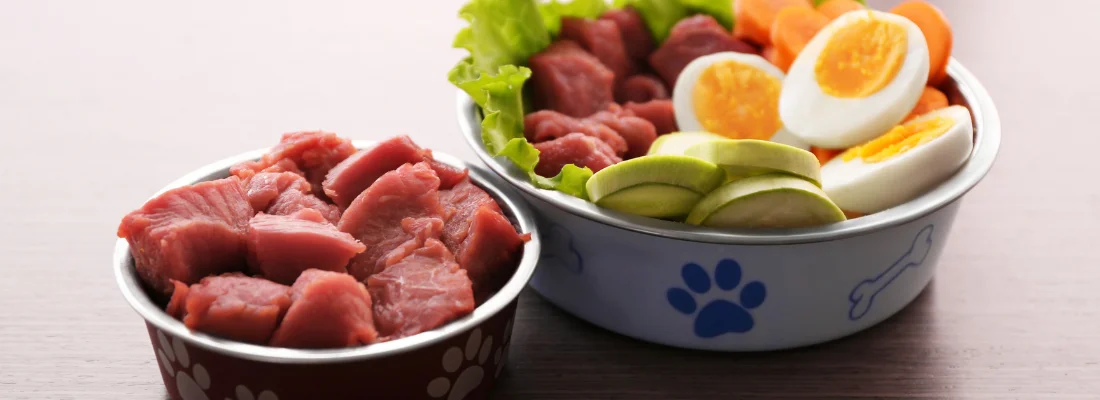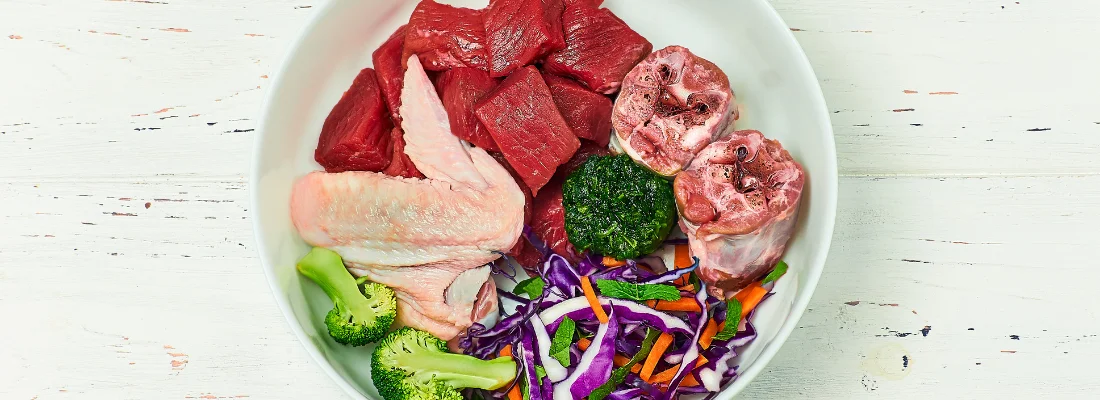
Raw feeding is safe when the protocol is right. It's not safe when it isn't. The difference between the two is paying attention to a small number of rules that, once internalized, become habit.
Most articles on raw food safety go in one of two directions. They dismiss the risks ("dogs handle bacteria better than humans, don't worry about it"). Or they weaponize them ("raw is dangerous, here's why you shouldn't feed it"). Neither is useful.
The truth is simpler: raw feeding requires the same kitchen hygiene as cooking raw chicken for your family, plus a few raw-feeding-specific protocols around sourcing, freezing, thawing, and feeding. Master those and the day-to-day safety burden is no different from any other kitchen.
This guide is the complete safety playbook for our household — the rules we follow, the protocols we use, and the reasoning behind both. We feed three doodles raw at home, with premium kibble for travel. None of us have ever gotten sick from the practice. Neither have the dogs. The protocols below are why.
If you're considering raw feeding and the safety question is what's holding you back, this guide is the conversation. If you're already feeding raw and want to audit your routines, this is the checklist.
The Real Risks (and the Perceived Ones)
Three pathogens dominate the raw-feeding safety conversation: salmonella, E. coli, and listeria. All three can be present in raw meat. None of the three are unique to raw dog food — they're the same pathogens you handle every time you cook raw chicken for dinner.
What actually matters:
- Dogs are not humans. Dogs have a much shorter and more acidic GI tract than humans, which makes them remarkably resistant to most foodborne pathogens. Studies of raw-fed dogs consistently show low rates of clinical illness from salmonella, E. coli, and similar bacteria, despite measurable exposure.
- Humans face the same risks as cooking raw chicken. Real but manageable, with basic kitchen hygiene. The bacterial load on raw pet food is not categorically different from the chicken at the grocery store.
- Cross-contact is the actual risk — bacteria from raw meat ending up on a surface that contacts ready-to-eat food, or on hands that then touch a face. Not the meat itself.
Risks people worry about that are mostly outdated or exaggerated:
- "Raw food contains parasites." Virtually all commercial raw meat sold for pet consumption is frozen at temperatures and durations that kill parasites. Sourcing from a reputable supplier and respecting the freezing protocol below addresses this almost entirely.
- "Raw bones cause obstruction." Ground raw meaty bone (typically 10% of a balanced raw diet) is safe. Whole cooked bones are the dangerous variant — they splinter. Whole raw bones, used appropriately, are not the same risk class.
- "Salmonella shedding makes raw-fed dogs walking biohazards." Fecal shedding does occur but at low rates, and basic poop-pickup hygiene plus hand-washing eliminates the household risk for the vast majority of households.
Where actual care is needed:
- Vulnerable household members. Infants under one year, elderly individuals, immunocompromised family members, or pregnant women face higher consequences from any bacterial exposure. The protocol scales up for these households — see the dedicated section below.
- Improper thawing. Countertop thawing creates ideal conditions for bacterial multiplication. This is where most home raw-feeding accidents start.
- Food left in the bowl. Raw meat sitting at room temperature is a real risk after about an hour. Pick up the bowl, don't leave it.
- Cheap meat. Sourcing from suppliers without testing protocols, freezing standards, or clear quality information is where avoidable problems begin.
The rest of this guide is the practical protocol that addresses the real risks while ignoring the manufactured ones.
Sourcing: the First Safety Filter
The single biggest determinant of raw-feeding safety is where the meat came from. Before any kitchen protocol matters, the source has to be right. A perfect kitchen routine on bad meat is still bad.
What to look for in a raw meat supplier:
- Sells specifically for raw pet feeding (not just unsorted scrap meat)
- Provides clear sourcing information — what farm, what country, what quality grade
- Freezes at -18 °C / 0 °F or lower for parasite control before sale
- Has testing protocols for major pathogens (or sources from suppliers that do)
- Stores meat in conditions that prevent cross-contamination
- Has reasonable inventory turnover — frozen meat sitting for a year is lower quality than meat moving through regularly
For US-based readers: Commercial premade raw brands (Stella & Chewy's, Primal, Vital Essentials, Steve's Real Food, Open Farm) have the strictest testing protocols and are the safest choice for owners new to raw or for households where safety stakes are higher (small children, vulnerable adults). Local raw-feeding co-ops and butchers can be excellent if vetted — ask about their freezing standards, their sourcing, and whether they handle pet meat separately from human meat. Avoid anything labeled "for pet consumption only" without a clear processing standard, since this often means meat that didn't pass human-grade testing for reasons that may or may not matter for dogs.
For our household (Finland): We buy directly from a wholesaler in large packs of single proteins — mostly horse, occasionally reindeer. Both are lean, both are well-suited to sensitive doodles, and both are produced under strict EU food-safety regulations even when sold as pet food. We freeze in portion-sized bags immediately on arrival. We rotate suppliers occasionally to monitor for any quality drift.
The principle is simple: cheap raw meat is rarely safe raw meat. Budget the sourcing accordingly, and treat the supplier choice as one of the most consequential decisions in raw feeding.
Freezing: What It Kills, What It Doesn't
Commercial raw meat is almost always frozen before sale. Even meat sourced fresh from a butcher should be frozen at home before feeding.
Why freezing matters:
- Freezing at -18 °C / 0 °F for at least three days kills nearly all parasites relevant to pet feeding (Toxoplasma, Sarcocystis, Trichinella).
- Freezing does not kill bacteria. Salmonella, E. coli, and listeria survive freezing — sometimes indefinitely. They become inactive but reactivate the moment the meat thaws.
- Longer freezing (4+ weeks at -18 °C) reduces bacterial loads modestly through cellular damage, but doesn't sterilize the meat.
This is why freezing alone isn't a safety guarantee. It's part of a layered protocol: freezing for parasite kill, sourcing for low initial bacterial load, hygiene for cross-contact prevention. No single layer is sufficient on its own.
Our freezing rules:
- All raw meat goes into the freezer within two hours of arriving home.
- We freeze in portion-sized bags so no thawed meat is ever refrozen.
- We mark the freezing date on every bag and use within 6 months for muscle meat, 3 months for organ meat.
- The freezer runs at -20 °C / -4 °F, slightly colder than minimum, for safety margin.
- We never refreeze partially thawed meat.
Common freezing mistakes:
- Refreezing thawed meat — multiplies bacterial load each cycle.
- Using a freezer that runs warmer than -15 °C — insufficient for reliable parasite kill.
- Storing raw meat above ready-to-eat food in a shared freezer — drips or accidents contaminate other items.
- Long-term freezing assuming "it kills everything" — wrong about bacteria.
Thawing: Where Most Home Accidents Happen
Done wrong, thawing creates ideal conditions for bacterial multiplication. The "danger zone" — the temperature range where bacteria multiply fastest — is roughly 4 °C to 60 °C / 40 °F to 140 °F. Frozen meat that thaws on the counter spends hours in that zone. By the time it reaches the bowl, the bacterial load is many times higher than what came out of the freezer.
The only acceptable thawing methods:
- Refrigerator thawing. Move tomorrow's portion from freezer to fridge the night before. Slow, predictable, safe. Thawed meat keeps in the fridge for 24–48 hours before feeding.
- Cold-water thawing in a sealed bag. For emergency same-day thawing. Submerge the sealed bag in cold water, change every 30 minutes. Use within 4 hours.
Methods to never use:
- Countertop thawing — bacteria multiply exponentially in the danger zone.
- Microwave thawing — uneven heating creates partially cooked spots while leaving cold cores; bacteria survive in the cold parts and the texture is wrong for raw feeding anyway.
- Hot water thawing — same issue as microwave, plus accelerated bacterial growth.
- "It thawed during the day" — if it's been at room temperature more than two hours, throw it out. It's not worth the risk of a sick dog or a sick human.
Our thawing rule: dinner portions go from freezer to fridge in the morning, ready by evening. Breakfast portions go down the night before. We never improvise.
Kitchen Hygiene Rules
The practical day-to-day rules that prevent cross-contact between raw pet food and household food preparation. None of these are exotic. All of them matter.
Surfaces:
- A dedicated cutting board for raw pet food, color-coded if possible. Never used for human food preparation, washed in hot soapy water after every use.
- The counter is wiped with hot soapy water after any raw-meat contact. For deeper sanitation, a dilute bleach solution (1 tablespoon per gallon of water) once a week or after any visible spill.
- The dog's bowl is washed daily with hot soapy water and a separate sponge — not the same sponge that washes human dishes.
Hands:
- Wash with hot soapy water after every contact with raw meat, before touching anything else.
- Don't touch your face, phone, or other surfaces between handling raw meat and washing hands.
- Avoid handling raw meat with cuts on hands. If unavoidable, use disposable gloves.
Tools:
- Knives, scissors, and tongs used for raw meat go directly to hot soapy water (or to the dishwasher on a hot cycle).
- Plastic containers used for portioning go to the dishwasher.
- Never use the same tool for raw meat and ready-to-eat food without thorough washing in between.
Storage:
- Thawed raw meat is stored in sealed containers on the bottom shelf of the fridge — never above produce or ready-to-eat food.
- Frozen raw meat is in sealed bags, separated from human food by a divider or tray.
- Bowls of fed raw food are not left out. Pick up and wash after meal time.
The whole protocol takes about five minutes per meal once it's habit. The first month it feels like a lot. By month two, it's invisible.
Feeding Hygiene
What happens at the bowl matters as much as what happens in the kitchen.
Where the dog eats:
- A defined feeding area, ideally tile or another easy-to-clean surface. Not on a rug or upholstered surface.
- The same spot every time — easier to clean, easier to monitor, easier for the dog.
- Out of high-traffic family areas where small children might crawl through immediately afterwards.
The feeding routine:
- Put down the bowl, let the dog eat, pick up immediately when done.
- Don't leave raw food in the bowl for more than 30 minutes.
- If the dog doesn't finish, the rest goes back to the fridge in a sealed container — once. Don't refrigerate, re-offer, refrigerate again.
- After every meal: wipe the floor under and around the bowl, wash the bowl in hot soapy water.
Mouth and face:
- Many dogs are tidy raw eaters; some aren't. Wipe muzzles and beards after the meal if needed (doodles are particularly prone to carrying residue in their facial hair — the price of the coat).
- Avoid face-to-face contact for the first 30 minutes after eating. Dogs swallow quickly, but their fur and beard can carry residue.
Households With Kids, Elderly, or Immunocompromised Members
This is where extra care matters most. The protocol scales up. None of these are reasons not to feed raw, but each is a reason to be more careful about the rules above.
With small children, especially crawling-age:
- Feed the dog when children aren't on the floor in the same area.
- Use a feeding mat that wipes clean — bleach-water if needed.
- Wash the dog's mouth and face area with a damp cloth after meals.
- Children should not handle raw meat at all. Older kids can help with kibble bowls only.
- Don't allow kissing the dog on the face for at least an hour after a raw meal.
With elderly or immunocompromised family members:
- Same rules as for kids, plus consider whether someone other than the at-risk person can manage the raw feeding.
- Wash hands diligently after every contact with the dog, including petting, for the immediate post-meal period.
- Some households choose freeze-dried raw instead of fresh raw specifically because the bacterial load is lower (freeze-drying reduces pathogen counts). See our freeze-dried transition guide for the practical alternative.
With pregnancy:
- Pregnant household members should not handle raw meat directly during pregnancy. Have someone else manage the raw feeding, or switch to freeze-dried for the duration.
- The risk isn't to the dog; it's to the human handling the meat. Toxoplasmosis is the main concern, much lower in commercial frozen meat but still present.
What to Do If Your Dog Gets Sick
Raw-related illness in dogs is rare but happens. Symptoms to watch for:
- Vomiting more than once in 24 hours
- Diarrhea lasting more than 24–48 hours
- Lethargy that doesn't lift
- Loss of appetite (different from a single skipped meal)
- Fever (rectal temperature above 39.5 °C / 103 °F)
- Bloody stool
What to do:
- Stop the current raw protein. Don't feed for 12–24 hours, only water.
- Save a sample of the food they ate (even if frozen) in case the vet wants to test it.
- Call the vet. Tell them the dog is on raw and what protein. This is critical for accurate diagnosis — a vet who doesn't know the dog is raw-fed may misread the bloodwork or stool culture.
- Reintroduce food with a bland cooked meal (turkey or white fish plus rice) for two to three days before returning to raw.
- If a specific protein is implicated, rotate it out for 30 days minimum before reintroducing — and reintroduce in small amounts to confirm it's tolerated.
What to Do If a Human Gets Sick
Foodborne illness symptoms in humans (vomiting, diarrhea, fever, abdominal pain) within 6–72 hours of raw-meat contact may indicate cross-contact contamination.
What to do:
- Standard care — hydration, rest, contact a doctor if symptoms are severe or last more than 24 hours.
- Tell the doctor that you handle raw pet food. This affects the differential diagnosis.
- Audit the kitchen for the failure mode: was a surface cross-contaminated? Did the affected person handle the dog directly after a meal? Did food sit in the bowl too long?
- After recovery, tighten the protocol that failed. The point isn't to abandon raw feeding — it's to fix the specific gap.
In years of feeding three doodles raw, no human in our household has gotten sick from the practice. We've also never had a "near miss" we caught in time. That's what the protocol earns you when it's followed consistently.
Travel and Raw Feeding
This is where freeze-dried earns its place, even in households that feed fresh raw at home (which is exactly what we do for Gösta).
Fresh raw doesn't travel well: there's no portable freezer, no kitchen hygiene control, no reliable way to clean the dog's bowl properly between meals at a hotel or kennel.
Our travel rule:
- Anything beyond a single overnight gets freeze-dried instead of fresh raw.
- Premium kibble is the backup for kennels that can't accommodate freeze-dried preparation.
- Whatever the dog eats while traveling, we never compromise on bowl hygiene — bring our own bowl, wash with hot soapy water from a hotel sink, dry thoroughly between meals.
For the practical playbook on switching between tiers when travel disrupts a fresh-raw routine, the freeze-dried transition guide is the next read.
Raw Food Safety Quick Checklist
Before any raw meal, mentally check:
- Was this meat thawed in the refrigerator (or in cold water within the last four hours)?
- Has the bowl been washed since its last meal?
- Is the feeding area clear of children, food prep, and anything else that needs to stay clean?
- Have I washed my hands after handling the meat?
- Will I pick up the bowl within 30 minutes of putting it down?
After the meal:
- Bowl into hot soapy water
- Floor under bowl wiped down
- Hands washed before handling anything else
- Cutting board (if used) washed and stored
- Any leftover food refrigerated in a sealed container (and used within 24 hours, only once)
Internalize the checklist and the rest follows.
Where to Go from Here
Raw feeding is safe when the protocol is right. It's not safe when it isn't. The difference between the two is paying attention to a small number of rules that, once internalized, become habit.
For the why behind feeding raw at all, see our feeding philosophy — raw is the strongest tier in our 3-tier hierarchy, but the right answer for your household depends on what fits your life. If raw isn't realistic, the freeze-dried tier is the next-best step and shares much of this safety protocol. The kibble track skips most of these rules entirely, which is one of the practical reasons many households start there.
This is the overview. The follow-up guides in our Raw Food Safety series — published as we build them out — go deeper on the parts that matter most:
- Sourcing raw meat for sensitive doodles: what to look for, what to avoid
- Freezing and thawing protocols, in detail
- The 5-minute daily kitchen routine for raw feeders
- Raw feeding with kids in the house
- The salmonella-and-E.-coli question: real risks vs. fearmongering
- Travel feeding without breaking the routine
Cross-links go here as those guides go live.